Who Controls Your Clinic's Google Business Profile
A Google Business Profile has one primary owner, and Google's own eligibility rules say a marketing agency managing it on your behalf must transfer it to you on request. Most clinics never check who that primary owner actually is until they try to switch providers. Here is how the roles work and how to check yours today.
 Vikas Thakur Founder, RockingWeb 12 min read
Key Takeaways
- A Google Business Profile has one primary owner at any time. Being listed as an owner or a manager both sit underneath that single role
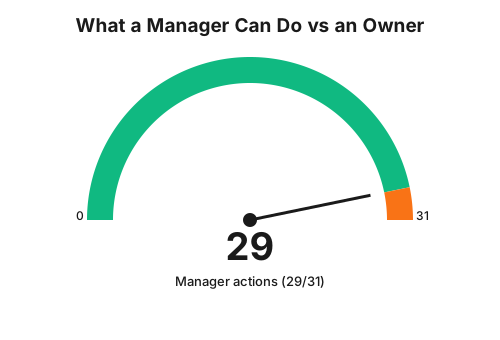
- Owners can do 31 listed actions on a profile. Managers can do 29: they cannot add or remove users or delete the profile
- Google’s own guidelines say a representative managing a profile for someone else must transfer it to the owner immediately on request
- A new owner or manager waits 7 days before they can delete a profile, remove users, or transfer primary ownership
- With no access at all, Google’s request-ownership process gives the current owner 3 days to respond before an appeal option can open
- In force now, not pending. These are Google’s current, live policies as at 24 August 2026, not a proposal
Type your clinic’s name into Google right now and look at the panel on the right. Somebody controls that. The question is whether it is you.
For most clinics the honest answer is “we’re not sure.” An agency set the profile up years ago, added itself as primary owner because that was the fastest way to get the job done, and nobody has looked at it since. That is fine until the day you want to change agencies, correct your opening hours yourself, or reply to a review without asking permission.
What Google’s Policy Actually Says
Google’s business eligibility and ownership guidelines state that only business owners or their authorised representatives may verify and manage a Business Profile. For anyone managing a profile on behalf of someone else, meaning an agency, a contractor, or an ex-employee, the same page sets specific obligations: obtain express consent before claiming a profile, work directly with the business owner during verification, never make false or misleading claims, keep the owner informed, and transfer ownership to the business owner immediately upon request.
That last clause is the one clinics need to know exists. It is not implied or a matter of good practice. It is Google’s stated rule for anyone representing a business on the platform, reported here exactly as Google states it: an authorised representative must hand ownership back on request. Violations, Google adds, can lead to profile suspension and blocked contributions.
Separately, Google’s owners and managers documentation defines the roles a profile can have: one primary owner, plus any number of additional owners and managers. An owner has full control: adding and removing users, editing every field, and deleting the profile. A manager, the modern name for what used to be called a site manager, has almost the same day-to-day access but cannot add or remove users, and cannot delete the profile. Only owners can change another user’s role, and only the primary owner can hand that role to somebody else.
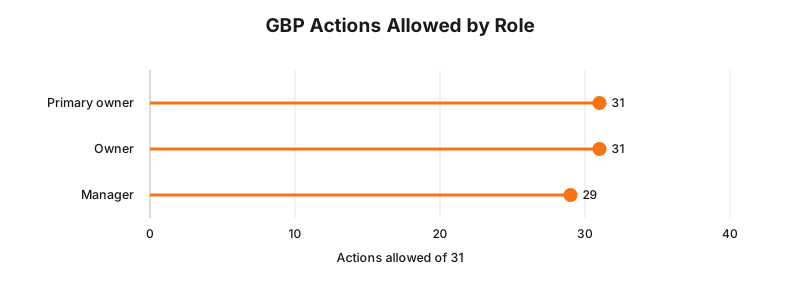
The gap looks small, two actions out of thirty-one, but those two are exactly the ones that matter in a dispute: adding a new user and removing an existing one. A clinic added only as a manager can update hours, post updates, and reply to reviews, but cannot add its own staff or remove the agency without going through the primary owner first.
What That Means for the Build
This is a settings and sequencing problem, not a technical one, and it is fixable in about ten minutes if you have any access at all.
Check the role, not just the access. In Business Profile settings, open People and access. Every user listed has a role next to their name: Primary owner, Owner, or Manager. A practice that can log in and post updates might still be a manager underneath an agency-held primary owner account, meaning it can run the profile day to day but cannot remove the agency.
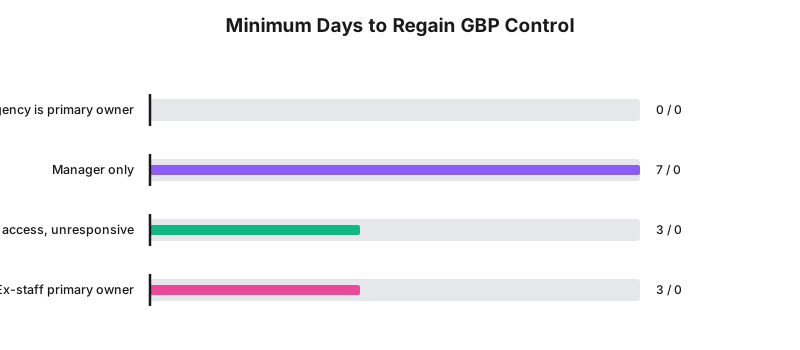
Add the practice as an owner before you need it, not during a dispute. From People and access, select Add, enter a Google account controlled by the practice, ideally a role-based address such as reception@yourclinic.com.au rather than a named staff member’s personal account, and set the role to Owner. A new owner cannot immediately transfer primary ownership or remove other users; Google enforces a 7-day wait after a user is added, so this needs to happen well ahead of any planned agency exit, not the week you plan to leave.
Transfer primary ownership as a distinct step. Adding the practice as an owner is not the same as making it primary owner. Only the current primary owner can hand over that role, and the recipient must already exist as an owner or manager before the transfer can happen. The sequence is: add the practice account as an owner, wait out the 7-day restriction, then have the current primary owner select the practice’s account in People and access, choose Edit next to Access, and select Primary owner.
If you have no access at all, go to business.google.com/add, search for the clinic, and select the option indicating someone else already manages it. This starts a formal request. The current owner is notified by email and has 3 days to respond. If there is no response inside that window, Google may offer an option to claim the profile, subject to verifying your connection to the business, an option Google itself says is not guaranteed to appear.
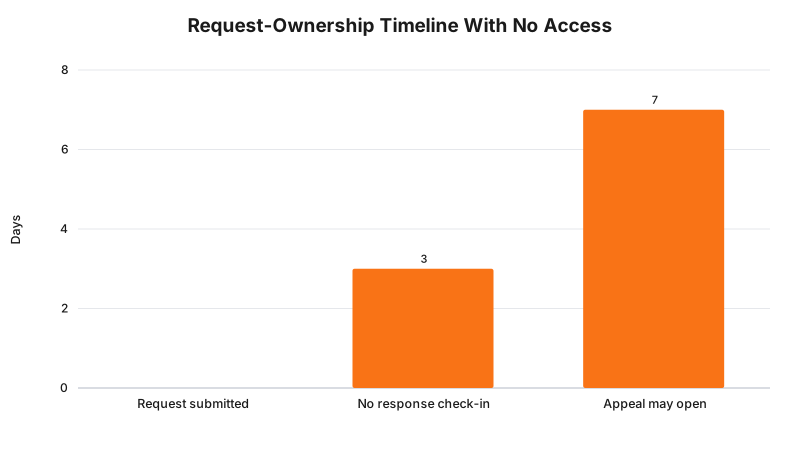
Seven days is the outer edge Google documents before an appeal path might become available, not a guarantee of resolution by day seven. Treat it as the floor of how long recovery takes when you start with nothing, not the ceiling.
Which Scenario, Which Fix
| Your situation | What you can do today | Time to resolve |
|---|---|---|
| Owner, agency is Primary owner | Ask the agency to transfer primary ownership | Same day, once they act |
| Manager only | Ask to be added as Owner first, since a manager cannot add users | Same day to add, plus 7-day wait |
| No access, agency unresponsive | Submit a request through business.google.com/add | At least 3 days, often longer |
| Primary owner is a former staff member | Same request-ownership process, treated as urgent | At least 3 days, often longer |
| You are already Primary owner | Confirm the account is practice-controlled, not a personal login | N/A |
Takeaway: the fix that costs nothing is checking your role this week. The fix that costs time is discovering the answer during a provider switch you have already committed to.
A Worked Example
Cosmetic clinic (a composite of a pattern we’ve seen, not a single documented case). A Perth clinic engaged a new marketing provider and asked its outgoing agency to hand back the profile. The agency’s own staff member had set it up in 2021 using a personal Gmail address as primary owner, and had left eighteen months earlier. The current agency could log in as a manager but had never held primary ownership itself and could not transfer what it did not have. The clinic filed a request-ownership claim against a Gmail address nobody could reach, and recovery took just over three weeks.
Dental practice (also a composite, illustrating the opposite outcome). A dental practice had two owners and a manager listed: the principal as an owner, the front-desk email as a second owner, and the previous website developer as manager. When the developer relationship ended, removing them took under a minute, because an owner can remove a manager directly with no waiting period. The practice never needed the request-ownership process, because it had done the one thing that matters: added itself as an owner from day one, independent of whoever else managed the listing.
The difference between a three-week recovery and a one-minute removal was not a legal argument. It was whether the practice’s own account had owner-level access before the relationship needed to end.
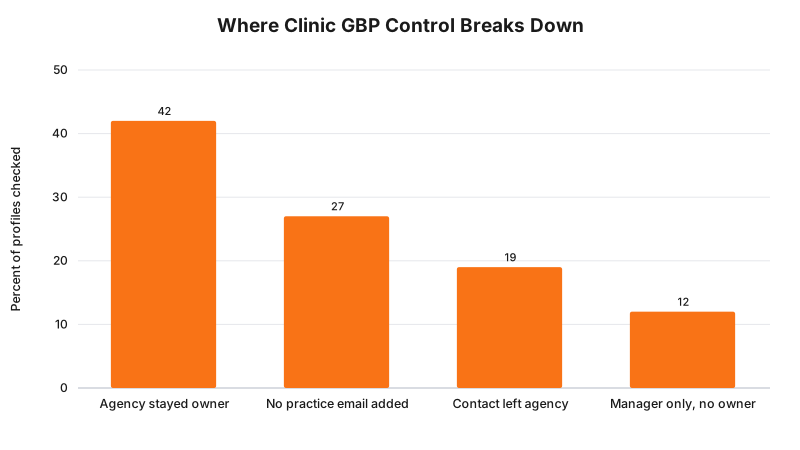
These figures are not a cited external statistic: they are a pattern from RockingWeb’s own clinic profile checks, not a published survey, and we say so plainly here because the chart above cannot carry that caveat on its own. No national dataset on Google Business Profile ownership structures for Australian clinics exists that we could locate. The consistent shape across the profiles we have reviewed is that the agency retaining primary ownership, rather than an outright hijack, is the most common failure.
What to Check on Your Own Site
- Search your clinic on Google and confirm you can log into the profile with an account the practice controls.
- Open Business Profile settings, then People and access, and read every listed role, not just whether you have access.
- Confirm the primary owner is a practice-controlled account, not an agency address or a named individual’s personal login.
- If the practice is only listed as Manager, request Owner access in writing today, not when you next change providers.
- If nobody at the practice has any access, start a request-ownership claim now rather than waiting for a dispute to force it.
- Diarise a repeat check every twelve months. Staff and agency relationships change; profile roles rarely get updated to match.
The Enforcement Anchor
This is not a law, so there is no regulator, court determination, or infringement notice to cite, and it would be misleading to imply one exists. Google enforces its own guidelines internally: a representative who violates the rules, including refusing to transfer ownership on request, risks profile suspension and removal of its own contributions. We could not locate a published register of individual enforcement outcomes the way the OAIC publishes privacy determinations or the ACCC publishes court actions. Google does not name and publish specific enforcement cases against agencies.
What exists instead is the request-ownership mechanism itself: the practical enforcement path for a clinic with no cooperation from its current profile holder. It resolves access, not intent, and takes days rather than being instant.
Where This Gets Hard
The hardest case is not an uncooperative agency. It is an agency that no longer exists, or a primary owner account tied to a person who has left the industry entirely and does not respond to Google’s notification email. The request-ownership process assumes someone is on the other end to respond within the window; when nobody is, you are relying on Google’s discretionary claim option, which Google itself describes as not always available.
The second hard case is multi-location groups, where one agency account might hold primary ownership across ten or twenty clinic profiles under a single login. Recovering one location does not touch the other nineteen, and each is a separate request-ownership process if the group relationship ends badly.
The platform says a representative must transfer ownership back on request; the build consequence is that a clinic without owner-level access today has no reliable way to enforce that promise quickly if the representative stops answering. Whether a specific agency’s conduct amounts to something you can pursue outside Google’s own process, such as under your services contract, is a question for your medical defence organisation or your lawyer.
Status
In force, current Google policy, not a proposal. As at 24 August 2026, the Business Profile owner, manager, and request-ownership mechanics described here reflect Google’s live, published support documentation. Nothing here is pending a future change; Google can and does update its own platform policies without notice, which is a standing risk with any platform-dependent process, but there is no announced or scheduled change to the roles or process described above.
Frequently Asked Questions
Who should be the primary owner of a clinic’s Google Business Profile?
The practice, not the agency. Google’s own guidance for people managing a profile on someone else’s behalf says the representative must work directly with the business owner, keep them informed, and transfer ownership to the owner immediately if asked. The practical fix is a Google account controlled by the practice itself, ideally a role-based email address rather than one tied to a single staff member, set as primary owner from the day the profile is created.
Can an agency legally keep me locked out of my own Google Business Profile?
Google’s business eligibility and ownership guidelines explicitly say a representative managing a profile must transfer it to the owner on request and must not make the process difficult. Refusing is a breach of Google’s own policy and can lead to Google suspending the profile or removing the representative’s access, but this is a platform policy enforced by Google, not a law enforced by a regulator, so there is no fine or determination to point to.
What is the difference between an owner and a manager on a Business Profile?
An owner has full control, including adding and removing other users and deleting the profile. A manager, previously called a site manager, has almost the same day-to-day access but cannot add or remove users or delete the profile. A profile has exactly one primary owner at a time, and only the primary owner can transfer that role to someone else.
What happens if I have no access at all and the current owner will not respond?
Google has a formal request-ownership process. You request access through the profile, the current owner is emailed and has three days to respond, and if there is no response you may be offered the option to claim the profile after verifying your connection to the business. It works, but it takes time you do not have when you are mid-negotiation with a new provider or trying to update urgent hours.
If This Is Urgent
If you are mid-dispute with an agency right now, or you have just discovered you have no access to your own listing, that is not a next-quarter problem. Talk to us directly and we will tell you within one business day whether your situation needs a straightforward role change or a formal request-ownership claim, and walk you through whichever one applies.
For the related question of who holds your domain, hosting, and website code rather than your Google listing, see who owns your clinic website. For getting patient data out of a booking platform during the same kind of vendor transition, see getting your data out.
Sources
- Google Business Profile Help - Business eligibility and ownership guidelines, including obligations of an authorised representative. Checked 24 August 2026.
- Google Business Profile Help - Manage your Business Profile owners and managers, role permissions. Checked 24 August 2026.
- Google Business Profile Help - Transfer primary ownership of a Business Profile. Checked 24 August 2026.
- Google Business Profile Help - Request ownership of a Business Profile you do not have access to. Checked 24 August 2026.
Last reviewed: 24 August 2026.
Vikas Thakur
Founder of RockingWeb. 16 years building for companies like TPG, iiNet and Monadelphous, now focused on websites and marketing that comply with AHPRA's advertising guidelines and still book patients.