$120,000: The AHPRA Fine Optometry Ads Can Trigger (2026)
Optometry advertising in Australia carries a fine of up to $120,000 per breach for a body corporate under Section 133 of the National Law, the same rule that applies to every AHPRA-registered profession. The Optometry Board of Australia confirms the increased penalty scale has applied in every jurisdiction, including WA, since July 2024.
 Vikas Thakur Founder, RockingWeb 8 min read
Key takeaways
- $120,000 is the maximum National Law fine for a body corporate advertising breach, and $60,000 for an individual practitioner, a scale the Optometry Board confirms has applied in every jurisdiction, including WA, since July 2024
- That penalty scale is a 12-fold increase: before a 2022 amendment, the maximums were $5,000 for an individual and $10,000 for a body corporate
- Optometry advertising sits under Section 133 of the National Law, the same rule that binds every AHPRA-registered profession, not a separate optometry-only code
- 69 optometrists were the subject of an AHPRA complaint in 2023/24, the highest figure in five years, up from 44 in 2020/21
- Registered optometrist numbers reached 7,051 in the Optometry Board’s 2023/24 annual report, a 4.3% year-on-year rise
- 50% of 2023/24 optometry complaints related to clinical care, not advertising, and no national dataset breaks out an optometry-specific advertising complaint figure
- A “free eye test” or discounted-glasses ad is lawful only if it states the terms and conditions of the offer in the same advertisement
An optometry practice can be fined up to $120,000 for a single advertising breach in Australia. That is the maximum body corporate penalty under Section 133 of the Health Practitioner Regulation National Law, the same rule that binds every AHPRA-registered profession, optometry included. The Optometry Board of Australia confirms this scale, individual $60,000 and body corporate $120,000 per offence, has applied nationally, including Western Australia, since July 2024. Optometrists are not exempt just because their advertising rarely involves the cosmetic procedures that usually make AHPRA headlines. The same rule that bans testimonials and undisclosed discounts for a cosmetic clinic bans them for an optical retailer running a “2-for-1 glasses” campaign too. Complaints against optometrists also hit a five-year high in 2023/24, though most concerned clinical care rather than advertising. This guide sets out what Section 133 bans, what a breach costs, and what it means for a practice’s website and ads.
What Section 133 Actually Bans
The National Law does not give optometry a separate advertising code. Section 133 applies to anyone advertising a regulated health service, or a business that provides one, and it bans five specific things. An advertisement must not be false, misleading or deceptive. It must not offer a gift, discount or other inducement unless the terms and conditions of the offer are stated in the same ad. It must not use testimonials or purported testimonials about the service or business. It must not create an unreasonable expectation of beneficial treatment. And it must not directly or indirectly encourage the indiscriminate or unnecessary use of a regulated health service.
For an optometry practice, these map onto everyday marketing habits. A Google review widget on a service page is a testimonial. A “free eye test with any frame purchase” ad without the conditions spelled out is an undisclosed inducement. “See clearer than ever, guaranteed” is an unreasonable expectation of benefit. A blanket reminder telling every patient they are “overdue” for a check-up regardless of clinical need risks the indiscriminate-use clause. None of these require a cosmetic procedure to trigger the rule. Get in touch with RockingWeb to check a website against this list, testimonials and undisclosed inducements included, against the specific provision each one falls under.
| Prohibited under Section 133 | Common optometry example |
|---|---|
| False, misleading or deceptive claims | Overstating what a lens coating or treatment achieves |
| Undisclosed gift, discount or inducement | ”Free eye test” ad with no stated conditions |
| Testimonials or purported testimonials | Embedded Google review widgets, patient quotes |
| Unreasonable expectation of benefit | ”Guaranteed clearer vision” style copy |
| Encouraging indiscriminate or unnecessary use | Blanket “you’re overdue” reminders with no clinical basis |
Takeaway: Section 133 applies to optometry the same way it applies to every AHPRA profession, and the everyday habits it catches, review widgets, undisclosed discounts, guarantee language, are common in optical retail marketing specifically.
What a Breach Actually Costs
The financial penalties are not new, but they are far higher than most practice owners assume if they last checked before 2022. The Optometry Board of Australia states plainly that a 2022 National Law amendment increased the maximum penalty for an individual from $5,000 to $60,000 per offence, and for a body corporate from $10,000 to $120,000 per offence, a 12-fold jump in both cases. The board also confirms these increased penalties now apply in all jurisdictions, including Western Australia, as of July 2024.
Unlawful use of a protected title is a separate offence under the National Law, and beyond the financial penalty for an advertising breach, a National Board can treat the breach as a conduct concern and place conditions on a practitioner’s registration.
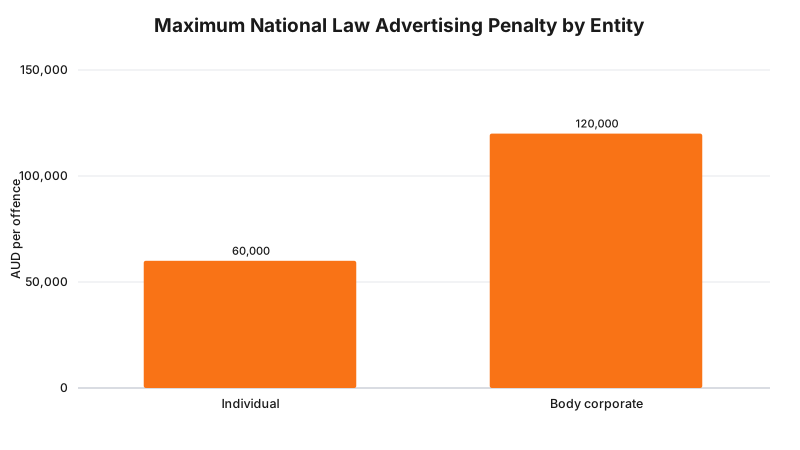
Takeaway: the $120,000 figure is not a cosmetic-surgery-only number. It is the standard body corporate advertising penalty for every AHPRA-registered profession, optometry practices included, and it has applied nationally since July 2024.
Why Enforcement Is No Longer Theoretical
Complaints against optometrists reached a five-year high in the Optometry Board’s 2023/24 annual report: 75 notifications about 69 optometrists Australia-wide, up from 55 in 2019/20, 44 in 2020/21, 61 in 2021/22 and 57 in 2022/23. That represents 1% of the entire profession. Registered optometrist numbers grew alongside that, reaching 7,051 in the same report, a 4.3% year-on-year rise and 16% growth over five years, up from 6,043 in 2019/20.
Half of those complaints, 50%, related to clinical care, and a further 13% to communication. Behaviour, offence against other law and documentation each accounted for 5%, with the remaining 21% categorised as other. No national dataset separately publishes how many were specifically about advertising, unlike the dedicated cosmetic surgery complaints hotline AHPRA reports for cosmetic procedures. That is a genuine gap in the public data, not a sign the rule goes unenforced.
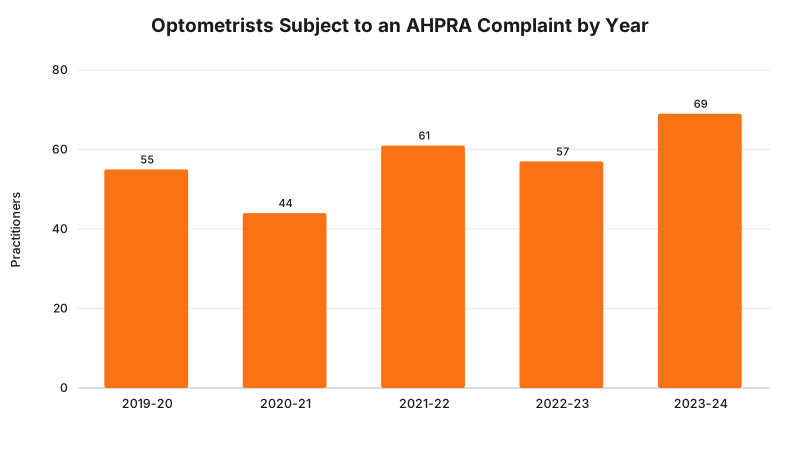
Takeaway: the profession is growing and so is complaint volume in absolute terms, even though the public data does not isolate advertising-specific breaches for optometry the way it does for cosmetic procedures.
What This Means for Your Optometry Website
Section 133 sets the same ceiling for every page on an optometry website, whatever the service. A dedicated landing page for myopia management, dry eye, orthokeratology, low vision or contact lens fittings can describe what the service involves and who it is generally for, in factual, evidence-based language. It cannot lean on a testimonial, promise a guaranteed outcome, or run a “book now, first visit free” offer without stating the conditions in the same ad. Building separate pages per service, rather than one generic “eye care” page, is a marketing decision, not a clinical one: it matches the specific search a parent researching myopia control or an adult researching dry eye is actually running, which tends to produce a better-matched enquiry than one page competing for every keyword at once. It is the same compliance discipline we apply whenever we build a website for an AHPRA-regulated practice, regardless of which National Board the practitioner sits under.
The workforce data also shows where digital competition is building: NSW carries the largest optometry workforce, followed by Victoria, Queensland, Western Australia and South Australia.
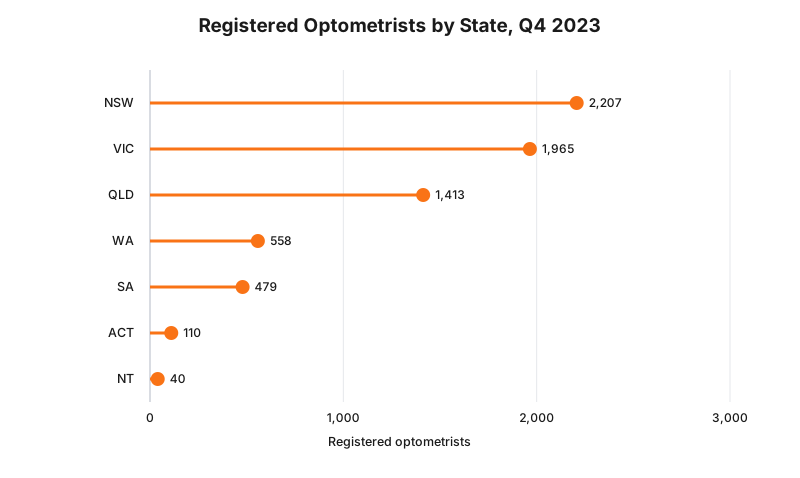
More registrants per state generally means more practices competing for the same local searches, which raises the cost of a generic page and the value of a compliant, locally specific one.
Takeaway: the digital lever available to an optometry practice is page structure and disclosure, not clinical claims. Section 133 sets the same limits regardless of which service the page is selling.
FAQ
What are the AHPRA advertising rules for optometrists in Australia?
Optometrists are bound by Section 133 of the Health Practitioner Regulation National Law, the same rule that applies to every AHPRA-registered profession. It bans false or misleading claims, undisclosed gifts or discounts, testimonials, claims that create an unreasonable expectation of benefit, and encouraging indiscriminate or unnecessary use of a regulated health service.
What is the maximum fine for breaching optometry advertising rules?
Up to $60,000 per offence for an individual practitioner and up to $120,000 per offence for a body corporate. The Optometry Board confirms this scale, up from $5,000 and $10,000 before a 2022 National Law amendment, has applied in every Australian jurisdiction, including WA, since July 2024.
Can an optometry practice advertise a free or discounted eye test?
Yes, but only if the advertisement also states the terms and conditions of the offer. Section 133 bans offering a gift, discount or other inducement unless the conditions are disclosed in the same ad, not buried on a separate page or left for the enquiry call.
Do complaints about optometrists usually relate to advertising?
No. The Optometry Board’s 2023/24 annual report shows half of all complaints related to clinical care and 13% to communication. No national dataset separately publishes an optometry-specific advertising complaint figure, unlike the dedicated cosmetic surgery hotline data AHPRA reports for cosmetic procedures.
Get an Advertising Compliance Check Before AHPRA Does
RockingWeb reviews AHPRA-regulated practice websites and ad accounts against the current National Law requirements, testimonials and undisclosed inducements included, and flags each finding against the specific provision it falls under.
Talk to us about your practice’s website and advertising
Sources and References
Optometry Board of Australia - Advertising a regulated health service: Section 133 prohibited list, the 2022 penalty increase from $5,000/$10,000 to $60,000/$120,000, and the July 2024 national commencement date
Insight - Complaints against Australian optometrists hit a five-year high: the 2019/20-2023/24 complaint trend, 2023/24 complaint categories, and registrant growth figures, citing the Optometry Board of Australia’s 2023/24 annual report
Insight - Registered optometrists surpass 7,000: state-by-state registrant totals from the Optometry Board of Australia’s Q4 2023 quarterly statistics
Related reading:
- AHPRA Advertising Fines for Cosmetic Clinics: the penalty structure for cosmetic procedure advertisers
- AHPRA Advertising Complaints Hit 380 a Year: enforcement activity across all AHPRA professions
- Cosmetic Clinic Websites: compliant website builds for AHPRA-regulated practices
For a website and ad accounts that stay inside Section 133 regardless of which National Board applies, see ClinicPipeline or talk to us about your practice’s marketing.
Vikas Thakur
Founder of RockingWeb. 16 years of experience from working at TPG, iiNet and Monadelphous, now building websites, software and digital marketing for local businesses in Rockingham and Perth.