$120,000 Per Breach: Dental Marketing Statistics Australia
An AHPRA advertising breach can cost a dental practice up to $120,000. A peer-reviewed 2023 study found 85% of Australian dental websites already breach at least one rule. Full data on market size, patient spend, and marketing risk.
 Vikas Thakur Founder, RockingWeb 9 min read
Key takeaways
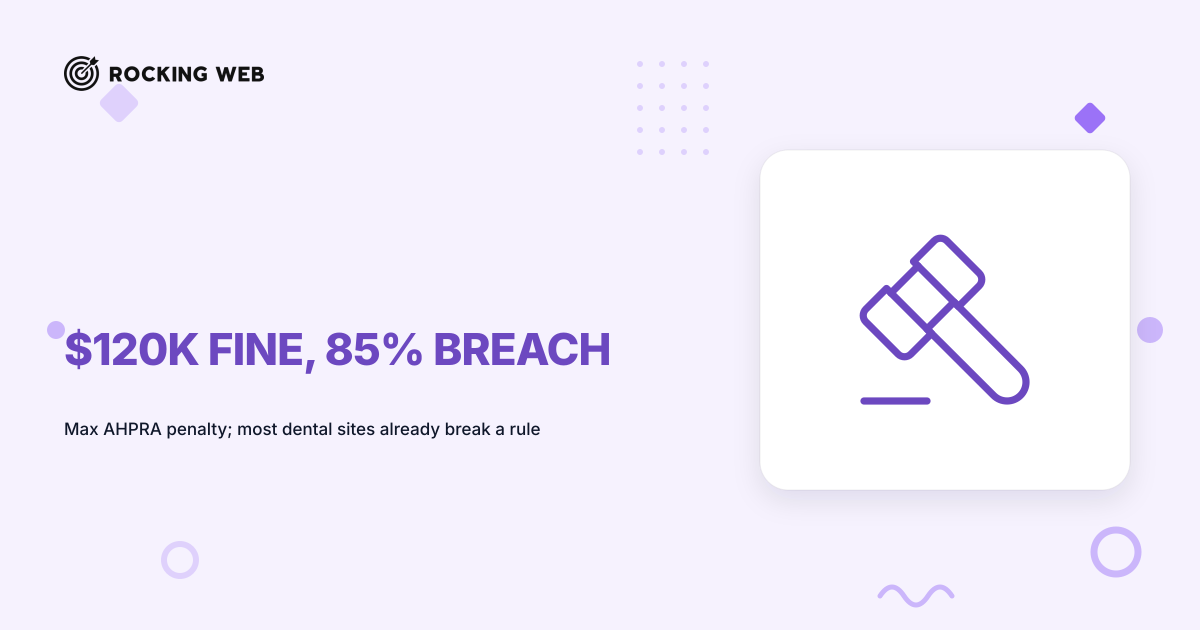
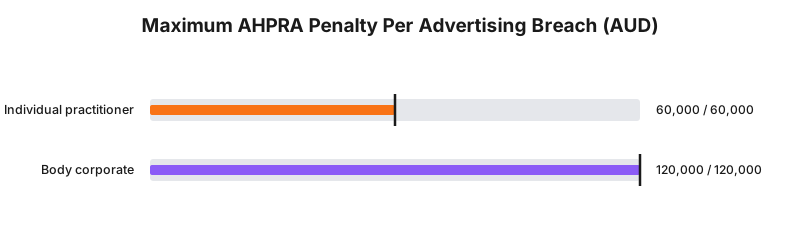
- A single AHPRA advertising breach can cost a dental practice up to $60,000 for an individual practitioner or $120,000 for a body corporate, under section 133 of the Health Practitioner Regulation National Law
- 85% of 192 Australian general dental practice websites breached at least one AHPRA advertising requirement, per a peer-reviewed 2023 study in the Australian Dental Journal
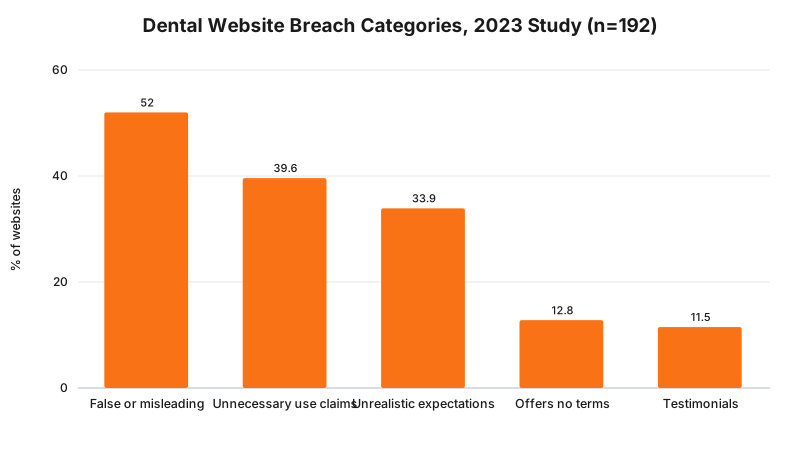
- 52% of those breaches were false or misleading content, the single largest category, ahead of testimonials at 11.5%
- 60% of Australians who considered a cosmetic dental procedure said social media influenced that decision, per the Australian Dental Association’s 2025 Consumer Survey of over 25,000 respondents
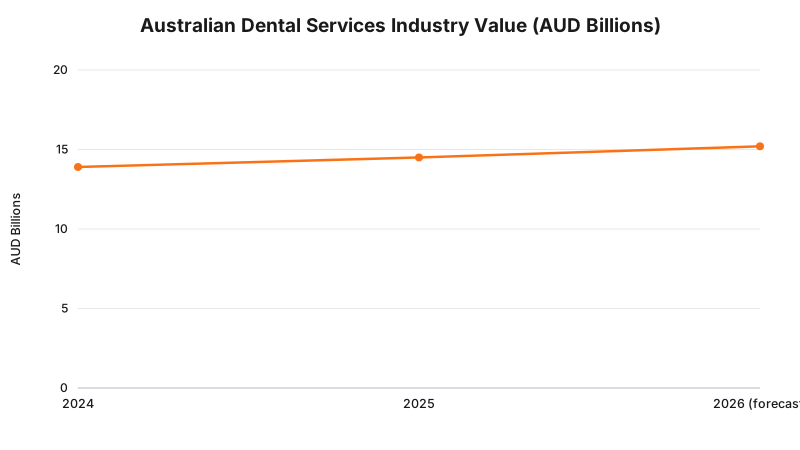
- Australia’s dental services industry is worth $14.5 billion in 2025, up 4.3% on 2024, and roughly 20,300 dentists compete for that spend nationally
- Patients funded $8.0 billion of dental care out of their own pocket in 2023-24, and out-of-pocket spending made up 61% of total dental funding on a $12.5 billion base in 2022-23, the highest out-of-pocket share of any major health category
- Rules tightened further on 2 September 2025, when AHPRA’s amended guidelines banned patient testimonials outright for every registered health practitioner in Australia
A dental advertising breach can cost an Australian practice up to $120,000, under AHPRA’s national law rules effective September 2025. A 2023 Australian Dental Journal study found 85% of Australian dental websites breach at least one rule. Australia’s dental services market itself is worth $14.5 billion, per IBISWorld’s 2025 report.
$120,000 is the maximum penalty a dental practice faces for a single AHPRA advertising breach, and here is why that number should worry more practices than it currently does: a peer-reviewed 2023 study found 85% of Australian dental websites already breach at least one advertising rule, and the rules have only tightened since. This post pulls together the numbers that matter for anyone marketing a dental practice in Australia in 2026: what the market is worth, what patients actually spend, where cosmetic demand comes from, and what non-compliant marketing costs when AHPRA notices. Every figure below is sourced and dated. Start with the compliance numbers, because they carry the sharpest financial teeth.
What an AHPRA Breach Actually Costs
Every dentist registered in Australia sits under the same AHPRA National Law as cosmetic medicine clinics, which means the same advertising penalties apply to a dental practice’s Facebook ad as to a cosmetic clinic’s Instagram post.
| Breach type | Maximum penalty | Legal basis |
|---|---|---|
| Individual practitioner | $60,000 | Section 133, Health Practitioner Regulation National Law |
| Body corporate | $120,000 | Section 133, Health Practitioner Regulation National Law |
| Applies from | 2 September 2025 amendments | AHPRA advertising guidelines |
These figures apply per breach, not per website. A practice running a “smile makeover” landing page with a before-and-after gallery and a page of written testimonials is not looking at one violation. It is looking at one violation for each non-compliant element, and those add up fast across a website, a Google Business Profile, and a social feed.
Takeaway: the penalty structure scales with the number of non-compliant assets, so an unaudited website with several breach points carries multiplied risk, not a single flat fine.
85% of Dental Websites Already Break the Rules
A peer-reviewed study published in the Australian Dental Journal in June 2023 sampled 192 general dental practice websites from every Australian state and territory, weighted to match AHPRA’s actual registrant distribution. Two independent raters scored each site against 17 criteria across five compliance domains. The result: 85% breached at least one requirement.
| Breach category | % of websites breaching |
|---|---|
| False or misleading information | 52% |
| Indiscriminate or unnecessary use of services | 39.6% |
| Unrealistic expectations of treatment benefit | 33.9% |
| Offers or inducements lacking terms and conditions | 12.8% |
| Written testimonials | 11.5% |
Source: Jensen ED et al., “Advertising and general dental practice: how compliant are practice websites in Australia with legal requirements?”, Australian Dental Journal, 2023;68(2):92-97.
These figures do not add to 100%, because most non-compliant sites breached more than one category. False or misleading content led the table at 52%, and it is the easiest category to breach by accident, since it rarely reads as “advertising” to the person writing the copy. It reads as ordinary marketing language: unverifiable pain-free claims, superiority claims over other practices, outdated credentials on a team page.
Testimonials sat lowest at 11.5% in this dataset, but that number is now obsolete in the way that matters most. Since the September 2025 amendments, written and video testimonials are banned outright for every AHPRA-registered practitioner, dentists included, not merely a risk factor in one in nine sites. A study measuring 2023 compliance against 2023 rules is, if anything, an underestimate of where the industry sits against the current rules. Our full breakdown of the AHPRA advertising rules for cosmetic dentistry covers exactly what changed and what a compliant page can still say.
Takeaway: the biggest compliance risk in dental marketing is not the obvious stuff like before-and-after photos. It is ordinary sales copy that drifts into unverifiable or misleading claims without anyone flagging it.
Where Cosmetic Dental Demand Actually Starts
Compliance risk sits on one side of dental marketing. Demand generation sits on the other, and the Australian Dental Association has now put a number on where that demand begins.
The ADA’s 2025 Consumer Survey, covering more than 25,000 Australians and published 31 July 2026, found 60% of respondents said social media influenced their decision to pursue a cosmetic dental procedure. A follow-up ADA article, published 4 August 2026, quotes Dr Andrew Gikas, an ADA Board director, on rising patient requests for whitening, orthodontics and other cosmetic work, noting that patients “don’t always rely on the best, evidence-based, information” when forming those requests.
That gap matters for marketing specifically, not just for clinical practice. Social media is an unregulated first stop. The moment a prospective patient clicks through from a social post to a practice website, they land on a page AHPRA’s advertising guidelines do regulate. A page still leaning on the same before-and-after imagery or outcome language the social post got away with carries the compliance exposure the platform itself does not.
| Metric | Figure | Source |
|---|---|---|
| Social media influenced cosmetic dental decision | 60% | ADA 2025 Consumer Survey (n=25,000+) |
| Dental websites breaching AHPRA rules | 85% | Jensen et al., Australian Dental Journal, 2023 |
| Maximum penalty per breach, body corporate | $120,000 | Section 133, Health Practitioner Regulation National Law |
Takeaway: demand for cosmetic dental work increasingly starts on a phone, in a channel the practice does not control. The website it lands on next is the one channel AHPRA’s rules do control, and that is where compliant marketing has to do the work.
The Market Behind the Marketing
Australia’s dental services industry is worth $14.5 billion in 2025, up 4.3% on 2024’s $13.9 billion, according to IBISWorld’s Dental Services industry report. Roughly 20,300 dentists were registered nationally as of 2023, per the Australian Institute of Health and Welfare, up from around 15,800 in 2014. IBISWorld separately counts 20,347 dental businesses operating in 2025, a different metric (entities, not people) that lands on a near-identical number purely by coincidence of scale.
That is more dentists and more practices competing for a market where patients feel the cost directly. Individuals funded $8.0 billion of dental care out of their own pocket in 2023-24, 18.1% of all out-of-pocket health spending nationally, according to AIHW’s Health Expenditure Australia data. On AIHW’s most recent published funding-split figures, out-of-pocket spending accounted for 61% of Australia’s $12.5 billion total dental spend in 2022-23, with private health insurance covering roughly 20% and government and other sources making up the balance. Dental care runs on personal spending far more than the Medicare-bulk-billed model most patients expect from a GP visit, which is exactly why price transparency and trust signals carry more marketing weight in this category than in most other health services.
Takeaway: more dentists chasing a market where six in ten dollars come straight from a patient’s own pocket means marketing has to work harder on trust and transparency, not just visibility.
What Compliant Dental Marketing Looks Like in Practice
None of this means dental marketing has to go quiet. It means the persuasive weight shifts from outcome imagery and patient quotes to information a prospective patient can actually verify before booking.
- Practitioner credential pages. Qualifications, training and clinical approach, all factual and independently checkable, not claims of being “the best.”
- Process content, not outcome content. What happens during a veneer fitting, how Invisalign works from consult to completion, how long whitening takes. This answers research-stage questions without promising a result.
- Transparent indicative pricing. A visible price range sets expectations before someone books a consultation, which matters for a market where 61% of spend is out of pocket.
- No written or video testimonials, no before-and-after cosmetic imagery, anywhere on the site, including hidden in alt text or schema markup.
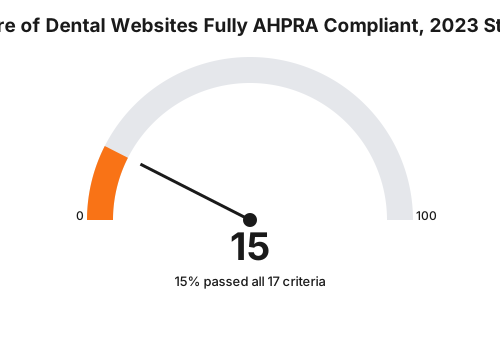
Only 15% of the 192 websites in the Jensen study passed every one of the 17 compliance criteria clean. That is the flip side of the 85% breach figure from earlier in this post, and it is the number worth sitting with before publishing a new landing page: most practices are not the exception.
Most practices do not know which of these areas their current site gets wrong until someone checks it against the current rules. RockingWeb can flag exactly what needs fixing before a competitor, or a patient complaint, does it for you.
Takeaway: compliant dental marketing still converts. It persuades with verifiable facts instead of outcome claims, which is the only lever AHPRA’s rules leave on the table.
How RockingWeb Builds for Australia’s Dental Market
RockingWeb is an AHPRA-compliance specialist building websites for cosmetic clinics and dental practices across Australia’s $14.5 billion dental industry. Every site starts from the current advertising guidelines, so growth and compliance are never a trade-off a practice has to make on its own.
For practices that want the audit, the compliant rebuild and ongoing compliant ad management as one service, ClinicPipeline is built specifically for regulated dental and cosmetic clinics navigating these exact rules. Get in touch to talk through where your current marketing sits against the numbers above.
Data sources: Jensen ED et al., “Advertising and general dental practice: how compliant are practice websites in Australia with legal requirements?”, Australian Dental Journal, 2023;68(2):92-97; Australian Dental Association, 2025 Consumer Survey, published 31 July 2026; IBISWorld, Dental Services in Australia industry report (2025); Australian Institute of Health and Welfare (AIHW), Oral health and dental care in Australia, and Health Expenditure Australia 2023-24; AHPRA, Guidelines for advertising a regulated health service (September 2025 amendments); Section 133, Health Practitioner Regulation National Law.
Vikas Thakur
Founder of RockingWeb. 16 years of experience from working at TPG, iiNet and Monadelphous, now building websites, software and digital marketing for local businesses in Rockingham and Perth.