ADA Survey: 60% Say Social Media Drove Cosmetic Dental Choice
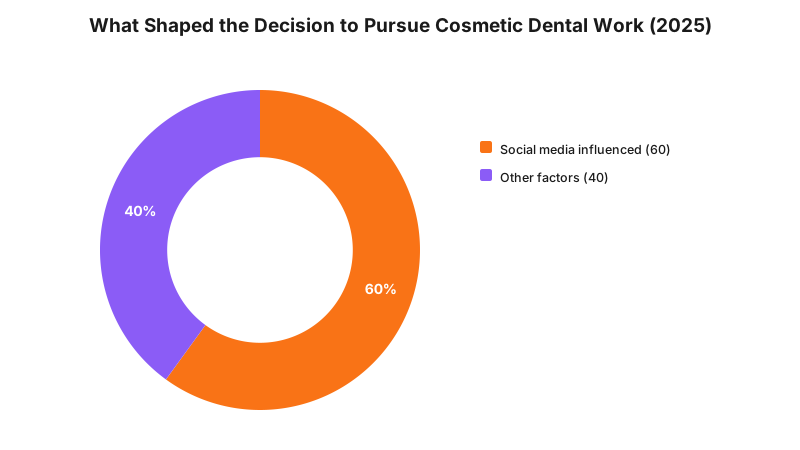
The Australian Dental Association's 2025 Consumer Survey of more than 25,000 Australians, published 31 July 2026, found 60% of respondents said social media influenced their decision to pursue cosmetic dental procedures. Here is what that means for a cosmetic dental practice's website and booking flow.
 Vikas Thakur Founder, RockingWeb 9 min read
On this page 9
- Key Takeaways
- What the ADA Survey Actually Found
- Why This Group Is Asking for Cosmetic Work in the First Place
- What This Means for Your Website, Not Your Clinical Practice
- The AHPRA Rules Still Apply Once the Click Lands
- Measuring Whether the Traffic Actually Converts
- FAQ
- Get an AHPRA-Compliant Website Built for Social-Referred Patients
- Sources and References
Key Takeaways
- The Australian Dental Association’s 2025 Consumer Survey, covering more than 25,000 Australians and published 31 July 2026, found 60% of respondents said social media influenced their decision to pursue a cosmetic dental procedure
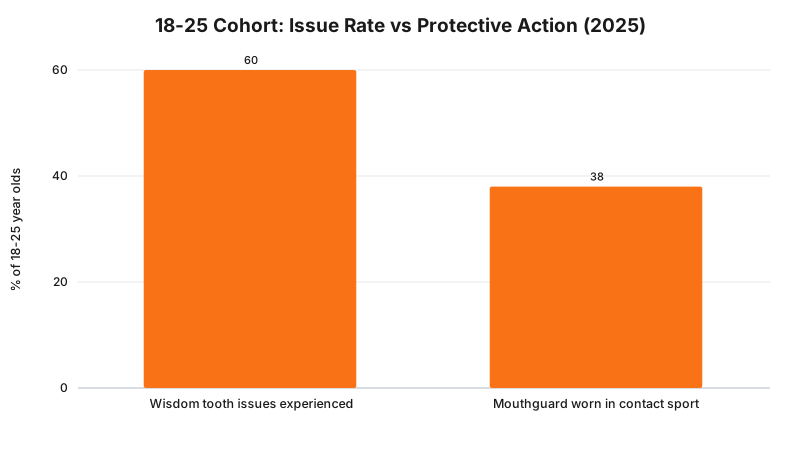
- The same release found 60% of Australians aged 18-25 have experienced wisdom tooth related issues, while only 38% of young adults in contact and high-impact sports reported wearing a mouthguard
- A follow-up ADA article published 4 August 2026 quotes Dr Andrew Gikas, ADA Board director and clinic director of the University of Melbourne Dental Clinic, on rising patient requests for whitening, orthodontics, and other cosmetic procedures
- Dr Gikas states patients “don’t always rely on the best, evidence-based, information” when forming those requests
- AHPRA’s advertising guidelines, in effect since 2 September 2025, ban before/after imagery, testimonials, and outcome claims for cosmetic dental advertising, the same as for cosmetic medicine
- Social media is where the demand starts. The practice website, not the social feed, is where AHPRA’s advertising rules actually apply to what a prospective patient reads next
Six in ten Australians who considered a cosmetic dental procedure say social media pushed them toward that decision. That is the headline finding from the Australian Dental Association’s 2025 Consumer Survey, drawn from more than 25,000 respondents and published on 31 July 2026. It confirms something most cosmetic dental practices already suspected but had no number for.
Here is the part that matters for your website. Social media is an unregulated first stop. The moment that same person clicks through to your practice, they land on a page AHPRA’s advertising guidelines do regulate. If that page still leans on the same before/after imagery or outcome language the social post got away with, the compliance exposure sits with the practice, not the platform.
This post covers what the ADA’s survey actually says, what a follow-up ADA piece says about why patients are asking, and what a practice website needs to do differently now that most of its cosmetic dental demand starts on a phone screen, one scroll away from a competitor’s ad.
What the ADA Survey Actually Found
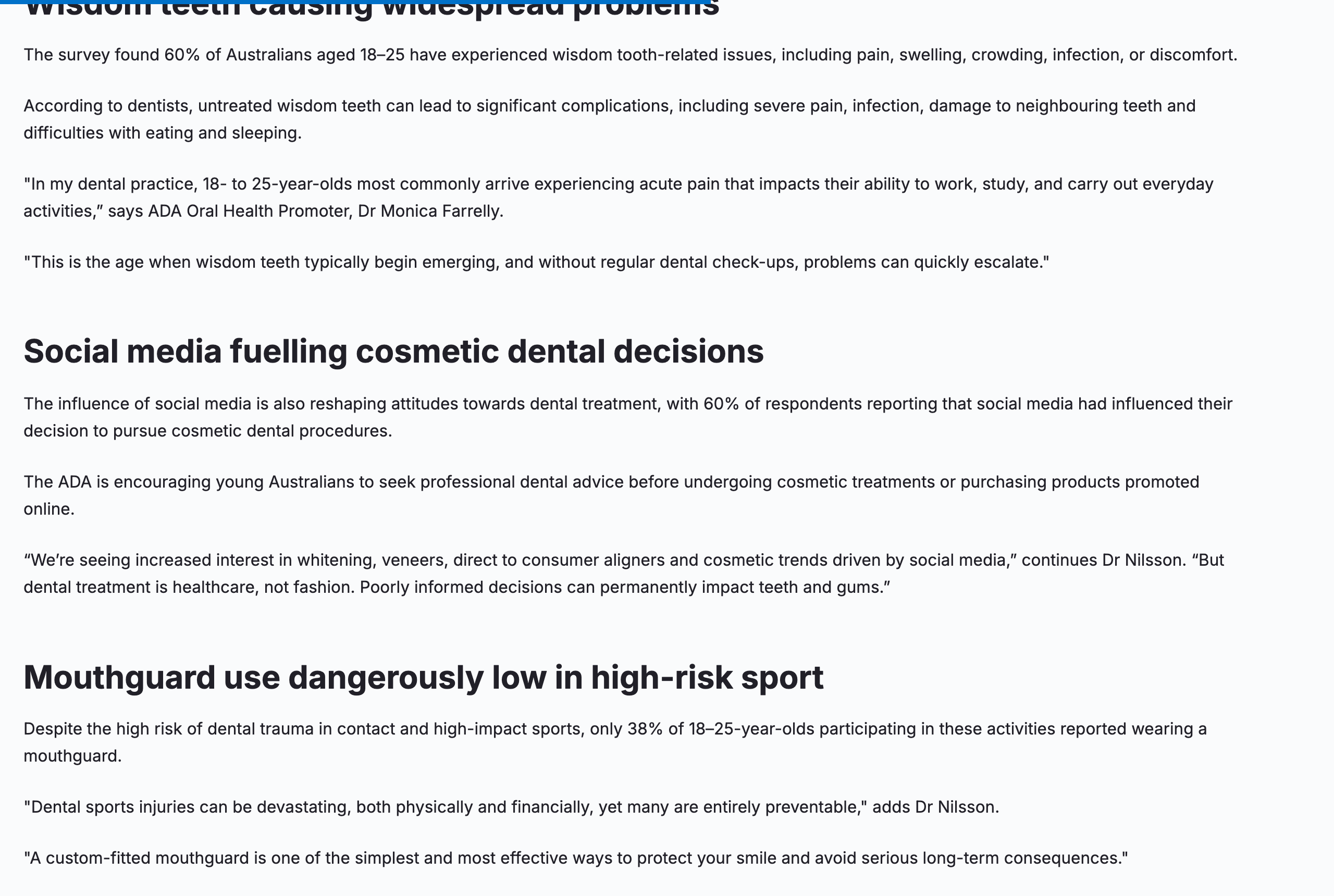
The ADA’s 2025 Consumer Survey polled more than 25,000 Australians and was published as part of Dental Health Week 2026 coverage. The finding driving this post: 60% of respondents reported that social media had influenced their decision to pursue cosmetic dental procedures, exactly as the ADA phrased it.
The same release covered general oral health, not only cosmetic procedures. It found 60% of Australians aged 18-25 have experienced wisdom tooth related issues, including pain, swelling, crowding, infection, or discomfort. It also found only 38% of 18-25 year olds playing contact or high-impact sports reported wearing a mouthguard. Neither of those two figures is about cosmetic dentistry directly, but they describe the same age cohort the cosmetic finding sits inside, and the pattern is consistent: this group experiences dental issues at a high rate and does not always act on protective, evidence-based information.
Takeaway: the 60% social media figure is not an isolated data point. It sits inside a wider ADA finding that young Australians are forming dental decisions, cosmetic and otherwise, without consistently reliable information in front of them.
Why This Group Is Asking for Cosmetic Work in the First Place
A second ADA article, published 4 August 2026, adds the “why” behind the survey number. Dr Andrew Gikas, an ADA Board director and clinic director of the University of Melbourne Dental Clinic, says more patients are asking if aspects of their smile can be improved, whether through whitening, orthodontics, or other cosmetic procedures.
Dr Gikas’s stated concern is not that patients are asking. It is that patients “don’t always rely on the best, evidence-based, information” when they ask. He recommends patients choose a dentist willing to explain benefits, limitations, risks, and alternatives, and adds that if a dentist advises against a particular cosmetic procedure, it is worth listening carefully to the reason.
That is a clinical judgement for the dentist to make in the chair, and RockingWeb has no view on it. What we can say is where the information gap Dr Gikas describes actually opens up: on the practice website, before the patient ever sits in that chair. A page that only shows a polished result photo, with no explanation of process, timeline, or realistic limitations, is contributing to the exact gap he is describing.
Takeaway: the demand described in this survey is arriving already partly informed by social media and only partly informed by the practice. The website is the practice’s one chance to close that gap before the first consultation.
What This Means for Your Website, Not Your Clinical Practice
RockingWeb builds and audits websites. We are not going to tell a practice which cosmetic procedures are clinically appropriate for an 18-25 year old patient, and nothing here should be read that way. What we can say is what a compliant, conversion-ready website looks like once most cosmetic dental enquiries start on a phone, from a social link, from someone in the exact age bracket this survey describes.
Three changes matter most:
- Process pages, not outcome pages. Every cosmetic treatment page should describe what happens during the appointment, roughly how long it takes, and what aftercare looks like, rather than showing a result. AHPRA’s guidelines ban before/after imagery and outcome claims for cosmetic procedures outright, and the ADA’s own commentary on unrealistic smile ideals is a reason to lean into factual process content even where a rule does not force it.
- Transparent indicative pricing. A visible price range for whitening, veneers, or orthodontic consultations sets an honest expectation before someone books, which matters for a cohort described as coming off their parents’ private health insurance around this same age, per the ADA’s Dr Angie Nilsson.
- A mobile-first booking form. If the referral source is a social app on a phone, the booking form has to work on that same phone in three taps or fewer, not a desktop-first contact page that makes someone pinch and zoom.
Takeaway: none of this is about whether a procedure is right for a given patient. It is about whether your website gives that patient the same factual grounding Dr Gikas says is currently missing.
The AHPRA Rules Still Apply Once the Click Lands
The ADA’s survey describes where cosmetic dental interest starts. It does not change where the advertising rules apply. AHPRA’s advertising guidelines for cosmetic procedures, in effect since 2 September 2025, ban before/after imagery, testimonials, and outcome claims. The Dental Board of Australia applies the same restrictions to dentistry as AHPRA’s medical boards apply to cosmetic medicine.
A practice that runs a social campaign built around a “smile transformation” is generating exactly the influence the ADA’s survey measured, and doing it in a channel where AHPRA’s advertising rules still bite the moment that content lives on a website the practice controls. Read our full breakdown of what the dental-specific AHPRA advertising rules permit and ban before publishing a new cosmetic treatment page.
Takeaway: the survey is a demand signal, not a compliance signal. Where the demand comes from does not change what your website is allowed to show once that visitor lands on it.
Measuring Whether the Traffic Actually Converts
Sixty per cent of a decision being influenced by social media is not the same as sixty per cent of your bookings coming from social media. Most practices we audit cannot answer that second question because their analytics do not separate social-referred visitors from search or direct traffic, let alone track them through to a completed booking.
Instrumenting that gap does not require a rebuild. It requires tagging campaign links per platform and setting up a booking form completion as a tracked goal, then checking which landing pages social traffic converts on versus which ones it just bounces from.
Takeaway: the ADA’s finding tells you where the influence starts. Your own analytics are the only source that tells you whether that influence is actually turning into booked patients.
FAQ
Does the ADA’s 60% figure mean my practice should post more on social media?
The survey shows where demand is forming, not what your practice’s social output should be. A patient who arrives from a social post lands on your website next. If that site cannot answer their questions with factual, compliant content, the influence social media had on them is wasted at the exact moment they were ready to book.
What can a cosmetic dental website legally show, given AHPRA’s rules on testimonials and before/after imagery?
AHPRA’s advertising guidelines ban before/after imagery, testimonials, and outcome claims for cosmetic procedures, and the Dental Board applies the same rules to dentistry. A compliant page describes the treatment process, typical timelines, and indicative pricing ranges rather than promising a result. See our full breakdown of the dental-specific rules for what is and is not allowed.
Should our website show exact prices for veneers or whitening?
Showing a transparent indicative price range, rather than a single fixed figure, sets expectations before a patient books a consultation and reduces the number of speculative enquiries that never convert. This is a website and conversion decision, not a clinical or legal one, so treat it as content strategy rather than a pricing policy question.
How do we know if our social media traffic is actually converting into bookings?
Tag each social platform as a separate traffic source in your analytics and track it through to a completed booking form submission, not just a landing page visit. Without that instrumentation, a practice is guessing which platform, which post, and which landing page actually produced a patient rather than a bounce.
Get an AHPRA-Compliant Website Built for Social-Referred Patients
RockingWeb builds and audits cosmetic clinic and dental practice websites against the current AHPRA advertising rules, with mobile-first booking flows designed for patients arriving from a social link. We review process pages, pricing transparency, and booking conversion together, not as separate projects.
See how a compliant build looks on our cosmetic clinic website page, or get in touch about your practice.
Sources and References
- Australian Dental Association - primary source: the 2025 Consumer Survey findings, including the 60% social media influence figure, published 31 July 2026
- Australian Dental Association - follow-up commentary published 4 August 2026, including Dr Andrew Gikas’s remarks on patient requests and evidence-based information
- AHPRA Advertising Rules for Cosmetic Dentistry - full breakdown of how the September 2025 AHPRA advertising amendments apply to dental practices
Related reading:
- Cosmetic Clinic Websites: compliant website builds for AHPRA-regulated practices
- Cosmetic Dentistry Market Australia: market context for the demand this survey describes
Vikas Thakur
Founder of RockingWeb. 16 years building for companies like TPG, iiNet and Monadelphous, now focused on websites and marketing that comply with AHPRA's advertising guidelines and still book patients.
![85% of Dental Websites Breach AHPRA Ad Rules: Study [2026]](/assets/ahpra-cosmetic-dentistry-advertising-CH-AE8rx.png)