$4.5B by 2032: Dental Contouring Cost & Market Australia
The global dental contouring market was worth USD 2.6 billion in 2022 and is forecast to reach USD 4.5 billion by 2032, a 5.8% CAGR, according to Allied Market Research. Australian clinics charge $200 to $500 per tooth for the procedure.
 Vikas Thakur Founder, RockingWeb 12 min read
On this page 13
- Key takeaways
- What Dental Contouring Actually Is
- The Global Market: USD 2.6 Billion to USD 4.5 Billion by 2032
- Who Is Driving the Growth: Equipment, Teeth and Applications
- Where Australia Fits Against the Global Curve
- What Australian Clinics Actually Charge Per Tooth
- How Contouring Compares to Bonding Pricing
- The Compliance Angle: Advertising a Quick-Fix Cosmetic Procedure
- Getting Pricing and Compliance Checked Before Chasing This Growth
- How RockingWeb Builds for Growing Dental Practices
- FAQ
- Need a hand with your website?
- Sources and References
Key takeaways
- The global dental contouring market was worth USD 2.6 billion in 2022 and is forecast to hit USD 4.5 billion by 2032, a 5.8% CAGR, per Allied Market Research
- North America held 46.1% of the global market in 2022 and is expected to keep leading through the forecast period
- Diamond burs, the primary cutting instrument for the procedure, led the equipment segment in 2022 and are projected to grow at a 6.2% CAGR through 2032
- Central incisors, the two front teeth, captured the largest share by tooth type, also projected at a 6.2% CAGR
- Irregular edges was the single largest clinical application in 2022, at 39.9% of the market, projected at a 5.9% CAGR
- Australian clinics charge $200 to $500 per tooth for contouring and reshaping, per price lists published by three separate providers
- Australia’s broader cosmetic dentistry market is on a similar curve: USD 369.2 million (2022) to a forecast USD 1,119.4 million by 2030, a 14.9% CAGR, per Grand View Research
- Composite veneer bonding, item 526, the closest billed alternative when material is added rather than removed, averaged $393 per tooth nationally in 2023-24, per Private Healthcare Australia’s claims data
Answer: The global dental contouring market was worth USD 2.6 billion in 2022 and is forecast to reach USD 4.5 billion by 2032, a 5.8% CAGR, according to Allied Market Research. In Australia, clinics charge $200 to $500 per tooth for the procedure, with no single ADA item code setting a national benchmark price.
The global dental contouring market is worth USD 2.6 billion right now, and Allied Market Research expects it to hit USD 4.5 billion by 2032. That is a 5.8% compound annual growth rate for a procedure most patients have never heard called by its clinical name. Ask a Perth or Brisbane clinic for a quote and you will pay somewhere between $200 and $500 per tooth, depending on how much enamel needs shaping and which practice you walk into. Here is the problem: almost no Australian clinic prices this the same way twice, because there is no single ADA item code a patient can check against the way they can for a filling or a crown. This guide breaks down where the global growth is coming from, what Australian clinics actually charge per tooth, and how contouring pricing compares to the composite bonding work it often gets confused with.
What Dental Contouring Actually Is
Dental contouring, also called tooth reshaping or odontoplasty, is the removal of small amounts of enamel to change the shape of a tooth. A dentist uses a rotating polishing tool to smooth a chipped edge, shorten a pointed canine, or even out a slightly overlapping front tooth. No material is added. Nothing is drilled into and filled. Most clinics describe it as a single-visit, no-recovery procedure, and several list it alongside teeth whitening as an entry-level cosmetic option.
That is a different treatment to dental bonding, even though the two get marketed under overlapping language. Bonding adds tooth-coloured composite resin to a tooth. Contouring removes existing enamel. Our separate breakdown of dental bonding cost in Australia covers the item-code pricing for the “add material” side of this comparison. This post covers the “remove material” side, and the market driving demand for it.
Takeaway: contouring and bonding solve different problems, cost differently, and neither has a single official price list in Australia, which is exactly why clinic quotes vary so much.
The Global Market: USD 2.6 Billion to USD 4.5 Billion by 2032
| Year | Market Size (USD) |
|---|---|
| 2022 (actual) | $2.6 billion |
| 2024 (CAGR-modelled) | $2.91 billion |
| 2026 (CAGR-modelled) | $3.26 billion |
| 2028 (CAGR-modelled) | $3.65 billion |
| 2030 (CAGR-modelled) | $4.08 billion |
| 2032 (forecast) | $4.5 billion |
CAGR 2023-2032: 5.8%. Only the 2022 and 2032 figures are directly reported by Allied Market Research; the 2024, 2026, 2028 and 2030 figures are calculated by applying that CAGR year on year, not independently sourced data points.
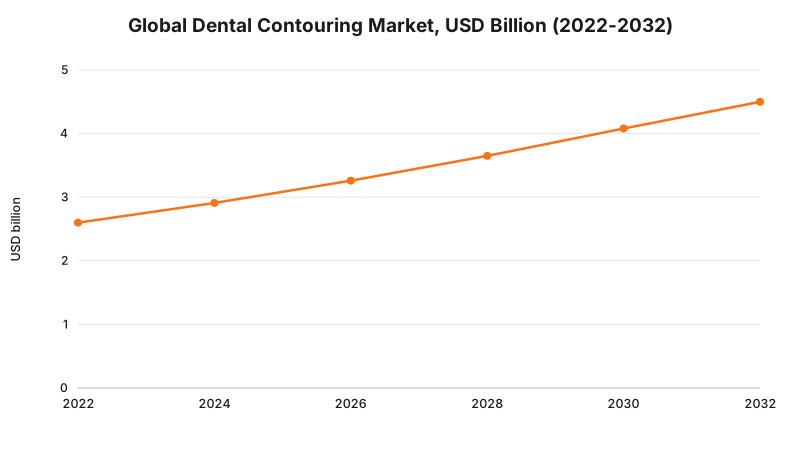
Allied Market Research names three growth drivers behind that curve: a growing need for higher-precision cutting instruments, rising demand for cost-effective cosmetic treatments compared with veneers or crowns, and increasing aesthetic consciousness among patients paying out of pocket. North America dominated with 46.1% of the market in 2022 and is expected to hold that lead through 2032, which the report attributes to stronger regional support for cosmetic dentistry and oral health spending generally.
Takeaway: the reported endpoints, USD 2.6 billion in 2022 and USD 4.5 billion by 2032, are the two hard numbers here. Everything in between is a modelled trajectory, not a separately published figure.
Who Is Driving the Growth: Equipment, Teeth and Applications
Allied Market Research segments the global market three ways. By equipment, diamond burs led the 2022 share and are projected to grow at 6.2% CAGR through 2032, ahead of sanding discs and dental drills, the other two categories the report tracks. By tooth type, central incisors, the two front teeth that carry the most cosmetic weight in a smile, captured the largest 2022 share and are also projected at 6.2% CAGR. By clinical application, irregular edges was the single biggest category at 39.9% of the market in 2022, projected to grow at 5.9% CAGR, ahead of tooth overlapping, chips and cracks, and minor crowding.
That pattern lines up with what Australian clinics actually advertise. Every provider referenced in this post markets contouring for the same short list: chipped edges, pointy or uneven teeth, and minor overlap on front teeth, not major structural work. The global data and the local marketing copy are describing the same narrow procedure.
Takeaway: the market is not growing because of one breakthrough treatment. It is growing because a specific, low-cost fix for uneven front teeth keeps getting more precise instruments and more patient demand at the same time.
Where Australia Fits Against the Global Curve
Allied Market Research’s USD 2.6 billion to USD 4.5 billion figures cover the global dental contouring market specifically, tracked by equipment and technique. That is a different report, from a different publisher, to Grand View Research’s Australia-specific cosmetic dentistry market data, which covers the broader category of implants, crowns, veneers, braces, whitening and equipment across the whole country. The two should not be read as the same market measured two ways.
What they do share is direction. Grand View Research puts Australia’s cosmetic dentistry market at USD 369.2 million in 2022, forecast to reach USD 1,119.4 million by 2030, a 14.9% CAGR, more than double the global contouring segment’s growth rate. Our full breakdown of Australia’s cosmetic dentistry market covers that data procedure by procedure. Both curves point the same way: more patients paying out of pocket for smaller cosmetic fixes, in Australia and globally, over the same forecast decade.
Takeaway: two different reports, two different scopes, but the same conclusion. Demand for low-cost, single-visit cosmetic dental work is rising faster than general dental spending in both datasets.
What Australian Clinics Actually Charge Per Tooth
| Clinic | Location | Quoted Price (per tooth) |
|---|---|---|
| Smile Team | Australia (multi-location) | From $50 |
| Cosmetique Dental | Australia | Around $200 |
| Swish Dental | Brisbane | Fixed at $250 |
| Care Family Dental | Australia | Around $500 |
Prices as published on each provider’s own website. None of these figures come from a government or insurer fee schedule, since contouring has no single dedicated billing item most clinics use.
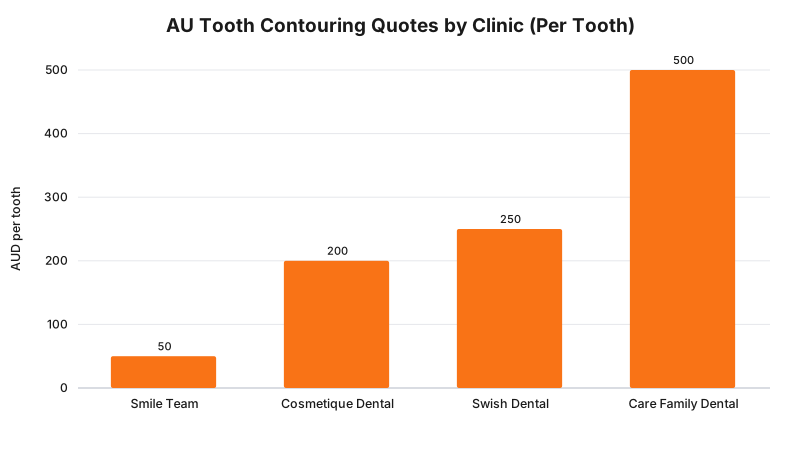
That is a tenfold spread between the cheapest advertised quote and the most expensive, for a treatment every provider describes the same way: minor enamel reshaping, one visit, no recovery time. Every clinic caveats its figure the same way too, noting the final price depends on how much work each specific tooth needs and how many teeth the patient wants reshaped. None of the four publish a per-tooth average, only a starting or fixed figure.
The ADA’s Australian Schedule of Dental Services does list a specific code for this procedure, item 171, “Odontoplasty, per tooth.” It does not appear among the most-funded items in Private Healthcare Australia’s 2023-24 claims factsheet, the same dataset that reports item 526 composite veneer pricing below. That gap suggests contouring is billed rarely enough, or funded outside private health insurance often enough, that no national claims average exists for it.
Takeaway: without a claims-backed national average, a $50 quote and a $500 quote for the same procedure name are both technically accurate, and a patient has no independent number to check either one against.
How Contouring Compares to Bonding Pricing
Contouring and bonding get marketed together often enough that patients search for both under the same umbrella term. The pricing tells a different story. Private Healthcare Australia’s claims data puts item 526, “Composite Veneer, Direct, Per Tooth,” the closest billed match to composite bonding, at $393 average nationally in 2023-24, with patients paying $227 out of pocket after insurance covered 42% of the treatment cost. That figure sits inside the contouring price range clinics advertise, but it comes from actual insurer claims data, not a marketing page.
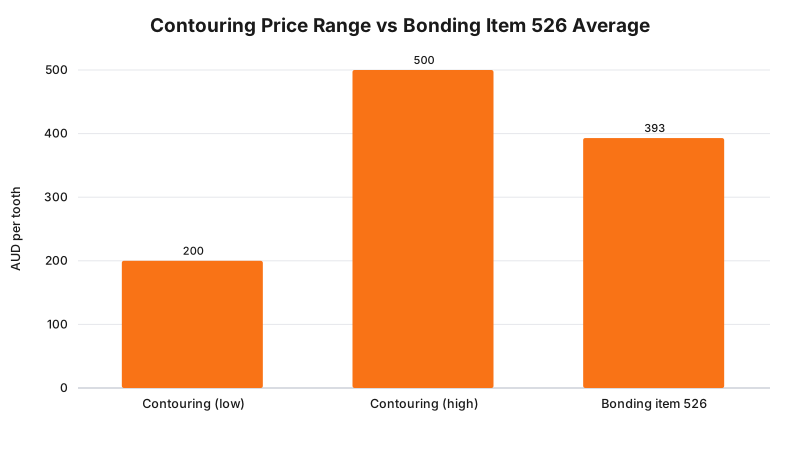
The gap matters for how a practice presents pricing. Bonding has a claims-verified national average behind it. Contouring, at least on the public data available, does not, which means a clinic quoting contouring alongside bonding on the same pricing page is mixing a verifiable figure with an unverifiable one. See our full breakdown of dental bonding cost in Australia for the complete item-code ladder, including fillings and crowns.
Takeaway: a patient comparing a $200 contouring quote to a $393 bonding average is comparing a marketing figure to a claims-verified national average, not two numbers measured the same way.
The Compliance Angle: Advertising a Quick-Fix Cosmetic Procedure
A market growing at 5.8% to 14.9% a year, depending on which report you read, draws more marketing spend chasing it. Dentists in Australia are regulated by the Dental Board of Australia under the same AHPRA National Law as cosmetic medicine clinics, so the same advertising restrictions apply to a contouring before-and-after post as to a Botox result photo. Our full breakdown of AHPRA’s advertising rules for cosmetic dentistry covers what changed under the September 2025 amendments, including the testimonial ban and narrower before-and-after imagery exemptions, both of which apply directly to how a practice can show off a contouring result.
That matters more for a low-cost, high-volume treatment like contouring than for a big-ticket procedure. A practice advertising a $200 fix is more likely to lean on a fast before-and-after gallery or a quick patient quote to sell the volume needed to make that price point work, and that is exactly the content AHPRA’s current guidelines restrict hardest.
Takeaway: the cheaper and faster the procedure, the more a clinic’s marketing tends to rely on exactly the imagery and testimonials AHPRA’s current rules limit.
Getting Pricing and Compliance Checked Before Chasing This Growth
Most practices do not know which parts of their current pricing page or before-and-after gallery would fail an AHPRA review until someone checks it line by line. If your site has not been reviewed since the September 2025 amendments landed, RockingWeb can flag exactly what needs to change before a patient complaint does it for you.
That is a cheaper starting point than a bigger ad budget chasing a market growing at 5.8% a year. A compliant pricing page and a compliant gallery mean every dollar spent capturing this demand is spent on assets that survive a regulator’s review.
Takeaway: the audit costs nothing and catches the exact gap between what a pricing page claims and what current AHPRA rules allow it to claim.
How RockingWeb Builds for Growing Dental Practices
RockingWeb builds cosmetic clinic and dental websites where every pricing page maps to a real procedure and a defensible price range, not a single flattened number borrowed from a competitor’s site. For practices marketing lower-cost, high-volume treatments like contouring, that means booking flows and pricing pages built to survive both patient scrutiny and an AHPRA review.
Get in touch to review your pricing pages and booking flow.FAQ
How much does dental contouring cost in Australia?
Australian clinic price lists put tooth contouring and reshaping between $200 and $500 per tooth, with at least one provider quoting from $50 for minor work. There is no single ADA item code patients can check, so quotes vary by clinic and by how much enamel needs shaping.
How big is the global dental contouring market?
Allied Market Research valued the global dental contouring market at USD 2.6 billion in 2022 and forecasts it will reach USD 4.5 billion by 2032, a 5.8% compound annual growth rate driven mostly by demand in North America.
Is dental contouring the same as dental bonding?
No. Contouring, also called odontoplasty, removes small amounts of enamel to reshape a tooth. Bonding, billed under ADA item 526 as a “Composite Veneer, Direct, Per Tooth,” adds tooth-coloured composite resin. They solve different problems and are billed differently.
Does private health insurance cover dental contouring in Australia?
Odontoplasty, item 171 in the Australian Schedule of Dental Services, does not appear among the most-funded items in Private Healthcare Australia’s 2023-24 claims factsheet. No verified national average exists for insurer coverage of that specific item.
Need a hand with your website?
If you want a second pair of eyes on how this applies to your own site, request a callback and we will talk it through.
Sources and References
- Allied Market Research - Dental Contouring Market Size, Share and Forecast to 2032: global market value, CAGR, regional share, and segment breakdown by equipment, tooth type and application
- EIN Presswire - syndicated press release corroborating Allied Market Research’s 2022 and 2032 market figures, CAGR, and segment shares
- Private Healthcare Australia - “Typical Prices of Dental Care” consumer factsheet, item 526 composite veneer pricing, 2023-24 claims data
- Australian Dental Association - Australian Schedule of Dental Services and Glossary, confirming item 171 (Odontoplasty, per tooth)
- Care Family Dental - published tooth contouring and reshaping pricing
- Swish Dental - published fixed tooth contouring pricing, Brisbane
- Smile Team - published tooth reshaping price range
Related reading:
- Dental Bonding Cost Australia: item-code pricing for composite bonding, fillings and crowns
- Cosmetic Dentistry Market Australia: full Australian market segment breakdown
- AHPRA Advertising Rules for Cosmetic Dentistry: what a treatment or pricing page can say about outcomes and cost
- Cosmetic Clinic Websites: compliant website builds for AHPRA-regulated clinics and dental practices
Vikas Thakur
Founder of RockingWeb. 16 years of experience from working at TPG, iiNet and Monadelphous, now building websites, software and digital marketing for local businesses in Rockingham and Perth.