What Can Be Booked Online Without a Consultation
AHPRA's September 2025 guidelines do not ban online booking for cosmetic treatments, but a Schedule 4 injectable cannot be sold like a haircut slot. Here is what a booking widget can let a patient self-select and what needs a consultation gate first.
 Vikas Thakur Founder, RockingWeb 13 min read
On this page 12
Key takeaways
- A general or initial consultation can be self-selected and paid for online with no gate. A Schedule 4 prescription-only cosmetic injectable cannot
- AHPRA’s guideline for practitioners who perform non-surgical cosmetic procedures, in effect since 2 September 2025, applies to every registered health practitioner except medical practitioners, who sit under the Medical Board’s separate guideline instead
- The performance guideline requires an in-person or video consultation every time a Schedule 4 cosmetic injectable is prescribed, not once per patient relationship
- Asynchronous prescribing of cosmetic injectables by text, email or online questionnaire is named directly as not acceptable practice
- Between September 2022 and March 2025, AHPRA investigated about 360 notifications about non-surgical cosmetic procedures, closed about 300, and logged over 1,500 calls to its cosmetic surgery hotline
- Under National Law section 41, an approved guideline is admissible in disciplinary proceedings as evidence of appropriate professional conduct, so a booking log showing no consultation before a Schedule 4 treatment can become exactly that evidence
- No money should be payable for a gated treatment until the required consultation step has happened, other than for the consultation itself
A cosmetic clinic booking widget can let a patient self-select and pay for a general consultation appointment with no gate at all. It cannot let a patient self-select and pay a deposit for a specific Schedule 4 prescription-only cosmetic injectable, such as an anti-wrinkle treatment or dermal filler, without a consultation happening first. Under AHPRA’s guideline for registered health practitioners who perform non-surgical cosmetic procedures, in effect since 2 September 2025, an authorised prescriber must hold an in-person or video consultation with the person every time they prescribe a Schedule 4 cosmetic injectable, not once per patient relationship. A booking flow that treats “select treatment, pick a time, pay a deposit” as a single uninterrupted step for every service on the menu is building past a rule the guideline states in plain language.
What the Guideline Actually Says
AHPRA and the National Boards published two documents that took effect on 2 September 2025: the Guidelines for practitioners who perform non-surgical cosmetic procedures and the Guidelines for practitioners who advertise higher risk non-surgical cosmetic procedures. Announcing them, AHPRA said the new practice guideline “brings all registered health practitioners in line with medical practitioners, who already have their own guidelines,” and that it “builds on the safeguards put in place by the Medical Board of Australia in 2023.”
That framing matters, because the performance guideline’s own scope section is direct about who it covers and who it does not: “These guidelines apply to any health practitioners registered under the National Law who perform non-surgical cosmetic procedures, except medical practitioners. Since medical practitioners also perform cosmetic surgery, they should refer to the Medical Board’s Guidelines for registered medical practitioners who perform cosmetic surgery and procedures.” Nurse practitioners, registered and enrolled nurses, dental practitioners, podiatrists and Chinese medicine practitioners sit under the September 2025 guideline. Medical practitioners sit under the Medical Board of Australia’s Guidelines for registered medical practitioners who perform cosmetic surgery and procedures, dated 1 July 2023, a separate document with its own separate wording. A clinic running a nurse injector and a visiting cosmetic doctor on the same booking page is building against two documents, not one.
Both documents converge on the same consultation rule for prescription-only injectables, in near-identical language. The September 2025 guideline states: “registered health practitioners who are authorised to provide prescription only cosmetic injectables must have either an in-person or video consultation with the person, each time they prescribe them a cosmetic injectable. Asynchronous prescribing of cosmetic injectables by text, email or online (or equivalent) is not acceptable practice.” The Medical Board’s 2023 guideline states the equivalent for doctors: “Medical practitioners must have a consultation with the patient, either in person or by video, each time they prescribe them schedule 4 (prescription only) cosmetic injectables.” Neither document limits this to first-time patients. It applies to every prescription, every time.
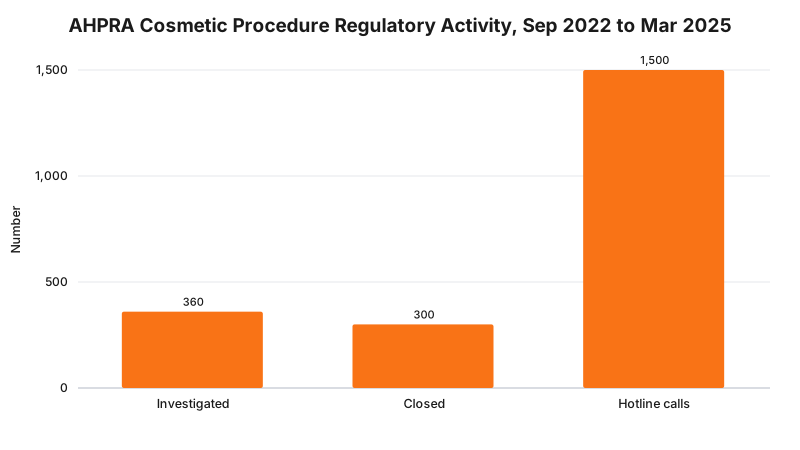
These figures cover complaints against every practitioner type named in the guideline, medical practitioners, nurses, midwives, dentists, psychologists and Chinese medicine practitioners among them. They are not booking-widget specific, but they show a regulator that is actively investigating this exact patient group, not one publishing guidelines and moving on.
What That Means for the Build
Give every bookable service a requires_consultation flag, not a blanket rule. A single “book now” button treating every line on the treatment menu the same way cannot express a distinction the guideline makes explicitly. General consultations and non-prescription procedures can carry requires_consultation: false. Schedule 4 cosmetic injectables carry requires_consultation: true, and that flag has to block the treatment-specific slot, not just display a warning next to it.
Route a gated service to a consultation booking, not a treatment slot. When a patient selects “anti-wrinkle injection, 20 units” without an existing, current consultation on file, the flow should offer a consultation appointment, not a calendar of injection slots. The treatment slot only becomes selectable once the practice management system has a record that the consultation happened.
Hold deposits behind the consultation, not the treatment page. The guideline’s own wording, “no money should be payable until after the cooling-off period (other than for initial consultations)”, draws a clear line: payment for a consultation is fine at any point, payment that locks in a specific prescription-only treatment before the consultation has happened is collecting money against something that cannot yet lawfully proceed.
Reject “video consultation equals asynchronous approval”. A live video call satisfies the rule. A text message, an emailed photo, or an online questionnaire answered without a real-time conversation does not, because the guideline names asynchronous prescribing directly as unacceptable. If your booking or intake flow lets a patient submit a form and receive treatment approval with no live exchange, that is the specific pattern the guideline rules out.
Treat “every time” as a repeat check, not a one-off flag. A returning patient who had a consultation eighteen months ago for their last treatment does not automatically clear the gate for a new prescription today. The system needs to check for a current, valid consultation tied to that specific prescribing event, not a lifetime “verified patient” badge.
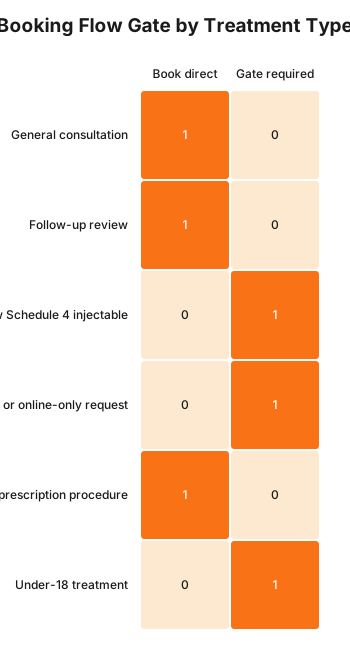
Decision Matrix: What Can Be Booked Direct
| Treatment or booking type | Bookable direct online? | Requires consultation gate first? | Why |
|---|---|---|---|
| General or initial cosmetic consultation | Yes | No, this is the consultation | The appointment itself is the assessment step the guideline requires |
| Follow-up review with an existing, currently assessed patient | Usually yes | No new gate, subject to your state’s repeat-prescription rules | The prescriber already holds a current consultation and prescription for that person |
| Schedule 4 cosmetic injectable, new patient or lapsed prescription | No | Yes, an in-person or video consultation each time it is prescribed | Stated directly in both AHPRA’s performance guideline and the Medical Board’s 2023 guideline |
| Any cosmetic injectable where the only contact is text, email or an online questionnaire | No | Yes, and a live consultation, not just a form | Asynchronous prescribing is named as not acceptable practice |
| Non-prescription non-surgical procedure (chemical peel, laser hair removal, dermaplaning) | Generally yes, subject to your own clinical governance | No AHPRA-mandated per-booking gate identified in the September 2025 guideline | These sit outside the guideline’s definition of a cosmetic injectable |
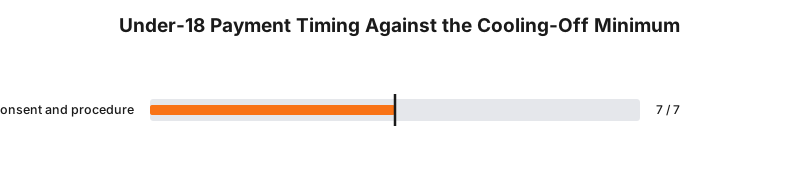
| Any non-surgical cosmetic procedure for a patient under 18 | No direct treatment booking | Yes, informed consent then a seven-day cooling-off, though the initial consultation can be booked and paid for directly | The cooling-off and payment-timing rule is explicit in both guidelines |
A Worked Example
A cosmetic clinic’s booking widget listed every service on one calendar, general consultations, anti-wrinkle top-ups, dermal filler and skin needling all selectable by the same “choose a time” flow. A returning patient could rebook a filler appointment and pay a deposit without the system checking whether their last consultation with the prescribing nurse practitioner was six weeks or sixteen months old.
The rebuild split the service catalogue into two tiers inside the practice management system. Tier one, general consultations and non-prescription procedures, kept the existing one-step booking flow. Tier two, Schedule 4 injectables, was reconfigured so selecting the treatment no longer opened a calendar of injection slots directly. Instead it checked for a consultation record dated within the practice’s own clinically defined window for that prescriber. Where none existed, or where the last one had lapsed, the widget offered a consultation booking instead, with the treatment slot becoming selectable only after that consultation was marked complete in the system. The deposit field moved with it, from the treatment page to a step that only exists once a valid consultation record is on file.
Nothing about the clinic’s actual clinical practice changed. The nurse practitioner was already holding a real consultation before every prescription. What changed was that the booking software could no longer let a patient’s online actions get ahead of what the practitioner was legally required to do first.
What to Check on Your Own Site
- List every service on your booking widget and mark which ones involve a Schedule 4 cosmetic injectable.
- For each of those, check whether a patient can reach a specific treatment slot and a payment field without a consultation record existing first.
- Check what counts as a “consultation” in your system. If a submitted online form or a text exchange can satisfy it, that does not match the guideline’s definition.
- Confirm the gate re-checks on every prescribing event, not once per patient relationship.
- Check where your deposit field sits relative to the consultation, for gated services specifically, not just for under-18 bookings.
- If any practitioner on your site is a medical practitioner, confirm your flow assumes the Medical Board’s 2023 guideline for their patients, not the September 2025 guideline this post covers.
The seven-day figure above is the mandatory floor for under-18 patients specifically, not a general rule for every gated booking. It is included here because it is the one place both guidelines put an explicit number on payment timing, and that number is the clearest test of whether your deposit logic is holding the line the guidelines describe.
The Enforcement Anchor
Between September 2022 and March 2025, AHPRA investigated about 360 notifications about non-surgical cosmetic procedures, with about 300 closed and complaints recorded against medical practitioners, nurses, midwives, dentists, psychologists and Chinese medicine practitioners. Under section 41 of the National Law, an approved guideline is admissible in disciplinary proceedings as evidence of what constitutes appropriate professional conduct for the profession, which means a booking system’s own records, showing a prescription-only treatment booked and paid for with no consultation on file, could become part of exactly that evidence if a notification is made.
There is no published Australian determination we can point to that turns specifically on a clinic’s online booking widget skipping the consultation gate. The regulatory activity and the admissibility of the guideline are on the record; a case built around booking-flow mechanics specifically is not. Reporting that honestly matters more than manufacturing a citation that does not exist.
Where This Gets Hard
Most booking platforms were not built with a two-tier gate in mind. They model a calendar and a payment gateway, not a rule that says “this service category cannot be selected until another record exists.” Building the check usually means custom logic over the platform’s API, a manual verification step a staff member performs before confirming a booking, or, for smaller practices, keeping Schedule 4 treatment bookings off self-service entirely and handling them by phone until the software catches up. None of those options is free.
There is also a genuine judgement call in how long a consultation stays “current” before a new one is required for a repeat prescription. The guidelines set the every-time rule but leave the interval for what counts as a fresh consultation to state and territory drugs and poisons legislation and to the prescriber’s own clinical judgement, which is a decision your booking logic has to encode without inventing a number the guideline itself does not give.
The regulator says an authorised prescriber must hold a consultation, in person or by video, each time they prescribe a Schedule 4 cosmetic injectable, and that asynchronous prescribing is not acceptable practice; the build consequence is that a booking widget cannot let a patient reach a specific injectable slot and a payment field without a current consultation record on file; whether your particular flow satisfies the obligation in your circumstances is a question for your medical defence organisation or your lawyer.
Status
In force since 2 September 2025. AHPRA’s guideline for registered health practitioners who perform non-surgical cosmetic procedures is a current obligation, not a proposal and not pending commencement. The Medical Board’s separate guideline for medical practitioners has applied since 1 July 2023 and is not new.
Frequently Asked Questions
Can a patient book and pay for an anti-wrinkle injection online without ever speaking to a prescriber first?
No. AHPRA’s guideline for registered health practitioners who perform non-surgical cosmetic procedures requires an in-person or video consultation with the person every time a Schedule 4 prescription-only cosmetic injectable is prescribed, and states explicitly that asynchronous prescribing by text, email or online questionnaire is not acceptable practice. A booking widget that lets a patient lock in a specific injectable slot and pay a deposit with no consultation step skips a requirement the guideline states directly.
Does every cosmetic treatment require a consultation before it can be booked online?
No. The consultation-each-time rule in AHPRA’s guideline is written around prescription-only cosmetic injectables specifically. A general or initial consultation appointment can be self-selected online with no gate at all, because the appointment itself is the assessment step. Non-prescription non-surgical procedures fall outside the guideline’s definition of a cosmetic injectable, so no AHPRA-mandated per-booking consultation gate applies to them, though a clinic’s own clinical governance may still require an assessment.
Who does AHPRA’s September 2025 performance guideline apply to, and who is excluded?
The guideline applies to any health practitioner registered under the National Law who performs non-surgical cosmetic procedures, except medical practitioners. AHPRA’s own wording is explicit on this point. Medical practitioners are directed instead to the Medical Board of Australia’s separate Guidelines for registered medical practitioners who perform cosmetic surgery and procedures, in force since 1 July 2023, which contains its own, near-identical consultation requirement.
Can a clinic take payment for a Schedule 4 injectable booking before the consultation has happened?
The guidelines address this directly for patients under 18, stating no money should be payable until after the mandatory cooling-off period, other than for initial consultations. That wording draws the same line for any age group by implication, a payment for the consultation itself is fine, a payment that locks in a specific prescription-only treatment before a prescriber has assessed the person is collecting money for something that cannot yet lawfully be provided.
Get Your Booking Flow Checked
Get in touch with RockingWeb and we will walk your booking widget service by service and report exactly which ones are missing the consultation gate the guidelines require.
Sources and References
AHPRA
- Putting patients first: New guidelines for cosmetic procedures, 2 September 2025. Checked 11 August 2026.
AHPRA
- Guidelines for practitioners who perform non-surgical cosmetic procedures, in effect since 2 September 2025. Checked 11 August 2026.
AHPRA
- Booming billion-dollar cosmetic industry on notice with new cosmetic procedures guidelines, 3 June 2025 (notification and hotline figures). Checked 11 August 2026.
Medical Board of Australia
- Guidelines for registered medical practitioners who perform cosmetic surgery and procedures, in force since 1 July
- Checked 11 August 2026.
AHPRA
- Cosmetic surgery hub, information for the public on injectables (guideline scope FAQ). Checked 11 August 2026.
Last reviewed: 11 August 2026.
Vikas Thakur
Founder of RockingWeb. 16 years of experience from working at TPG, iiNet and Monadelphous, now building websites, software and digital marketing for local businesses in Rockingham and Perth.