Time-Limited Offers on a Cosmetic Website: The Two Rules That Collide
Section 133 of the National Law says a time-limited offer is fine as long as its terms and conditions are stated. A separate 2025 advertising guideline says urgency itself can breach a practitioner's duty of care, and disclosure does not fix that. A clinic that only adds terms and conditions has closed one exposure and left the other open.
 Vikas Thakur Founder, RockingWeb 13 min read

Key takeaways
- Section 133 of the National Law requires an advertisement offering a gift, discount or other inducement to state its terms and conditions. A genuine expiry date, once disclosed, meets that test
- A separate rule says higher risk cosmetic procedures must not be advertised in a way that exploits vulnerabilities or insecurities to increase demand. Urgency framing runs straight at that wording regardless of disclosure
- Disclosure fixes the first rule and does nothing for the second. A clinic that treats “add terms and conditions” as the whole fix has closed one exposure and left the other open
- The second rule only engages for higher risk non-surgical cosmetic procedures, named in Ahpra’s visual examples material. A time-limited offer on a general dental or skincare page does not carry it
- Section 133 penalties run to $60,000 for an individual and $120,000 for a body corporate per offence, under the current National Law text
- Both rules are in force now, as at 10 September 2026. Neither is a proposal
A clinic marketing team asks for a countdown timer on the filler pricing page, and the person building it does the responsible thing: they add a terms and conditions field, state the expiry date plainly, list the eligible treatments, and ship it. That closes the exposure most people have heard of. It does nothing for the one most people have not.
Section 133 of the Health Practitioner Regulation National Law only asks that an offer state its terms. A separate, newer rule asks something entirely different: whether the offer itself, disclosed or not, is designed to pressure someone into a cosmetic decision faster than they otherwise would make it. A time-limited offer on a higher risk procedure page can pass the first test cleanly and fail the second one just as cleanly, because the two rules are not testing the same thing.
What the Rules Say
The first rule is the one most clinics already know about. Section 133 of the Health Practitioner Regulation National Law makes it an offence to advertise a regulated health service in a way that offers a gift, discount or other inducement to attract a person to use the service or the business, unless the advertisement also states the terms and conditions of the offer. A time limit is a term. State it, along with what the offer covers and who is eligible, and the ad meets this test on its face.
The second rule sits in a different document entirely. Ahpra’s guidelines for advertising higher risk non-surgical cosmetic procedures, in effect from 2 September 2025, state that higher risk cosmetic procedures must not be advertised in a way that exploits the vulnerabilities or insecurities of individuals to increase demand for procedures, and that a practitioner’s duty of care to their patient is the paramount consideration in all practitioner-patient interactions, including through advertising. Nothing in that wording refers to disclosure. It is a test about what the advertisement does to a viewer’s decision-making, not about whether the fine print is present.
The guidelines apply to the health practitioner and the business advertising on their behalf, which covers registered nurses, dental practitioners and other registered health practitioners performing non-surgical cosmetic procedures. Medical practitioners sit under the Medical Board’s own 2023 guideline for registered medical practitioners who advertise cosmetic surgery, which carries a comparable duty-of-care framing. Either way, the point that matters for a build is the same: a second rule exists, it is not satisfied by anything section 133 requires, and it only bites for higher risk non-surgical cosmetic procedures specifically, not for every regulated health service.
That scope limit matters. A general dental cleaning promotion or a skincare consultation offer sits outside the second rule entirely. A filler, thread lift, PRP or, in dentistry, a veneers offer, named directly in Ahpra’s visual examples material, sits inside it.
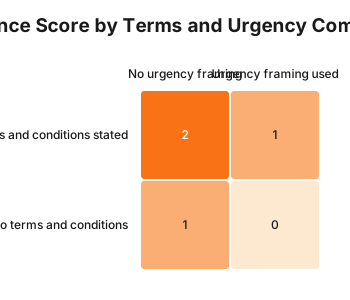
The scale runs from 0 to 2, one point for each rule satisfied, for a higher risk cosmetic procedure page. Terms stated plus no urgency framing clears both rules. Terms stated plus a countdown or expiry banner clears section 133 and fails the duty-of-care test. Nothing stated plus no urgency clears the duty-of-care test but fails disclosure. Both missing fails both. This is a build judgement against the two rules’ wording, not a published regulator scale.
What That Means for the Build
Split the offer schema from the risk-tier flag. Give every treatment or service record a boolean, something like higherRiskCosmeticProcedure, set once per treatment type rather than per page, so it propagates to every page that treatment appears on. Ahpra’s visual examples material is the reference list for setting it: injectables, thread lifts, PRP, hair transplants and, in dentistry, veneers, plus any other non-surgical cosmetic procedure the guideline covers.
Make the terms field mandatory on every offer block, everywhere. This satisfies section 133, which applies to advertising for any regulated health service, not only higher risk cosmetic ones. An offer component without a populated termsAndConditions field should not be publishable at all.
Gate the urgency styling at the schema level, not the review level. Add an urgencyStyle option to the offer component, covering things like countdownTimer, expiryBanner and scarcityCounter. Where higherRiskCosmeticProcedure is true on the linked treatment record, the CMS should not offer those options at all, rather than allow them and rely on a human reviewer to catch it before publish. A dropdown that simply does not list the option is a stronger control than a style guide nobody reads under deadline.
Keep the plain price list path open. A static price, with no expiry claim and no urgency element, is the lowest-risk pattern and remains fully available for higher risk procedures. Clarity is not what either rule restricts. Pressure is.
Add a publish-time check for genuine expiry. Where an offer does carry a real end date, even on a non-higher-risk page, confirm the date is wired to something real: a calendar entry, a stock count, a practitioner’s actual availability window. A countdown that resets or a date that never arrives moves the problem into the Australian Consumer Law’s misleading conduct provisions, on top of whichever health practitioner rule is in play.
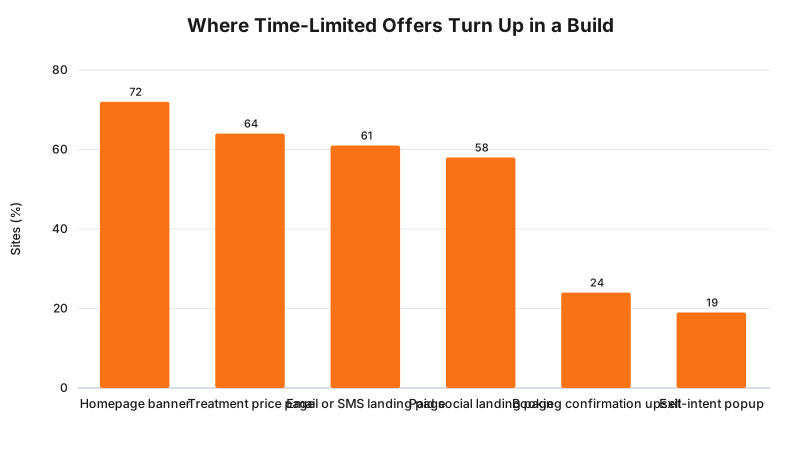
That distribution is a build-experience estimate across clinic sites this team has reviewed, not an audited sample. The shape is the useful part: the two placements furthest from a booking form, the homepage banner and the general landing page, are also where an urgency element is easiest to leave in place without anyone treating it as a treatment-page decision.
Decision Matrix
| Offer element | Procedure risk tier | Section 133 disclosure test | Duty-of-care exploitation test | Build verdict |
|---|---|---|---|---|
| Countdown timer, terms stated, filler pricing page | Higher risk cosmetic | Passes | Fails | Remove the timer |
| ”Offer ends Friday” banner, no terms, general dental cleaning page | Not higher risk cosmetic | Fails | Not engaged | Add a terms field |
| Static price list, no expiry claim, filler pricing page | Higher risk cosmetic | Not applicable, no inducement offered | Passes | Ship as is |
| Scarcity counter not tied to real availability, terms stated, thread lift page | Higher risk cosmetic | Passes disclosure, separate ACL exposure exists | Fails | Remove entirely |
| End-of-financial-year banner, terms stated, general skincare page | Not higher risk cosmetic | Passes | Not engaged | Ship as is |
| ”Book by midnight” banner, terms stated, PRP treatment page | Higher risk cosmetic | Passes | Fails | Remove the banner |
| Referral discount code, 48-hour expiry, cash-back to referrer, injectables page | Higher risk cosmetic | Passes disclosure, separate inducement-ban exposure exists | Fails | Remove entirely |
The column that decides the outcome is the fourth one, the duty-of-care test. Three of the seven rows pass section 133’s disclosure requirement outright and still get removed, because disclosure was never the problem for them.
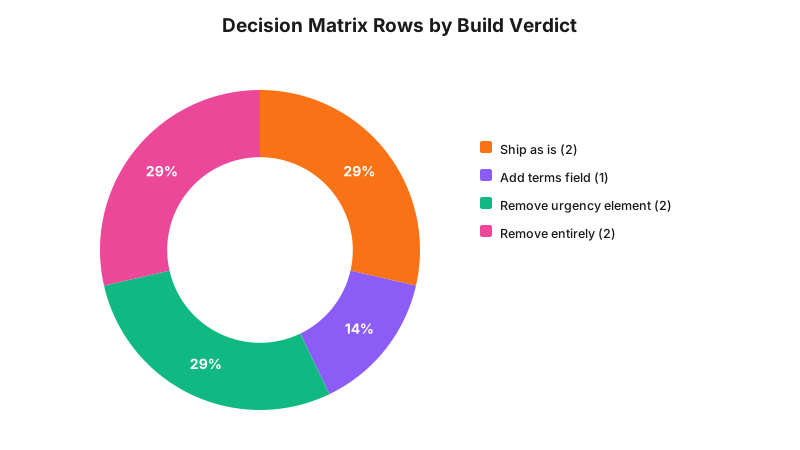
Two of the seven example rows needed nothing. One needed a single missing field added. Four needed the offer element removed rather than repaired, because the fault sits in a conduct rule that no amount of extra disclosure text can satisfy.
A Worked Example
A cosmetic clinic ran a filler and anti-wrinkle promotion page carrying a countdown timer set to expire every Sunday at midnight and reset on Monday, with terms and conditions listed in a footer link stating the discount percentage, eligible treatments and the expiry rule itself. Read narrowly, the page satisfied section 133: the terms were there, and the offer genuinely did reset each week rather than faking urgency against a fixed date.
That satisfied the wrong rule. Filler and anti-wrinkle injections sit inside the higher risk non-surgical cosmetic procedure category Ahpra’s visual examples material names directly. A weekly-resetting countdown timer is, by design, a mechanic whose entire purpose is to make a viewer decide before the clock runs out. That is urgency applied to a cosmetic procedure decision, which is the exact behaviour the duty-of-care and anti-exploitation wording targets, independent of whether the terms and conditions link exists.
The rebuild kept the discount and the terms and conditions link, since neither was the problem. It removed the timer and the weekly-reset framing entirely, replacing the banner with a static line stating the current price and that it was a standing offer, no urgency styling, no reset behaviour. Bookings from the promotion page dropped in the first fortnight and recovered within six weeks, once organic and referral traffic, which had never depended on the countdown, made up the difference.
What to Check on Your Own Site
- List every treatment or service page carrying a time-limited offer, a discount banner or a countdown element.
- For each one, check whether the underlying treatment is a higher risk non-surgical cosmetic procedure under Ahpra’s visual examples list.
- Where it is, check for urgency styling: a countdown, an expiry banner, a scarcity counter, a flashing “ends today” label. Its presence is the issue, not whether terms and conditions sit nearby.
- Where it is not a higher risk procedure, confirm the terms and conditions are stated on the same page as the offer, satisfying section 133 on its own.
- For any offer with a real end date, confirm the date is tied to something genuine rather than a script that quietly resets it.
- Check your CMS: can an editor currently attach a countdown component to a higher risk treatment page without any system-level warning or block?
The Enforcement Anchor
Ahpra’s guidelines state plainly that National Boards and Ahpra can act through Board disciplinary processes where a practitioner’s conduct is considered unsatisfactory, and through prosecution of advertising breaches via the court system where prosecution guidelines are met. The guidelines also note that a serious breach of professional expectations may amount to a contravention of section 133, which carries a maximum penalty of $60,000 for an individual and $120,000 for a body corporate per offence under the current National Law text.
There is no published Australian determination or court decision that turns specifically on a time-limited offer or a countdown timer applied to a cosmetic procedure page. The obligation wording is direct and on the record. The case law testing this specific combination of a disclosed offer and a duty-of-care breach is not there yet, and it would be wrong to imply otherwise.
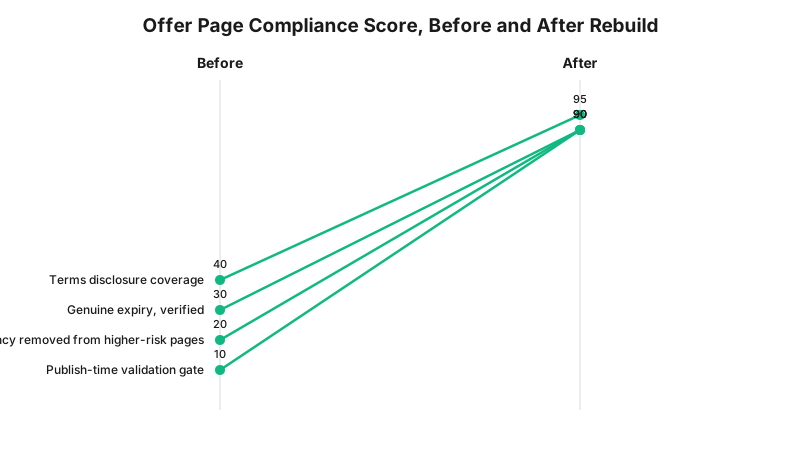
These are build-judgement scores against the two rules discussed above, not a regulator’s audit. The lowest starting point, a publish-time validation gate, is also the cheapest fix: a schema change that removes the option rather than a training exercise that asks people to remember not to use it.
Where This Gets Hard
The genuinely hard part is telling a real time constraint apart from urgency manufactured to sell. A practitioner with a two-week locum window has a real reason to advertise availability as limited. A discount that resets every Sunday, whether or not it is technically true each time, reads to most people as the second thing rather than the first, and neither rule draws a bright line between a legitimate capacity constraint and a marketing pattern dressed up as one.
The regulator says higher risk cosmetic procedures must not be advertised in a way that exploits vulnerabilities or insecurities to increase demand; the build consequence is that urgency styling comes off higher risk treatment and offer pages regardless of whether the terms and conditions are disclosed; whether a specific time-limited offer on your site crosses that line is a question for your medical defence organisation or your lawyer.
Status
Both rules are in force, not proposals, as at 10 September 2026. Section 133’s disclosure requirement has applied for years and predates the 2025 cosmetic guidelines. The advertising guideline’s anti-exploitation and duty-of-care wording has applied since 2 September 2025. Neither has a pending commencement date or a consultation stage still open.
Frequently Asked Questions
Does adding terms and conditions make an “offer ends Friday” banner compliant?
It satisfies one of two separate rules. Section 133 of the National Law requires an advertisement offering a gift, discount or other inducement to state its terms and conditions, and a genuine expiry date is exactly the kind of term that clause expects. It does nothing for the advertising guideline’s separate rule that higher risk cosmetic procedures must not be advertised in a way that exploits vulnerabilities or insecurities to increase demand, which is a conduct test unrelated to disclosure. A fully disclosed countdown timer on a filler page can still fail that second test.
Can a cosmetic clinic run a genuine time-limited offer at all?
Yes. Section 133 permits a disclosed, genuinely time-limited offer for any regulated health service. The added exposure sits specifically with higher risk non-surgical cosmetic procedures, where the separate advertising guideline treats urgency framing as a demand-increasing mechanic regardless of disclosure. A time-limited offer on a general, non-cosmetic service page does not carry that second exposure.
Does the exploiting-vulnerabilities rule apply to every clinic discount, or only higher risk cosmetic procedures?
Only higher risk non-surgical cosmetic procedures, as named in Ahpra’s visual examples material, which lists injectables, thread lifts, PRP and dermal treatments, and in dentistry, veneers. A time-limited offer for a routine dental clean or a general skin consultation sits outside that guideline’s scope, though section 133’s disclosure requirement still applies, because it covers advertising for any regulated health service.
What happens if the countdown timer or “limited spots” claim is not real?
That is a third exposure, under the Australian Consumer Law rather than either health practitioner rule. A countdown or scarcity claim not tied to genuine availability is capable of misleading or deceptive conduct no matter how the health practitioner rules are handled, so a fake urgency mechanic can fail on three fronts at once.
Get Your Offer Pages Checked
Get in touch with RockingWeb to list every time-limited offer, countdown and discount banner on your site against both rules and flag which ones need a terms field, which need the urgency element removed, and which are already fine.
For the deposit-page and countdown patterns this piece builds on, see the companion post on deposit pages and inducement. For how a mandatory under-18 cooling-off interval interacts with a booking flow, see building a booking flow for the 7-day under-18 cooling-off.
Sources
- AHPRA - Guidelines for advertising higher risk non-surgical cosmetic procedures, in effect from 2 September 2025, exploitation of vulnerabilities and duty-of-care obligations. Checked 10 August 2026.
- AHPRA - Visual examples information sheet naming procedures in scope, including veneers. Checked 10 August 2026.
- Queensland Legislation - Health Practitioner Regulation National Law Act 2009, current as at 10 April 2026: section 133, gift, discount or inducement disclosure requirement, $60,000 (individual) and $120,000 (body corporate) maximum penalty.
- ACCC - Misleading or deceptive conduct, section 18 Australian Consumer Law, referenced for the fake-urgency exposure noted above. Checked 10 August 2026.
Last reviewed: 10 September 2026.
Vikas Thakur
Founder of RockingWeb. 16 years of experience from working at TPG, iiNet and Monadelphous, now building websites, software and digital marketing for local businesses in Rockingham and Perth.