Deposit Pages and Inducement: Where a Clinic Offer Crosses the Line
AHPRA's advertising guidelines say higher risk cosmetic procedures must not be advertised in a way that exploits vulnerabilities or insecurities to increase demand. A countdown timer on a deposit page is a build decision that runs straight at that rule.
 Vikas Thakur Founder, RockingWeb 8 min read
Key Takeaways
- The guidelines state higher risk cosmetic procedures must not be advertised in a way that exploits the vulnerabilities or insecurities of individuals to increase demand
- Practitioners must recognise strong demand from people who may be experiencing psychological conditions, including body dysmorphic disorder, and must not advertise in a way that targets or drives demand from them
- Practitioners must recognise the potential for conflict between financial gain and duty of care. A deposit page is where that conflict becomes a build decision
- Countdown timers, scarcity counters and expiring discounts are the elements that convert a price page into an inducement
- The guidelines bind corporate entities, not only practitioners, so a marketing decision made at company level is in scope
- In force since 2 September 2025
A deposit page is where a clinic’s marketing stack meets its clinical obligations, and most deposit pages were built by someone who only had the first half of that sentence in mind. The conversion patterns that work everywhere else, urgency, scarcity, an expiring discount, are the exact patterns the advertising guidelines describe as problems.
What the Guidelines Say
AHPRA’s guidelines for advertising higher risk non-surgical cosmetic procedures, date of issue 2 September 2025, set out obligations under the heading of practitioner responsibility. Three are directly relevant to how a deposit or offer page is built.
Higher risk cosmetic procedures must not be advertised in a way that exploits the vulnerabilities or insecurities of individuals to increase demand for procedures, and a practitioner’s duty of care to their patient is the paramount consideration in all practitioner-patient interactions, including through advertising.
Registered health practitioners must recognise that there is strong demand from people who may be experiencing psychological conditions, such as body dysmorphic disorder, and must recognise the potential harm to such individuals. Procedures must not be advertised in a way that targets or drives demand from such individuals.
Registered health practitioners must recognise the potential for conflict between financial gain and their duty of care to patients, and must recognise that these procedures may have a negative physical, psychological or financial impact on some patients regardless of the practitioner’s skill.
Read those three together and a design principle falls out: any element whose purpose is to make someone decide faster than they otherwise would is running against the guideline.
The Elements That Cause the Problem
| Element | Why it exists | Guideline tension |
|---|---|---|
| Countdown timer | Manufacture urgency | Pressures a clinical decision |
| ”Only 3 spots left” | Manufacture scarcity | Same, plus often untrue |
| Discount expiring today | Accelerate commitment | Financial gain over duty of care |
| Prepaid multi-treatment package | Lock in revenue | Commits before assessment |
| ”Before and after” next to price | Sell the outcome | Outcome claim plus inducement |
| Exit-intent discount popup | Recover abandonment | Targets hesitation directly |
The last row deserves attention because it is the most defensible commercially and the least defensible clinically. An exit-intent offer fires precisely when someone has decided not to proceed. Applying a financial incentive at that moment is, by design, an attempt to override hesitation about a clinical procedure.
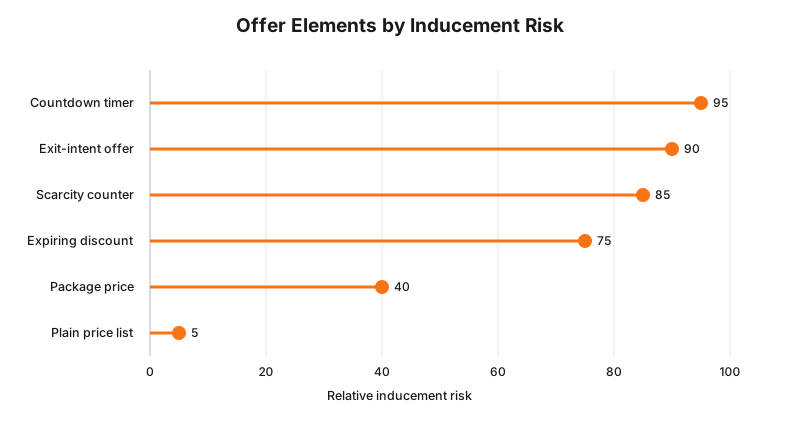
This ranking is a build judgement against the guideline wording, not a regulator’s scale. No official risk ranking of web elements exists, which is precisely why a clinic has to reason from the wording.
What That Means for the Build
State the price, plainly. A price list with no urgency framing is the lowest-risk pattern and remains entirely permitted. Clarity is not the enemy here; pressure is.
Make the deposit page a transaction page. It should say what the deposit is, what it secures, whether it is refundable and under what conditions, and nothing else. No timer, no counter, no discount.
Put the consultation before the payment. A deposit taken before any clinical assessment structurally puts the financial commitment ahead of the duty of care. Sequencing the consultation first resolves most of the tension without costing a booking.
Remove exit-intent offers from treatment and booking paths entirely. Keep them on non-clinical pages if you want them at all.
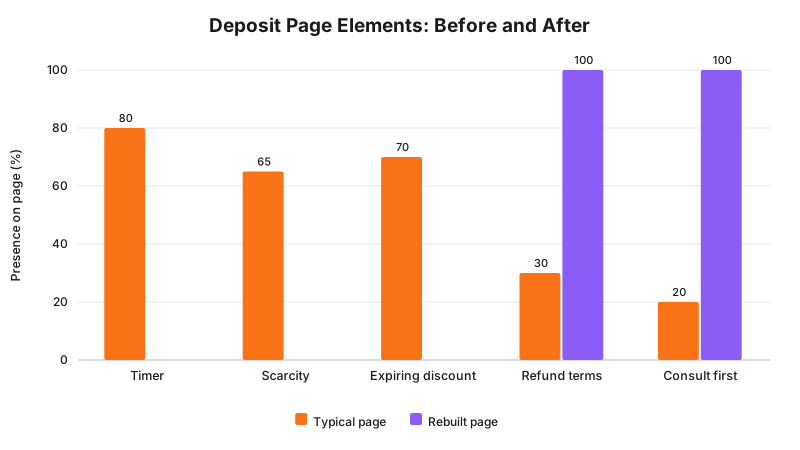
The typical row is a build-experience estimate of what clinic deposit pages contain, not an audited sample. The rebuilt row is the target state.
A Worked Example
Cosmetic clinic. A deposit page charged $99 to hold an appointment, with a banner reading “Offer ends midnight” and a live counter claiming three remaining places that reset each day. The counter was not connected to actual availability, which adds a misleading conduct problem under the Australian Consumer Law to the advertising one.
The rebuild removed the timer and counter, restated the deposit as a booking fee with written refund terms, and moved the payment step to after the consultation for new patients. Bookings dropped slightly. Consultation attendance rose, and the no-show rate fell, because the people booking had decided rather than been pressured.
Dental practice. A veneers page paired a package price with a before-and-after gallery and a “this month only” saving. Veneers are named in AHPRA’s visual examples material as a procedure in scope. The gallery and the time-limited saving both came off; the package price stayed, restated as a standard fee for a defined scope of work.
What to Check on Your Own Site
- Load every treatment and booking page and note any timer, counter or expiring offer.
- Check whether any scarcity claim is connected to real availability. If not, that is a separate consumer law problem.
- Trigger your exit-intent popups by moving the cursor to the address bar. Note which pages fire an offer.
- Check whether a deposit can be paid before any consultation occurs.
- Read your deposit refund terms as a patient would. Are they on the page, or in a linked PDF nobody opens?
- Check paid social creative, which often carries urgency language the website no longer does.
The Enforcement Anchor
AHPRA’s guidelines state that National Boards and Ahpra can act through Board disciplinary processes where a practitioner’s conduct is considered unsatisfactory, and through prosecution of advertising breaches via the court system where prosecution guidelines are met. The guidelines also note that serious breaches of professional expectations may amount to a contravention of section 133.
There is no published Australian decision we can point to that turns specifically on a countdown timer on a clinic deposit page. The obligation wording is on the record and is unusually direct; the case law is not there yet.
Where This Gets Hard
The honest difficulty is that these elements work. Removing them costs conversions in the short term, and a clinic owner watching an unregulated competitor run the same tactics will feel that acutely. The counter-argument is not that compliance is free, it is that the patients who convert under pressure are also the patients most likely to complain, request a refund, or present poorly for the procedure.
The regulator says higher risk cosmetic procedures must not be advertised in a way that exploits vulnerabilities or insecurities to increase demand; the build consequence is that urgency and scarcity mechanics come off treatment and booking pages; whether a specific offer crosses the line in your circumstances is a question for your medical defence organisation or your lawyer.
Status
In force since 2 September 2025. These are the current advertising guidelines. Separately, the Competition and Consumer Amendment (Unfair Trading Practices) provisions dealing with drip pricing and similar practices have their own later commencement and are not the basis for anything stated above.
Frequently Asked Questions
Can a cosmetic clinic take a deposit online at all?
Taking a deposit is not itself prohibited. What the advertising guidelines restrict is how the offer around it is presented. A deposit page that states a price, what the deposit secures, and the refund terms is a transaction. A deposit page built around scarcity pressure, a countdown, or a discount that expires is an offer designed to increase demand, and that is where the guidelines bite.
Are countdown timers banned on clinic websites?
No rule names countdown timers. The guidelines say higher risk cosmetic procedures must not be advertised in a way that exploits the vulnerabilities or insecurities of individuals to increase demand. A countdown timer exists to create urgency, and urgency applied to a clinical decision is difficult to defend against that wording, which is why it is the first element to remove.
Does the inducement problem apply to dental practices too?
The advertising guidelines cover higher risk non-surgical cosmetic procedures, and AHPRA’s own visual examples material names dental veneers among the procedures in scope. So a veneers offer page is subject to the same reasoning as a filler offer page, while a routine check-up promotion is a different question.
Is a package or course-of-treatment price an inducement?
Not inherently. A package price is a pricing structure. It becomes a problem when it is presented as a limited-time saving that pressures a decision, when it bundles a clinical assessment into a prepaid commitment, or when the structure makes it hard for a patient to stop partway through.
Get Your Offer Pages Reviewed
Hire RockingWeb to review every urgency, scarcity and offer element on your site and flag which ones sit on treatment or booking paths.
Sources
- AHPRA - Guidelines for advertising higher risk non-surgical cosmetic procedures, date of issue 2 September 2025, practitioner responsibility obligations. Checked 10 August 2026.
- AHPRA - Visual examples information sheet naming procedures in scope. Checked 10 August 2026.
- ACCC - Misleading or deceptive conduct, section 18 Australian Consumer Law. Checked 10 August 2026.
Last reviewed: 10 August 2026.
Vikas Thakur
Founder of RockingWeb. 16 years building for companies like TPG, iiNet and Monadelphous, now focused on websites and marketing that comply with AHPRA's advertising guidelines and still book patients.