Naming Botox on Your Website: The $18.2m TGA Rule
Under section 42DLB(7) of the Therapeutic Goods Act 1989, naming a Schedule 4 substance like Botox to the public is a civil penalty offence. Here is the exact rule, what to write instead, and what it costs to get it wrong.
 Vikas Thakur Founder, RockingWeb 13 min read
On this page 13
- Key takeaways
- The short answer
- What the Act actually says
- What that means for the build
- Decision matrix: what can and cannot appear on the page
- Worked example: a Rockingham cosmetic clinic
- What to check on your own site right now
- Has the TGA actually enforced this?
- Where this gets hard
- Status: in force now
- Frequently Asked Questions
- Need a hand with your website?
- Sources and references
You cannot write “Botox” on a clinic website and advertise it to the public. That has been the rule since section 42DLB(7) of the Therapeutic Goods Act 1989 (Cth) made it a civil penalty offence to advertise a Schedule 3, 4 or 8 substance to consumers, and botulinum toxin brands sit in Schedule 4 of the Poisons Standard. The maximum penalty scales with the Commonwealth penalty unit, currently $364 as of 1 July 2026, which puts the ceiling for a body corporate at roughly $18.2 million.
Key takeaways
- Section 42DLB(7) of the Therapeutic Goods Act 1989 bans advertising a substance in Schedule 3, 4 or 8 of the Poisons Standard to the public. Botulinum toxin type A is Schedule 4.
- Botox, Dysport, Azzalure and Xeomin are all covered by the same rule. It is not a Botox-specific ban, it is a substance-class ban.
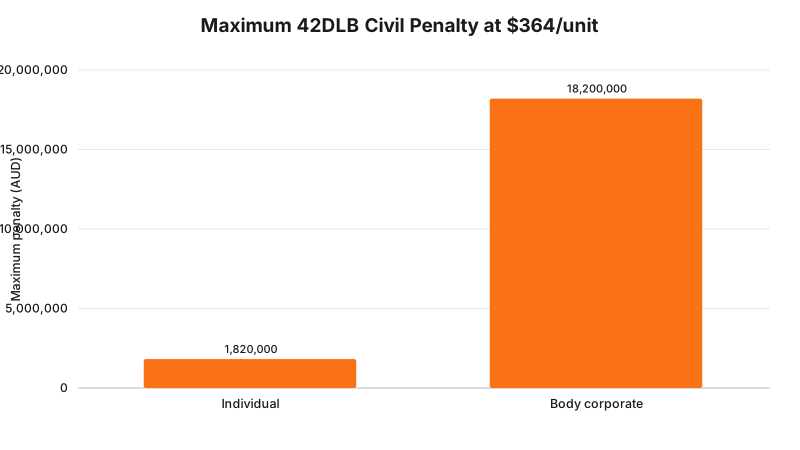
- Maximum civil penalties under section 42DLB run to 5,000 penalty units for an individual and 50,000 for a body corporate, per health-law commentary on the section.
- At the current $364 penalty unit (from 1 July 2026), that maximum works out to roughly $1.82 million for an individual and $18.2 million for a body corporate.
- Health-law reporting on the TGA’s updated advertising guidance says coded references, abbreviations and hashtags for a Schedule 4 substance are treated the same as the brand name.
- The generic, non-brand description “botulinum toxin type A” or “anti-wrinkle injections” is the commonly used workaround, though it is industry practice rather than an explicit statutory safe harbour.
- The TGA’s own consultation on the Advertising Code, which closed 3 September 2026, presented options only and did not commit to any change to this rule.
- No TGA enforcement action naming a specific cosmetic clinic for brand-naming a botulinum toxin product on a website could be independently confirmed for this piece. The closest documented precedent is a $10 million Federal Court penalty against Peptide Clinics Australia for advertising a Schedule 4 substance to the public.
The short answer
If your website copy says “we offer Botox” instead of “we offer anti-wrinkle injections” or “botulinum toxin type A treatments,” you are running a page that a lawyer would call an advertisement referring to a Schedule 4 substance, and section 42DLB(7) of the Therapeutic Goods Act 1989 makes that a civil penalty matter. This applies whether the words sit in body copy, a treatment menu, a meta description, alt text, or a hashtag. It applies to Dysport, Azzalure and Xeomin exactly the same way it applies to Botox, because the rule is about the substance schedule, not the brand.
What the Act actually says
The operative test lives in section 42DLB of the Therapeutic Goods Act 1989 (Cth), the current compilation of which is on the Federal Register of Legislation. Health-law firm Sydney Health Law and telehealth-focused firm Law Quarter both report the operative subsection in the same terms: subsection 42DLB(7) applies to an advertisement “if it refers to substances, or goods containing substances, included in Schedule 3, 4 or 8 to the current Poisons Standard but not in Appendix H.” Botulinum toxin type A is a Schedule 4 substance under the Poisons Standard, so a website reference to it, or to a brand product containing it, falls squarely inside that test.
The same two sources report that section 42DLB is a civil penalty provision, with a maximum of 5,000 penalty units for an individual and 50,000 penalty units for a body corporate. We could not independently confirm those exact unit counts against the primary legislative text ourselves, since the compiled Act runs to hundreds of pages and the section-level view on AustLII returned an access error when we tried to fetch it directly. Two independent legal sources agreeing on the same figures is reasonable grounds to report them, with that caveat attached.
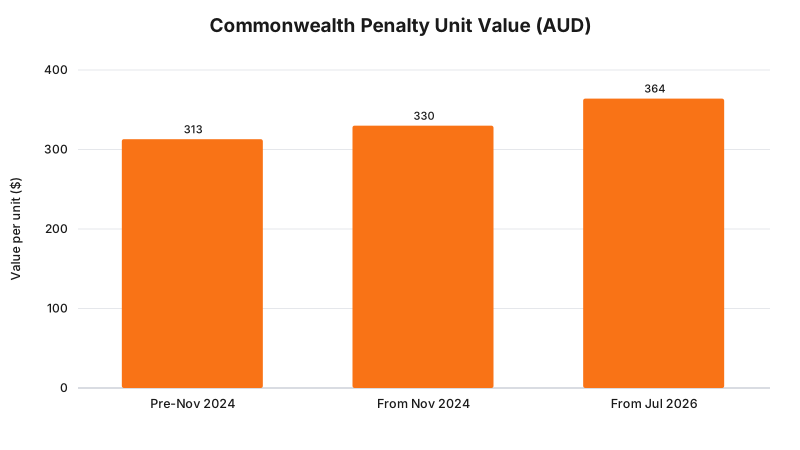
What we could verify directly is the dollar value of a penalty unit. The Commonwealth penalty unit is set under section 4AA of the Crimes Act 1914 and has moved three times recently: $313, then $330 from 7 November 2024, then $364 from 1 July 2026 under the section 4AA indexation formula. Older blog posts quoting “$1.565 million” and “$15.65 million” for the 42DLB maximums are using the $313 rate. At the current $364 rate, the same unit counts work out to roughly $1.82 million for an individual and $18.2 million for a body corporate.
What that means for the build
For a developer or practice manager working on the actual site, this comes down to a find-and-replace exercise across every place a treatment name can leak into public-facing text.
- Body copy and treatment menus. Search the CMS for “Botox,” “Dysport,” “Azzalure,” “Xeomin,” and any other brand name your clinic stocks. Replace with “anti-wrinkle injections” or “botulinum toxin type A treatment” in anything visible to a visitor who has not logged in or been screened as a health professional.
- Meta titles and descriptions. A page
<title>or meta description that says “Botox Rockingham | [Clinic Name]” is still an advertisement to the public, arguably a more prominent one, since it appears in search results before the visitor even lands on the page. - Image alt text and file names.
botox-before-after.jpgandalt="Botox injection Perth"are text, and text is what the test looks at. Rename files and rewrite alt attributes to the generic term. - Structured data and schema markup. If you are marking up a
MedicalProcedureorServiceschema with the brand name in thenamefield, that field renders in rich results. Use the generic term there too. - Hashtags and social captions synced to the site. If your website pulls in an Instagram feed or a social proof widget, a caption reading “#BTX results” imports the same risk onto your own domain. Health-law commentary on the TGA’s updated guidance is explicit that coded or abbreviated references get the same treatment as the brand name itself, so filter these out of any embedded feed.
- Booking widget treatment lists. Practice management platforms often let staff type a free-text treatment name into a booking form that then renders publicly. Audit the dropdown labels, not just the marketing pages.
Decision matrix: what can and cannot appear on the page
| What the page says | Names a scheduled substance? | Commonly treated as compliant? | Why |
|---|---|---|---|
| ”Botox” | Yes, Schedule 4 | No | Names a specific Schedule 4 product to the public |
| ”Dysport,” “Azzalure,” “Xeomin” | Yes, Schedule 4 | No | Same test applies to every Schedule 4 brand, not only Botox |
| ”Botulinum toxin type A” | Names the substance class, generically | Common industry practice | Describes the ingredient class rather than a specific branded product |
| ”Anti-wrinkle injections” / “wrinkle relaxer treatment” | No substance named | Widely used | Describes the outcome and procedure, not the product |
| ”#BTX” or a stylised brand reference | Yes, if identifiable | No | Reported as treated the same as naming the product outright |
Worked example: a Rockingham cosmetic clinic
Imagine a clinic in Rockingham, WA, that has just added anti-wrinkle treatments to its service list. The original page copy reads: “Book your Botox appointment today, from $12 per unit.” That single sentence contains a Schedule 4 brand name, a supply-adjacent claim (“book your appointment”), and a price, all directed at the public on an indexable page.
The build fix keeps the same commercial intent while removing the substance name: “Book your anti-wrinkle injection consultation today. Ask our team about pricing.” The price-per-unit detail moves to a private, gated PDF or an in-clinic conversation rather than the public page, since discussing exact dosage-based pricing publicly raises separate advertising issues under the same Code. The treatment category page, the booking widget dropdown, the meta title, and the Instagram feed embed all get the same generic-term pass.
What to check on your own site right now
- Search your CMS for every Schedule 4 injectable brand name your clinic stocks: Botox, Dysport, Azzalure, Xeomin, and any dermal filler brand names too, since fillers carry their own separate rules.
- Check page
<title>tags and meta descriptions specifically. These are easy to miss because they do not show in the visual page editor. - Check image file names and alt text, not just body copy.
- Check any embedded social feed, review widget, or testimonial carousel for brand names arriving from a source you do not directly control.
- Check booking platform treatment labels and confirmation emails, since these are also “advertisements” if they promote the goods to the public.
- Check structured data (
name,descriptionfields inMedicalProcedureorServiceschema).
Has the TGA actually enforced this?
We looked for a specific enforcement action against a cosmetic clinic for brand-naming a botulinum toxin product on a website and could not independently confirm one for this piece. The clearest example we could verify of the underlying rule being enforced, reported by Sydney Health Law, is Secretary, Department of Health v Peptide Clinics Australia Pty Ltd (2019 proceedings), which resulted in a $10 million Federal Court penalty for advertising and supplying Schedule 4 substances to the public through a website and social media. That case involved peptides rather than botulinum toxin, but it turned on the same statutory question: was a Schedule 3, 4 or 8 substance advertised directly to consumers.
The TGA also issued 45 infringement notices totalling $742,500 against InstantScripts Pty Ltd for advertising prescription-only medicines through its telehealth service. Worth reporting honestly: those notices were later withdrawn as part of a Federal Court settlement, under which InstantScripts agreed not to materially change its service until the TGA published further guidance. That outcome is a reminder that an infringement notice is not the same as a final, tested penalty, and that the TGA’s own guidance in this space has been actively moving.
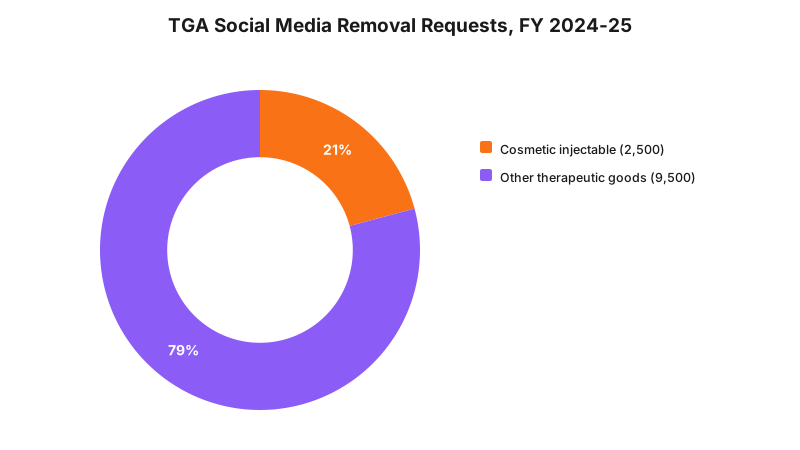
The chart above uses the TGA’s own reported figures for one financial year: over 12,000 social media advertising removal requests in total, of which more than 2,500 related specifically to cosmetic injectable products. The exact totals are minimums as reported (“over,” “more than”), so treat the split as directional rather than a precise percentage.
Takeaway: the enforcement record shows the TGA is actively removing cosmetic injectable content at volume, even without a headline case naming a specific clinic for brand-naming Botox on a website.Where this gets hard
The generic-term workaround, using “botulinum toxin type A” instead of “Botox,” is reported industry practice, not a line item written into the Act as an explicit exemption. Reasonable, careful clinics use it, and the health-law commentary we reviewed treats it as the accepted approach. But nothing in what we could verify guarantees that every generic phrasing is automatically safe in every context, particularly where the surrounding copy still makes the product identifiable (for example, describing dosing or packaging details specific to one brand). Whether a specific page on your specific site crosses the line is a question of applying a statutory test to real facts, and that is a job for your medical defence organisation or your lawyer, not a blog post.
There is also a live regulatory process that could change the settings entirely. The TGA ran a consultation titled “Improvements to the Therapeutic Goods Advertising Code,” which closed for submissions on 3 September 2026. The consultation paper explicitly presented options rather than a preferred position, so nothing about the current naming rule should be treated as locked in for the long term. A generic-term approach that is defensible today could need revisiting once that process produces an outcome.
Separately, if you are a registered health practitioner performing the procedure (not just running the website), you also sit under AHPRA’s advertising guidelines, which is a different regulatory layer to the product-naming rule covered here. Registered health practitioners other than medical practitioners moved to a single consolidated set of AHPRA guidelines from 2 September 2025; medical practitioners remain under the Medical Board’s separate 2023 cosmetic procedure guidelines. Getting the TGA product-naming rule right does not automatically mean the practitioner-conduct rules are satisfied too. They are separate obligations, checked separately.
Status: in force now
Section 42DLB of the Therapeutic Goods Act 1989 is enacted, in force Commonwealth law, not a proposal and not something “coming into effect” on a future date. It applies today, and it will keep applying after the Advertising Code consultation closes, unless and until Parliament or the TGA changes the underlying settings.
If your clinic’s website currently names Botox, Dysport, Azzalure or any other Schedule 4 injectable brand on a public page, that is a live compliance gap today, not a future one. A site rebuild or a content audit is one place to start; get your development team to run the checklist above before your next content refresh, and if you would rather have a second set of eyes on the build itself, our team at RockingWeb can be reached through the RockingWeb client portal.
Frequently Asked Questions
Can I name Botox on my clinic website in Australia?
No. Section 42DLB(7) of the Therapeutic Goods Act 1989 makes it a civil penalty offence to advertise a substance included in Schedule 3, 4 or 8 of the Poisons Standard to the public, and botulinum toxin brands including Botox, Dysport and Azzalure sit in Schedule 4. Use a generic term such as “botulinum toxin type A” or “anti-wrinkle injections” instead.
What is the actual penalty for naming a Schedule 4 medicine in an ad?
Civil penalties under section 42DLB run up to 5,000 penalty units for an individual and 50,000 penalty units for a body corporate. At the Commonwealth penalty unit value of $364 (current from 1 July 2026), that is roughly $1.82 million and $18.2 million respectively, though the unit count comes from health-law commentary rather than a figure we independently verified in the primary text.
Can I use a hashtag or abbreviation like #BTX instead of the brand name?
Health-law firms reporting on the TGA’s updated advertising guidance say no. Coded, abbreviated or implied references to a Schedule 4 substance are treated the same as naming it outright, so a hashtag workaround does not change the risk.
Need a hand with your website?
If you want a second pair of eyes on how this applies to your own site, request a callback and we will talk it through.
Sources and references
- Therapeutic Goods Act 1989 (Cth), current compilation, Federal Register of Legislation: legislation.gov.au/C2004A03952. Date checked: 15 August 2026.
- Sydney Health Law, “A small injection of strictness: The TGA’s clampdown on cosmetic injectables advertising” (12 May 2024): sydneyhealthlaw.com. Date checked: 15 August 2026.
- Law Quarter, “Telehealth Providers Beware: TGA Cracks Down on Prescription Drug Advertising”: lawquarter.com.au. Date checked: 15 August 2026.
- Therapeutic Goods Administration, “WITHDRAWN - InstantScripts Pty Ltd fined $742,500 for alleged unlawful advertising of therapeutic goods”: tga.gov.au. Located via search 15 August 2026; TGA’s own domain blocks automated content fetching, so only the published title and headline outcome are reported here.
- Gavin Ma & Co, “Commonwealth Penalty Unit Increase from 1 July 2026”: gavinmaandco.com.au. Date checked: 15 August 2026.
- TGA consultation, “Improvements to the Therapeutic Goods Advertising Code,” closed 3 September 2026: consultations.tga.gov.au. Date checked: 15 August 2026.
- Ahpra, “New guidelines for cosmetic procedures” (2 September 2025): ahpra.gov.au. Date checked: 15 August 2026.
Last reviewed: 15 August 2026.
Vikas Thakur
Founder of RockingWeb. 16 years of experience from working at TPG, iiNet and Monadelphous, now building websites, software and digital marketing for local businesses in Rockingham and Perth.