Since 2 Sept 2025, Your Risk Statement Can't Hide
AHPRA's advertising guideline for higher risk non-surgical cosmetic procedures has applied since 2 September 2025. Here is what the rule requires and how to mark up a risk statement that survives an audit.
 Vikas Thakur Founder, RockingWeb 12 min read
On this page 11
- What AHPRA’s Advertising Guideline Requires
- Turning “Prominent” Into Markup
- Which Pages Need the Risk Statement
- Two Worked Examples
- Audit Checklist For Your Own Site
- Does AHPRA Enforce This Rule?
- Where This Gets Hard
- Is This Rule In Force Right Now?
- Frequently Asked Questions
- Building This Into Your Site
- Sources and References
Picture your injectables landing page today. The headline promises a fresher look by Friday, the before and after gallery does the selling, and the risk statement AHPRA now requires sits in nine point type at the very bottom of the page, under the footer links nobody clicks. That single placement choice is the difference between a page that meets AHPRA’s advertising rule and one that does not. Here is what the rule requires, what “prominent” means once you turn it into HTML, and how to check whether your own site clears the bar.
Since 2 September 2025, AHPRA’s advertising guideline requires a risk statement on every Australian ad for higher risk non-surgical cosmetic procedures.
Key facts for this rule:
- AHPRA’s Guidelines for advertising higher risk non-surgical cosmetic procedures has applied to every ad for a named higher risk procedure since 2 September 2025.
- The guideline’s own visual examples resource names five procedure types: veneers, injectables, thread lifts, PRP and hair transplants.
- A separate, single performance guideline covers every registered health practitioner except medical practitioners, who stay under the Medical Board’s 2023 cosmetic guidelines instead.
- The advertising ban on misleading claims and testimonials sits in section 133 of the Health Practitioner Regulation National Law, with maximum penalties commonly cited as $60,000 for an individual and $120,000 for a body corporate.
- AHPRA investigated about 360 notifications about non-surgical cosmetic procedures between September 2022 and March 2025, closing around 300, alongside more than 1,500 calls to its cosmetic surgery hotline in the same period.
- The TGA’s Compliance Principles 2026 to 2027, published January 2026, name cosmetic injectables as a stated enforcement priority for the full two year window.
What AHPRA’s Advertising Guideline Requires
AHPRA published the Guidelines for advertising higher risk non-surgical cosmetic procedures as part of a wider reform to its cosmetic surgery hub, and the regulator’s own announcement confirms the guideline came into effect on 2 September 2025 (ahpra.gov.au, 2 September 2025). The guideline sits alongside AHPRA’s visual examples information sheet, which names five procedure categories the rule covers: veneers, injectables, thread lifts, PRP and hair transplants (ahpra.gov.au visual examples resource).
The legal backing for the whole advertising regime sits in section 133 of the Health Practitioner Regulation National Law, the provision that bans misleading claims and testimonials in advertising for a regulated health service (Health Practitioner Regulation National Law, s133, Federal Register of Legislation). Maximum penalties are commonly cited as $60,000 for an individual and $120,000 for a body corporate, matching the National Law maxima. Some marketing blogs quote lower figures of $30,000 and $60,000, so check the current legislation for your state’s adoption of the National Law rather than repeating a figure from a secondary source.
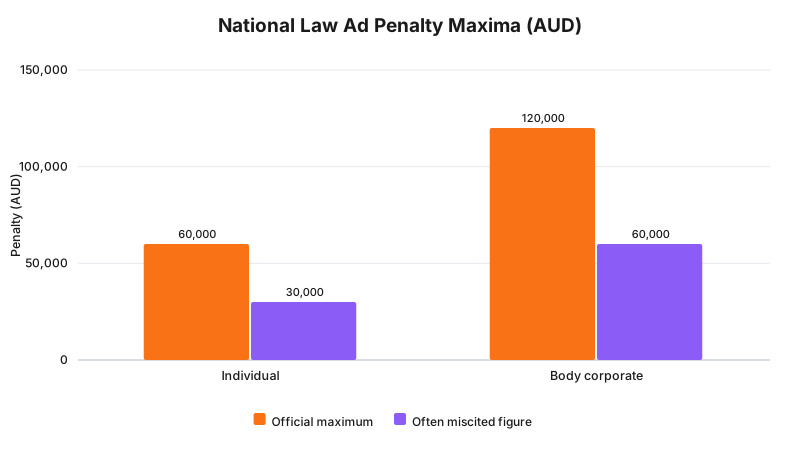
Figures per the Health Practitioner Regulation National Law s133 maxima. Lower figures circulate in secondary sources and should not be treated as current without checking the legislation.
A separate but related guideline governs who can perform these procedures rather than how they are advertised. That performance guideline, the Guidelines for registered health practitioners who perform non-surgical cosmetic procedures, applies to every registered health practitioner except medical practitioners, who remain under the Medical Board’s own 2023 cosmetic guidelines instead (ahpra.gov.au, 2 September 2025). That performance guideline answers a different question: who is allowed to perform the procedure and how they must obtain consent, not what has to appear in an ad. Do not conflate the two documents when you work out which risk statement applies to a page, and check with your medical defence organisation which practitioner type rules apply to your business.
Takeaway: the advertising rule and the performance rule are two separate documents with two separate scopes, and only the advertising one governs what sits on your page.
Turning “Prominent” Into Markup
AHPRA’s guideline does not ship a CSS spec. Like most Australian advertising rules, it sets a standard, prominent and impossible to miss, and leaves the mechanics to the business publishing the ad. In practice that standard works the way it does everywhere else regulators use it: an investigator asks whether an ordinary reader would see the statement in the normal course of reading the ad, not whether it exists somewhere in the page source.
That test has direct build consequences.
- Render the risk statement as real text in the page’s HTML, not as an image, an SVG, or text baked into a background graphic. Screen readers, search crawlers and anyone browsing with images disabled all need to reach it the same way they reach the price.
- Place it in the same viewport as the claim it qualifies. A risk statement sitting only in the footer of a page that scrolls three or four screens fails the ordinary reader test the moment your analytics show most visitors never scroll that far.
- Do not gate it behind a click, a hover tooltip, or a modal that only opens on request. A statement the reader has to go looking for is not prominent, it is hidden with extra steps.
- Keep it out of a cookie style dismissible banner. Once dismissed, it disappears from the page for that session, and the ordinary reader test applies to what a first time visitor sees, not what remains after someone closes a popup.
- Server render it. If the statement only appears after a JavaScript call finishes, a crawler, a slow connection, or a reader who navigates away in the first second never sees it at all.
- Use a semantic wrapper, a section or aside element with a clear aria-label such as “Procedure risk information”, so assistive technology announces it as a distinct block rather than folding it into surrounding paragraph text.
None of that list is AHPRA’s own wording. It is the same build logic web teams already apply to any consumer protection disclosure, cooling off notice, or terms reference: if a regulator will judge visibility, code for visibility first and decoration second.
Which Pages Need the Risk Statement
| Procedure | Named on AHPRA’s visual examples sheet | Practitioner performance guideline | Needs the advertising risk statement |
|---|---|---|---|
| Anti wrinkle injections | Yes | Non-medical performance guideline, or Medical Board 2023 if a doctor performs it | Yes |
| Dermal filler | Yes | Same split as above | Yes |
| Thread lifts | Yes | Same split as above | Yes |
| PRP (platelet-rich plasma) | Yes | Same split as above | Yes |
| Hair transplants | Yes | Same split as above | Yes |
| Porcelain veneers | Yes | Dental Board of Australia (dentists are not medical practitioners) | Yes |
| Teeth whitening | Not named on the current sheet | Dental Board of Australia | Confirm with your medical defence organisation before assuming it is exempt |
Takeaway: five procedure types are confirmed on AHPRA’s own list. Anything not on that list is a judgment call, not an automatic exemption.
Two Worked Examples
Cosmetic clinic: an anti wrinkle injections landing page. The hero section carries the headline claim and the booking button. Directly underneath the hero, before the pricing table and before the before and after gallery, a visible section holds the risk statement in body sized text:
<section class="procedure-risk" aria-label="Procedure risk information">
  <p>This is a non-surgical cosmetic procedure. Every injectable treatment
  carries risks, and outcomes vary between patients. Discuss your medical
  history and the specific risks that apply to you with your practitioner
  before you book.</p>
</section>
That block sits in the normal document flow, in the same font size as the surrounding copy, above the fold on a typical mobile viewport and before the first pricing figure. It is not inside an accordion, a tab panel, or a component that only renders client side.
Cosmetic dentistry: a porcelain veneers page. The build pattern is identical, only the copy changes:
<section class="procedure-risk" aria-label="Procedure risk information">
  <p>Porcelain veneers are an irreversible cosmetic dental procedure. Your
  dentist will need to remove a small amount of tooth enamel, and outcomes
  vary. Ask about the risks and alternatives specific to your teeth during
  your consultation.</p>
</section>
Both examples use the same placement rule: after the claim, before the price, in real text, in the normal scroll path.
Audit Checklist For Your Own Site
- Search your rendered page for the risk statement text with your browser’s find function. If you cannot find it that way, a reader could not find it either.
- Check whether the text lives inside an image, a downloadable PDF, or a background image div. Any of those is invisible to a crawler and to a screen reader.
- Scroll test the page on an actual phone. If the statement sits below the second scroll, under the booking button, move it up.
- Disable JavaScript in your browser’s dev tools and reload the page. If the risk statement section disappears, it was client rendered and a crawler likely never saw it either.
- Check every landing page and every ad specific page on its own. A statement on your homepage does not cover a Google Ads landing page built from a different template.
- Re-check after any page builder or theme update. Drag and drop builders regularly move blocks or wrap them inside accordions during a redesign, without anyone noticing the risk statement moved with them.
Does AHPRA Enforce This Rule?
A named case of AHPRA disciplining a practitioner specifically over risk statement placement was not available in the sources checked for this piece, and this post will not invent one. What is confirmed is the volume of activity behind the guideline: AHPRA investigated about 360 notifications concerning non-surgical cosmetic procedures between September 2022 and March 2025, closed around 300 of them, and logged more than 1,500 calls to its dedicated cosmetic surgery hotline in the same period (ahpra.gov.au, 3 June 2025).
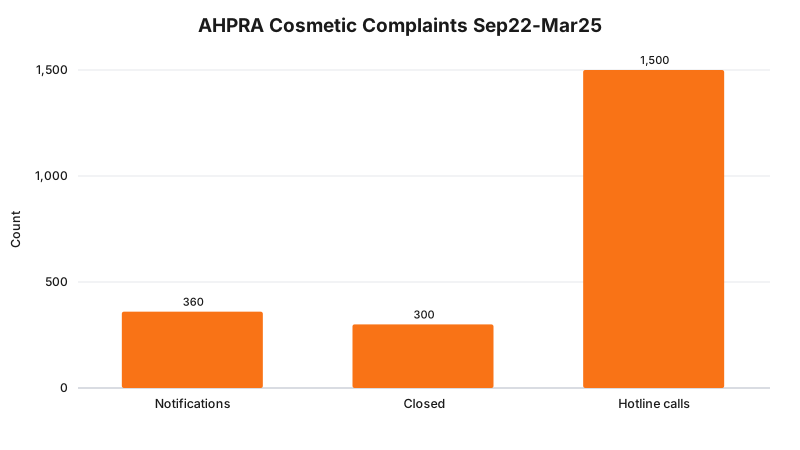
That is the regulator showing, in its own numbers, that this category gets checked regularly. It is not proof of a risk statement specific enforcement action.
The wider enforcement backdrop adds context. The TGA’s Compliance Principles 2026 to 2027, published in January 2026, name cosmetic injectables as a stated priority for the entire two year window. AHPRA and the TGA regulate different things, AHPRA covers practitioner conduct and advertising, the TGA covers the products themselves, but a category flagged as a priority by one regulator tends to draw more scrutiny from the other.
Takeaway: no single infringement notice ties directly to risk statement placement, but the notification and hotline volume shows this procedure category sits under active watch.
Where This Gets Hard
A single practitioner nurse injector site is the easy case. Most real clinics are not that simple. A clinic with both a nurse injector and a cosmetic physician on staff can have two different performance guidelines applying to two different practitioners on the same domain, while the advertising risk statement rule sits on top of both. If a booking system lets a patient choose their practitioner after landing on a generic procedure page, the risk statement may need to persist across every practitioner variant of that page, not just the one your marketing team tested.
Procedures AHPRA has not explicitly named are the second hard case. Teeth whitening, for one example, does not appear on the current visual examples sheet the way veneers do. That does not automatically mean whitening is exempt. It might mean the sheet has not caught up, or the omission is deliberate, and either reading is a judgment call outside what a website audit can answer.
Page builders are the third hard case, and the most common one in practice. A risk statement block built correctly in one release can end up wrapped inside an FAQ accordion by a theme update months later, invisible until a visitor clicks to expand it. Nothing about the code technically breaks. The block still exists in the page. It just no longer meets the ordinary reader test the guideline is built around.
None of this is a substitute for legal advice, and none of it should be treated as one. The regulator says a risk statement must appear prominently in advertising for named higher risk procedures; the build consequence is that the statement has to render as visible, indexable text in the normal flow of the page rather than hidden behind an interaction; whether that applies to your circumstances is a question for your medical defence organisation or your lawyer.
Is This Rule In Force Right Now?
Status: AHPRA’s Guidelines for advertising higher risk non-surgical cosmetic procedures have been in force since 2 September 2025. They are not a proposal or a consultation draft, and no sunset or review date is noted alongside them in the sources checked for this piece.
Frequently Asked Questions
Which cosmetic procedures does the AHPRA risk statement rule cover?
AHPRA’s visual examples resource names veneers, injectables, thread lifts, PRP and hair transplants as higher risk non-surgical cosmetic procedures. Check the current version of that resource before publishing an ad for a procedure that is not on this list, since AHPRA can update it.
Does the risk statement rule apply the same way to doctors and nurse injectors?
The advertising guideline in this piece applies to the advertisement itself, not to who performs the procedure. A separate performance guideline splits by practitioner type. It covers every registered health practitioner except medical practitioners, who instead follow the Medical Board’s own 2023 cosmetic guidelines.
Can the risk statement be an image or sit inside a popup instead of body text?
RockingWeb recommends against it. AHPRA’s prominence standard is judged on whether an ordinary reader sees the statement in the normal course of reading the ad, and an image only or click to reveal statement is harder to defend against that test than plain, server rendered text.
Building This Into Your Site
If your booking platform makes this the sort of thing you would rather have checked and fixed than audit yourself, RockingWeb builds and reviews clinic websites for this exact category of AHPRA advertising mechanics. Sign up to get a build reviewed, or if you already have an account, log in to your dashboard.
Sources and References
- AHPRA, Guidelines for advertising higher risk non-surgical cosmetic procedures. ahpra.gov.au. Date checked: 15 August 2026.
- AHPRA news announcement, New guidelines for cosmetic procedures, 2 September 2025. ahpra.gov.au. Date checked: 15 August 2026.
- AHPRA news announcement, New cosmetic procedure guidelines, 3 June 2025. ahpra.gov.au. Date checked: 15 August 2026.
- AHPRA, Resources for advertising higher risk non-surgical cosmetic procedures (visual examples sheet). ahpra.gov.au. Date checked: 15 August 2026.
- Health Practitioner Regulation National Law, section 133. Federal Register of Legislation. Date checked: 15 August 2026.
- Medical Board of Australia, cosmetic procedures guidelines (2023). medicalboard.gov.au. Date checked: 15 August 2026.
- Dental Board of Australia. dentalboard.gov.au. Date checked: 15 August 2026.
- TGA Compliance Principles 2026 to 2027, published January 2026. tga.gov.au. Date checked: 15 August 2026.
AHPRA’s site returned an automated access block during source verification for this piece, so the exact current wording of the risk statement should be pulled directly from source 1 before publishing an ad, rather than paraphrased from this post. Facts above are drawn from AHPRA’s own announcement pages (sources 2 and 3) and RockingWeb’s organic content research register.
Last reviewed: 15 August 2026.
Vikas Thakur
Founder of RockingWeb. 16 years of experience from working at TPG, iiNet and Monadelphous, now building websites, software and digital marketing for local businesses in Rockingham and Perth.