Consent Forms Change: Prove Which Version Was Signed
AHPRA's cosmetic procedure guidelines already changed once in 2025. If your consent form updated with them, can your records show which version a specific patient actually saw before they signed?
 Vikas Thakur Founder, RockingWeb 12 min read
Key takeaways
- AHPRA’s Guidelines for registered health practitioners who perform non-surgical cosmetic procedures took effect on 2 September 2025 and apply to every registered health practitioner except medical practitioners, who stay under the Medical Board’s 2023 cosmetic guidelines
- The September 2025 guidelines are themselves a consolidation. AHPRA merged what were previously separate performance documents into one, which is a real, dated example of consent content going out of date underneath a practice that never updated its form
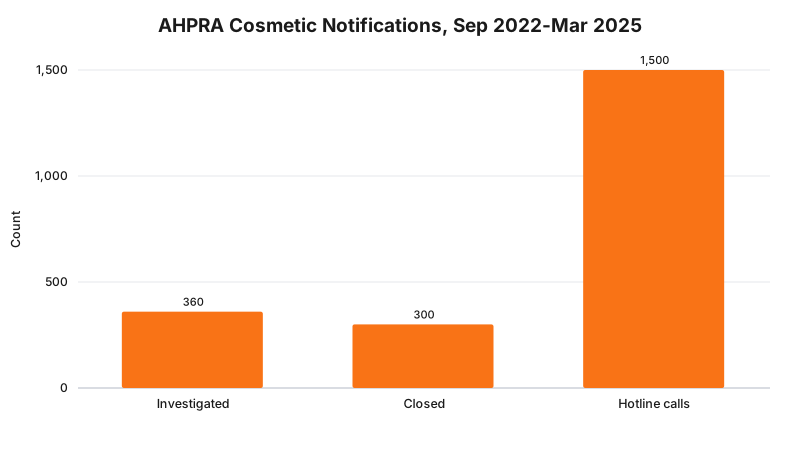
- Between September 2022 and March 2025, AHPRA investigated about 360 notifications concerning non-surgical cosmetic procedures, closed about 300, and logged over 1,500 calls to its cosmetic surgery hotline
- Written consent material has to be in plain language and must not minimise the complexity of a procedure or overstate results, under the guidelines AHPRA published on 2 September 2025
- A practice that edits its consent PDF in place, instead of issuing a new version, cannot later show what a patient signed against on any given date
- No published AHPRA finding ties a case specifically to consent document version control. That gap in the public record is stated plainly here, not filled with an invented example
- A workable version control build needs three fields at minimum: a version identifier, an effective date range, and the version identifier recorded against each signature, not just against the current document
Consent forms are not static. AHPRA’s own guidelines for cosmetic procedures changed on 2 September 2025, consolidating what had been separate documents into one. If a practice updated its patient information sheet to match, and most compliant ones did, then anyone who signed before that date consented against different written content to anyone who signed after it. The question that matters is whether the practice’s records can say, for a specific patient, which one it was.
Most practices cannot answer that question today. Their consent form lives as a single file on a server or inside a practice management template, edited in place whenever the wording needs a refresh. The current version is easy to find. The version a patient actually saw eight months ago is gone, overwritten by whatever came after it.
What AHPRA’s Guidelines Say About Consent Content
AHPRA’s Guidelines for registered health practitioners who perform non-surgical cosmetic procedures, in effect since 2 September 2025, apply to every registered health practitioner under the National Law who performs a non-surgical cosmetic procedure, with one exclusion. Medical practitioners are carved out and remain under the Medical Board of Australia’s own guidelines, in force since 1 July 2023. Nurses, dentists and other registered practitioners performing injectables, thread lifts and similar treatments sit under the newer, consolidated set.
On content, the guidelines require informed consent to be backed by clear written information, provided in plain language, that does not minimise the complexity of the procedure or overstate results in a way that implies an outcome the patient cannot realistically expect. Practitioners have to disclose their own registration details and qualifications, and costs have to be itemised, including deposits, payment terms and a statement that Medicare does not cover the procedure. Our earlier guide on what a digital consent record has to contain covers the full disclosure list. What the guidelines do not do, because it is not their job, is specify how a practice should track which version of that written material a given patient was shown.
That gap matters because the guidelines themselves are proof that the underlying content changes. The September 2025 guidelines replaced a prior arrangement of separate documents for different practitioner groups with one consolidated guideline. A practice that updated its consent information sheet to reflect the September 2025 changes, and kept no record of the switch, has no way to show a regulator, a court, or a patient’s own lawyer which version was current on the date a specific person signed.
Takeaway: the regulator sets the content standard. Tracking which content a specific patient actually saw, on the date they saw it, is a records problem the practice has to solve on its own.
What That Means for the Build
Version control for a consent document is not complicated engineering. It is three fields, applied consistently, and a rule that content is never edited in place once it has been shown to a patient.
A version identifier. Every distinct piece of consent content, the information sheet, the risk disclosure, the pricing schedule, needs its own identifier. A simple incrementing integer or a date-stamped string both work. What matters is that it is stored against the content itself, not inferred from a file’s last-modified date, which changes every time someone touches the file for any reason, including a typo fix that changes nothing material.
An effective date range. Each version needs a start date and, once superseded, an end date. When version 2 goes live, version 1’s end date gets set. This turns “what did our consent form say on 14 August 2025” into a single lookup instead of a guess.
A signature-to-version link. This is the field most practices are missing entirely. The consent record for a specific patient has to store which version identifier they were shown, not just a boolean that says consent happened. Without it, the version history exists but is disconnected from the one thing that actually matters: proving what one named patient agreed to.
The practical rule that makes this work is simple: once a version has been shown to even one patient, it is frozen. Any further change creates a new version. Editing the live file is what destroys the evidence trail, and it is also the easiest habit to fall into, because most content management systems and practice management form builders default to letting you edit a document in place with no prompt to version it.
| Change type | New version required | Why |
|---|---|---|
| Guideline update (e.g. September 2025 consolidation) | Yes | Underlying disclosure obligations changed; old content no longer reflects current requirements |
| Pricing change | Yes | Cost disclosure is a named requirement; old pricing shown to a prior patient is a historical fact that must stay retrievable |
| New treatment added to the practice’s offering | Yes | New risk and qualification disclosures apply that earlier versions never covered |
| Typo or formatting fix with no content change | No, but log it | Nothing a patient relied on changed; a lightweight changelog entry is enough |
| Practitioner registration detail change | Depends | New version if the form embeds practitioner-specific detail; no change if it is pulled from a separate, already-versioned record |
Takeaway: version control is not a feature to buy. It is a rule, three fields, and the discipline never to edit content that has already been shown to a real patient.
A Worked Example
Cosmetic clinic. An injectable clinic ran its consent information sheet as a single PDF linked from its booking page. When AHPRA’s consolidated guidelines took effect in September 2025, the practice manager updated the pricing disclosure and the risk section to match, and re-uploaded the same filename. A patient who had signed six weeks earlier, under the pre-update content, later disputed a cost she said was never disclosed. The clinic pulled its records and found one PDF, the current one, with no way to prove it was not the one she actually saw. The fix going forward: the PDF gets a version number in its filename and its metadata, the booking system stores which version number was live at the moment of each signature, and the old PDF stays hosted at its own URL indefinitely rather than being overwritten.
Cosmetic dentistry. A dental practice offering veneers used its practice management software’s built-in consent template, which the vendor updated centrally without any practice-side version log. When the vendor pushed a content change to the standard risk disclosure, every practice using that template inherited it silently. A patient who had signed under the earlier wording could not have that wording reproduced by the practice months later, because the practice’s own system only ever showed the current template, never a historical snapshot. The fix was to ask the vendor whether their template stores a snapshot per signature, and if not, to export and archive a dated copy of the live template every time the vendor logs a change, so the practice has its own version history even when the content lives outside its own systems.
The numbers below are an illustrative example of what the two approaches cost in staff time, not a measured industry figure.
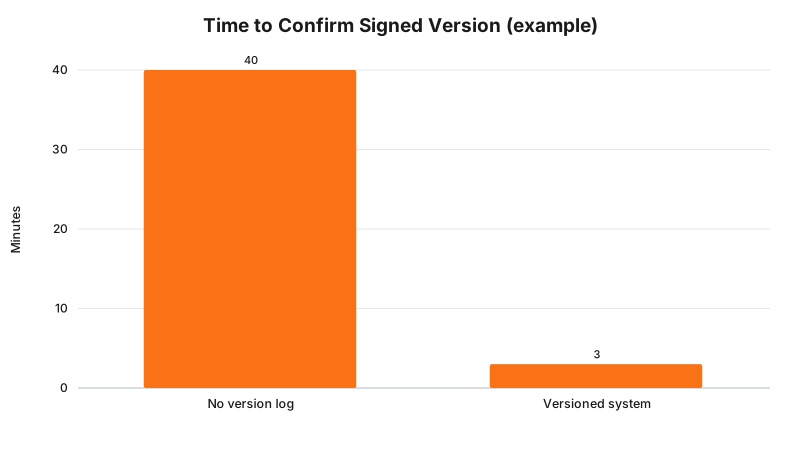
Takeaway: the failure in both cases was the same. Content changed, the system had no memory of the change, and the one record that mattered, what a specific patient actually saw, was gone.
What to Check on Your Own Site
- Open your consent PDF or form template and check whether it carries a version number or a “last updated” date visible in the document itself.
- Check whether your booking or intake system stores a version identifier against each individual patient’s signature, or only links to whatever the current document is.
- Try to answer, for a patient who signed more than six months ago, exactly what your consent document said on that date. If the answer requires guessing, the gap is real.
- Confirm your process for updating consent content never edits the live file in place. It should always publish a new version and retire the old one, not overwrite it.
- If your consent template comes from a booking or practice management vendor, ask them directly whether they snapshot the content shown at each signature, or only serve the current version.
- Check that pricing, risk disclosure, and practitioner qualification content are versioned as a single bundle per signature event, not as separate files that can drift out of sync with each other.
- Confirm old versions stay retrievable, even after retirement, rather than being deleted once superseded.
The Enforcement Anchor
There is no published AHPRA case that finds against a practitioner specifically over consent document version control. That is a genuine gap in the public record, and this guide is not going to invent one to make the point sound stronger than the evidence supports.
What does exist is the volume of activity around cosmetic procedure consent generally. Under its announcement of the new guidelines, AHPRA reported it investigated about 360 notifications concerning non-surgical cosmetic procedures between September 2022 and March 2025, with about 300 of those closed, and received more than 1,500 calls to its dedicated cosmetic surgery hotline over the same period. Any one of those notifications could turn on exactly what a patient was told before they signed, which is what a version-linked consent record exists to answer.
Takeaway: the absence of a named version-control case is not evidence the risk is small. It is evidence the specific question has not yet been tested publicly, against a notification pipeline that is clearly active.
Where This Gets Hard
Version control tells you what content a system served. It cannot tell you what a patient actually read before they signed, or whether the practitioner’s verbal explanation matched the written page. A perfectly versioned record still only proves what document was live at a given moment, not what happened in the consultation room.
There is also a retrofitting problem. A practice that starts versioning today cannot reconstruct the exact wording shown to a patient who signed two years ago if no copy of that older content survived. Version control protects everything from the point it is switched on. It does nothing for the gap behind it, and that gap is exactly where an older dispute is most likely to sit.
The regulator says written consent information has to be plain language, accurate and not overstated; the build consequence is a system that keeps every version of that content addressable and links each patient’s signature to the specific version they saw; whether a specific practice’s existing records discharge that obligation in its own circumstances is a question for its medical defence organisation or its lawyer.
Status
In force since 2 September 2025. AHPRA’s Guidelines for registered health practitioners who perform non-surgical cosmetic procedures are current, binding guidelines for every covered practitioner, not a proposal and not pending commencement. Consent document version control, as described in this guide, is a build practice for meeting that obligation defensibly. It is not a separate, codified requirement AHPRA has itself published.
Frequently Asked Questions
Does AHPRA require a specific consent form version control system?
No. AHPRA’s guidelines set out what has to be disclosed to a patient in plain language before consent is valid, but they do not specify a document management standard. Version control is a build decision a practice has to make to be able to prove which disclosure a patient actually saw, not a separately codified AHPRA requirement.
How often do cosmetic procedure consent forms need to be updated?
Whenever the underlying guideline or your own clinical information changes. AHPRA consolidated two separate cosmetic procedure guidelines into one in September 2025, which is a concrete example of the kind of change that should trigger a new consent document version rather than a silent edit to the existing one.
What is the difference between editing a consent form and versioning it?
Editing overwrites the content a patient may have already seen and signed against, with no way to reconstruct what it said on a given date. Versioning keeps the old content intact under its own identifier, adds the new content as a new version, and records which version each signature was captured against.
Get Your Consent Records Checked
Sign up or get in touch and RockingWeb will check whether your booking and intake system can tell you, for any patient on any date, exactly which version of your consent content they signed against.
Sources
- AHPRA - Putting patients first: New guidelines for cosmetic procedures, 2 September 2025. Checked 15 August 2026.
- AHPRA - Booming billion-dollar cosmetic industry on notice with new cosmetic procedures guidelines, 3 June 2025. Checked 15 August 2026.
- Medical Board of Australia - Guidelines for registered medical practitioners who perform cosmetic surgery and procedures, in effect 1 July 2023. Checked 15 August 2026.
- Clayton Utz - Navigating the 2025 AHPRA guidelines on cosmetic procedures. Checked 15 August 2026.
- Meridian Lawyers - Changing the face of the cosmetic industry: new guidelines regulating non-surgical cosmetic procedures. Checked 15 August 2026.
Last reviewed: 15 August 2026.
Vikas Thakur
Founder of RockingWeb. 16 years of experience from working at TPG, iiNet and Monadelphous, now building websites, software and digital marketing for local businesses in Rockingham and Perth.