161,000 Australian Websites Run on WordPress (2026 Data)
An estimated 161,000 Australian websites run on WordPress, part of the platform's 41.1% share of every website worldwide in 2026. Here is the full market share breakdown, sourced straight from W3Techs.
 Vikas Thakur Founder, RockingWeb 8 min read

On this page 7
- Key takeaways
- How Many Websites Actually Run WordPress in 2026
- WordPress Usage in Australia: The Best Estimate Available
- WordPress vs Shopify, Wix, Squarespace and the Rest
- Which Version of WordPress Actually Runs the Web
- WooCommerce: WordPress’s Ecommerce Engine
- What This Means If You Are Choosing a Platform in 2026
Key takeaways
- An estimated 161,000 Australian websites run on WordPress, based on BuiltWith host data compiled by DemandSage in 2026.
- WordPress powers 41.1% of every website on the internet, according to W3Techs data pulled in August 2026.
- WordPress holds 59.1% of the CMS market, more than the next five platforms combined.
- Shopify is the closest rival at just 5.3% of all websites, with Wix at 4.3% and Squarespace at 2.5%.
- WordPress 7 now runs on 55.2% of all WordPress sites, ahead of WordPress 6 at 37.4%.
- WooCommerce powers more than 4 million online stores and runs on 31% of the top 1 million ecommerce sites.
- 30.4% of all websites use no content management system that W3Techs tracks, which makes WordPress’s share even more dominant among the sites that do.
The short answer: WordPress runs 41.1% of all websites worldwide as of August 2026, according to W3Techs. In Australia, BuiltWith host data puts the estimated WordPress installed base at 161,000 sites, per DemandSage’s 2026 analysis.
An estimated 161,000 Australian websites run on WordPress right now, out of the platform’s 41.1% share of every website on the internet, according to W3Techs data pulled in August 2026. That is more than four in every ten websites globally, and it makes WordPress the default pick for small business owners, bloggers, and agencies from Perth to Cairns. Market share alone hides a messier picture, though. Shopify, Wix, and Squarespace have all been chipping away at the edges for a decade, and WordPress has quietly moved most of its own base onto a new major version. If you build websites, sell WordPress plugins, or just want to know what platform your competitors are standing on, the numbers below settle the argument. We pulled live figures from W3Techs, checked the best available country estimate against BuiltWith host data, and broke out the version and ecommerce splits that actually matter for a 2026 decision.
How Many Websites Actually Run WordPress in 2026
Start with the number everyone actually wants: 41.1% of all websites on the internet run on WordPress. That figure comes directly from W3Techs, which tracks content management systems across tens of millions of live sites and updates its numbers continuously. Pulled fresh in August 2026, it puts WordPress ahead of every other platform by a wide margin.
The more useful number for anyone comparing platforms is the CMS market share figure: among websites that use a known content management system at all, WordPress accounts for 59.1%. W3Techs also reports that 30.4% of all websites use no CMS it tracks, which usually means a custom-built site, a static page, or a platform too small to register. Strip those out and WordPress still owns more of the remaining market than every other tracked CMS combined.
| Metric | Figure | Source |
|---|---|---|
| WordPress, share of all websites | 41.1% | W3Techs, August 2026 |
| WordPress, share of CMS market | 59.1% | W3Techs, August 2026 |
| Websites using no tracked CMS | 30.4% | W3Techs, August 2026 |
| Estimated WordPress sites in Australia | 161,000 | BuiltWith data via DemandSage, 2026 |
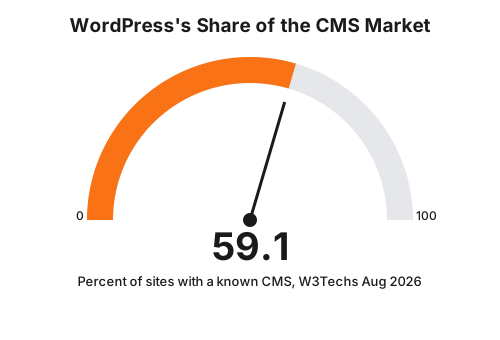
One takeaway: WordPress does not just lead the CMS market, it dominates it, holding almost six in every ten sites that run any content management system at all.
WordPress’s CMS market share has not moved in a straight line. W3Techs’s own historical tracking shows the platform peaked at 65.2% of the CMS market in 2022, then eased back over four straight years to the 59.1% figure quoted above, as Shopify, Wix, and other newer platforms picked up ground. The chart below plots that eight-year run.
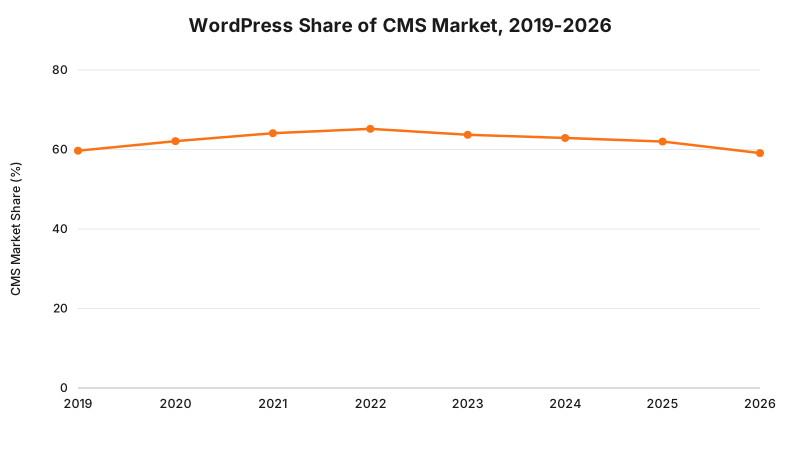
Takeaway: WordPress’s CMS market share peaked in 2022 and has eased every year since, though it still leads every rival by a wide margin.
WordPress Usage in Australia: The Best Estimate Available
Here is the honest part most “WordPress in Australia” articles skip. Neither W3Techs nor the Australian Bureau of Statistics publishes a country-level breakdown of CMS market share. W3Techs reports global figures only. The ABS tracks broad business technology adoption, not which CMS a business runs. BuiltWith does track country-level CMS data, but that breakdown sits behind its live trends dashboard rather than a static, publicly citable page.
The most specific figure available comes from DemandSage’s 2026 compilation of BuiltWith host data, which puts the Australian WordPress installed base at approximately 161,000 websites. Treat that as a solid working estimate rather than a government statistic. It is a third party’s read of BuiltWith’s crawl data, not a live, independently reproducible count, and BuiltWith itself does not publish the raw Australian figure on a page we could verify directly.
What we can say with confidence is the shape of the picture. Australia’s small business sector runs overwhelmingly on hosted platforms rather than custom code, and every agency-side data point we could verify points to WordPress as the largest single platform in that mix, consistent with its 41.1% global share. If your business, client base, or competitor set sits in the Australian small-to-medium market, the safest assumption is that WordPress is still the platform you are most likely to run into.
| Data Point | Figure | Source | Year |
|---|---|---|---|
| Estimated WordPress websites in Australia | 161,000 | DemandSage, citing BuiltWith host data | 2026 |
| WordPress share of all websites, global | 41.1% | W3Techs | 2026 |
| Country-level CMS breakdowns published by W3Techs | None available | W3Techs | 2026 |
Takeaway: 161,000 is the best publicly available estimate for WordPress sites in Australia, not a confirmed government count, and anyone citing a more precise Australian figure is likely rounding a private or paid dataset.
WordPress vs Shopify, Wix, Squarespace and the Rest
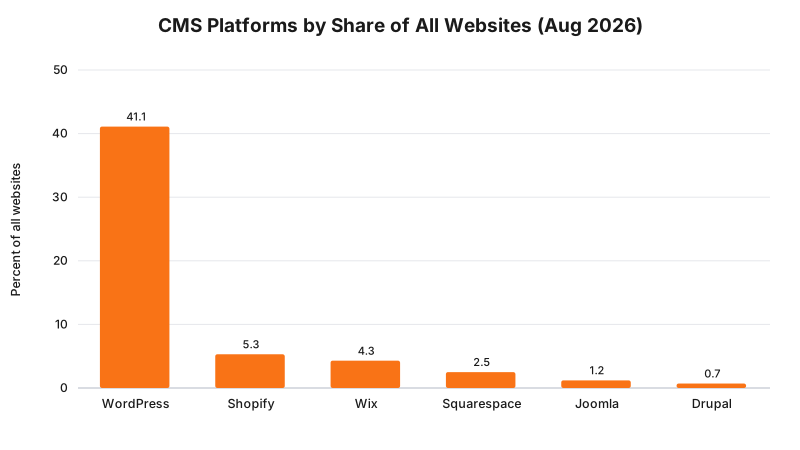
WordPress’s nearest competitor is not close. Shopify, the platform most associated with ecommerce, runs 5.3% of all websites and 7.6% of the CMS market. Wix sits at 4.3% and 6.1%. Squarespace, popular with creative and service businesses, holds 2.5% and 3.5%. Joomla and Drupal, both older open source platforms, have fallen to 1.2% and 0.7% of all websites respectively.
| Platform | Share of All Websites | Share of CMS Market |
|---|---|---|
| WordPress | 41.1% | 59.1% |
| Shopify | 5.3% | 7.6% |
| Wix | 4.3% | 6.1% |
| Squarespace | 2.5% | 3.5% |
| Joomla | 1.2% | 1.7% |
| Drupal | 0.7% | 1.0% |
Add up every one of WordPress’s tracked rivals and they still do not reach half of WordPress’s own share. That gap explains why most web agencies, including ours, default to WordPress unless a client has a specific reason to run something else, such as a Shopify-first ecommerce build.
Takeaway: WordPress’s five biggest tracked rivals combined still control less than a quarter of the CMS market WordPress holds alone.
Looking at both metrics side by side sharpens the picture. Plot every platform’s share of all websites against its share of the CMS market, and WordPress is not just ahead on every axis, it is ahead by a wider margin than any rival manages on either measure alone.
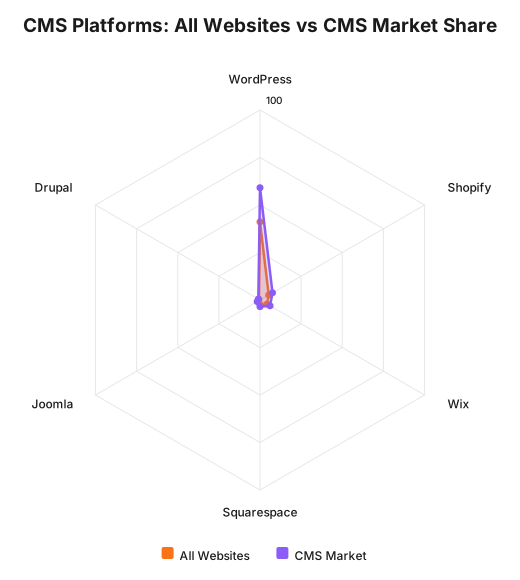
Takeaway: WordPress leads on both axes at once, a combination none of its tracked rivals come close to matching.
Which Version of WordPress Actually Runs the Web
WordPress ships major version updates every year, and adoption of the newest release is a useful signal of how actively a site is maintained. As of August 2026, W3Techs reports that WordPress 7 already runs 55.2% of all WordPress sites, ahead of WordPress 6 at 37.4%. Older versions make up the remainder: WordPress 5 at 5.1%, WordPress 4 at 2.1%, and WordPress 3 at just 0.2%.
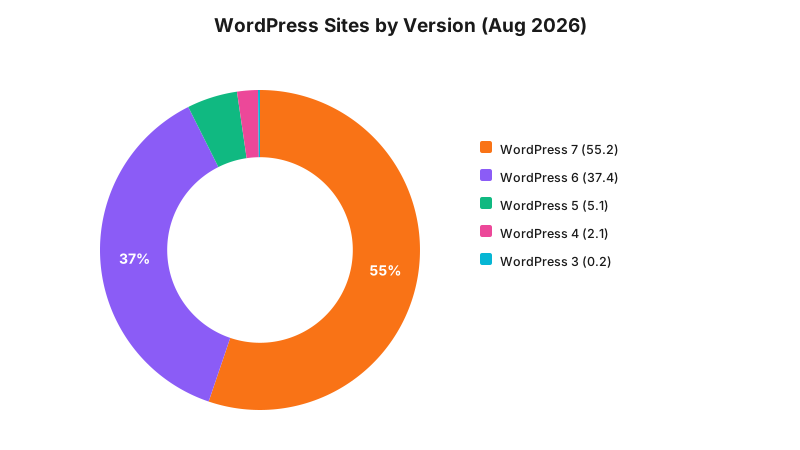
That split matters for anyone running an old install. A site still on WordPress 4 or 5 sits with roughly 7% of the installed base, well outside current security support, and is a common source of the compromised WordPress sites you read about in hosting security reports.
Takeaway: More than nine in ten active WordPress sites now run version 6 or 7, so a site still on an older release is the exception, not the norm.
WooCommerce: WordPress’s Ecommerce Engine
WordPress’s ecommerce reach runs through WooCommerce, its free ecommerce plugin. WooCommerce now powers more than 4 million online stores, according to Store Leads data published on WooCommerce’s own site in 2026, and it accounts for 31% of the top 1 million ecommerce websites globally.
| WooCommerce Metric | Figure | Source |
|---|---|---|
| Online stores built with WooCommerce | 4,000,000+ | Store Leads, via WooCommerce.com, 2026 |
| Share of top 1 million ecommerce sites | 31% | Store Leads, via WooCommerce.com, 2026 |
For a business deciding between a hosted platform like Shopify and a self-hosted WordPress and WooCommerce build, that 31% figure is the clearest signal that WooCommerce is not a niche choice. It is the plugin equivalent of WordPress’s own dominance, just applied to online stores instead of content sites.
Takeaway: Nearly one in three of the world’s top ecommerce sites runs on WooCommerce, not a dedicated ecommerce platform.
What This Means If You Are Choosing a Platform in 2026
None of this means WordPress is the right choice for every business. Shopify still makes sense for a store owner who wants inventory, shipping, and payments handled in one place with minimal setup. Squarespace and Wix suit a small service business that wants a template and nothing to maintain. But the numbers above explain why WordPress keeps winning by default: a 41.1% share of the entire internet, a 59.1% share of the CMS market, and an ecosystem, in WooCommerce, that runs nearly a third of the world’s top online stores.
If you are weighing up a rebuild, a migration off an older WordPress version, or whether WordPress is even the right platform for your business, that is exactly the kind of decision we help Rockingham and Perth-area businesses work through. See how we approach web design and development, or get in touch to talk through your specific site.
Vikas Thakur
Founder of RockingWeb. 16 years of experience from working at TPG, iiNet and Monadelphous, now building websites, software and digital marketing for local businesses in Rockingham and Perth.