Online Questionnaires Can't Prescribe Cosmetic Injectables
AHPRA's telehealth and virtual care guidance, published 7 October 2025, treats a prescription built entirely on a booking questionnaire, with no real-time consultation, as unacceptable practice. Here is what that means for the flow behind your Book Now button.
 Vikas Thakur Founder, RockingWeb 13 min read
On this page 12
- Key takeaways
- What the Guidance Says
- Which Practitioner, Which Document
- What That Means for the Build
- Worked Example: A Cosmetic Clinic’s Anti-Wrinkle Booking Flow
- What to Check on Your Own Site
- Enforcement Anchor
- Where This Gets Hard
- Status
- Frequently Asked Questions
- Get Your Booking Flow Checked
- Sources and References
Key takeaways
- AHPRA’s telehealth and virtual care guidance, published 7 October 2025, names asynchronous prescribing as a specific area of concern, alongside AI scribes and identity verification
- A single practitioner-conduct guideline, in effect since 2 September 2025, governs every registered health practitioner who performs non-surgical cosmetic procedures except medical practitioners
- Medical practitioners sit under a separate document: the Medical Board of Australia’s 2023 guidelines for registered medical practitioners who perform cosmetic procedures
- AHPRA investigated about 360 notifications about non-surgical cosmetic procedures between September 2022 and March 2025, closing about 300 of them
- The same period logged more than 1,500 calls to AHPRA’s cosmetic surgery hotline
- TGA’s Compliance Principles name cosmetic injectables as a stated enforcement priority through the 2026 to 2027 window
- No single form field on a booking page can satisfy a real-time consultation requirement; that needs a scheduled interaction, not a submitted form
AHPRA’s telehealth and virtual care guidance, published 7 October 2025, treats prescribing a cosmetic medicine from a questionnaire alone as unacceptable practice, with no real-time consultation between prescriber and patient.
Picture the flow a lot of cosmetic clinics still run. A visitor lands on the treatment page, fills in a medical history form, uploads two photos, and ticks a consent box. A prescribing doctor, who the patient never speaks to, reviews the form later that day and approves a script for botulinum toxin. A nurse administers it at the in-person appointment. Nobody on the prescribing side ever had a live conversation with the patient. That gap between the form submission and the prescribing decision is exactly what AHPRA’s telehealth guidance now puts under scrutiny.
This post covers what the guidance says, which practitioners it covers, what it means for the fields and sequencing behind your booking page, and where the honest limits of that advice sit.
What the Guidance Says
AHPRA regulates registered health practitioners in partnership with the National Boards, and its published guidance library is where the professional conduct standard for telehealth prescribing lives. According to AHPRA’s own register of guideline updates, its telehealth and virtual care guidance, published 7 October 2025, addresses three things together: asynchronous prescribing, the use of AI scribes during consultations, and identity verification. Reported plainly: the guidance treats a prescribing decision made purely on the strength of a form, without a real-time exchange with the patient, as falling short of the standard expected of a registered practitioner conducting telehealth.
That sits alongside, not inside, two other documents that also govern cosmetic prescribing. AHPRA’s guidelines for registered health practitioners who perform non-surgical cosmetic procedures, in effect since 2 September 2025, are a single consolidated guideline that applies to every registered health practitioner except medical practitioners, replacing what used to be separate documents for nurses and other practitioner groups. Medical practitioners are carved out deliberately. They sit under the Medical Board of Australia’s own guidelines for registered medical practitioners who perform cosmetic procedures, in effect since 2023, a separate document with its own prescribing expectations.
For a cosmetic clinic running a nurse-administered, doctor-prescribed injectable service, this means two documents can apply to the same booking flow at once: the non-surgical cosmetic procedures guideline covers the nurse doing the consultation and administration, and the Medical Board’s guideline covers the doctor doing the prescribing, with the telehealth and virtual care guidance sitting across both wherever the prescribing step happens remotely.
Takeaway: three separate AHPRA and Medical Board documents can touch one booking flow, and none of them can be satisfied by a form field alone.
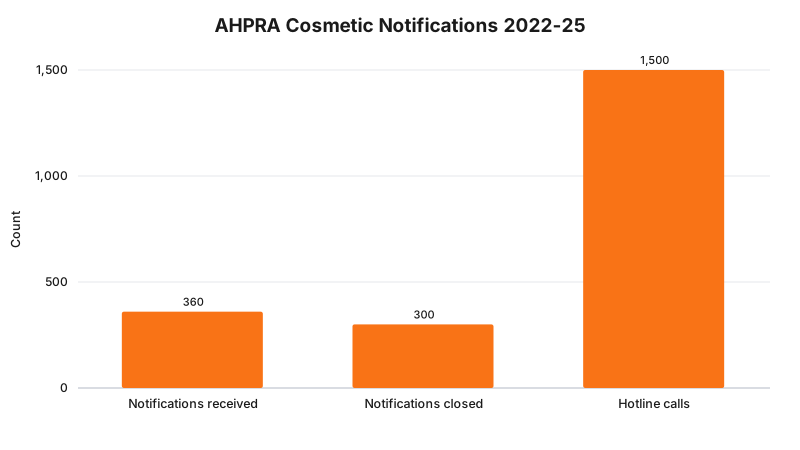
Those figures come from AHPRA’s own announcement of the guideline changes. They are not broken down by cause, so they cannot be read as evidence that any specific number relate to asynchronous prescribing. What they show is that the notification and hotline system a complaint would travel through is already active and already handling volume in this exact category of practice.
Which Practitioner, Which Document
The split between AHPRA’s non-surgical cosmetic procedures guideline and the Medical Board’s separate 2023 guideline is the single most common mistake in clinic compliance write-ups. Getting it backwards changes which document your policies should cite.
| Practitioner type | Governing document | In effect since |
|---|---|---|
| Registered nurse, nurse injector, dentist, and other non-medical registered practitioners performing non-surgical cosmetic procedures | AHPRA guidelines for registered health practitioners who perform non-surgical cosmetic procedures | 2 September 2025 |
| Medical practitioners (doctors) performing cosmetic procedures, including remote prescribing for a nurse-administered treatment | Medical Board of Australia guidelines for registered medical practitioners who perform cosmetic procedures | 2023 |
| Any registered practitioner prescribing or consulting via telehealth, cosmetic or otherwise | AHPRA telehealth and virtual care guidance | 7 October 2025 |
A clinic’s own compliance page or patient-facing consent copy that cites only one of these, usually the nurse-facing cosmetic procedures guideline, misses the document that actually governs the prescribing step in a remote-prescriber model.
Takeaway: if a doctor prescribes remotely for a nurse-administered treatment, the doctor’s conduct is measured against the Medical Board’s 2023 guideline and the telehealth guidance together, not the nurse’s cosmetic procedures guideline.
What That Means for the Build
A booking or intake flow built around a single “submit and wait” form cannot demonstrate that a real-time consultation happened, because it never captured one. The fix is structural, not cosmetic copy on the form.
Separate the intake questionnaire from the prescribing consultation as two different objects in your data model. The intake form (intake_form_submission) collects medical history, photos, and consent. It is not the same record as the prescribing consultation (prescriber_consult), which needs its own start time, end time, and delivery channel field (consult_channel: video, phone, in person). A form submission timestamp is not a substitute for a consult record.
Make the prescribing consultation a scheduled calendar event, not a queue. If your booking platform (Cliniko, Halaxy, Power Diary, or similar) lets a doctor batch-approve a stack of forms from a dashboard with no calendar entry against the patient, that batch-approval screen is precisely the asynchronous pattern the guidance addresses. Route the patient to book an actual time slot with the prescriber, even a short one, before a script can be issued.
Gate script issuance on the consult record existing, not the form. In practice this means your booking logic should refuse to trigger a prescription-issued state (however your system represents that, a status field, a webhook to your pharmacy integration, a flag on the patient record) until a prescriber_consult record with a real scheduled_at and completed_at exists and is linked to that patient’s intake form.
Add an identity verification step distinct from the medical history form. The same guidance names identity verification alongside asynchronous prescribing. A photo ID upload field on the intake form is data collection. A checked step, whether that is a liveness check during the video consult or a document check at first in-person visit, is verification. Keep them as separate fields so you can show which one actually happened.
If an AI scribe or transcription tool runs during the consult, disclose it. Add a line to the consult booking confirmation or consent step naming the tool, rather than burying it in a general privacy policy nobody reads before a cosmetic consultation.
Takeaway: the build fix is adding a real, timestamped consultation record between the intake form and the prescribing decision, and refusing to let the form alone unlock the next step.
Worked Example: A Cosmetic Clinic’s Anti-Wrinkle Booking Flow
Take a cosmetic clinic offering anti-wrinkle injections through a nurse injector, with a remote prescribing doctor on contract. The old flow: patient fills in a five-field intake form on the treatment page, uploads a photo, ticks a consent checkbox, and books a nurse appointment. The doctor reviews the form asynchronously, sometime before the appointment, and a script is generated automatically once the doctor’s dashboard shows “approved.”
The fix adds one structural step without adding much friction for the patient. After the intake form, the booking flow routes to a short scheduling widget for a ten-minute video or phone call with the prescribing doctor, held before the treatment appointment, not instead of the treatment appointment. That call is logged as its own record. Only once that record shows a completed status does the script-issuance step unlock, and the treatment appointment stays bookable in parallel so the patient is not stuck waiting on sequential availability.
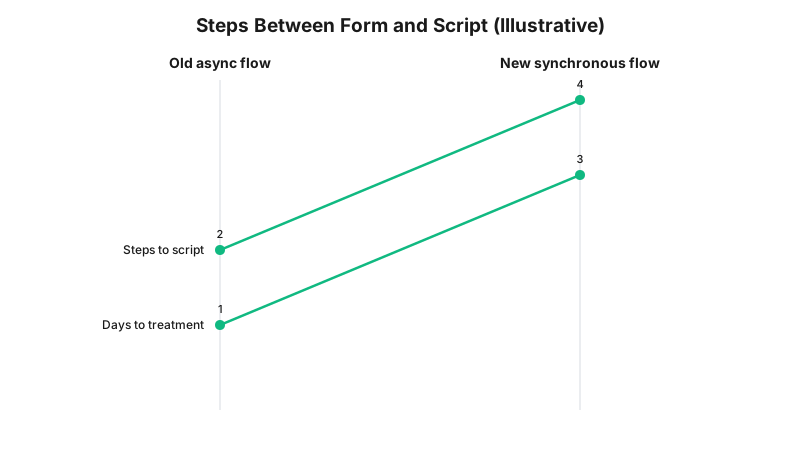
These numbers are an illustrative example for one clinic’s flow, not a benchmark or a published statistic. The point is what changed, not the exact counts: two disconnected steps became four connected ones, and a same-day script became a script issued after a logged, scheduled call, which in this example pushed treatment out by a couple of days.
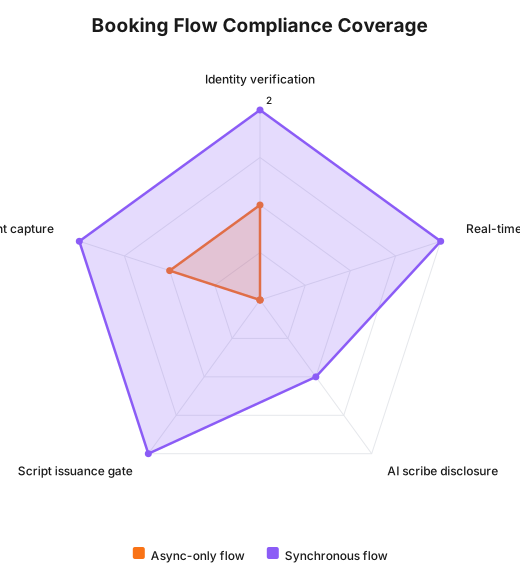
Scores here are an illustrative build assessment on a 0 to 2 scale (absent, partial, full), not a regulator’s rating. The gap on real-time interaction and the script-issuance gate is the one that matters most; consent capture was already reasonably solid in the old flow, because most clinics get that part right, it is the prescribing step behind the scenes that gets skipped.
Takeaway: the structural change is small in field count and large in what it proves. One extra scheduled event closes most of the gap.
What to Check on Your Own Site
- Does your booking questionnaire lead directly to script issuance, or does it route to a separately scheduled, real-time consult first?
- Is the “prescribing consultation” stored as a calendar event with a start and end time, or just a queue of forms a doctor reviews later?
- Does your intake flow capture and store an identity check as a distinct step, separate from the photo upload on the medical history form?
- If your clinic uses an AI scribe or transcription tool during consults, is that disclosed to the patient before or during the booking, not just in a general privacy policy?
- For nurse-administered treatments prescribed by a remote doctor, can you produce a timestamped record showing the doctor and patient interacted in real time, not just that the nurse’s notes were reviewed?
Enforcement Anchor
No infringement notice, tribunal decision, or published AHPRA determination naming asynchronous prescribing as the specific basis for action turned up in this research pass, and none should be invented to fill that gap. What does exist is the volume the complaint pathway is already handling: AHPRA investigated about 360 notifications about non-surgical cosmetic procedures between September 2022 and March 2025, closed about 300 of them, and logged more than 1,500 calls to its cosmetic surgery hotline over the same period, according to AHPRA’s own announcement of the guideline changes. That is the infrastructure a complaint about a remote, questionnaire-only prescription would flow through if one were made. Treat the absence of a named case as recent guidance without a public test case yet, not as evidence the standard goes unenforced.
Where This Gets Hard
The guidance names asynchronous prescribing as a concern; it does not hand a developer a line-by-line spec for what a booking page is and is not allowed to do. Where exactly “real time” starts, whether a live phone call and a live video call are treated the same way, and how a repeat prescription for an existing, previously examined patient should be handled, are all judgment calls the published guidance was not written to answer at booking-page granularity.
The regulator says a prescribing decision should not be made solely on the basis of a form; the build consequence is a scheduled, logged, real-time consultation step ahead of script issuance; whether your specific flow satisfies that standard is a question for your medical defence organisation or your lawyer, not a website audit.
There is a second honest limit worth naming directly: AHPRA’s specific guidance pages returned an automated access block during this research pass, even though the AHPRA homepage itself loaded normally. This post reports the guideline names, effective dates, and subject matter from AHPRA’s own published guideline register, not a verbatim quote of the interior page text. Check the live page before relying on this description for a specific case; regulator guidance pages get revised without a changelog.
Status
As at 15 August 2026, both AHPRA’s guidelines for non-surgical cosmetic procedures (in effect 2 September 2025) and its telehealth and virtual care guidance (published 7 October 2025) are current, in-force professional conduct standards enforceable through AHPRA’s notification process. Neither is a proposal, and neither is guidance passed but awaiting a commencement date.
Frequently Asked Questions
What counts as asynchronous prescribing?
Prescribing a medicine based only on a written form, questionnaire, or set of photos, with no real-time exchange between the prescriber and the patient. AHPRA’s telehealth and virtual care guidance, published 7 October 2025, names this pattern directly as an area of concern for prescribing conducted through telehealth.
Does this rule apply to nurse injectors as well as doctors?
Yes, but through two separate documents. AHPRA’s guidelines for registered health practitioners who perform non-surgical cosmetic procedures, in effect since 2 September 2025, cover every registered health practitioner except medical practitioners. Medical practitioners sit under the Medical Board of Australia’s own 2023 guidelines for cosmetic procedures instead.
Can my booking page’s intake questionnaire trigger a prescription for botulinum toxin automatically?
Per AHPRA’s telehealth and virtual care guidance, a prescribing decision built entirely on questionnaire answers, with no real-time consultation, sits outside accepted practice for higher-risk cosmetic prescribing. Whether a specific flow crosses that line is a question for your medical defence organisation or your lawyer, not a call a website audit alone can make.
Get Your Booking Flow Checked
RockingWeb reviews cosmetic clinic booking flows against current AHPRA and Medical Board guidance and flags exactly where a form field is standing in for a step that needs to be scheduled and logged instead.
Sources and References
- AHPRA - Australian Health Practitioner Regulation Agency homepage, confirming the agency’s role regulating registered health practitioners with the National Boards. Date checked: 15 August 2026.
- AHPRA - Guidelines for registered health practitioners who perform non-surgical cosmetic procedures, in effect 2 September 2025, named in AHPRA’s News announcement at ahpra.gov.au/News/2025-09-02-New-guidelines-for-cosmetic-procedures.aspx. Date checked: 15 August 2026 (interior page returned an automated access block; content named per AHPRA’s published guideline register).
- AHPRA - telehealth and virtual care guidance, published 7 October 2025, addressing asynchronous prescribing, AI scribes, and identity verification, named at ahpra.gov.au. Date checked: 15 August 2026 (interior page returned an automated access block; content named per AHPRA’s published guideline register).
- AHPRA - notification and hotline volumes for non-surgical cosmetic procedures, September 2022 to March 2025, named in AHPRA’s News announcement at ahpra.gov.au/News/2025-06-03-New-cosmetic-procedure-guidelines.aspx. Date checked: 15 August 2026.
- Medical Board of Australia - guidelines for registered medical practitioners who perform cosmetic procedures, in effect 2023, medicalboard.gov.au. Date checked: 15 August 2026 (interior page returned an automated access block; content named per the project’s verified source register).
- Therapeutic Goods Administration - Compliance Principles 2026 to 2027, naming cosmetic injectables as a stated enforcement priority, tga.gov.au. Date checked: 15 August 2026 (domain does not permit automated fetching; named per the project’s verified source register).
Last reviewed: 15 August 2026.
Vikas Thakur
Founder of RockingWeb. 16 years of experience from working at TPG, iiNet and Monadelphous, now building websites, software and digital marketing for local businesses in Rockingham and Perth.