$1.82 Million: The TGA Fine for Advertising Botox in Australia
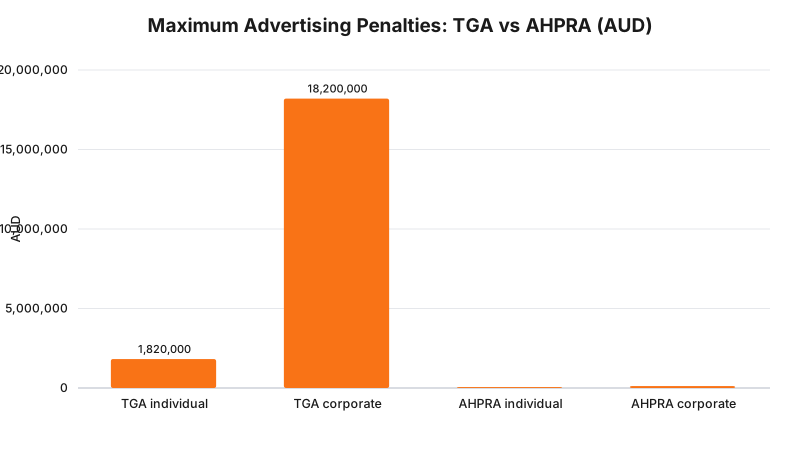
Advertising Botox by name to the public carries a maximum civil penalty of $1.82 million for an individual and $18.2 million for a body corporate, under section 42DLB of the Therapeutic Goods Act 1989. That is separate from, and far larger than, AHPRA's own advertising penalties.
 Vikas Thakur Founder, RockingWeb 9 min read
Key takeaways
- Advertising Botox, or any Schedule 4 substance, by name to the public carries a maximum civil penalty of $1.82 million for an individual and $18.2 million for a body corporate, under section 42DLB of the Therapeutic Goods Act 1989
- That ceiling is 5,000 penalty units for an individual and 50,000 penalty units for a corporation, calculated at the Commonwealth penalty unit rate of $364, which took effect 1 July 2026
- AHPRA’s separate advertising penalty under the National Law caps at $60,000 for an individual and $120,000 for a body corporate per offence, a fraction of the TGA’s exposure
- The TGA fined telehealth provider InstantScripts $742,500 in late 2023 for allegedly promoting prescription-only medicines
- The TGA issued 20 infringement notices totalling $159,840 to Mode Medical Pty Ltd, trading as Drip IV Australia, over advertising that referenced prescription-only ingredients
- A NSW registered nurse was fined $11,880 across three infringement notices in May 2026 over unapproved botulinum toxin imports
- Section 42DLB applies to anyone who places the ad, not only AHPRA-registered practitioners, and covers indirect substitute terms as well as the brand name itself
Advertising Botox by name to the public in Australia can cost an individual up to $1.82 million and a company up to $18.2 million. That is not an AHPRA figure. It comes from section 42DLB of the Therapeutic Goods Act 1989, the Commonwealth law that bans advertising Schedule 4 substances directly to consumers, botulinum toxin type A included.
Most cosmetic clinics know AHPRA does not like the word “Botox” on a treatment page. Fewer know why the number attached to getting it wrong is so much larger than the AHPRA fines everyone quotes. This guide sets out exactly what the law says, what it has actually cost real businesses, and what it means for how you build and word a clinic website.
The Rule: Section 42DLB of the Therapeutic Goods Act
Section 42DLB(1) and (7) of the Therapeutic Goods Act 1989 prohibits advertising a substance, or goods containing a substance, listed in Schedule 3, 4 or 8 of the current Poisons Standard, other than a reference authorised or required by a government or government authority. Botulinum toxin type A, marketed under brand names including Botox, is a Schedule 4 prescription-only substance. Naming it in an advertisement directed at the public is a direct breach.
This is a civil penalty provision, and it applies to individuals and corporations alike. It is separate from, and predates, AHPRA’s own advertising rules for cosmetic procedures. A clinic could have a spotless AHPRA record and still breach section 42DLB the moment a treatment page, ad, or social media caption names the substance.
Takeaway: the Botox naming ban is not an AHPRA invention. It sits in Commonwealth medicines law, and AHPRA’s own cosmetic procedure guidelines say advertisers must separately comply with it.
Why the TGA Figure Dwarfs AHPRA’s
AHPRA’s own penalty structure is well known in the sector. In 2022, the Health Practitioner Regulation National Law was amended to raise the maximum financial penalty for an advertising offence from $5,000 to $60,000 for an individual, and from $10,000 to $120,000 for a body corporate. Those increases applied nationally, including in Western Australia, from July 2024.
Section 42DLB works on a different scale entirely. Its maximum is set in penalty units rather than a fixed dollar figure, 5,000 units for an individual and 50,000 for a body corporate, and penalty units rise with the Commonwealth rate. That rate increased from $330 to $364 on 1 July 2026, which puts the current statutory ceiling at $1.82 million for an individual and $18.2 million for a corporation. Nobody has been fined that maximum for a Botox-naming breach. The point is that the law allows for it, and the ceiling moves upward every time the penalty unit is indexed.
Takeaway: AHPRA’s fines are the ones clinics hear about most. The TGA’s are the ones that carry the largest theoretical exposure, and they apply whether or not a registered practitioner is involved.
What the TGA Has Actually Fined Businesses For
The gap between statutory maximum and real enforcement matters, so here is what the TGA has actually done. In late 2023, the TGA fined telehealth provider InstantScripts Pty Ltd $742,500 for allegedly promoting prescription-only medicines through its telehealth services. Separately, the TGA issued 20 infringement notices totalling $159,840 to Mode Medical Pty Ltd, trading as Drip IV Australia, and an executive officer of the company, over alleged unlawful advertising of intravenous infusion products, including references to prescription-only ingredients such as glutathione.
Closer to the cosmetic injectable sector specifically, a NSW registered nurse received three infringement notices totalling $11,880 in May 2026, over the alleged unlawful importation of unapproved botulinum toxin vials and pre-filled syringes. None of the products involved were listed on the Australian Register of Therapeutic Goods, meaning the TGA had never assessed them for quality, safety or efficacy. The regulator has named therapeutic goods used in cosmetic procedures a priority focus area under its Compliance Principles for 2026 and 2027.
| Penalty type | Applies to | Amount | Basis |
|---|---|---|---|
| TGA s42DLB maximum | Individual | $1.82 million | 5,000 penalty units at $364 |
| TGA s42DLB maximum | Body corporate | $18.2 million | 50,000 penalty units at $364 |
| AHPRA National Law s133 maximum | Individual | $60,000 per offence | 2022 amendment, national from July 2024 |
| AHPRA National Law s133 maximum | Body corporate | $120,000 per offence | 2022 amendment, national from July 2024 |
| Real case: InstantScripts, 2023 | Body corporate | $742,500 | Telehealth prescription medicine advertising |
| Real case: Mode Medical (Drip IV), 2023 | Body corporate | $159,840 | 20 infringement notices, prescription ingredient references |
| Real case: NSW registered nurse, 2026 | Individual | $11,880 | 3 infringement notices, unapproved botulinum toxin import |
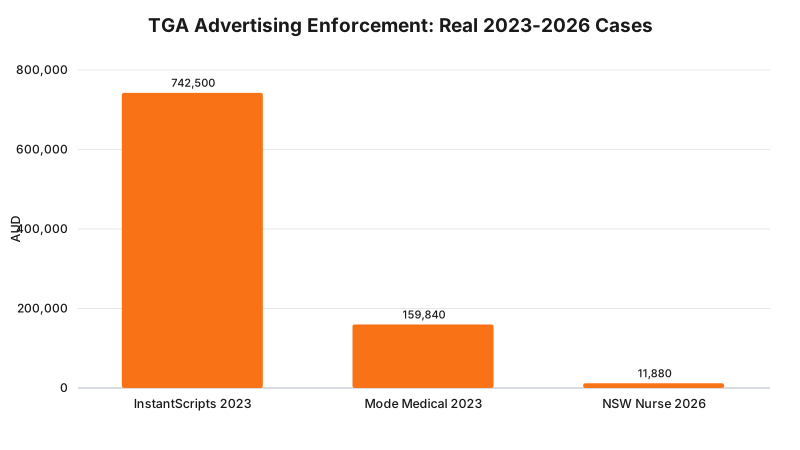
Takeaway: real infringement notices sit well below the statutory maximum, but they are not trivial either. A three-notice case against a single nurse still totalled $11,880, and a full prosecution can go much higher again.
What This Means for Your Clinic Website and Ad Accounts
Section 42DLB does not ban describing a treatment. It bans naming the substance directly to the public. That distinction is the difference between a compliant landing page and a $1.82 million exposure.
A page titled “Anti-wrinkle injections Perth” that never names botulinum toxin or a brand describes a treatment category. A page titled “Botox Perth” names a Schedule 4 substance, and every visit to it is a live breach, not a one-off. This is also why dedicated landing pages built around treatment categories, rather than brand names, carry less regulatory risk while still ranking for the searches patients actually run.
The TGA’s more recent guidance closes an adjacent gap: indirect language and substitute terms used specifically to point at a named product, and public-facing booking systems that let a visitor reserve a named prescription treatment without any clinical assessment step. A generic category term used honestly is not the problem the TGA is targeting. A workaround designed to still identify the product is. For a full audit of what your website, ad accounts, and booking flow currently expose, get in touch with RockingWeb.
The enquiry-quality effect is real too. Clinics that rebuild treatment pages around compliant category language, rather than pruning brand names as an afterthought, tend to see enquiries framed around the outcome a patient wants rather than a specific product, which is a better starting point for the consultation itself. RockingWeb builds cosmetic clinic websites around that category-first structure from the first draft, rather than retrofitting it after a compliance issue surfaces.
Takeaway: the safest clinic website names the treatment category everywhere client-facing, and reserves the substance name for the clinical conversation that happens after someone has already enquired.
FAQ
Can you advertise Botox by name in Australia?
No. Botulinum toxin type A, sold under brand names including Botox, is a Schedule 4 prescription-only substance. Section 42DLB of the Therapeutic Goods Act 1989 prohibits advertising a Schedule 4, Schedule 3 or Schedule 8 substance directly to the public, with narrow exceptions for government-authorised references. This is a Commonwealth law, not an AHPRA rule, and it applies to whoever places the advertisement, not just registered practitioners.
What is the maximum penalty for advertising Botox by name to the public?
Up to 5,000 penalty units for an individual and 50,000 penalty units for a body corporate under section 42DLB, a civil penalty provision. At the Commonwealth penalty unit rate of $364, which took effect 1 July 2026, that is a maximum of $1.82 million for an individual and $18.2 million for a body corporate.
Can I still use terms like “anti-wrinkle injections” on my clinic website?
Yes. Category language that describes the type of treatment without naming a specific prescription-only substance, brand or generic, is standard practice and does not trigger section 42DLB. What the TGA has flagged is indirect language and substitute terms used specifically to point at a named product while avoiding the word itself, including through booking systems.
Does this rule only apply to AHPRA-registered practitioners?
No. Section 42DLB applies to any person or business that publishes the advertisement, including marketing agencies, front-desk staff, and unregistered social media managers. AHPRA’s own advertising guidelines for higher risk cosmetic procedures state they apply to registered practitioners, unregistered individuals, and businesses and corporate entities alike.
Get Your Website and Ad Accounts Checked
RockingWeb reviews cosmetic clinic websites, booking flows, and ad accounts against both AHPRA’s advertising guidelines and the TGA’s Schedule 4 naming restrictions, and flags every instance against the specific provision it falls under.
Talk to us about your clinic’s website and ad complianceSources and References
Law Quarter (secondary source) - section 42DLB text summary, the botulinum toxin type A example, the 5,000/50,000 penalty unit figures, and the InstantScripts and Mode Medical infringement cases
ASIC - current Commonwealth penalty unit value of $364, effective 1 July 2026
Aesthetic Medical Practitioner - the NSW nurse’s $11,880 infringement notices, May 2026, and the TGA’s new guidance on substitute terms and booking systems
AHPRA - the 2022 National Law amendment raising advertising offence penalties to $60,000 (individual) and $120,000 (body corporate), national from July 2024
AHPRA, via MDA National - Guidelines for advertising higher risk non-surgical cosmetic procedures: who the guidelines apply to, and the requirement to separately comply with TGA rules for therapeutic goods
Related reading:
- AHPRA Treatment Naming: What Your Clinic Website Can and Cannot Say: the full compliant naming convention list for injectables and fillers
- TGA Fined a Nurse $11,880 Over a Booking Loophole: the booking-system guidance in full
- AHPRA Advertising Fines for Cosmetic Clinics: the full AHPRA penalty structure
For a website and ad account built around compliant treatment naming from day one, see ClinicPipeline or get in touch with RockingWeb.
Vikas Thakur
Founder of RockingWeb. 16 years of experience from working at TPG, iiNet and Monadelphous, now building websites, software and digital marketing for local businesses in Rockingham and Perth.