Show a Google Star Rating on Your Clinic Site Without the Reviews
You can display an aggregate Google star rating on a clinic website without breaching the testimonial rule in section 133 of the National Law, provided the number stands alone. The risk most sites miss is not the visible badge, it is review text still sitting in hidden schema markup or CSS-hidden widget code that a scraper or a regulator can still read.
 Vikas Thakur Founder, RockingWeb 11 min read
Key takeaways
- Section 133 of the National Law bans testimonials, meaning statements about a clinical aspect of a service, in advertising a regulated health service
- AHPRA’s guidelines for advertising higher risk non-surgical cosmetic procedures, in effect since 2 September 2025, describe the kinds of advertising the National Boards consider will contravene section 133
- A bare number and a review count is not itself a statement, which is why an aggregate rating with no review text is the pattern most clinics land on
- The risk that gets missed is not the visible badge, it is review text sitting in hidden JSON-LD schema markup that a plugin writes into the page source without displaying it on screen
- Google’s own structured data guidelines say a page is ineligible for the star review rich result if the business controls the reviews about itself, so schema markup rarely earns you stars in search results anyway
- AHPRA investigated about 360 notifications about non-surgical cosmetic procedures between September 2022 and March 2025, evidence the wider advertising rules in this space get enforced
- No published AHPRA determination names a star rating badge specifically. That is stated plainly here rather than implied away
A clinic that wants to show “4.9 stars, 212 reviews” on its homepage is not, on the face of it, doing anything section 133 of the National Law was written to stop. The National Law’s testimonial prohibition targets statements about a clinical aspect of a service: a symptom, a treatment, an outcome. A number and a review count are neither.
That is the good news, and as at 16 September 2026 it holds. The catch is where the risk actually lives. It is rarely the visible badge a clinic chose deliberately. It is the review text a plugin or theme writes into the page’s source code without ever putting it on screen, and the assumption that a numbers-only display is automatically safe simply because nobody can see the text.
What the Rule Actually Says
Section 133 of the Health Practitioner Regulation National Law restricts advertising a regulated health service, and the testimonial prohibition is the provision most clinics run into. AHPRA’s guidelines for advertising higher risk non-surgical cosmetic procedures, dated 2 September 2025, describe the types of advertising the National Boards consider will contravene section 133. The guidelines bind registered health practitioners, individuals who are not registered health practitioners, and businesses, partnerships and corporate entities, so a clinic cannot treat the rule as something only the injector has to worry about.
AHPRA’s guidelines describe a testimonial as a statement referring to a clinical aspect of a service, made by or attributed to a patient. A star rating with no accompanying text does not fit that description. It carries no clinical statement, so treating it differently from a page full of quoted reviews is consistent with how the rule is written, not a workaround of it.
The AHPRA volume data below is not specific to star ratings. It shows the general enforcement backdrop the rule sits inside, which is the honest reason to treat any self-hosted rating claim with some care even in the absence of a case on point.
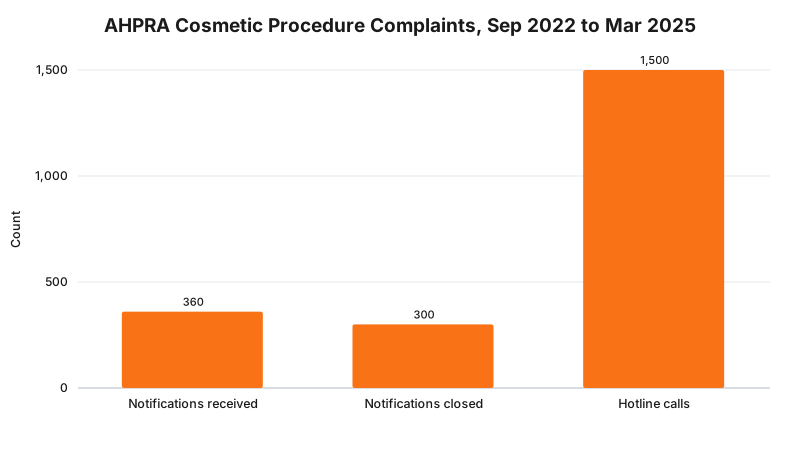
Figures are AHPRA’s own, covering notifications about non-surgical cosmetic procedures and calls to its cosmetic surgery hotline over the same period. They describe the wider advertising and testimonial rules generally, not a case about star ratings specifically.
Section 133 applies to advertising a regulated health service regardless of who performs the treatment, so the same testimonial rule covers a dental practice’s website as much as a cosmetic clinic’s.
What That Means for the Build
Three things determine whether a star rating display is actually safe, and only one of them is visible on the page.
The source of the number. The lowest-effort, lowest-risk option is Google’s own embeddable review link or widget for a Business Profile, because Google hosts the data and you are linking to it or displaying a badge Google itself generates. A manually typed number avoids any live pull, but it needs to stay accurate, since a stale figure raises its own Australian Consumer Law question separate from the testimonial rule.
Whether review text exists anywhere in the page, visible or not. This is the part a visual check misses. Open the page’s rendered source, not the design view, and search for a <script type="application/ld+json"> block. Many WordPress themes and reviews plugins write a Review schema object into that block for every review pulled, complete with a reviewBody field holding the full text, even when the on-page widget only renders a star icon and a number. The text is not displayed. It is still published, in the sense that any bot, scraper or manual reviewer reading page source can read it.
Whether that markup is even useful for search. Google’s structured data guidelines for the review snippet feature state that a page using LocalBusiness or Organization structured data is ineligible for the star review rich result if the entity being reviewed controls the reviews about itself. A clinic marking up its own aggregate rating on its own site is exactly that scenario. Adding AggregateRating schema to your own page rarely earns a star snippet in Google’s results, which removes the main reason clinics reach for it in the first place.
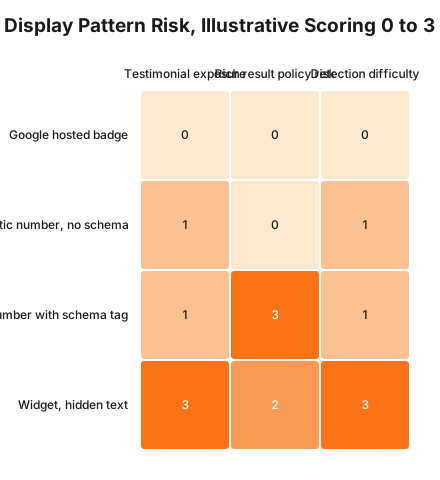
This is a judgement model built from the rule as reported above and Google’s own review snippet policy, not a measured audit of any named product. Zero is lowest risk, three is highest.
Choosing a Display Pattern
| Pattern | What it shows | Testimonial risk | Search snippet value |
|---|---|---|---|
| Google hosted badge or link | Number and count, hosted by Google | Lowest | None on your own page, the rating lives on Google’s surface |
| Static number, no schema | Number and count, typed by hand | Low | None, no structured data present |
| Number with AggregateRating schema | Number and count, marked up in JSON-LD | Low if no reviewBody present | Rarely eligible, self-serving |
| Reviews widget, text hidden by CSS | Number visually, full text in the DOM | High, text is still published | Not applicable, and the hidden text is a separate audit finding |
| Reviews widget, full text shown | Number and quoted reviews | Highest | Rarely eligible, self-serving |
A Worked Example
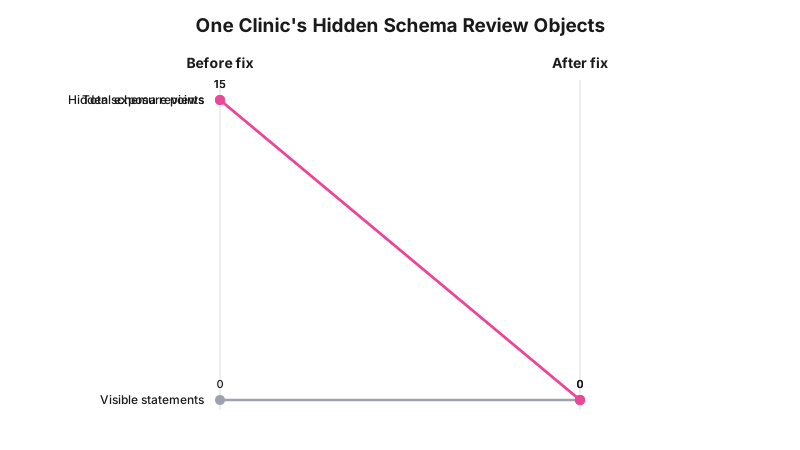
Cosmetic clinic. A clinic replaced a reviews widget with a plain aggregate badge reading its current rating and review count, linking out to its Google Business Profile for anyone who wanted to read further. The visible page looked identical before and after to a casual visitor. Viewing the page source told a different story: the plugin had been writing fifteen Review schema objects into a JSON-LD block on every page load, each carrying the full text of a review, none of it ever rendered on screen. Turning off the plugin’s structured data output removed all fifteen without touching the visible badge.
Dental practice. A dental practice’s booking page carried a static, hand-typed line reading its Google rating and review count, updated by whoever ran the front desk whenever they remembered. Nobody had checked it in over a year, and the number no longer matched the profile. The practice moved to Google’s own embeddable badge instead, which updates itself and removes the manual-accuracy problem entirely, at the cost of a small amount of setup time.
What to Check on Your Own Site
- View the rendered page source, not the design editor, on every page carrying a rating badge.
- Search that source for
application/ld+json,Review, andreviewBody. Any of the three is worth investigating further. - Run the page through Google’s Rich Results Test tool and read what it reports the page is marking up, not just what loads on screen.
- Check the plugin or theme’s settings after every update. A setting that was off can reset to on without any visible change to the page.
- Confirm the number itself is current if it is typed by hand rather than pulled live.
The Enforcement Anchor
No published AHPRA determination, Board disciplinary outcome or court decision names a clinic’s star rating badge specifically. Saying so plainly is more useful than implying a case exists when it does not. What is on the record is the general enforcement mechanism: AHPRA’s guidelines state that National Boards and AHPRA can deal with inappropriate advertising through disciplinary processes where conduct is considered unsatisfactory, and through prosecuting breaches of the advertising provisions in the National Law through the courts where prosecution guidelines are met. The complaint and hotline volumes in the first chart above show that mechanism getting used at scale on advertising and testimonial issues generally, even without a case that turns on a rating badge alone.
Where This Gets Hard
AHPRA has not published guidance that draws a bright line between a bare number and a number sitting inside framing language. “Rated excellent by our patients” printed next to a star badge starts to look like a statement rather than a fact, and nothing in the guidelines tells a clinic exactly where that line sits.
The bigger operational problem is that this is not a one-time fix. Theme and plugin updates can silently re-enable a setting that was previously off, and a new starter building a landing page can install a different reviews plugin with different defaults without knowing the last one was deliberately configured. Treat this as something to check on a schedule, not something to fix once and forget.
The regulator says advertising a regulated health service must not use testimonials, meaning statements about a clinical aspect of care; the build consequence is that a bare aggregate rating with no review text anywhere in the page, including hidden markup, is the safer pattern; whether a specific rating display on your own site meets that standard is a question for your medical defence organisation or your lawyer.
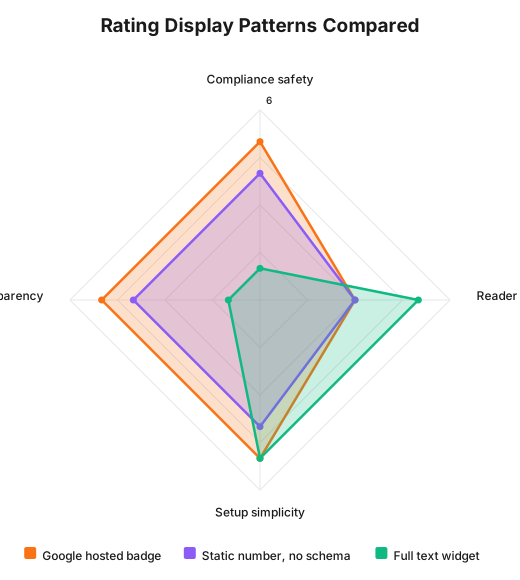
Again, this is a judgement scale built from the pattern comparison above, not a measured survey. Higher is better on every axis.
Status
As at 16 September 2026, section 133 of the Health Practitioner Regulation National Law is in force nationally, and AHPRA’s guidelines for advertising higher risk non-surgical cosmetic procedures have applied since 2 September 2025. Google’s self-serving review policy for structured data is the platform’s own operational rule rather than a law, and it can change on Google’s own schedule without notice.
Frequently Asked Questions
Can a clinic show a Google star rating without breaching the testimonial rule?
Generally yes. The testimonial prohibition in section 133 of the National Law and AHPRA’s advertising guidelines describe testimonials as statements about a clinical aspect of a service. A bare number and a review count carry no clinical statement, so the pattern that most clinics land on safely is an aggregate rating with no review text anywhere on the page, visible or hidden.
Does an AggregateRating schema tag help my star rating show up in Google search results?
Usually not, and it can create a separate problem. Google’s structured data guidelines say a page is ineligible for the star review rich result if the entity being reviewed controls the reviews about itself, which describes almost every clinic marking up its own aggregate rating. The badge still helps a visitor who lands on the page, it just will not reliably earn stars in Google’s organic results.
My reviews plugin says it only shows the rating, is that enough to check?
No. Many plugins render a visual badge but still write full review objects, including review text, into a JSON-LD script block in the page’s source code. That block is invisible on screen but fully readable by anyone who views source, including an automated scan. Check the rendered HTML, not just what appears on the page.
Does this apply the same way to a dental practice as a cosmetic clinic?
Yes. Section 133 governs advertising a regulated health service, and dentistry and cosmetic medicine are both regulated health services under the National Law. The same aggregate-only pattern, and the same schema check, applies whether the practice is a dental clinic or a cosmetic injectables clinic.
Is a manually typed star rating safer than a live widget?
It removes the live-pull risk, since nothing is scraping review text into your page automatically, but it introduces an accuracy obligation instead. A number that goes stale or was never accurate risks a separate misleading-conduct question under the Australian Consumer Law, on top of whatever the National Law says about testimonials.
Get Your Rating Display Audited
Get in touch with RockingWeb to check your page source for hidden schema review text, not just what the page renders on screen, and get a written report of what it finds.
Sources
- AHPRA - Guidelines for advertising higher risk non-surgical cosmetic procedures, date of issue 2 September 2025, including scope and dealing with non-compliance. Checked 16 September 2026.
- Federal Register of Legislation - Health Practitioner Regulation National Law, section 133. Checked 16 September 2026.
- Google Search Central - Review snippet structured data guidelines, including the self-serving reviews restriction for LocalBusiness and Organization types. Checked 10 August 2026.
- AHPRA - Announcement citing notification and cosmetic surgery hotline volumes, September 2022 to March 2025. Checked 16 September 2026.
Last reviewed: 16 September 2026.
Vikas Thakur
Founder of RockingWeb. 16 years of experience from working at TPG, iiNet and Monadelphous, now building websites, software and digital marketing for local businesses in Rockingham and Perth.