Why You Cannot Embed a Reviews Widget on a Health Website
A Google reviews widget pulls whatever patients wrote, including clinical outcomes. Section 133 of the National Law bans testimonials in advertising a regulated health service. An automated widget cannot filter for that, which is the whole problem.
 Vikas Thakur Founder, RockingWeb 8 min read
Key Takeaways
- Section 133 of the National Law governs advertising a regulated health service, and the testimonial prohibition is the provision clinics breach most
- A review left unprompted on a platform you do not control is generally not your breach. Embedding it on your own site is
- A reviews widget is an automated republisher. It cannot distinguish a comment about parking from a comment about a treatment outcome
- Filtering to five stars makes it worse: it does not remove clinical content, and selective display raises a separate consumer law problem
- The lower-risk patterns are an aggregate rating with no review text, or non-clinical written feedback you curate manually
- AHPRA’s advertising guidelines apply to practitioners, non-registered individuals, and corporate entities, so “the company posted it” is not a defence
A reviews widget is a piece of software whose entire job is to take what patients wrote about your clinic and publish it on your website automatically. Section 133 of the National Law restricts advertising a regulated health service, and the testimonial prohibition is the part that catches clinics.
Put those two sentences next to each other and the conflict is structural. It is not a configuration problem you can solve with better settings, because the widget’s purpose is the thing the rule restricts.
What the Guidelines Actually Say
AHPRA’s guidelines for advertising higher risk non-surgical cosmetic procedures, date of issue 2 September 2025, are explicit about who they bind. They apply to those advertising higher risk cosmetic procedures performed by registered health practitioners, and that includes registered health practitioners, individuals who are not registered health practitioners, and businesses, partnerships and corporate entities.
That scope matters here. A clinic sometimes reasons that the practice company installed the widget rather than the practitioner, so the practitioner is not advertising. The guidelines close that off: the corporate entity is squarely within scope.
The guidelines also set out that they describe types of advertising the National Boards consider will contravene section 133, which applies to all advertisers, alongside professional expectations of registered practitioners, and that the two can overlap.
Control Is the Line
The distinction that actually decides most cases is control.
| Scenario | Your channel | Breach risk |
|---|---|---|
| Patient posts a review on Google, unprompted | No | Low for the clinic |
| Clinic replies to that review thanking them for the outcome | Yes, the reply is yours | Raised |
| Clinic embeds a widget pulling that review onto its site | Yes | High |
| Clinic screenshots the review for Instagram | Yes | High |
| Clinic asks patients to mention their treatment in reviews | Yes, solicitation | High |
The review itself is not the clinic’s advertising. The act of bringing it onto a surface the clinic controls is.
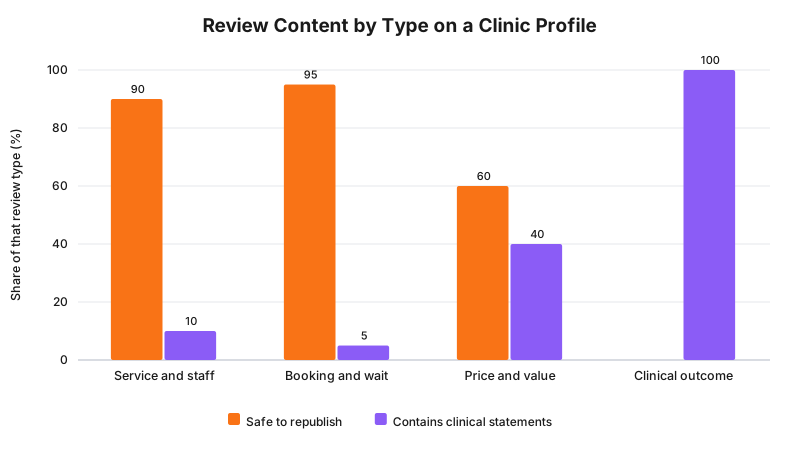
This is an illustrative model of review composition, not an audit of any clinic’s profile. The point it encodes is that clinical statements are concentrated in exactly the reviews a clinic most wants to display.
Why the Widget Cannot Be Fixed
To be compliant, a widget would need to classify each review as clinical or non-clinical before display, and hold that classification when the review is later edited. Widgets sort by recency and rating. None of the mainstream ones classify by clinical content, and a sentiment filter is not a clinical-content filter.
There is also a timing problem. A widget pulls live. A review that is compliant today can be edited tomorrow to add “and my filler results were amazing”, and it publishes to your site the moment it changes, with no human in the loop.
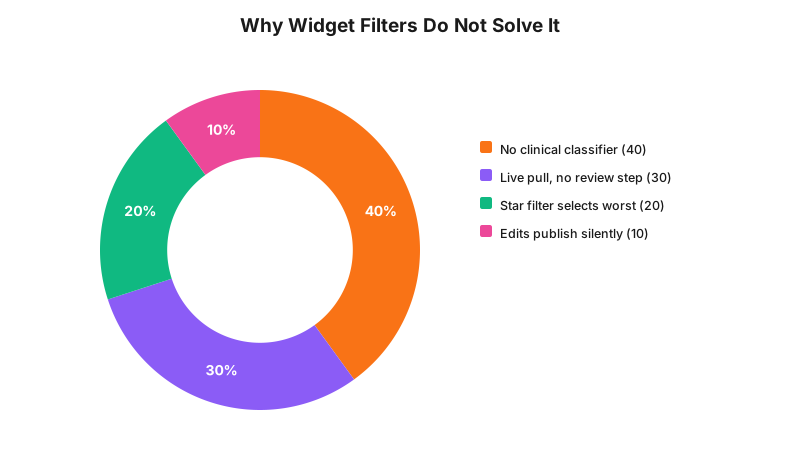
The weightings are a judgement about which failure mode dominates, not measured data. All four are present in every mainstream widget we have examined.
What That Means for the Build
Three patterns work, in descending order of usefulness.
1. Aggregate rating only. Display a star rating and a review count, with no review text and no link that pulls text onto your page. This keeps the social proof and removes the published clinical statements. Frame it plainly and do not editorialise around it.
2. Curated non-clinical feedback. Collect written feedback through your own form, ask specifically about the experience rather than the result, and publish only what a human has read and approved. Store the approval decision so you can show your process later.
3. Remove and redirect. Take the widget off and link to your public profile instead. A link to Google is not republication.
| Pattern | Keeps social proof | Removes clinical statements | Needs a human |
|---|---|---|---|
| Aggregate rating only | Mostly | Yes | No |
| Curated non-clinical | Yes | Yes, if done properly | Yes, every item |
| Link out to profile | Partly | Yes | No |
| Widget with star filter | Yes | No | No |
A Worked Example
Cosmetic clinic. A clinic ran a widget showing its most recent ten Google reviews. Six mentioned a treatment by name and four described outcomes. Replaced with an aggregate rating and a link to the profile. The homepage kept its rating, and the six published testimonials came off the site the same afternoon.
Dental practice. A practice collected written feedback via its own form with the prompt “How was your visit?“. Responses about parking, reception and appointment times were publishable. Responses describing veneer results were not, and the form now says so above the field, which reduced the number of unusable submissions substantially.
What to Check on Your Own Site
- Find every page with embedded review text, including the footer, which is the commonly forgotten one.
- Read the ten most recent displayed reviews. Do any mention a symptom, a treatment or a result?
- Check your social feed embeds. A feed pulling your own Instagram can republish comments too.
- Look at how you solicit reviews. Does your request template invite people to describe their results?
- Check your Google Business Profile replies. Your reply is your content even when the review is not.
The Enforcement Anchor
AHPRA’s guidelines state plainly that National Boards and Ahpra can deal with inappropriate advertising through Board disciplinary processes where conduct is considered unsatisfactory, and through prosecuting breaches of the advertising provisions in the National Law via the court system where prosecution guidelines are met.
That is the enforcement mechanism on the record. A published Australian decision turning specifically on an embedded reviews widget is not something we can point to, and pretending otherwise would be exactly the kind of overclaiming this category exists to avoid.
Where This Gets Hard
The commercial pressure is real and should be acknowledged. Reviews convert, competitors in unregulated adjacent industries display them freely, and a clinic that removes its widget can watch a beauty salon down the road keep theirs. That asymmetry is a consequence of being a regulated health service, not a loophole to find.
The regulator says advertising a regulated health service must not use testimonials about clinical aspects; the build consequence is that automated republication of patient reviews on your own channels has to stop; whether a specific review is a testimonial in your circumstances is a question for your medical defence organisation or your lawyer.
Status
In force. Section 133 of the National Law is current, and AHPRA’s advertising guidelines for higher risk non-surgical cosmetic procedures carry a date of issue of 2 September 2025 and are in effect now. Nothing here is pending commencement.
Frequently Asked Questions
Are patient reviews on Google a breach of the advertising rules?
A review a patient posts unprompted on a platform the clinic does not control is generally not a breach by the clinic. The exposure begins when the clinic republishes, embeds or otherwise adopts that content on a channel it does control, because that is advertising by the clinic. The distinction is control and adoption, not where the words were first typed.
What counts as a testimonial under section 133?
Broadly, a statement referring to a clinical aspect of a service: a symptom, a diagnosis, a treatment, or an outcome. A comment about parking, reception staff or how easy the booking form was is generally not clinical and is not a testimonial in that sense. The problem with an automated widget is that it cannot tell the two apart.
Can I embed a reviews widget if I filter to five-star reviews only?
Filtering by star rating makes the problem worse in two directions. It does not remove clinical content, since five-star reviews are the most likely to describe a great outcome, and selectively displaying only positive reviews raises a separate misleading-conduct issue under the Australian Consumer Law.
Can I show a star rating without the review text?
An aggregate rating with no clinical statements displayed is a materially lower-risk pattern, and many clinics land there. It is not risk-free, because how the rating is framed still matters, but it removes the specific problem of publishing patient statements about outcomes on a channel you control.
Get Your Review Surfaces Audited
Get in touch with RockingWeb to find every surface on your site publishing patient statements, including widgets, feed embeds and footers.
Sources
- AHPRA - Guidelines for advertising higher risk non-surgical cosmetic procedures, date of issue 2 September 2025, including scope and dealing with non-compliance. Checked 10 August 2026.
- Federal Register of Legislation - Health Practitioner Regulation National Law, section 133. Checked 10 August 2026.
- ACCC - Guidance on online reviews and testimonials. Checked 10 August 2026.
Last reviewed: 10 August 2026.
Vikas Thakur
Founder of RockingWeb. 16 years building for companies like TPG, iiNet and Monadelphous, now focused on websites and marketing that comply with AHPRA's advertising guidelines and still book patients.