AHPRA's 2 Sep 2025 Rule: Fix Your Treatment Page
AHPRA's higher-risk cosmetic procedure advertising guideline banned testimonials and set new page requirements from 2 September 2025. Here is the treatment page template that actually complies.
 Vikas Thakur Founder, RockingWeb 13 min read
On this page 10
- What AHPRA’s higher-risk guideline actually says
- What this means for your treatment page build
- Standard treatment page vs higher-risk procedure page
- Worked example: an anti-wrinkle injection page
- What to check on your own site
- The rule already has teeth
- Where this gets hard
- Status
- Frequently Asked Questions
- Sources and references
Since 2 September 2025, AHPRA bans testimonials and influencer promotion on treatment pages advertising higher-risk non-surgical cosmetic procedures such as fillers, thread lifts and veneers.
If you run a cosmetic clinic website and that sentence made you think about your reviews widget, you are already ahead of most of the industry. AHPRA and the National Boards published a single, consolidated advertising guideline for higher-risk non-surgical cosmetic procedures, effective 2 September 2025. It bans testimonials outright, sets mandatory disclosure content, and restricts before and after imagery. Most cosmetic clinic and cosmetic dentistry websites still run a generic treatment page template built for a pre-2025 rulebook, with a Google Reviews carousel sitting two scrolls below a before and after gallery. This post is the build fix, not the legal explainer: what the guideline actually requires, what that means for your page template, and a checklist to run against your own site today.
Key takeaways
- AHPRA’s higher-risk non-surgical cosmetic procedure advertising guideline took effect 2 September 2025 and bans testimonials, including paid or gifted influencer testimonials.
- The guideline applies to every registered health practitioner except medical practitioners, who stay under the Medical Board of Australia’s separate 2023 cosmetic guidelines.
- Procedures named as higher risk include cosmetic injectables, injection lipolysis, thread lifts, sclerotherapy, platelet-rich plasma procedures, hair transplants and dental veneers.
- AHPRA investigated about 360 notifications about non-surgical cosmetic procedures between September 2022 and March 2025, closing about 300, alongside more than 1,500 calls to its cosmetic surgery hotline in the same period.
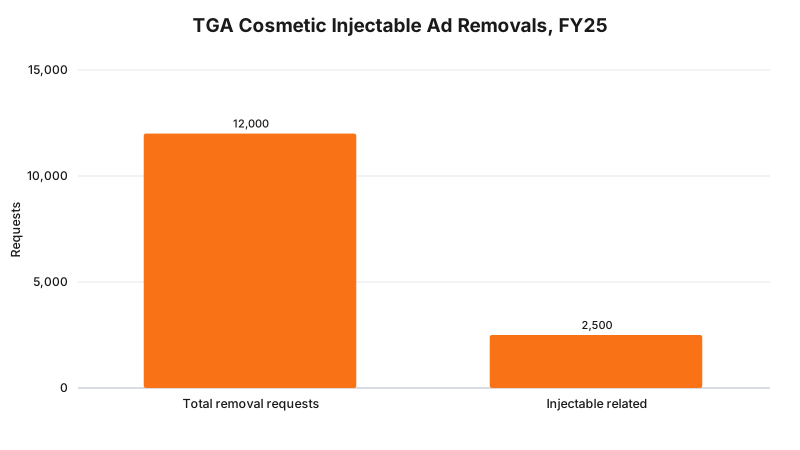
- The TGA logged more than 12,000 social media removal requests in one financial year, over 2,500 of them tied to cosmetic injectable products.
- The guideline requires registration details, risk information and recovery times on the page, and bans marketing phrases such as “world renowned”, “safe”, “painless” and “restore self-esteem”.
What AHPRA’s higher-risk guideline actually says
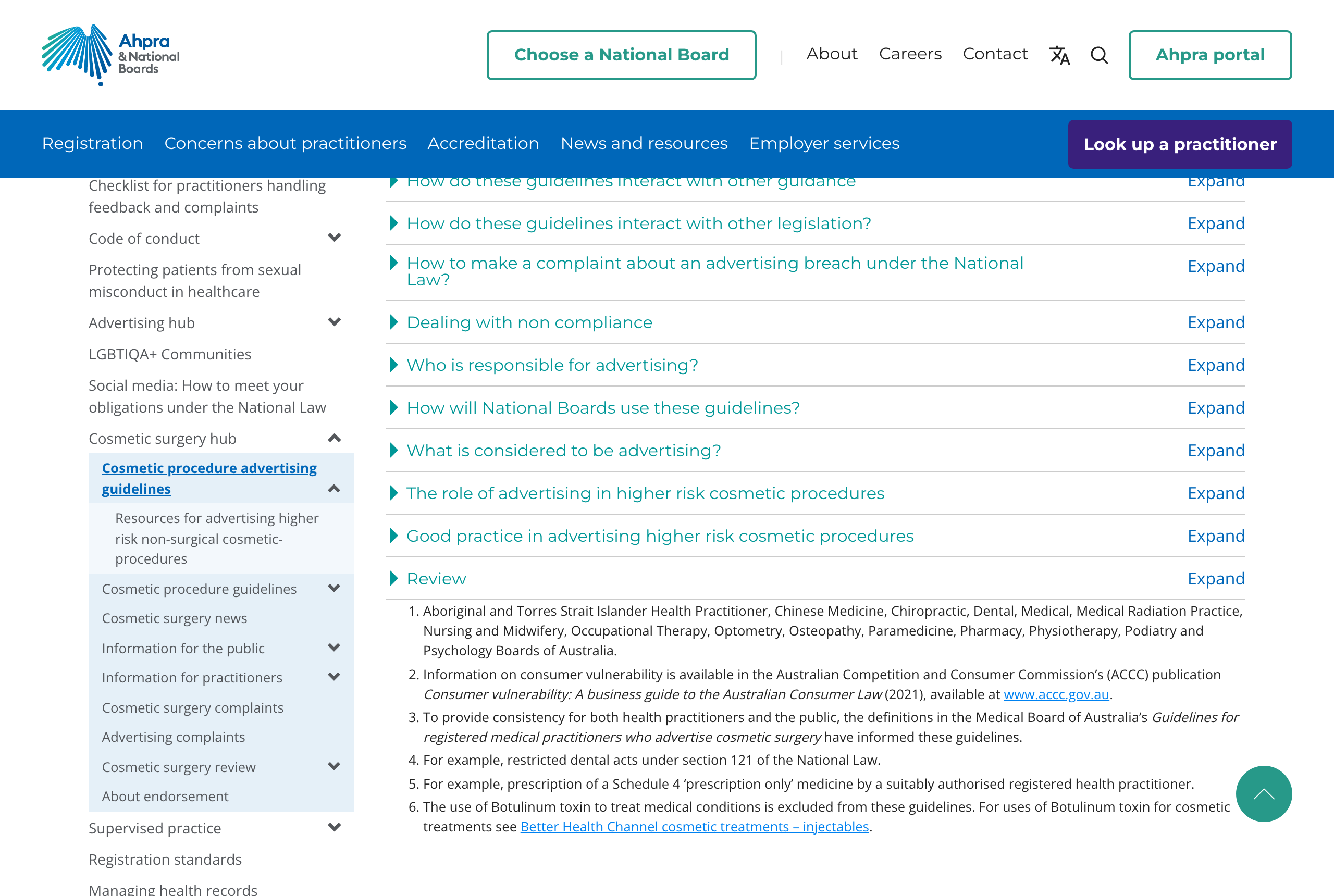
AHPRA and the National Boards publish the rules directly: Guidelines for advertising higher risk non-surgical cosmetic procedures, in effect from 2 September 2025. The guideline replaced an older, less specific set of expectations with a named list of covered procedures and a much harder line on testimonials.
The higher-risk procedures named in the guideline and its supporting resources include cosmetic injectables (such as botulinum toxin and dermal fillers), injection lipolysis, thread lifts, sclerotherapy and microsclerotherapy, procedures using platelet-rich plasma or other blood-derived products, hair transplants, and dental veneers, per coverage of the guideline’s supporting resources reported by MDA National and Clayton Utz.
For a page advertising one of those procedures, the guideline requires:
- Registration details for the treating practitioner, including their registration number.
- Information on risks, recovery times and warnings, stated on the page rather than left to a consent form the patient sees after booking.
- No testimonials of any kind, including influencer testimonials whether paid or gifted, and no liking, sharing or leaving up a testimonial posted by someone else on a linked third-party page.
- No automated tools that predict a patient’s appearance after the procedure.
- No advertising targeted at people under 18, and adult content labelling where the platform requires it.
- No use of superlative or reassurance language such as “world renowned”, “safe”, “painless”, “happier you” or “restore self-esteem”, per the examples reported by MDA National above.
One correction that changes who this applies to: the guideline covers every registered health practitioner except medical practitioners. Medical practitioners, including cosmetic physicians who hold medical registration, stay under the Medical Board of Australia’s own 2023 cosmetic surgery guidelines, a separate document with its own advertising rules. A nurse practitioner, dentist, or other non-medical registered health practitioner advertising a higher-risk procedure sits under the September 2025 guideline covered here. If your clinic has a mixed team of nurses and doctors performing the same procedure list, you may be running two different advertising standards on two different practitioner bio pages, and your template needs to know which one applies to which byline.
This is not a small compliance backwater. AHPRA reports investigating around 360 notifications about non-surgical cosmetic procedures between September 2022 and March 2025, closing about 300 of them, plus more than 1,500 calls to its dedicated cosmetic surgery hotline over the same period, per AHPRA’s own announcement.
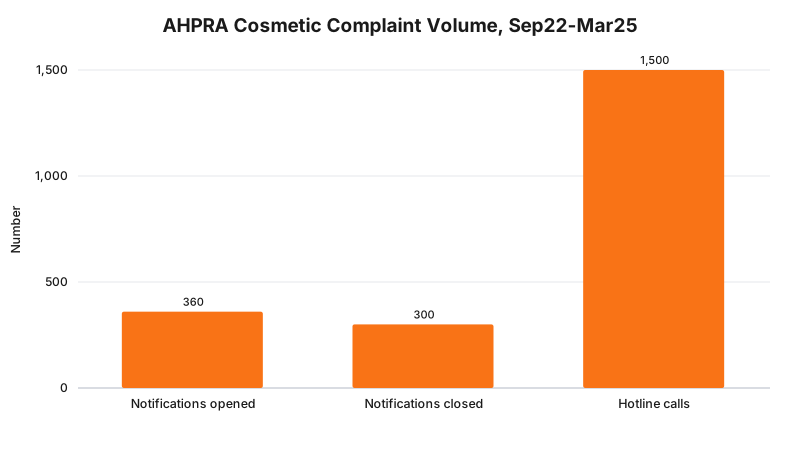
That volume is why a generic “add a disclaimer paragraph” fix will not hold up. AHPRA is actively working a backlog in exactly this category.
Takeaway: the guideline names specific procedures and bans testimonials outright, and it applies to everyone except medical practitioners, who follow a separate rulebook.
What this means for your treatment page build
Read as a legal document, the guideline is a list of dos and don’ts. Read as a build brief, it is a content model change. Here is what that looks like in practice.
Flag the content type. Add a boolean field, something like isHigherRiskProcedure, to your treatment page content model or CMS collection. Every template decision below hangs off that flag, and you want it settable per page, not inferred from a category slug that might drift.
Build a disclosure block as a component, not a paragraph. Registration number, risk summary, recovery time and warnings need a dedicated component that renders near the top of the page, above the fold on desktop, not inside a collapsed accordion at the bottom next to the FAQ. The guideline is about informing the reader before they decide, not after.
Kill the testimonial widget conditionally, not manually. Most clinic sites run a sitewide reviews carousel, a Google Reviews embed, or a Facebook Recommendations plugin as a global partial. That partial needs a conditional check against your isHigherRiskProcedure flag before it renders, and the same check needs to cover any third-party embed your team did not build (Elfsight, Trustpilot widgets, and similar). “We removed the reviews from that one page” is not the same as “the reviews module cannot render on that page.”
Rebuild the before and after gallery as a reviewed component. A free-upload image field invites exactly the problem the guideline targets: unfiltered claims dressed as evidence. Build the gallery component with mandatory caption metadata (consent reference, realistic outcome disclaimer text) and remove any “virtual try-on” or AI outcome predictor widget from these pages entirely.
Add a banned-phrase check to your publish flow. A simple pre-publish lint, similar in spirit to a content style check, that flags “world renowned”, “safe”, “painless”, “happier you” and “restore self-esteem” in the body copy of any page flagged as higher risk catches what an editor scanning quickly will miss.
Handle age targeting at the platform, not just the page. Excluding under-18 audiences and adding adult content labels is largely an ad platform and social publishing setting (Meta Ads Manager audience controls, TikTok content labelling), not a markup fix. Your build checklist should include a line item for the marketing team’s ad account settings, because a compliant page linked from a non-compliant ad does not solve the problem.
Sequence matters. Put registration details and risk information ahead of price and the booking call to action in the page’s reading order, not after it. That sequencing is defensible when someone asks why the page is built the way it is.
Takeaway: this guideline is a content model and component change, not a copy edit, and the fixes belong in the template, not in one page at a time.
Standard treatment page vs higher-risk procedure page
| Template element | Standard treatment page | Higher-risk procedure page |
|---|---|---|
| Testimonials and reviews widgets | Allowed, subject to the general National Law advertising rules | Banned entirely, including influencer and third-party reposts |
| Before and after images | Optional, general disclaimer sufficient | Restricted, consent-tracked component, no outcome predictor tools |
| Practitioner registration number | Good practice, not always mandatory | Mandatory, visible on page, not schema markup alone |
| Risk, recovery and warning content | Optional or in consent paperwork only | Mandatory on the page, above the fold where practical |
| Marketing superlatives (“safe”, “painless”) | Discouraged | Explicitly banned by name in the guideline |
| Under-18 ad targeting and content labels | Not addressed by this guideline | Excluded from targeting, labelled where the platform requires it |
Worked example: an anti-wrinkle injection page
Picture a cosmetic clinic’s existing “Anti-wrinkle injections” page. The current build has a hero image, a three-paragraph benefits pitch, a five-star Google Reviews widget under the hero, a before and after slider halfway down, a price list, and a booking button. The practitioner’s name appears once, in a byline with no registration number.
Under the September 2025 guideline, that page needs to change in four concrete ways: the reviews widget is removed from the template for this page type, not just deleted from the page (the flag-based conditional above); a disclosure block naming the treating nurse or practitioner, their registration number, common risks, and typical recovery time moves above the price list; the before and after slider is rebuilt as the consent-tracked component with a disclaimer caption; and any copy using words like “painless” or “safe” is rewritten to describe what actually happens (injection sites, typical duration of effect, when to expect results) instead of making a reassurance claim.
The same logic applies to a cosmetic dentistry veneers page, since dental veneers are named directly in the guideline’s list of higher-risk procedures. A dentist’s veneers landing page needs the identical disclosure block, the identical testimonial ban, and the identical before and after restrictions, built off the same isHigherRiskProcedure flag rather than a separate one-off dental template.
Takeaway: the fix is the same four changes on every higher-risk page, which is exactly why it belongs in the template, not a page-by-page cleanup project.
What to check on your own site
- Search your CMS for every treatment page that mentions injectables, thread lifts, sclerotherapy, PRP, hair transplants or veneers, and confirm each one is flagged as higher risk in your content model.
- Load each flagged page and check whether a reviews widget, testimonial quote block, or third-party review embed still renders anywhere on the page, including the footer and sidebar.
- Confirm the treating practitioner’s registration number appears as visible page text, not only inside schema markup.
- Confirm risk, recovery time and warning information appears on the page itself, not only inside a PDF consent form linked from the page.
- Search your page copy for “world renowned”, “safe”, “painless”, “happier you” and “restore self-esteem”, and rewrite any match.
- Check whether any before and after gallery on a flagged page includes an AI-based outcome predictor or “virtual try-on” feature, and remove it if so.
- Check your ad platform’s audience settings for higher-risk procedure campaigns to confirm under-18 exclusion is switched on.
The rule already has teeth
The Therapeutic Goods Administration, a separate regulator from AHPRA, is the one publishing enforcement outcomes in this space, and it names its Compliance Principles 2026 to 2027 cosmetic injectables as a stated priority for the full two-year window. Through late 2025 and into 2026, the TGA issued a run of infringement notices to registered nurses, several tied to unlawful importation of unapproved cosmetic injectables and unlawful advertising of prescription-only medicines on social media, with individual notice totals reported in the roughly $6,000 to $12,000 range per case, per the TGA’s own infringement notices register. In one financial year the TGA also logged more than 12,000 social media removal requests, over 2,500 of them relating to cosmetic injectable products, per the TGA’s updated social media advertising guidance released 5 November 2025.
AHPRA’s own testimonial and misleading advertising rules sit in section 133 of the Health Practitioner Regulation National Law. Penalty figures for a section 133 breach vary by the state adoption and have changed over time; secondary sources circulate different dollar amounts for individuals and bodies corporate. The regulator says a breach is prosecutable and penalised; the build consequence is that a testimonial widget left running on a flagged page is not a cosmetic oversight, it is the exact conduct section 133 targets. Whether a specific past breach on your site meets the legal threshold is a question for your medical defence organisation or your lawyer, not a web build checklist.
Takeaway: TGA enforcement in this exact procedure category is active and recent, even though AHPRA has not yet published a public determination naming a website specifically under the new September 2025 guideline.
Where this gets hard
The guideline gives named examples of higher-risk procedures. It does not give an exhaustive, testable definition that a developer can run as a rule against every possible treatment name on a clinic’s price list. A borderline procedure, a new treatment your clinic just added, or a combination treatment page covering both a named higher-risk item and an unrelated service will need a human compliance decision before your build team can set the flag correctly. Build the flag as an editable field a practice manager sets, not as something your code tries to infer from a treatment name string.
The other hard edge is enforcement visibility. AHPRA does not publish a public register of every advertising breach outcome the way the TGA publishes infringement notices, so a build team cannot point to a named AHPRA case against a clinic website under this specific guideline yet, only to the volume of notifications AHPRA reports handling and the parallel TGA enforcement record above. That is a genuine gap in the evidence, not a reason to treat the rule as untested.
Status
In force. AHPRA’s Guidelines for advertising higher risk non-surgical cosmetic procedures commenced 2 September 2025 and apply now to every registered health practitioner other than medical practitioners, who remain under the Medical Board of Australia’s separate 2023 cosmetic guidelines, current as at 15 August 2026.
Frequently Asked Questions
Does the AHPRA higher-risk guideline apply to dentists advertising veneers?
Yes. Dental veneers are named as a higher-risk non-surgical cosmetic procedure in AHPRA’s guideline, and dentists are registered health practitioners covered by the consolidated September 2025 rules, not the separate Medical Board guideline that applies only to medical practitioners.
Do I need to add an age gate to every treatment page on my site?
Only pages advertising a higher-risk non-surgical cosmetic procedure need to exclude under-18 targeting and, where the platform requires it, carry an adult content label on social posts. Whether a specific procedure on your site counts is a question for your medical defence organisation or your lawyer.
Can I still show before and after photos on a higher-risk treatment page?
The guideline restricts how before and after images can be used rather than banning them outright, and bans automated tools that predict a patient’s appearance after a procedure. The safest build approach is a reviewed, consent-tracked image component rather than a free-upload gallery field.
Sources and references
- AHPRA, “Guidelines for advertising higher risk non-surgical cosmetic procedures” (effective 2 September 2025), ahpra.gov.au. Date checked: 15 August 2026 (page blocks automated fetching; content cross-verified against the AHPRA announcement and legal-firm summaries below).
- AHPRA, “Booming billion-dollar cosmetic industry on notice with new cosmetic procedures guidelines” (3 June 2025), ahpra.gov.au. Date checked: 15 August 2026.
- Clayton Utz, “Navigating the 2025 AHPRA Guidelines on Cosmetic Procedures”, claytonutz.com. Date checked: 15 August 2026.
- MDA National, “Advertising (non-surgical) cosmetics: new rules”, mdanational.com.au. Date checked: 15 August 2026.
- Health Practitioner Regulation National Law (NSW), section 133, Advertising, austlii.edu.au. Date checked: 15 August 2026.
- Therapeutic Goods Administration, infringement notices register, tga.gov.au. Date checked: 15 August 2026 (direct fetch blocked; case figures per TGA’s own published release titles and search-indexed content).
- Therapeutic Goods Administration, “TGA releases updated social media advertising guidance to support improved compliance” (5 November 2025), tga.gov.au. Date checked: 15 August 2026.
Last reviewed: 15 August 2026.
Vikas Thakur
Founder of RockingWeb. 16 years building for companies like TPG, iiNet and Monadelphous, now focused on websites and marketing that comply with AHPRA's advertising guidelines and still book patients.