What the Meta Pixel Sends From a Cosmetic Clinic Booking Page
A Meta Pixel on a cosmetic clinic booking page does not just count conversions. It transmits the URL, and a URL like /book/anti-wrinkle-injections carries a health inference about a named browser. Here is exactly what leaves the page, and how to stop it.
 Vikas Thakur Founder, RockingWeb 9 min read
Key Takeaways
- The Meta Pixel transmits the page URL on every fire. A URL like
/book/anti-wrinkle-injectionscarries the treatment name off your site by design - Under the Privacy Act, health information includes an inference about a person’s health, so a treatment-named URL plus a persistent identifier is the exposure, not the pixel script itself
- Health service providers have no turnover exemption. A two-chair clinic is covered on the same terms as a hospital group
- The fix is URL structure plus firing rules, not a cookie banner. Generic booking URLs, and a pixel blocked from treatment paths, remove the inference at the source
- Consent under Australian privacy law must be voluntary, informed, current, specific and given by someone with capacity. A pixel that fires before the banner is answered fails that test
- This is an in-force obligation, not a proposal. The Australian Privacy Principles have applied to health service providers since 2014
Open your clinic’s booking page, open your browser’s network tab, filter for facebook, and read the request. You will see a dl parameter carrying the full page URL. If that URL is /book/anti-wrinkle-injections, you have just watched a treatment name leave your website attached to a persistent identifier, on a page a patient reached because they intend to have that treatment.
That is the whole problem, and it is not a problem with the Meta Pixel. It is a problem with your URL structure. The pixel is doing exactly what it says it does. Nobody configured it to send health data, and yet health data is what it is sending, because the URL is part of the default payload and the URL happens to name a Schedule 4 cosmetic treatment.
What Actually Leaves the Page
The pixel’s base code fires a PageView on load. That request carries, at minimum:
| Parameter | What it holds | Why it matters here |
|---|---|---|
dl | The full current page URL | Carries the treatment name if your URL does |
rl | The referrer URL | Carries the previous page, often a treatment page |
fbp | First-party browser cookie | Persistent identifier for this browser |
fbc | Click identifier from fbclid | Links the visit to an ad click and an account |
ud | Advanced Matching fields | Hashed email or phone, where enabled |
None of those are optional extras a developer switched on. dl, rl and fbp are default behaviour. Advanced Matching is a toggle, and where a clinic has enabled it and the booking form is on the same page, hashed contact details can be included too.
The pixel does not read your practice management system. It never sees a clinical note. What it sees is a URL and an identifier, and under Australian privacy law that pairing is enough.
Why a URL Is Health Information
The Privacy Act treats health information as a subset of sensitive information, and sensitive information attracts a higher standard than ordinary personal information. The definition is broader than most clinic owners expect. It covers information or an opinion about an individual’s health, including an inference, not only a diagnosis recorded by a practitioner.
Nothing in that definition requires the information to be accurate, clinical, or recorded in a health record. A signal that supports an inference that an identified person is seeking a particular treatment is health information about that person.
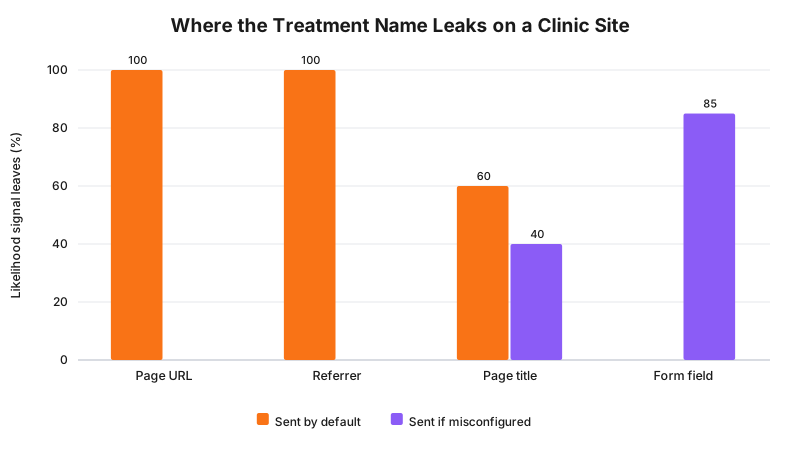
The chart above is a build model, not a measured study. It reflects what the pixel’s documented default payload includes versus what only leaves when a tag manager or Advanced Matching is configured to capture it.
What That Means for the Build
There are three levers, and they work in this order.
1. Change the URL structure. This is the only fix that removes the exposure rather than managing it. A booking flow that runs on /book/step-1, /book/step-2, /book/confirm carries no treatment name at any step. Hold the selected treatment in session state or a POST body, never in the path or the query string.
2. Block the pixel on treatment paths. Where existing URLs cannot change without losing rankings, prevent the pixel from firing on those paths. In Google Tag Manager this is a trigger exception on a Page Path matching a regex of your treatment slugs. Do not rely on a blocking rule alone, because a single new treatment page added later will not match your regex and will fire silently.
3. Strip the payload. Where the pixel must fire on a page whose URL you cannot change, override dl and rl with a generic value before the base code runs.
| Approach | Removes the inference | Survives a new page being added | Effort |
|---|---|---|---|
| Generic booking URLs | Yes | Yes | Medium, needs redirects |
| Trigger exception by path | Yes, for matched paths | No | Low |
| Payload override | Yes | Yes, if applied globally | Medium |
| Cookie banner only | No | Not applicable | Low |
A Worked Example
A Perth cosmetic clinic runs /treatments/anti-wrinkle-injections and a booking flow at /book?treatment=anti-wrinkle-injections. The pixel fires on both.
The rebuild moves booking to /book/appointment, holds the treatment selection server-side against a session identifier, and passes only a generic Schedule conversion event with no custom parameters. The treatment pages keep their URLs and their rankings, but the pixel is excluded from them by a path exception, and the conversion still attributes to the ad click through fbc.
Measurement lost: which treatment an individual booked, at the ad platform. Measurement retained: that a booking happened, and which campaign it came from. For most clinics that is the whole reporting requirement anyway.
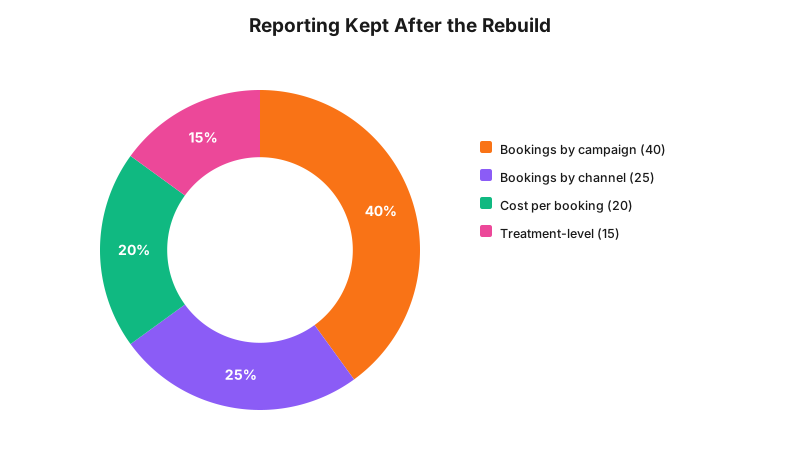
The slice marked treatment-level is the part that moves out of the ad platform and into your own analytics or practice software, where the health inference stays inside systems you control.
What to Check on Your Own Site
- Open a treatment page, open the network tab, filter
facebook.com/tr, and read thedlparameter. Does it name a treatment? - Repeat on every step of the booking flow, including the confirmation page. Confirmation pages are the most commonly missed.
- Check whether Advanced Matching is enabled in Events Manager, and whether your booking form sits on a page where the pixel is active.
- List every third-party script on the booking flow, not just Meta. The same URL exposure applies to any tag that sends a page URL.
- Check whether the pixel fires before a consent banner is answered. Load the page and watch the network tab without clicking anything.
The Enforcement Anchor
Australia does not yet have a published OAIC determination against a cosmetic clinic specifically for pixel-based health data disclosure, and it would be wrong to imply otherwise. What exists is the general enforcement posture: the OAIC’s determinations register covers health service providers, and the Notifiable Data Breaches scheme treats health information as the sector with the highest reported breach volume year after year.
The honest position is that this is a live exposure with a clear legal basis and no clinic-specific Australian precedent yet. Treating the absence of precedent as an absence of risk is the mistake.
Where This Gets Hard
Two places. First, attribution genuinely degrades when you stop sending treatment-level data, and a clinic running per-treatment ad campaigns will notice. There is no configuration that gives you per-treatment ad optimisation and no health inference at the same time; that is a real trade-off, not a technical gap.
Second, consent. The regulator says sensitive information generally requires consent, and that consent must be voluntary, informed, current, specific and given by someone with capacity; the build consequence is that a banner firing tags before it is answered cannot deliver that consent; whether your specific consent flow is valid for your circumstances is a question for your medical defence organisation or your lawyer.
Status
In force. The Australian Privacy Principles have applied to health service providers regardless of turnover since March 2014. Nothing described here depends on a proposed reform, and the separate automated decision-making transparency obligation commencing 10 December 2026 is a different requirement that does not change any of the above.
Frequently Asked Questions
Does the Meta Pixel send health information from a clinic booking page?
It sends the page URL, the referrer and a set of identifiers on every page view by default. It does not read your database, but where the URL itself names a treatment, such as /book/anti-wrinkle-injections, the combination of that URL and a persistent identifier supports an inference about an identified individual. Under the Privacy Act, health information is an inference about a person’s health, not only a clinical record, so the URL structure is the exposure rather than the pixel itself.
Does a cookie banner make pixel tracking on a clinic site compliant?
Not on its own. Australian privacy law does not have a standalone cookie-consent rule the way the EU does. What it has is a requirement that collection of sensitive information, which includes health information, generally requires consent, and that consent be voluntary, informed, current, specific and given by someone with capacity. A banner that fires the pixel before any interaction, or that bundles all purposes into a single Accept button, does not meet that standard.
Do I have to remove the Meta Pixel from my clinic website entirely?
No. The workable pattern is to keep the pixel on general pages and prevent it from firing on treatment-specific and booking-flow URLs, then send only a generic conversion signal with no treatment detail. That preserves most measurement while removing the health inference from the payload.
Is a small cosmetic clinic covered by the Privacy Act if it turns over less than $3 million?
Yes, where it provides a health service. Health service providers are covered regardless of annual turnover, so the small business exemption that applies to many other businesses does not apply. This has been the position for years and is separate from any proposed future removal of the small business exemption generally.
Get the Tracking Audit
RockingWeb can run a full third-party script inventory: every tag on your booking flow, what each one transmits, and which pages it fires on.
Sources
- OAIC - Australian Privacy Principles. Checked 10 August 2026.
- OAIC - Health information and health service providers. Checked 10 August 2026.
- OAIC - Notifiable Data Breaches scheme. Checked 10 August 2026.
Last reviewed: 10 August 2026.
Vikas Thakur
Founder of RockingWeb. 16 years building for companies like TPG, iiNet and Monadelphous, now focused on websites and marketing that comply with AHPRA's advertising guidelines and still book patients.