Google Ads Conversion Tags and What Your Clinic Site Leaks
Google restricts prescription drug terms in ads, landing pages and keywords, and requires certification for prescription drug services. Your conversion tag sends the landing page URL. If that URL names a Schedule 4 treatment, two separate problems fire at once.
 Vikas Thakur Founder, RockingWeb 7 min read
Key Takeaways
- Google’s healthcare policy restricts prescription drug terms in ads, landing pages and keywords, not just ad copy
- Google requires advertisers to apply and be approved to serve ads for prescription drug services, including telemedicine
- A conversion tag sends the page URL by default. A URL naming a treatment creates a privacy exposure alongside the policy one
- These are two separate problems with one shared cause: treatment names in URLs and labels
- The fix is generic conversion actions plus generic booking URLs, with treatment detail kept in systems you control
- Location-specific restrictions apply, so check the Australian entry rather than reasoning from a US example
There are two distinct failures happening on most cosmetic clinic ad accounts, and because they share a root cause they get confused for one problem.
The first is a Google Ads policy failure: restricted drug terms appearing where the policy does not allow them, including on the landing page. The second is a privacy failure: the conversion tag transmitting a treatment-named URL alongside identifiers. Fixing the ad disapproval does not fix the privacy exposure, and vice versa.
What Google’s Policy Actually Says
Google’s healthcare and medicines policy states that it restricts the use of prescription drug terms in ads, landing pages and keywords, and directs advertisers to check the location-specific restrictions for every location where they plan to advertise.
Separately, the policy covers prescription drug services, restricting promotion of services related to online prescribing, dispensing and sale of prescription drugs, and stating that businesses subject to the policy include but are not limited to online pharmacies and telemedicine providers. Advertisers must apply to serve ads for prescription drug services.
Two consequences follow for a clinic.
| Surface | Assessed by Google | Common clinic mistake |
|---|---|---|
| Ad headline and description | Yes | Usually cleaned up first |
| Keywords | Yes | Brand terms left in as exact match |
| Landing page | Yes | Page still names the Schedule 4 brand |
| Sitelinks and callouts | Yes | Treated as exempt |
The landing page row is the one that generates the most confused support tickets. An advertiser rewrites the ad, resubmits, and gets disapproved again, because the page behind the ad was always the problem.
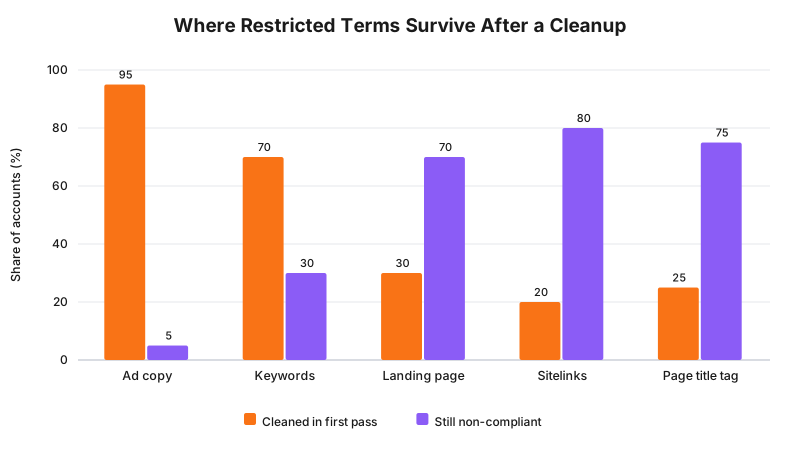
This is a build-experience model of where cleanups stop, not a measured account study. The pattern is consistent: advertisers fix what they can see in the ad editor and miss what sits on the page.
The Second Problem: What the Tag Sends
A Google Ads conversion tag, like any tag, transmits the page URL it fires on. Where your booking confirmation lives at /book/confirm?treatment=dermal-filler, the treatment name goes to the ad platform attached to a click identifier that ties back to an account.
Under the Privacy Act, health information includes an inference about an individual’s health. A signal that an identified person sought a named cosmetic treatment is an inference about their health. Nothing about the tag being a standard marketing tool changes that analysis.
This is the same underlying issue covered for Meta in what the Meta Pixel sends from a booking page; the mechanics differ slightly but the exposure is identical.
What That Means for the Build
One generic conversion action. Define a single conversion, “Booking completed”, with no treatment in the name and no treatment in the custom parameters. Resist the instinct to create one conversion action per treatment; that instinct is exactly what puts health inferences into an ad account.
Generic confirmation URLs. The confirmation page should be /book/confirm, with no query string carrying the selection. Hold the treatment server-side against the session.
Separate advertisable from non-advertisable landing pages. Where a treatment page must name a Schedule 4 substance for patient information purposes, that page should not be an ad destination. Build a separate, policy-clean landing page for the ad, and let the informational page rank organically.
Audit sitelinks and callouts as their own surfaces. They are assessed, they are edited in a different part of the interface, and they are routinely forgotten.
A Worked Example
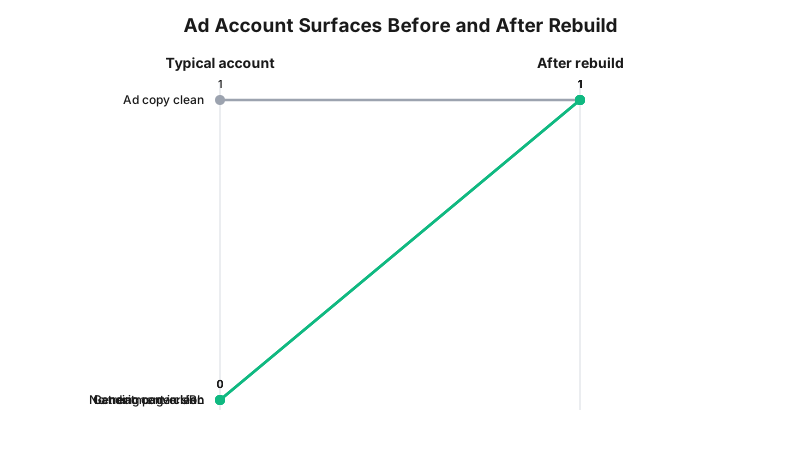
A clinic ran four campaigns, one per treatment, each with a conversion action named after the treatment and each pointing at a treatment page naming the product brand. Ads were disapproved intermittently, which the clinic attributed to inconsistent review.
The rebuild produced four policy-clean consultation landing pages that describe the concern rather than the product, one generic conversion action, and a booking flow with no treatment in any URL. Campaign structure still separates the four treatments, so the clinic can still see which campaign produced bookings. What Google no longer receives is which treatment a specific person booked.
Disapprovals stopped. Reporting granularity at the campaign level was unchanged. Per-treatment automated bidding inside the platform was lost, which is the real cost.
What to Check on Your Own Site
- Open each active ad’s final URL and search the rendered page for Schedule 4 brand names, including in the title tag and meta description.
- List your conversion actions. Does any name a treatment?
- Load a booking confirmation and read the network request to
googleadsorgoogle-analytics. Is a treatment in the URL parameters? - Review sitelinks and callouts separately from ad copy.
- Check the Australian entry in Google’s location-specific healthcare restrictions rather than relying on a general reading.
- Confirm whether anything you advertise falls within prescription drug services, which requires application and approval.
The Enforcement Anchor
The enforcement here is platform enforcement, and it is immediate and observable: disapproval, and in repeated cases account suspension. That is a different mechanism from regulatory enforcement, and it has the useful property that you can see it happening.
On the privacy side, there is no published Australian determination against a clinic for ad-tag health data specifically. The applicable law is clear and enacted; the sector-specific precedent is not there yet, and saying so is more useful than implying it is.
Where This Gets Hard
The trade-off is genuine. Per-treatment conversion data drives per-treatment bidding, and removing it costs optimisation efficiency in a measurable way. A clinic spending heavily on paid search will feel it. There is no configuration that preserves platform-side per-treatment optimisation while removing the health inference, because the inference is the data the optimisation runs on.
Google’s policy also changes without notice, and the location-specific table is the part that changes most. A quarterly re-read is the only reliable control.
Status
In force. Google’s healthcare and medicines policy applies now, as do the Australian Privacy Principles. Google policy is platform terms rather than legislation, so it can change at any time without a commencement date; the Privacy Act obligations behind the second problem are enacted law and are not pending reform.
Frequently Asked Questions
Does Google Ads restrict prescription drug terms on the landing page as well as the ad?
Yes. Google’s healthcare and medicines policy states that it restricts the use of prescription drug terms in ads, landing pages and keywords, with location-specific restrictions that must be checked for every location targeted. The landing page is assessed, not just the ad text, which is why a compliant ad pointing at a page naming a Schedule 4 brand still gets disapproved.
Do I need Google certification to advertise cosmetic injectables in Australia?
Google requires advertisers to apply and be approved to serve ads for prescription drug services, a category covering online prescribing, dispensing and sale of prescription drugs, including telemedicine providers. Whether a given clinic falls inside that category depends on what it actually advertises, so check the location-specific restrictions for Australia before assuming either way.
Is sending a treatment name to Google Ads as a conversion label a privacy problem?
It can be. A conversion label naming a treatment, combined with the identifiers a tag sends by default, supports an inference that an identified individual sought that treatment. Under the Privacy Act health information includes an inference about a person’s health, so the safer pattern is a single generic conversion action with the treatment detail held in your own systems.
Can I keep per-treatment reporting without sending treatment names to the ad platform?
Yes, by moving that reporting into your own analytics or practice software. You lose per-treatment bid optimisation inside the ad platform, which is a genuine trade-off, but you keep the business reporting that most clinics actually use.
Get Your Tags and Landing Pages Checked
Get in touch and RockingWeb will look at both surfaces at once: what your landing pages say, and what your tags transmit.
Sources
- Google Ads - Healthcare and medicines policy, including restricted drug terms and prescription drug services. Checked 10 August 2026.
- Google Ads - Restricted drug terms policy. Checked 10 August 2026.
- OAIC - Australian Privacy Principles. Checked 10 August 2026.
Last reviewed: 10 August 2026.
Vikas Thakur
Founder of RockingWeb. 16 years building for companies like TPG, iiNet and Monadelphous, now focused on websites and marketing that comply with AHPRA's advertising guidelines and still book patients.