TGA's Ad Code Rewrite: 24 Questions, 3 Weeks Left to Respond
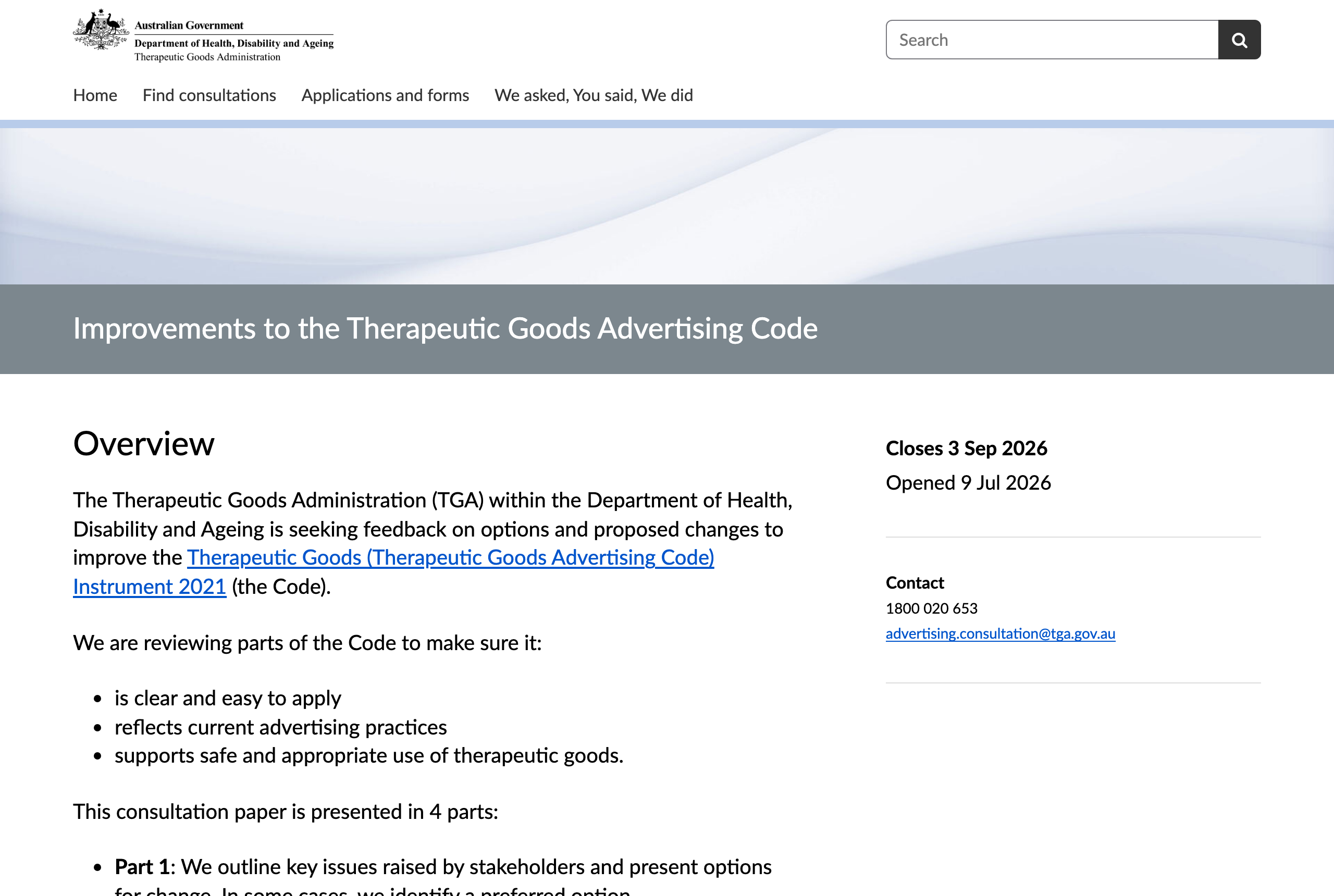
The TGA opened public consultation on rewriting the Therapeutic Goods Advertising Code on 9 July 2026, with submissions closing 3 September 2026. Two of the proposed changes are effectively front-end specs, not legal text, covering how prominently a mandatory statement must display and a brand new warning your treatment pages may need.
 Vikas Thakur Founder, RockingWeb 9 min read
On this page 10
- Key Takeaways
- What the TGA Just Opened for Public Comment
- The ‘Stand Out’ Requirement Is Back On the Table
- A New Content Block: ‘Only Available Through a Health Professional’
- Software, AI, and the Rest of the Paper
- What to Check on Your Own Site Before 3 September
- This Is a Consultation, Not a Law Change, Yet
- FAQ
- Get Your Mandatory Statements Checked Before the Rules Move
- Sources and References
Key Takeaways
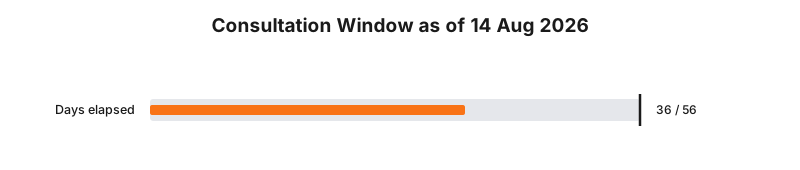
- The TGA opened its public consultation on 9 July 2026 and closes submissions on 3 September 2026, giving clinics roughly 20 days left to respond as of this post’s publish date
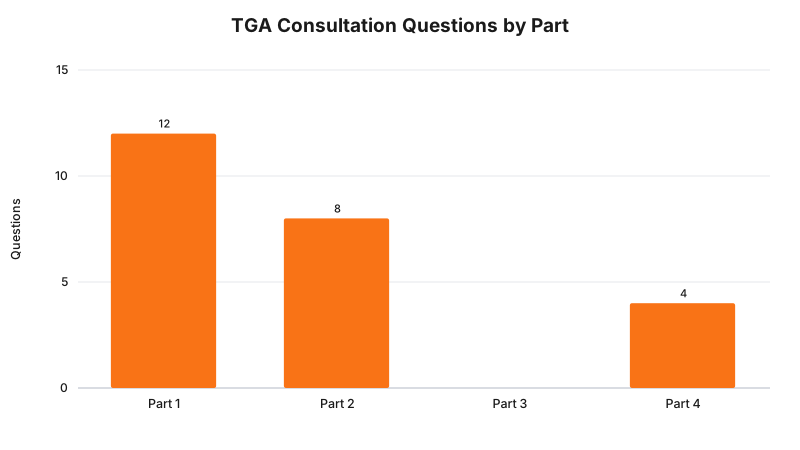
- The consultation paper runs 12 separate issues across 4 parts, carrying 24 numbered questions for stakeholders to answer
- Part 1 alone (the section with the biggest proposed changes) accounts for 12 of the 24 questions
- The TGA’s preferred proposal introduces a brand new mandatory statement: “This product [or treatment with this product] is only available through a [Health Professional]”
- A separate proposal would amend the Code’s definition of “prominently displayed or communicated” to explicitly require visual statements to “stand out”, wording that existed in earlier versions of the Code but is absent from the current one
- Software-based medical devices, including AI-enabled products, are also in scope, with options ranging from a mandatory ARTG number in ads to a dedicated “included in the ARTG” symbol
- Zero of the consultation’s 24 questions sit in Part 3, which covers administrative-only amendments
The Therapeutic Goods Administration wants to put the word “stand out” back into federal advertising law, and it is asking the public to weigh in before 3 September 2026. Two of the changes on the table are not really legal questions. They are front-end specs: how much visual weight a mandatory statement needs, and a brand new sentence some treatment pages may have to carry. The TGA opened this consultation on 9 July 2026, running across 12 issues and 24 numbered questions. If your clinic advertises anything only available through a health professional, or a mandatory statement on your site sits anywhere near a carousel, an accordion, or a dark-mode toggle, this is worth twenty minutes before the window closes.
What the TGA Just Opened for Public Comment
The consultation covers the Therapeutic Goods (Therapeutic Goods Advertising Code) Instrument 2021, the Code governing how therapeutic goods, including many cosmetic treatments, can be advertised in Australia. The TGA says it is reviewing the Code to make sure it “is clear and easy to apply”, “reflects current advertising practices”, and “supports safe and appropriate use of therapeutic goods.” The paper runs four parts: genuine options for change with a preferred approach flagged (Part 1), targeted clarifications (Part 2), administrative housekeeping (Part 3), and guidance-only issues (Part 4).
This is a different regulator to AHPRA, which handles practitioner conduct. The TGA regulates the therapeutic goods themselves, so two regulators can have a claim on the same page.
Takeaway: this is a genuine four-part rewrite with 24 separate questions on the table, not a minor technical tidy-up.
The ‘Stand Out’ Requirement Is Back On the Table
Buried in Part 2 is a change that matters more to your CSS than to your lawyer. The Code currently defines “prominently displayed or communicated” as a visual statement being “easily read from a reasonable viewing distance for the particular media type in the context in which the advertisement is intended to be viewed.” Earlier versions of the Code went further and explicitly required visual statements to “stand out” from the rest of the advertisement. That wording is missing from the current definition, and the TGA’s own paper says stakeholders have flagged the gap as a source of ambiguity. The TGA’s proposed fix is to amend the definition to put “stand out” back in, saying it expects mandatory information to “clearly stand out from the surrounding text and imagery so it can be easily noticed and/or understood.”
Read literally, that is a front-end brief. A mandatory statement in small grey text at the bottom of a treatment page is a different proposition to one set in a contrasting colour at reading size. A statement that only appears on the third slide of an auto-rotating carousel is not something a “reasonable viewing distance” test is likely to be kind to, and a dark-mode palette that washes a statement out to near-invisible grey-on-grey creates the same problem.
Takeaway: “prominently displayed or communicated” is drifting toward a testable visual hierarchy requirement, not just a legal phrase.
A New Content Block: ‘Only Available Through a Health Professional’
The Code already requires a mandatory statement for goods the public cannot buy directly. Section 16 currently mandates the wording “THIS PRODUCT IS NOT AVAILABLE FOR PURCHASE BY THE GENERAL PUBLIC,” prominently displayed, whenever a good is only available for supply through a health professional.
The TGA’s paper says stakeholders have raised a real problem with that wording: it can leave a consumer thinking the product is not available to them at all, rather than available once they see the right practitioner. The TGA’s preferred option is a new mandatory statement instead, worded as “This product [or treatment with this product] is only available through a [Health Professional],” letting advertisers name the kind of health professional a consumer needs to consult. The existing “not available for purchase” wording would then apply only to goods never supplied to consumers under any circumstances, such as laboratory diagnostic equipment.
For a clinic advertising a treatment that requires seeing a practitioner first, that is a new content block, not a copy edit: a place on the page template, a visual treatment that meets whatever the final prominence definition requires, and consistent wording across every page advertising the same treatment.
Takeaway: if this option is adopted, it is a new template element to design in from the start, not something bolted onto an existing layout later.
Software, AI, and the Rest of the Paper
The consultation goes beyond those two issues. Part 1 also covers software-based medical devices, including AI-enabled products, with options ranging from a mandatory Australian Register of Therapeutic Goods (ARTG) number in the ad to a dedicated “included in the ARTG” symbol. Part 2 covers vaccine advertising exemptions and an expanded permitted-samples list. Part 4 covers guidance-only issues such as what counts as “generic information.” None of the paper’s 24 questions fall in Part 3.
Takeaway: the consultation is broad, but for a clinic’s website the two issues above are the ones with a direct front-end consequence.
What to Check on Your Own Site Before 3 September
Run through this while the consultation is open, regardless of which way either proposal lands:
- Locate every mandatory statement on your site, including health warnings, “not available for purchase” wording, and AHPRA disclaimers.
- Check contrast and size against the surrounding page, not a colour-contrast tool in isolation. A statement can pass a raw ratio and still fail to “stand out” against a busy hero image.
- Check carousels, accordions, and modals. A statement appearing on one slide, or behind a collapsed “read more,” is a real risk under the proposed wording.
- Test the statement in dark mode. A palette that looks fine in light mode can wash a statement out once inverted.
- List every treatment a patient can only access through a health professional, the list of pages that would need the new statement if Option 1 becomes final.
RockingWeb already checks mandatory statement placement and visual treatment for clinics. Clinics rebuilding from scratch can design these requirements in from day one, which is the approach we take on every cosmetic clinic website build.
Takeaway: these five checks are good practice under the current Code and cheap insurance under the proposed one.
This Is a Consultation, Not a Law Change, Yet
Nothing in the current Code changes because a paper was published. The Instrument stays exactly as written until the TGA settles on a final position and amends the Code through the normal process. Submissions close 3 September 2026, via advertising.consultation@tga.gov.au or 1800 020 653.
Treating the proposals as a preview rather than a surprise is the cheaper option: a well-contrasted mandatory statement built into a template now costs a fraction of retrofitting one under a deadline later.
Takeaway: watch this consultation, but do not wait for a final ruling to fix a mandatory statement that already reads as an afterthought on your site.
FAQ
What is the TGA’s Advertising Code consultation about?
The Therapeutic Goods Administration opened a public consultation on 9 July 2026 covering proposed changes to the Therapeutic Goods (Therapeutic Goods Advertising Code) Instrument 2021. The paper is split into four parts covering 12 separate issues and asks 24 numbered questions, ranging from a new mandatory statement for health-professional-only products to how visually prominent mandatory statements need to be.
When does the TGA consultation close, and can I still submit feedback?
Submissions close 3 September 2026. The TGA lists contact details of advertising.consultation@tga.gov.au or 1800 020 653 on the consultation page for anyone wanting to lodge a response before that date.
What is the proposed “only available through a health professional” statement?
It is a new mandatory statement the TGA’s consultation paper proposes for advertisements about therapeutic goods that consumers cannot buy directly, worded as “This product [or treatment with this product] is only available through a [Health Professional].” It would let advertisers name the type of health professional a consumer needs to see, replacing a current statement that just says the product is not available to the general public.
Does this consultation change any advertising rule right now?
No. The current Therapeutic Goods Advertising Code Instrument 2021 remains in force exactly as written while the consultation runs. Nothing in the paper takes effect until the TGA decides on a final position and, where relevant, amends the Code through the normal legislative process.
Get Your Mandatory Statements Checked Before the Rules Move
RockingWeb reviews cosmetic clinic websites against current AHPRA and TGA advertising requirements, including mandatory statement placement, contrast, and visual prominence, and flags exactly what to fix before any regulator asks. No cost, no obligation.
Talk to us about your clinic’s website
Sources and References
TGA Consultation Hub - opening date, closing date, and four-part structure
TGA - “Improvements to the Therapeutic Goods Advertising Code” consultation paper (v1.0, July 2026): mandatory statement wording, the prominence definition change, SaMD/AI options, and question count per part
King & Wood Mallesons Pulse (secondary source) - independent summary of the consultation’s SaMD, sunscreen testimonial, and vaccine proposals
Related reading:
- TGA Fined a Nurse $11,880 Over a Booking Loophole: a separate 2026 TGA enforcement action against clinic booking systems
- AHPRA Advertising Fines for Cosmetic Clinics: the penalty structure under the other regulator with a claim on your ad copy
- Cosmetic Clinic Websites: compliant website builds for AHPRA and TGA-regulated clinics
Vikas Thakur
Founder of RockingWeb. 16 years building for companies like TPG, iiNet and Monadelphous, now focused on websites and marketing that comply with AHPRA's advertising guidelines and still book patients.