87% Read Reviews Before Buying: Australia Stats 2026
87% of consumers read online reviews for local businesses, according to BrightLocal's Local Consumer Review Survey of US consumers in 2020, a figure that has since climbed to 97% by 2026. Australian-specific data shows a related pattern: 41% of Australian shoppers check reviews as an online safety precaution, per Power Retail's 2025 Ecommerce Payments Experience Report of 1,031 Australian consumers.
 Vikas Thakur Founder, RockingWeb 9 min read
On this page 9
- Key takeaways
- The 87% Number: Where It Comes From, and Why It’s Already Old
- Trust Is Falling Even as Reading Goes Up
- How Many Reviews People Actually Check
- What the Australian Data Actually Shows
- What a Thin Review Profile Costs a Business
- Quick Win: Fix Review Recency First
- Get Your Google Reviews Working for You
- Frequently Asked Questions
Key takeaways
- 87% of consumers read online reviews for local businesses in 2020, up from 81% in 2019 (BrightLocal Local Consumer Review Survey, 1,013 US consumers)
- That figure has climbed to 97% in BrightLocal’s 2026 survey of 1,002 US consumers
- Trust in reviews has fallen from 79% (2020) to 42% (2025), based on how many consumers say they trust reviews as much as a personal recommendation
- Only 4% of consumers say they never read online business reviews (BrightLocal, 2025)
- 74% of consumers check two or more review sites before deciding, and by 2026 that had grown to an average of six sites per shopper (BrightLocal)
- In Australia, 41% of shoppers check online reviews as a safety precaution before buying, per Power Retail and Payments Consulting Network’s 2025 report of 1,031 Australian consumers
- 69% of Australian online shoppers rely on general online research to feel confident before buying, and 92% use search engines or retailer sites to research (IAB Australia and Pureprofile, 2026, 1,079 Australians)
- Only 48% of consumers would still consider a business rated below 4 stars, and 12% will only use a business with a perfect 5-star rating (BrightLocal, 2020)
87% of consumers read online reviews for local businesses, according to BrightLocal’s Local Consumer Review Survey of 1,013 US consumers in 2020. That number has only grown since: BrightLocal’s newest 2026 survey puts it at 97%. Australia does not have a review-reading study built the same way, but the closest local data points in the same direction: 41% of Australian shoppers now check reviews specifically as an online safety precaution, and 69% say they lean on general online research before they buy. Here’s the catch: while more people read reviews, fewer trust them the way they used to. Trust in reviews as much as a personal recommendation dropped from 79% in 2020 to 42% in 2025. This post breaks down the exact numbers behind that shift: how many reviews people check, which platforms they use, and what a business with a thin review profile is actually losing.
The 87% Number: Where It Comes From, and Why It’s Already Old
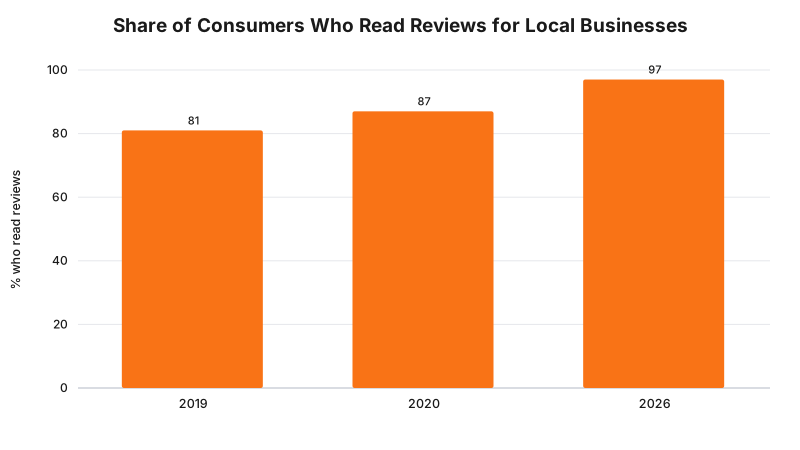
The 87% figure traces to BrightLocal’s Local Consumer Review Survey 2020, a representative panel of 1,013 US consumers surveyed in November 2020 and published that December. The question was direct: do you read online reviews for local businesses? 87% said yes, up from 81% the year before, a jump BrightLocal attributed partly to the shift to online research during that period.
Six years on, the same question gets asked a different way. BrightLocal’s newest edition, the Local Consumer Review Survey 2026, surveyed 1,002 US consumers and found 97% now read reviews for local businesses. Reading reviews has gone from common to close to universal in under a decade.
| Year | Read reviews for local businesses | Sample | Source |
|---|---|---|---|
| 2019 | 81% | US consumers | BrightLocal |
| 2020 | 87% | 1,013 US consumers | BrightLocal |
| 2026 | 97% | 1,002 US consumers | BrightLocal |
Neither of these BrightLocal surveys covers Australia. They are US consumer panels, and the honest read is that this is a global benchmark number, not a local one. It stays useful anyway. Google runs local search the same way in Perth as it does in Phoenix, and the mechanics that drive someone to check a review before booking a tradesperson do not stop at the border.
Takeaway: 87% was the headline number for years because it marked the point where reading reviews stopped being a habit for some shoppers and became the default for most. It is already out of date, and the true figure only keeps climbing.
Trust Is Falling Even as Reading Goes Up
Reading a review and trusting it are two different behaviours, and the gap between them has widened fast. BrightLocal’s 2020 survey found 79% of consumers trusted online reviews as much as a personal recommendation from a friend or family member. By its 2025 survey of 1,026 US consumers, that figure had fallen to 42%, a drop of 37 percentage points in five years.
| Year | Trust reviews as much as a personal recommendation | Sample | Source |
|---|---|---|---|
| 2020 | 79% | 1,013 US consumers | BrightLocal |
| 2025 | 42% | 1,026 US consumers | BrightLocal |
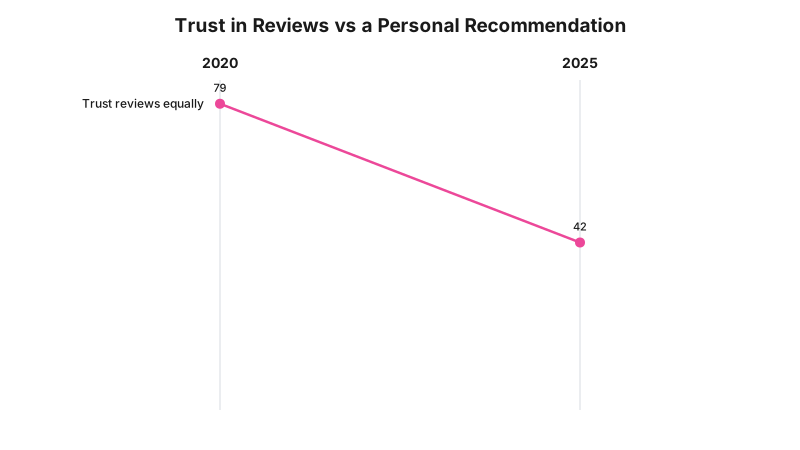
The gap opened as fake reviews, incentivised ratings, and AI-written testimonials became harder to spot. Shoppers still read reviews first, they just cross-check more before they act on one.
Takeaway: a business cannot rely on star count alone to earn trust anymore. Detail, specificity, and recent activity in a review carry more weight than the average score did five years ago.
How Many Reviews People Actually Check
Nobody stops at one review. BrightLocal’s 2025 survey found 74% of consumers check two or more review sites before deciding, with 27% relying on a single source. By the 2026 survey, the average shopper was checking six different review sites before choosing a business, and only 4% said they never read reviews at all.
| Metric | Figure | Year | Source |
|---|---|---|---|
| Check two or more review sites | 74% | 2025 | BrightLocal |
| Rely on a single review site | 27% | 2025 | BrightLocal |
| Average review sites checked | 6 | 2026 | BrightLocal |
| Never read online reviews | 4% | 2025 | BrightLocal |
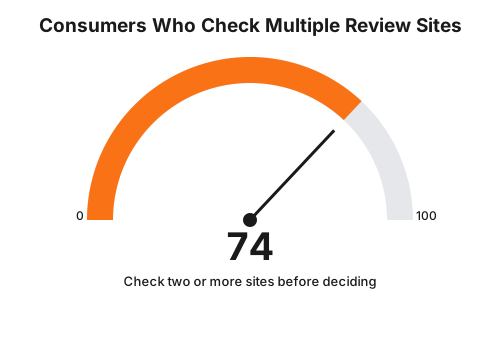
A business with strong reviews on Google but nothing on Facebook, industry directories, or Product Review is losing points with the growing share of shoppers who cross-reference before they commit.
Takeaway: a single five-star Google profile is not the finish line anymore. The shoppers who check the most sites are also the most cautious buyers, worth winning over properly.
What the Australian Data Actually Shows
Australia does not have a BrightLocal-style annual review survey. What exists instead is a set of adjacent studies that point the same direction. Power Retail and Payments Consulting Network’s 2025 Ecommerce Payments Experience Report, based on 1,031 Australian consumers, asked what safety precautions people take when shopping online. Checking reviews came in third, behind sticking to trusted brands and avoiding saving payment details.
| Behaviour | Share of Australian shoppers | Source |
|---|---|---|
| Shop with familiar or trusted brands | 58% | Power Retail and PCN, 2025 |
| Never save payment information on websites | 44% | Power Retail and PCN, 2025 |
| Check online reviews before purchasing | 41% | Power Retail and PCN, 2025 |
| Rely on general online research before buying | 69% | IAB Australia and Pureprofile, 2026 |
| Read online reviews or blogs before buying | 60% | Sensis Social Media Report, 2016 |
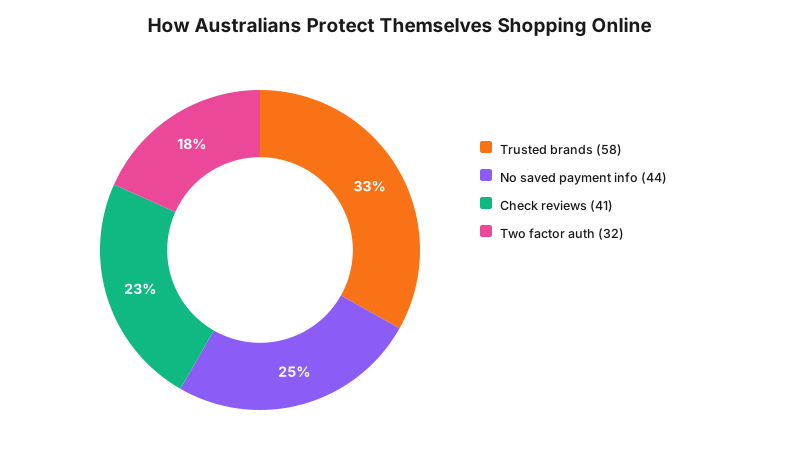
The 69% figure comes from the IAB Australia and Pureprofile Commerce and Discovery Report 2026, a nationally representative survey of 1,079 Australians and 877 New Zealanders aged 18 to 70 who had shopped online in the past year. It also found 92% use search engines or retailer websites to research purchases and 60% now use AI-powered tools somewhere in that process. The oldest number in the table, the 60% figure on reading reviews or blogs specifically, comes from the Sensis Social Media Report 2016. No Australia-wide review-reading survey at that scale has replaced it since, which is itself worth noting: the country that runs 92% of its purchase research through a search engine has not had its review-reading habits measured directly in nearly a decade.
Takeaway: the closest thing to Australian review data confirms the same direction as the US figures, without matching them number for number. Treat the 87% and 97% as the industry benchmark, and the 41% as the local proof point.
What a Thin Review Profile Costs a Business
Star rating alone sets a hard floor for who will even consider a business. BrightLocal’s 2020 survey found only 48% of consumers would still consider a business rated below 4 stars, and just 19% would consider one below 3 stars. At the other end, 12% of consumers will only use a business with a perfect 5-star rating.
| Star rating threshold | Share who would still use the business |
|---|---|
| Below 3 stars | 19% |
| Below 4 stars | 48% |
| Perfect 5 stars required | 12% |
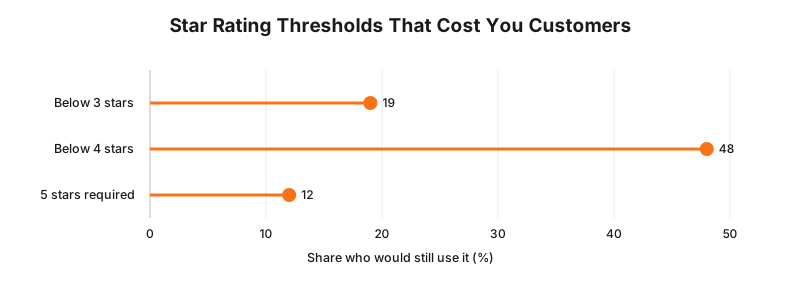
Recency compounds this. The same survey found 86% of consumers only weigh reviews from the past three months when forming a judgement. A business sitting on a strong rating built two years ago, with nothing recent, is invisible to most of that 86%.
Takeaway: a 4.9-star profile with no reviews in the last quarter loses to a 4.3-star profile that gets fresh reviews every fortnight.
Quick Win: Fix Review Recency First
Before chasing more reviews, check when your last one landed. If it has been longer than three months, that gap matters more than your overall star count, based on the 86% recency figure above. Set up an automatic review request that goes out after every job or purchase, not a manual one someone forgets to send. A steady trickle of recent reviews beats a burst of old ones every time a shopper actually checks the date.
Get Your Google Reviews Working for You
Reviews only convert if the right people see them at the right moment, which is a local search problem as much as a reputation one. Our local SEO service covers Google Business Profile setup, review response strategy, and the suburb-level search visibility that puts a strong review profile in front of people actually searching nearby. Get in touch for a review and local search check that looks at your actual profile, not just your star average.
Frequently Asked Questions
What percentage of people read online reviews before buying?
87% of consumers read online reviews for local businesses, according to BrightLocal’s Local Consumer Review Survey of 1,013 US consumers in 2020. That share has since climbed to 97% in BrightLocal’s 2026 survey of 1,002 US consumers.
Is the 87% online reviews statistic Australian data?
No. The 87% figure comes from BrightLocal’s US consumer panel. Australia-specific research does exist, though. Power Retail and Payments Consulting Network found 41% of Australian shoppers check reviews as an online safety precaution in their 2025 Ecommerce Payments Experience Report of 1,031 Australian consumers.
Do people still trust online reviews as much as they used to?
Trust is falling even as reading rises. BrightLocal found 79% of consumers trusted reviews as much as a personal recommendation in 2020. By 2025, that had dropped to 42%, based on a survey of 1,026 US consumers.
How many reviews does a business need to stay competitive?
BrightLocal’s 2020 survey found only 48% of consumers would consider a business with fewer than 4 stars, and 12% require a perfect 5-star rating. Review recency matters too: 86% of consumers only weigh reviews from the past three months.
Vikas Thakur
Founder of RockingWeb. 16 years of experience from working at TPG, iiNet and Monadelphous, now building websites, software and digital marketing for local businesses in Rockingham and Perth.