$104.5M by 2030: Teeth Whitening Market Australia
Australia's teeth whitening market is forecast to grow from USD 71.2 million in 2023 to USD 104.5 million by 2030, a 5.6% CAGR, according to Grand View Research. Only one in three Australians who whiten their teeth do so under a dentist's supervision, per the Australian Dental Association. Full market, method and demographic breakdown inside.
 Vikas Thakur Founder, RockingWeb 9 min read
On this page 8
- Key takeaways
- Australia’s Teeth Whitening Market: $71.2M to $104.5M by 2030
- Who’s Actually Whitening Their Teeth in Australia
- Where Australians Actually Buy Their Whitening
- Where Whitening Ranks Among Australia’s Cosmetic Dentistry Segments
- Growth Without Supervision Means More Advertising Scrutiny
- Getting a Whitening Page Compliant Before Chasing This Growth
- How RockingWeb Builds Websites for Australia’s Growing Whitening Market
Key takeaways
- Australia’s teeth whitening market is forecast to grow from USD 71.2 million in 2023 to USD 104.5 million by 2030, a 5.6% CAGR, according to Grand View Research
- 22% of Australians have whitened their teeth, up 8 percentage points since 2017, per the Australian Dental Association’s 25,000-person Dental Health Week survey
- Only 1 in 3 people who whiten their teeth do so under a dentist’s supervision
- Unsupervised methods, online kits, over-the-counter strips and gel, and non-dental services, make up the other two-thirds, all legally capped at 6% hydrogen peroxide (or 18% carbamide peroxide) under the Poisons Standard
- Whitening is most popular among 24 to 34 year olds, and women are more than twice as likely as men to whiten their teeth
- Whitening toothpastes were the highest-revenue product category in Australia’s whitening market in 2023, according to Grand View Research
- The whitening segment sits inside a broader Australian cosmetic dentistry market forecast to hit USD 1.1 billion by 2030, a 14.9% CAGR
Australia’s teeth whitening market was worth USD 71.2 million in 2023 and is forecast to reach USD 104.5 million by 2030. Grand View Research puts the growth rate at a 5.6% CAGR from 2024 to 2030. Only one in three Australians who whiten their teeth do so under a dentist’s supervision, per the Australian Dental Association.
USD 104.5 million by 2030 sounds like a market dentists are winning. They’re not, not most of it. Grand View Research puts Australia’s teeth whitening market at USD 71.2 million in 2023, growing at a 5.6% CAGR to USD 104.5 million by 2030. At the same time, the Australian Dental Association’s own survey of 25,000 Australians found only one in three people who whiten their teeth do it in a dental chair or with a dentist-prescribed kit. The rest buy online, grab strips off a pharmacy shelf, or use a non-dental service. That gap between a growing market and a shrinking share of professional supervision is the real story behind these numbers. This post breaks down where the growth is coming from, who’s actually buying, and what it means for a practice trying to win back a slice of a market that keeps choosing the cheaper, unsupervised option.
Australia’s Teeth Whitening Market: $71.2M to $104.5M by 2030
| Year | Market Size (USD) |
|---|---|
| 2023 (actual) | $71.2 million |
| 2025 (CAGR-modelled) | $79.4 million |
| 2027 (CAGR-modelled) | $88.6 million |
| 2030 (forecast) | $104.5 million |
CAGR 2024 to 2030: 5.6%. Only the 2023 and 2030 figures are directly reported by Grand View Research; the years in between are calculated by applying that CAGR year on year, not independently published data points.
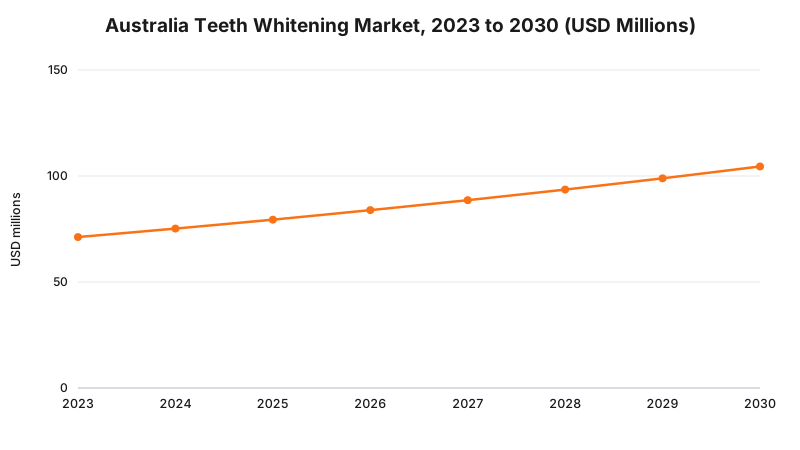
Grand View Research’s Australia Teeth Whitening Market report lists two hard numbers: USD 71.2 million in 2023 and USD 104.5 million by 2030. Everything between those two points on the chart above is a modelled trajectory at the reported 5.6% CAGR, not a separately published year-by-year figure. Whitening toothpastes were the single highest-revenue product category inside that market in 2023, ahead of strips, gels, and in-clinic treatments, according to the same report.
That growth sits inside a much larger picture. Our companion breakdown of Australia’s cosmetic dentistry market puts the whole category, implants, veneers, crowns, whitening, and equipment, on track for USD 1.1 billion by 2030, a 14.9% CAGR. Whitening is the smallest of the named procedure segments, but it’s also the one an ordinary patient interacts with most often, since it doesn’t require a clinical problem to justify the purchase.
Takeaway: the two hard numbers here are USD 71.2 million in 2023 and USD 104.5 million by 2030. Every figure in between is a modelled estimate, not a separately reported data point.
Who’s Actually Whitening Their Teeth in Australia
The Australian Dental Association surveyed 25,000 Australian adults for its Dental Health Week research and found 22% have whitened their teeth, up 8 percentage points since the survey first ran in 2017. Women are more than twice as likely as men to have done it, and the 24 to 34 age group whitens more than any other.
Here’s the part that matters more than the headline number: only one in three of those people did it under a dentist’s supervision.
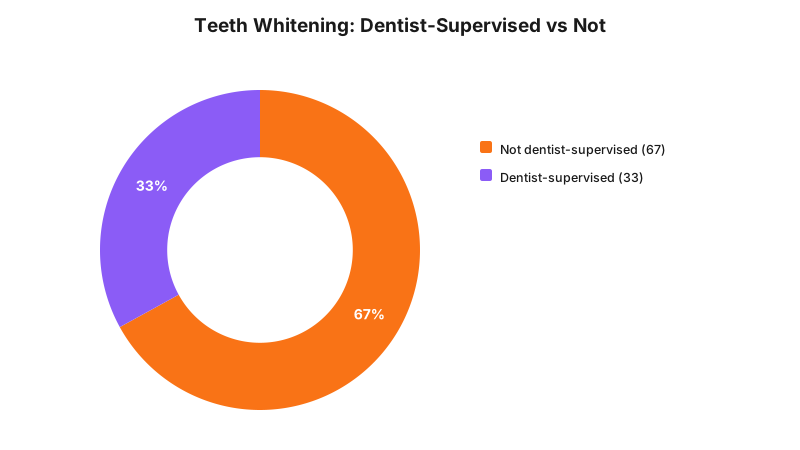
Two-thirds of Australians who whiten their teeth never sit in a dentist’s chair to do it. That’s not a small gap. It’s the majority of a growing market choosing an unsupervised method over a supervised one, most often on price.
Takeaway: the market is growing at 5.6% a year, but the share of it happening under professional supervision is shrinking, not growing with it.
Where Australians Actually Buy Their Whitening
Whitening splits into two supervision tiers, not five separate markets. Take-home kits and in-chair treatment require a registered dentist. Online kits, over-the-counter strips and gel, and non-dental services don’t, and that unsupervised tier is where two-thirds of Australia’s whitening users end up.
| Method | Supervision | Who Can Supply It |
|---|---|---|
| Online kits (DIY) | Unsupervised | Anyone (online retail) |
| Over-the-counter strips/gel | Unsupervised | Anyone (retail sale) |
| Non-dental services | Unsupervised | Non-dental provider |
| Take-home kits (dentist) | Dentist-supervised | Registered dentist only |
| In-chair whitening (dentist) | Dentist-supervised | Registered dentist only |
The Australian Dental Association’s Dental Health Week survey reports the supervision split above, roughly a third of whitening users go through a dentist, two-thirds don’t, but it doesn’t publish a per-method percentage breakdown of exactly how that unsupervised two-thirds divides across online kits, strips and gel, and non-dental services.
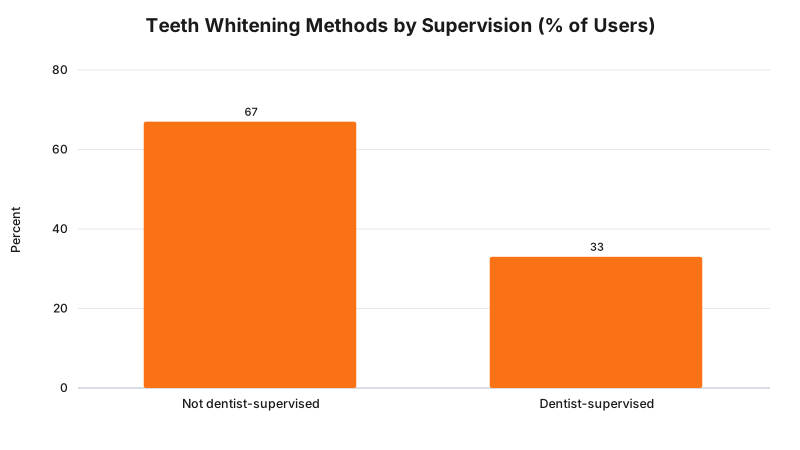
Unsupervised methods, online kits, over-the-counter strips and gel, and non-dental services, together account for roughly two-thirds of whitening purchases, more than dentist-supervised take-home kits and in-chair treatment combined. That’s a striking result for a treatment involving a bleaching agent applied to teeth without a dental check first. Australia’s Poisons Standard caps public-sale whitening products at 6% hydrogen peroxide (or 18% carbamide peroxide); anything above that concentration is Schedule 10 and restricted to registered dental practitioners. The same rule, and the advertising restrictions that sit alongside it, are covered in full in our AHPRA advertising rules for cosmetic dentistry breakdown, since dentists are regulated under the same National Law as cosmetic medicine clinics.
Takeaway: more Australians buy their whitening through an unsupervised method, online, over-the-counter, or non-dental, than get it from a dentist in any form, take-home kit or in-chair, combined.
Where Whitening Ranks Among Australia’s Cosmetic Dentistry Segments
| Segment | 2030 Forecast (USD) |
|---|---|
| Dental crowns and bridges | $324.7 million |
| Dental implants | $146.9 million |
| Dental veneers | $112.1 million |
| Teeth whitening | $104.5 million |
All figures from Grand View Research’s individual Australia market reports for each procedure, cited via our companion post on Australia’s cosmetic dentistry market.
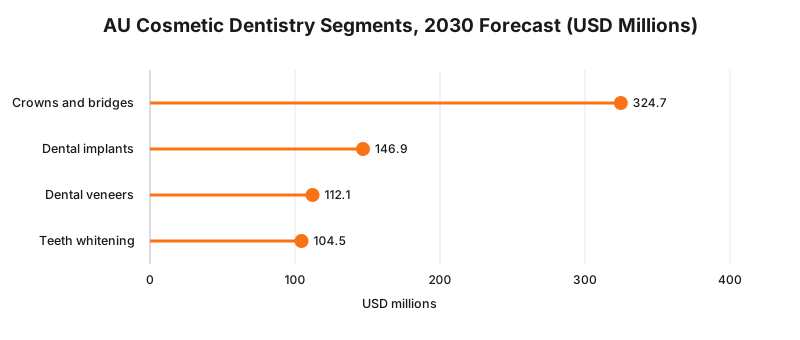
Whitening is the smallest of these four named segments by forecast value, sitting behind veneers, implants, and crowns and bridges. It’s also the segment with the lowest barrier to entry, no clinical need required, no custom fabrication, and the widest range of legal price points from a $20 pharmacy strip to a $1,500 in-chair session. That combination is exactly why it has the largest share of unsupervised, DIY purchasing of any procedure on this list.
Takeaway: whitening is the smallest cosmetic dentistry segment by dollar value and the easiest one for a patient to buy without ever booking an appointment.
Growth Without Supervision Means More Advertising Scrutiny
A market growing at 5.6% a year, with two-thirds of purchases happening outside a dentist’s chair, draws more marketing spend chasing that DIY volume, and more marketing spend under AHPRA’s rules carries more compliance exposure. Dentists are regulated by the Dental Board of Australia under the same AHPRA National Law as cosmetic medicine clinics, so the testimonial ban, the narrower before-and-after imagery rules, and the outcome-claim restrictions all apply the same way to a whitening landing page as to a Botox before-and-after gallery.
A practice can publish “in-chair whitening from $599” without issue. AHPRA’s guidelines prohibit pairing a before-and-after photo with a claim like “brighter smile guaranteed,” and section 133 of the National Law restricts the use of testimonials, including a patient quote about loving the result, regardless of whether the underlying claim is true.
Takeaway: you can compete on price and convenience in this market without ever touching the content that puts a practice in front of an AHPRA complaint.
Getting a Whitening Page Compliant Before Chasing This Growth
Most practices don’t know which parts of their current whitening page would fail an AHPRA review until someone checks it line by line, and the September 2025 amendments changed what’s allowed around testimonials and imagery. If your site hasn’t been reviewed since then, talk to RockingWeb and we will flag exactly what needs to change before a patient complaint does it instead.
That’s a cheaper starting point than a bigger ad budget chasing a market where most of the growth is already going to DIY kits. Fixing the compliance risk first means every dollar spent afterwards is spent on assets that survive a regulator’s review.
Takeaway: an audit is the cheapest insurance a growing practice can buy against the compliance side of a market this size.
How RockingWeb Builds Websites for Australia’s Growing Whitening Market
RockingWeb is an AHPRA-compliance specialist for Australian cosmetic clinics and dental practices, not a generalist agency that treats compliance as an afterthought. Every cosmetic clinic and dental website we build starts from the current advertising guidelines, so a practice never has to choose between a whitening page that converts and one that survives an AHPRA review.
For practices that want the audit, the compliant rebuild, and ongoing compliant ad management handled as one service while this market keeps growing, ClinicPipeline is built specifically for regulated dental and cosmetic clinics competing for a price-sensitive, mostly DIY buyer.
Ready to build a whitening page that actually converts the two-thirds of the market still buying online? Talk to us about your practice’s whitening page.
Data sources: Grand View Research, Australia Teeth Whitening Market report; Grand View Research, Australia Cosmetic Dentistry Market Size & Outlook, 2030 (crowns and bridges, implants, and veneers segment forecasts, cited via our companion market post); Australian Dental Association, Dental Health Week research (25,000-person survey); Poisons Standard Schedule 10 and Dental Board of Australia guidance on whitening concentration limits; AHPRA, Guidelines for advertising a regulated health service (September 2025 amendments).
Vikas Thakur
Founder of RockingWeb. 16 years of experience from working at TPG, iiNet and Monadelphous, now building websites, software and digital marketing for local businesses in Rockingham and Perth.