Dental Veneers Market Australia: $112M by 2030
Australia's dental veneers market is forecast to grow from USD 63.9 million in 2023 to USD 112.1 million by 2030, an 8.4% annual growth rate, according to Grand View Research. This post breaks down veneer pricing, survival data from a 16-year Australian clinical study, and where veneers sit inside the wider cosmetic dentistry market.
 Vikas Thakur Founder, RockingWeb 11 min read

On this page 9
- Key takeaways
- Australia’s Veneers Market Is Growing Faster Than Most Patients Can Afford
- Where Veneers Rank Against Crowns, Implants and Whitening
- What Porcelain and Composite Veneers Actually Cost in Australia
- How Long Veneers Actually Last, According to a 16-Year Australian Study
- Growth Like This Draws More AHPRA Advertising Scrutiny
- Check Your Own Site Before a Patient or Competitor Does
- How RockingWeb Builds Dental Websites for This Market
- Sources and References
Key takeaways
- Australia’s dental veneers market is forecast to grow from USD 63.9 million in 2023 to USD 112.1 million by 2030, an 8.4% CAGR, according to Grand View Research
- Veneers sit inside a wider Australian cosmetic dentistry market forecast to hit USD 1,119.4 million by 2030, up from USD 369.2 million in 2022, per the same source
- Porcelain veneers cost $1,200 to $2,500 per tooth in Australia in 2026, versus $300 to $1,200 for composite, based on published Australian practice pricing pages checked in our veneers cost breakdown
- Porcelain veneers hold a 91% survival rate at 12 to 13 years, dropping to 73% at 15 to 16 years, per a 16-year Australian clinical study of 304 veneers
- Dental crowns and bridges, not veneers, is the largest individual procedure segment, forecast at USD 324.7 million by 2030
- 61% of Australians delayed dental treatment in the past 12 months, and 63% of that group blamed affordability, per the Australian Dental Association’s 2024 Dental Health Week survey
- Composite veneers typically last 4 to 8 years; porcelain veneers typically last 10 to 15 years, per the systematic-review data in our porcelain vs composite lifespan breakdown
Australia’s dental veneers market is forecast to grow from USD 63.9 million to USD 112.1 million by 2030. That’s an 8.4% annual growth rate, according to Grand View Research. The figures cover the Australian market specifically and are reported in US dollars.
Australia’s dental veneers market is forecast to grow from USD 63.9 million in 2023 to USD 112.1 million by 2030, an 8.4% annual growth rate, according to Grand View Research. That’s real money chasing a treatment most patients still pay for entirely out of pocket, no Medicare, no extras cover. Every practice offering veneers is competing for a slice of a market set to grow by three-quarters in seven years, while patient budgets move the other way. Six in ten Australians already delay dental treatment over cost, and 63% of that group blame affordability directly, per the Australian Dental Association’s 2024 Dental Health Week research, so this growth isn’t coming from easier spending. It’s coming from somewhere else, and the data below shows exactly where. This post breaks down what a veneer costs per tooth in Australia right now, how long one actually lasts according to a 16-year clinical study, and where veneers rank against crowns, implants and whitening inside the wider market. Use the numbers to price competitively and market compliantly at the same time.
Australia’s Veneers Market Is Growing Faster Than Most Patients Can Afford
| Year | Australia Dental Veneers Market (USD) | Note |
|---|---|---|
| 2023 (actual) | $63.9 million | Base year reported by Grand View Research |
| 2030 (forecast) | $112.1 million | 8.4% CAGR, 2024 to 2030 |
Grand View Research reports these figures in US dollars, the currency the underlying report uses, not Australian dollars.
Every practice offering veneers is competing for a slice of a market set to grow by three-quarters in seven years, while patient budgets move the other way. Six in ten Australians already delay dental treatment over cost, and 63% of that group blame affordability directly, per the Australian Dental Association’s 2024 Dental Health Week research. Growth here isn’t coming from easier household spending. It’s coming from somewhere else: more clinics offering veneers, more financing options, and a widening gap between what a “smile makeover” costs and what an average patient can pay upfront.
Veneers are one segment inside a bigger category. Grand View Research puts the whole Australian cosmetic dentistry market at USD 369.2 million in 2022, forecast to hit USD 1,119.4 million by 2030, a 14.9% CAGR. That’s nearly triple in eight years, well ahead of veneers’ own 8.4% pace, which tells you veneers are growing but other procedures inside the same category are growing faster still.
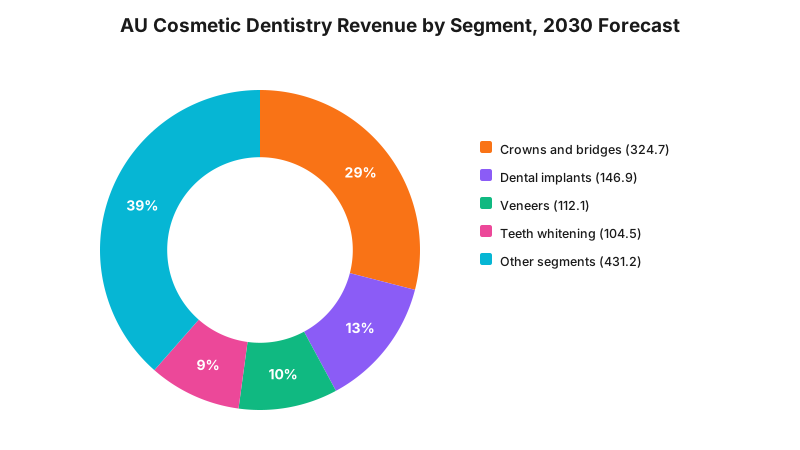
Takeaway: veneers are a real and growing line of revenue, but they’re a mid-sized slice of a much bigger pie, not the category’s main event.
Where Veneers Rank Against Crowns, Implants and Whitening
| Procedure | Baseline | 2030 Forecast | CAGR |
|---|---|---|---|
| Dental crowns and bridges | $171.7M (2024) | $324.7 million | 11.6% |
| Dental implants | $86.0M (2024) | $146.9 million | not separately published |
| Dental veneers | $63.9M (2023) | $112.1 million | 8.4% |
| Teeth whitening | $71.2M (2023) | $104.5 million | not separately published |
Dental crowns and bridges leads every individual procedure category, forecast at USD 324.7 million by 2030, nearly triple the veneers figure. Implants sit second at USD 146.9 million, veneers third at USD 112.1 million, and teeth whitening fourth at USD 104.5 million. All four numbers come from Grand View Research’s Australia-specific procedure reports, and all four use different baseline years because each report was published at a different time.
The crowns and bridges, veneers, and teeth whitening figures were each independently reconfirmed against Grand View Research’s own published Australia market pages during fact-checking for this post (see Sources and References below). The implants figure could not be independently reconfirmed against a currently accessible Grand View Research page, and a search for corroborating data turned up other Grand View Research and third-party figures for the Australian dental implants market that do not match it. Treat the USD 86.0 million to USD 146.9 million implants range as provisional until it’s directly verified against the underlying report.
Set against the wider market’s 14.9% CAGR, veneers’ 8.4% growth rate looks modest. Crowns and bridges grows at 11.6%, also below the category average, which means the segments pulling the overall market’s growth rate up sit outside these four, most likely orthodontic braces and dental systems and equipment, the two segments Grand View Research names as leading share and fastest growth respectively in the broader category report.
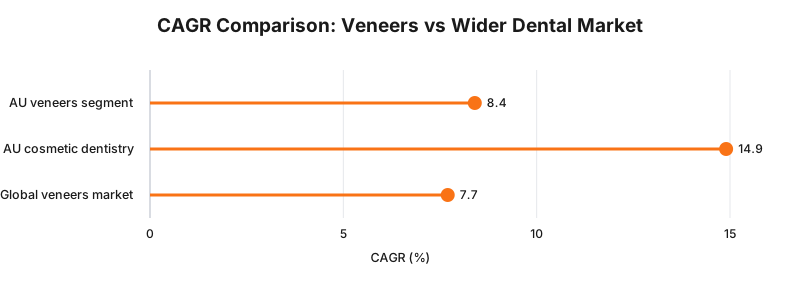
For global context, Grand View Research’s separate worldwide dental veneers report (a different report from the Australia segment data above, using its own market definition) puts the global market at USD 7.9 billion in 2025, forecast to reach USD 14.3 billion by 2033, a 7.7% CAGR. Australia’s segment CAGR of 8.4% runs slightly ahead of that global pace.
Takeaway: veneers are the third-largest individual procedure category in Australian cosmetic dentistry, growing steadily but not leading the pack.
What Porcelain and Composite Veneers Actually Cost in Australia
| Veneer Type | Cost per Tooth (AUD) | Typical Lifespan | Appointments |
|---|---|---|---|
| Composite | $300 to $1,200 | 4 to 8 years | 1 (direct application) |
| Porcelain | $1,200 to $2,500 | 10 to 15 years | 2 (lab-fabricated) |
Composite veneers are the cheaper, faster option: applied directly to the tooth in a single visit, at $300 to $1,200 per tooth, but they wear out faster, typically 4 to 8 years before they need repair or replacement. Porcelain veneers cost more, $1,200 to $2,500 per tooth based on published pricing from Australian cosmetic dental practices (checked practice-by-practice in our veneers cost breakdown), and need two appointments because the shell is fabricated in a lab, then bonded. What patients get for the higher price is a restoration that, per the systematic-review data in our porcelain vs composite lifespan breakdown, typically holds up for 10 to 15 years with proper care, with some long-running cohorts followed well beyond that.
Neither option is covered by Medicare, and most private health extras policies exclude veneers entirely when a treatment is classified as cosmetic rather than restorative. That’s the affordability squeeze from the Key Takeaways box showing up at the individual patient level: ArtSmiles’ published price list puts a 6-tooth smile makeover at roughly $3,600 in composite versus $8,862 in porcelain or zirconia, rising to around $6,000 versus $14,770 for 10 teeth, all of it paid out of pocket in most cases.
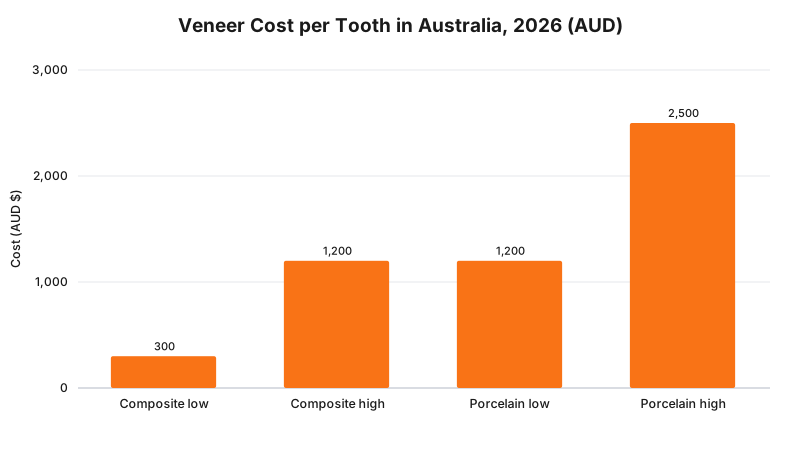
Takeaway: the price gap between composite and porcelain is roughly double at the low end and more than double at the high end, and that gap is exactly where a practice’s pricing page needs to set expectations before the consult, not during it.
How Long Veneers Actually Last, According to a 16-Year Australian Study
Most marketing pages quote a lifespan range without a source. One long-term Australian clinical study gives an actual number. Prosthodontists Danielle Layton and Terry Walton tracked 304 feldspathic porcelain veneers placed in 100 patients over 16 years, published in the International Journal of Prosthodontics in 2007.
| Follow-up Period | Survival Rate |
|---|---|
| 5 to 6 years | 96% (plus or minus 1%) |
| 10 to 11 years | 93% (plus or minus 2%) |
| 12 to 13 years | 91% (plus or minus 3%) |
| 15 to 16 years | 73% (plus or minus 16%) |
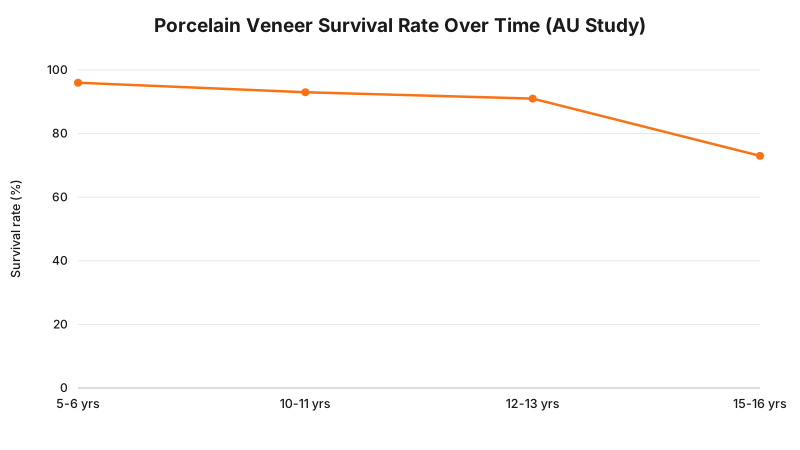
The 91% figure at 12 to 13 years is the number worth quoting: it comes from a large enough remaining sample to be reliable. The 73% figure at 15 to 16 years carries a wide margin of error, plus or minus 16%, because so few veneers in the original cohort had reached that follow-up point yet. Of the 16 veneers that failed across the study, aesthetic concerns and mechanical complications each accounted for 31% of failures, with periodontal issues, loss of retention, caries and tooth fracture making up the rest.
Takeaway: porcelain veneers are a durable restoration in the first decade, and the data past 15 years is real but thinner, worth quoting with its margin of error attached, not as a flat guarantee.
Growth Like This Draws More AHPRA Advertising Scrutiny
A market growing at 8.4% a year, inside a category growing at 14.9%, means more practices marketing veneers, and more veneer marketing sits under the same advertising rules as any other AHPRA-regulated treatment. Dentists answer to the Dental Board of Australia under the same National Law that governs cosmetic medicine clinics, so a veneer before-and-after gallery faces the same testimonial ban and imagery restrictions as a Botox campaign. Our breakdown of AHPRA’s advertising rules for cosmetic dentistry covers what changed under the 2025 amendments and what a compliant veneer gallery actually looks like now.
Takeaway: a growing market means a growing advertising footprint, and every new veneer landing page is another point of AHPRA exposure until it’s been checked.
Check Your Own Site Before a Patient or Competitor Does
Most practices don’t find out which pages fail these rules until a patient complains or a competitor reports them. If your site hasn’t been checked against the current guidelines, RockingWeb can flag exactly what to fix, page by page, before that happens.
Takeaway: an audit before publishing is cheaper than a takedown notice after a campaign is already spending money.
How RockingWeb Builds Dental Websites for This Market
RockingWeb builds dental and cosmetic clinic websites that start from AHPRA’s current advertising rules instead of bolting compliance on afterward. That matters more as the veneers segment grows toward USD 112.1 million by 2030: every new page a practice publishes to chase that growth is either an asset or a liability, depending on whether the copy, the before-and-after gallery, and the pricing page were built against the current rules from day one.
A compliant site converts the same way a non-compliant one does, minus the risk of a takedown notice arriving right when a campaign is working.
Sources and References
- Grand View Research, Australia Dental Veneers Market - USD 112.1 million by 2030, 8.4% CAGR (2024-2030); USD 63.9 million 2023 baseline. Reconfirmed against an independent citing source during fact-checking for this post.
- Grand View Research, Australia Cosmetic Dentistry Market - USD 1,119.4 million by 2030, 14.9% CAGR; USD 369.2 million 2022 baseline. Reconfirmed against an independent citing source.
- Grand View Research, Australia Dental Crowns & Bridges Market - USD 324.7 million by 2030, 11.6% CAGR; USD 171.7 million 2024 baseline. Reconfirmed against an independent citing source.
- Grand View Research, Australia Teeth Whitening Market - USD 104.5 million by 2030; USD 71.2 million 2023 baseline. Reconfirmed against independent citing sources.
- Grand View Research, Dental Veneers Market Size, Share & Growth Report, 2033 - global figures cited in this post: USD 7.9 billion in 2025, forecast USD 14.3 billion by 2033, 7.7% CAGR.
- Australian Dental Association, Dental Health Week #2: Cost of living affects dental habits (2024) - 61% of respondents delayed treatment in the past 12 months, 63% of that group cited affordability.
- Note on the dental implants figure: the USD 86.0 million (2024) to USD 146.9 million (2030) implants figure used in this post and its Grand View Research source could not be independently reconfirmed during this fact-check. A search for corroborating data surfaced other Grand View Research and third-party figures for the Australian dental implants market that do not match this range. Treat it as provisional pending direct verification.
- Veneers Cost Australia: State-by-State Price Data - per-tooth pricing checked against published Australian practice pricing pages.
- Porcelain vs Composite Veneers: Cost & Lifespan Data - lifespan figures drawn from peer-reviewed systematic reviews.
Want a dental website built for AHPRA compliance and conversions? Talk to RockingWeb about your veneers page.
Vikas Thakur
Founder of RockingWeb. 16 years of experience from working at TPG, iiNet and Monadelphous, now building websites, software and digital marketing for local businesses in Rockingham and Perth.