Card Surcharge Ban 2026: What Your Checkout Must Show Now
Card surcharging on eftpos, Mastercard and Visa ended on 1 October 2026. Here is what a Perth or Rockingham small business website's pricing, booking and checkout pages must now show, which fees stay allowed, and what to fix first.
 Vikas Thakur Founder, RockingWeb 11 min read
Key takeaways
- Card surcharging on eftpos, Mastercard and Visa credit, debit and prepaid cards ended on 1 October 2026
- The RBA says the ban does not cover weekend surcharges, public holiday surcharges, or booking or service fees
- A fee that applies regardless of payment method is not a card surcharge under the RBA’s FAQ
- Businesses can still offer discounts for particular payment methods, including cash
- RBA Governor Michele Bullock told a Senate committee on 28 October 2026 that “several large providers have reduced their card processing fees for small businesses”
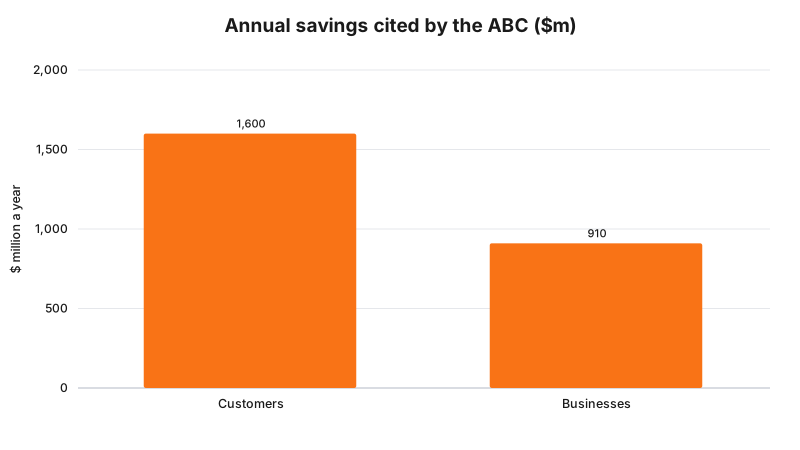
- The ABC reports the reforms are meant to save customers about $1.6 billion a year, and that the RBA maintains interchange cuts will save businesses $910 million a year, which the Australian Chamber of Commerce and Industry disputes
- Interchange caps on foreign-issued cards start later, on 1 April 2027
- Your checkout, booking widget and invoices need a check this week, not next quarter
Card surcharging in Australia ended on 1 October 2026, and by 28 October the Reserve Bank’s Governor was telling Senators that several large providers had already cut their card processing fees for small businesses. If your website still shows ”+ 1.5% card fee” anywhere, it is out of date. If you replaced it with a differently named fee, you need to read the next section carefully.
This is a follow-up to our earlier coverage of how to display a card surcharge while it was still legal. This one covers what changed, what stays allowed, and what the workarounds you are reading about mean for the pages on your site. It is a web development view of the change, not legal, tax or financial advice.
What Changed on 1 October 2026
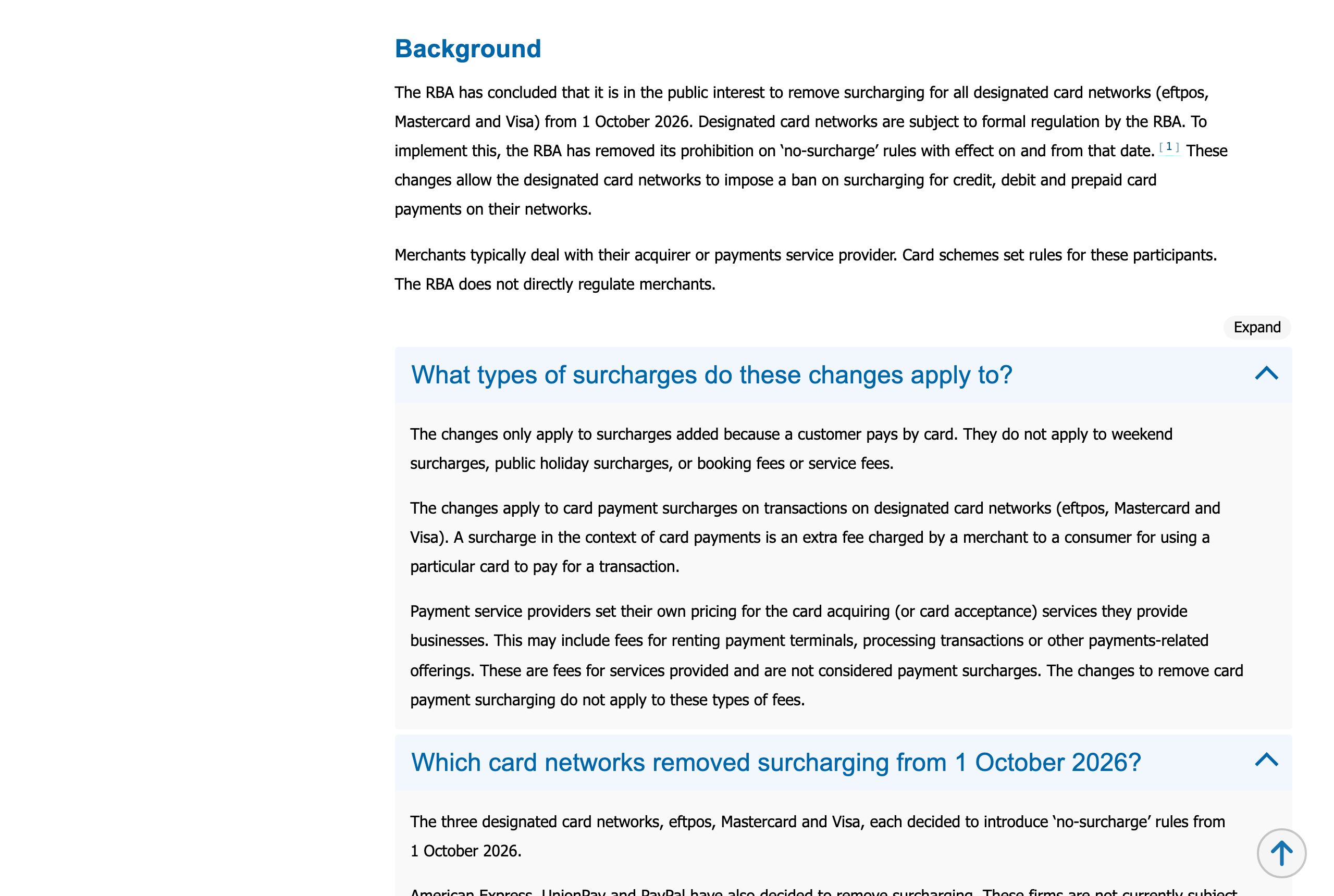
The RBA’s FAQ states that it “has concluded that it is in the public interest to remove surcharging for all designated card networks (eftpos, Mastercard and Visa) from 1 October 2026.” The three networks each decided to introduce no-surcharge rules from that date. Those rules cover credit, debit and prepaid cards on their networks, including internationally issued cards.
The same FAQ lists other providers. Here is the RBA’s own table of dates, simplified:
| Network | Surcharging ends |
|---|---|
| eftpos (debit, prepaid) | 1 October 2026 |
| Mastercard (credit, debit, prepaid) | 1 October 2026 |
| Visa (credit, debit, prepaid) | 1 October 2026 |
| American Express (credit) | 1 October 2026 |
| UnionPay | 1 October 2026 |
| PayPal | 5 October 2026 |
The RBA notes that American Express, UnionPay and PayPal are not currently subject to formal RBA regulation. They made their own decisions to follow.
Two more details matter for a website owner. The RBA does not regulate merchants directly, and its FAQ says “the card networks are ultimately responsible for ensuring compliance with these rules.” Separately, the ABC reported on 2 October 2026 that the ACCC previously enforced the surcharging rules, and that from that week card networks and payment service providers are responsible.
Takeaway: the people who will notice a surcharge on your checkout are no longer a distant regulator. They are your payment provider and the card networks behind it.
What Still Stays Allowed
The RBA’s FAQ is specific. In its words: “The changes only apply to surcharges added because a customer pays by card. They do not apply to weekend surcharges, public holiday surcharges, or booking fees or service fees.”
It adds two clarifications that matter for a booking or service business:
- “A card payment surcharge does not include a surcharge which applies regardless of payment method.”
- Payment service provider fees, such as renting a terminal or processing transactions, “are fees for services provided and are not considered payment surcharges.”
On discounts, the FAQ says “Businesses can continue to offer discounts for particular payment methods.” The RBA’s March 2026 summary adds that “businesses will continue to be able to offer discounts if they choose, including to consumers that pay by cash.”
| Fee or price on your site | RBA position |
|---|---|
| Extra fee only when the customer pays by Visa, Mastercard or eftpos | Ended 1 October 2026 |
| Weekend or public holiday surcharge | Not covered by the changes |
| Booking fee or service fee | Not covered by the changes |
| Fee that applies regardless of payment method | Not a card payment surcharge |
| Discount for a particular payment method, including cash | Can continue |
| Payment costs reflected in overall pricing | Allowed, per the RBA FAQ |
One point where the ban stops and a judgment call starts. The RBA defines a surcharge in this context as “an extra fee charged by a merchant to a consumer for using a particular card to pay for a transaction.” Read that next to the exemption for fees that apply “regardless of payment method.” A booking fee that every customer pays, whether by card, cash or bank transfer, sits on the allowed side. A “processing fee” or “payment fee” line that only appears when a customer picks card looks, on the RBA’s own wording, a lot like the thing that was banned. We could not open the ACCC’s guidance page on this, so we are not quoting the ACCC. Ask your payment provider before you rely on a relabelled fee.
Takeaway: a fee is safe to keep when every customer pays it. A fee that only card payers pay is the one to remove.
What the Workarounds Look Like
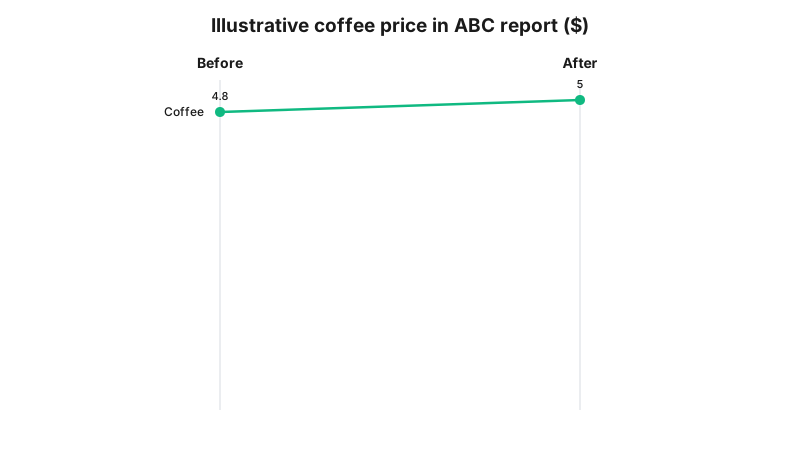
The ABC’s 2 October 2026 story on businesses finding ways to recoup the lost surcharge reported a range of responses. Salon owner Sheridan Shaw has built the revised bank and payment provider fees into her pricing. Restaurant owner Peter Papas has also raised prices. The ABC also quotes a forecast that venues will round prices up, for example a coffee going from $4.80 to a flat $5.00. That is an illustration in the story, not a measured price.
Other options came with caveats. Shaw ruled out pushing customers to direct debit or PayID transfers, citing reconciliation problems and the difficulty of chasing failed payments. Papas called cash discounts and restricting certain credit cards impractical. The Australian Chamber of Commerce and Industry’s Andrew McKellar told the ABC: “There are no real winners in any of this because the costs will still be there.”
For a website, the message is simple. The two clean routes are a higher headline price that already includes your costs, or a flat fee that every customer pays. Both put the real price where the customer sees it first. See our guide to what drip pricing rules mean for your checkout for the separate rule on mandatory fees.
Takeaway: the clean workaround is not a hidden fee. It is a price that already includes your costs.
What Providers Are Doing About Fees
The RBA’s March 2026 summary says it is lowering the maximum interchange fee on consumer credit and debit card payments, introducing a cap on interchange fees for foreign card payments, and requiring large acquirers, eftpos, Mastercard and Visa to publish the fees they charge. Businesses are to receive standardised fee information on their statements to help them compare quotes. The RBA FAQ dates the lower domestic caps from 1 October 2026 and the foreign-issued card caps from 1 April 2027.
On 28 October 2026, in her opening statement to the Senate Economics Legislation Committee, Governor Michele Bullock said “Card surcharging was removed from 1 October” and “so far, several large providers have reduced their card processing fees for small businesses.” She also said the RBA is seeing signs of increased competition. She did not give savings figures in that statement.
The savings numbers come from the ABC’s 2 October story. It says the reforms are meant to save customers about $1.6 billion annually, and that the RBA maintains the reduction in interchange fees will save businesses $910 million a year. The Australian Chamber of Commerce and Industry disagrees, saying this “won’t save them money” for small businesses in particular.
The practical step is not to wait for a provider to call you. The RBA is pushing providers to publish fees and pass savings on, which means your current merchant rate may be out of date. Pull your last statement and ask for a quote against the published fees.
Takeaway: the ban removed your ability to pass the cost on, so the rate you pay is now worth renegotiating.
What to Check on Your Site This Week
- Search every page, template and email for the words “surcharge”, “card fee”, “processing fee” and “payment fee”. Remove any that apply only to card payments.
- Open your payment gateway settings. Turn off or zero any surcharge percentage for Visa, Mastercard and eftpos, and for American Express, UnionPay and PayPal if you use them.
- Check your booking plugin or widget. Many have a separate “card fee” setting that the gateway does not control.
- Check invoices, quote templates and deposit requests, which often carry their own hardcoded line.
- If you keep a booking fee or service fee, make sure it is charged on every booking regardless of payment method, and that the price shown before payment already includes it.
- If you want to offer a cash or bank transfer discount, show it as a discount from the full price, not as a surcharge on card.
- Check your point-of-sale terminal in the shop. The terminal and the website should tell the same story.
- Update your terms, FAQ and checkout copy so no page promises a fee that no longer exists.
Where This Gets Hard
Three limits are worth stating plainly. First, we are reporting the RBA’s FAQ and summary, not the networks’ full scheme rules, and your merchant contract may add detail. Second, the RBA does not regulate merchants, so your payment provider’s reading of a borderline fee, not ours, is the one you will deal with in practice. Third, the ABC story shows that cost pressure is real: a ban on a fee does not remove the cost, it moves it into your price.
If your gateway, booking system and invoicing tool each hold their own fee setting, a site audit is the quickest way to find the one you missed. Whether a specific fee is compliant for your business is a question for your payment provider and, where the amounts are material, your accountant or lawyer.
Frequently Asked Questions
Can my website still add a card surcharge at checkout?
In general, no, not for eftpos, Mastercard or Visa cards. The RBA says card surcharging on those networks ended on 1 October 2026, and its FAQ says the three networks each decided to introduce no-surcharge rules from that date. The RBA lists American Express and UnionPay as also removing surcharging from 1 October, and PayPal from 5 October. The RBA FAQ also covers exemptions and business-to-business payments, so check it for your case.
Can I still charge a booking fee, service fee or public holiday surcharge?
The RBA’s FAQ says the changes do not apply to weekend surcharges, public holiday surcharges, or booking fees or service fees. It also says a card payment surcharge does not include a surcharge that applies regardless of payment method. A fee that only appears when a customer picks card is a different matter, because the RBA defines a card surcharge as an extra fee for using a particular card.
Can I offer a discount for paying by bank transfer or cash?
The RBA says businesses can continue to offer discounts for particular payment methods, and its March 2026 summary says this includes discounts for customers who pay by cash. Whether a particular discount is fine in your situation is a question for your payment provider and the ACCC’s guidance.
Who enforces the ban on my business?
The RBA’s FAQ says the card networks are ultimately responsible for ensuring compliance with the no-surcharge rules, not the RBA, and that the RBA does not directly regulate merchants. In practice that means your payment provider is the first place a surcharge on your site will be noticed.
Fix Your Checkout Before a Customer Finds It
Contact us for a quote and we will walk your booking, pricing and checkout pages the way a customer would, find every leftover card fee, and fix the pages that still carry one. Contact us for a quote.
Sources and References
Reserve Bank of Australia
, Frequently Asked Questions: Removal of Card Payment Surcharges From 1 October 2026. Read 31 October 2026.Reserve Bank of Australia
, Review of Retail Payments Regulation, March 2026 summary. Read 31 October 2026.Reserve Bank of Australia
, Governor Michele Bullock, Opening Statement to the Senate Economics Legislation Committee, 28 October 2026. Read 31 October 2026.ABC News
, Businesses finding ways to recoup now banned surcharge fees, 2 October 2026. Read 31 October 2026.
Last reviewed: 31 October 2026.
Vikas Thakur
Founder of RockingWeb. 16 years of experience from working at TPG, iiNet and Monadelphous, now building websites, software and digital marketing for local businesses in Rockingham and Perth.