Google September 2026 Spam Update: A Local Site Check
Google's September 2026 spam update ran for 13 days and 16 hours and finished on 8 October. Here is what Google says it does, and a practical checklist for a Rockingham or Perth small business website.
 Vikas Thakur Founder, RockingWeb 9 min read
On this page 9
Key takeaways
- Google’s September 2026 spam update began on 24 September 2026 and, per Google’s dashboard, ran 13 days and 16 hours
- Google confirmed the rollout was complete as of 8 October 2026
- Google said it applies globally and to all languages, so it covers Australian local sites
- Sites that violate Google’s spam policies may rank lower in results or not appear at all
- Google says improvement can take a period of months after a site is fixed, not days
- The September update ran far longer than the three earlier spam updates this year, per the same dashboard
- The fixes that matter for a small local site are boring ones: leftover pages, old redirects, scraped or auto-generated content and unnatural links
If your site’s enquiries or Google visibility moved at some point between 24 September and 8 October 2026, there is a clean explanation to rule in or out first. Google ran a spam update across that exact window, and it ran for 13 days and 16 hours, the longest spam update on its 2026 ranking history.
This is a web development view of what to check, not a promise about your rankings. Google has not said which sites it affected, and we cannot see yours from here. What we can do is walk through what Google has actually published, so you know where to look.
What Google Said About the September 2026 Update
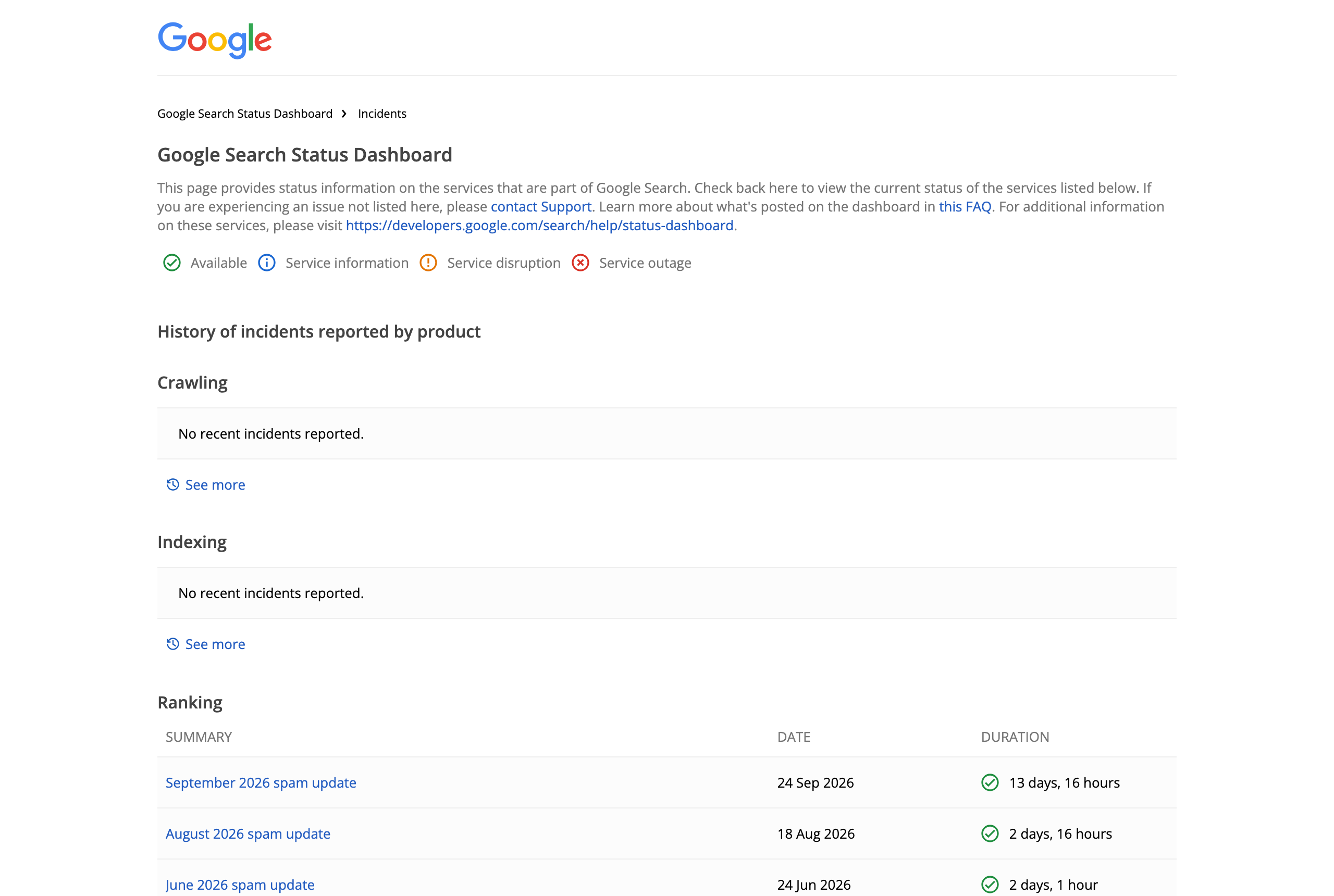
The Search Status Dashboard entry for the September 2026 spam update has two lines of detail. When it started, Google wrote that it “applies globally and to all languages” and that “the rollout may take up to two weeks to complete.” On 8 October 2026 it added: “The rollout was complete as of October 8, 2026.”
That is all the dashboard says. It lists no categories, no industries and no percentage of sites affected, so any post that tells you exactly what the update punished is guessing.
Here is how long each of the four spam updates on Google’s 2026 list ran, from the same dashboard.
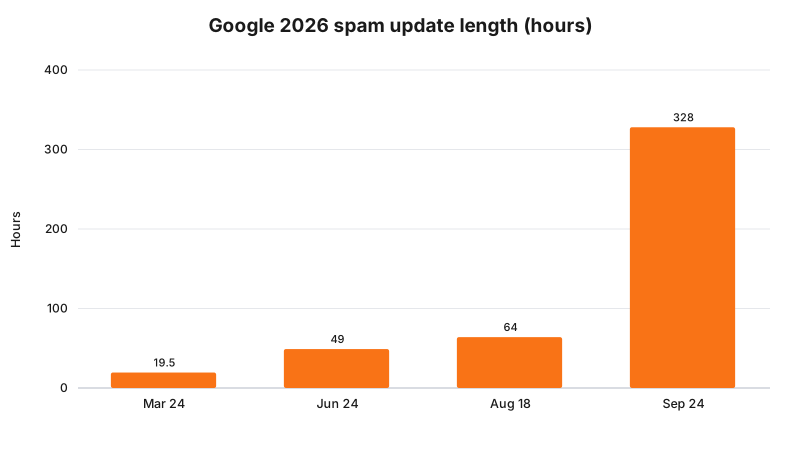
The March update took 19 hours and 30 minutes, June took 2 days and 1 hour, August took 2 days and 16 hours, and September took 13 days and 16 hours. Duration alone does not prove anything about severity, but it does tell you the window to compare against.
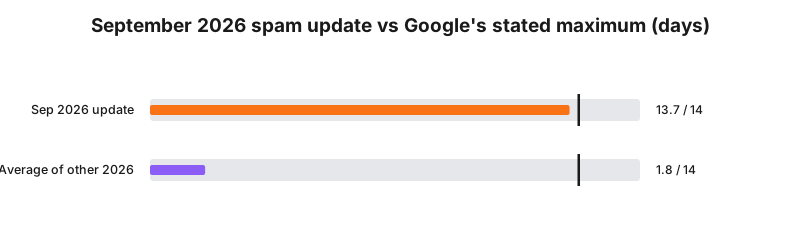
The 14-day target is Google’s own line that the rollout “may take up to two weeks”. The September update finished just inside it. The “other 2026” figure is our own average of the March, June and August durations in hours (19.5, 49 and 64), converted to days.
Takeaway: the window to check your own analytics against is 24 September to 8 October 2026.
What a Spam Update Is, in Google’s Words
Google’s documentation on spam updates explains that its automated spam-detection systems are always running, and that it calls a notable improvement to them a spam update. The page gives SpamBrain, its AI-based spam-prevention system, as an example of a system that is improved from time to time.
Three statements on that page matter for a small business owner:
- “Sites that see a change after a spam update should review our spam policies to ensure they are complying with those.”
- “Sites that violate our policies may rank lower in results or not appear in results at all.”
- Making changes may help a site improve “if our automated systems learn over a period of months that the site complies with our spam policies.”
The same page adds a caution on link spam updates: when Google’s systems remove the effect of spammy links, “any ranking benefit the links may have previously generated for your site is lost” and cannot be regained. Google has not said the September update was a link spam update, so do not assume it was.
Takeaway: Google’s advice is to read the spam policies and fix what you find. Recovery is measured in months, not days.
The Spam Policies a Local Site Can Trip Over
Google’s published spam policies cover many tactics. Most do not apply to a plumber, café or accountant with a ten-page site. These are the ones that can, quietly, catch a small business site.
| Policy | What Google says | How it shows up on a small site |
|---|---|---|
| Scaled content abuse | Many pages generated mainly to manipulate rankings, “no matter how it’s created”, including using generative AI tools to produce many pages without adding value | Dozens of near-identical suburb pages, or bulk AI-written blog posts |
| Expired domain abuse | An expired domain bought and repurposed mainly to manipulate rankings with low-value content | A bought domain pointed at your business to borrow its history |
| Sneaky redirects | Sending users somewhere different from what search engines see, or somewhere unexpected | An old redirect or compromised plugin sending mobile visitors elsewhere |
| Thin affiliation | Affiliate content copied directly from the merchant with no added value | Copied supplier descriptions on product pages |
Google is also explicit that legitimate redirects exist. Its examples include moving your site to a new address, consolidating several pages into one, and redirecting users to an internal page once they log in. A redirect is only sneaky if it is “intended to deceive either the users or search engines.”
Takeaway: for a local business the realistic risks are bulk or copied pages, redirects you forgot about, and a site that was tampered with.
A Local Site Check You Can Run This Week
This is the order we would work in for a Rockingham or Perth business site. None of it needs a developer for the first pass.
- Compare your dates. In Google Search Console and your analytics, look at impressions, clicks and enquiries before 24 September, during the update window and after 8 October. Note whether a drop or rise lines up, and whether it is sitewide or limited to a few pages. Google’s dashboard times are UTC, so the start of 16:15 UTC on 24 September is 00:15 AWST on 25 September in Perth.
- List every page that exists. Check your sitemap against what you actually meant to publish. Look for old test pages, duplicate suburb or service pages, and anything you do not recognise.
- Read your own thin pages. If a page says almost the same thing as five others with only a suburb name swapped, it is the pattern Google describes under scaled content abuse. Merge it into one useful page or remove it.
- Check your redirects. Visit your site on a phone and a desktop, from a Google search result, and see where you land. Review redirect rules in your hosting and any redirect plugin. Keep legitimate ones, such as old URL to new URL.
- Check for tampering. Search Google for your business name plus words you would never use, and view your pages for links or text you did not add. Update your CMS, themes and plugins, and remove any you do not use.
- Review who links to you. If you or an agency ever paid for links or directory blasts, note them. Google says benefit from spammy links, once removed, cannot be regained, so the goal is to stop adding more.
- Check Search Console messages. Google’s spam policies page mentions notifying sites through the Manual actions report and the Search Console message centre for at least one of its policies. Make sure someone reads those messages either way.
- Then hold still. Google says improvement can take months once systems learn a site complies. Make the fixes, record the date, and review in a quarter rather than changing the site every week.
If you find nothing on this list, that is a useful result too. It means the movement in your numbers is more likely to come from somewhere else, such as seasonality, competitors or your own changes.
Where This Gets Hard
Three limits are worth stating. First, Google has not published what the September 2026 update changed, so we cannot tell you why a specific site moved. Second, the spam updates documentation we read was last updated in December 2025, so treat it as general guidance on how Google describes these updates, not a description of this one. Third, a technical check is not a guarantee. It finds the things Google has said it cares about, and the rest is judgment.
If you would like a second pair of eyes on your site, see our Rockingham SEO service or read how local ads fit alongside it in our guide to Google Ads in Perth.
Frequently Asked Questions
When did the Google September 2026 spam update start and finish?
Google’s Search Status Dashboard lists it as starting on 24 September 2026, running 13 days and 16 hours, with Google confirming the rollout was complete as of 8 October 2026. Google said it applies globally and to all languages.
Did the update target Australian small businesses?
Google’s dashboard entry says the update applies globally and to all languages. It does not single out any country or industry, so a Perth or Rockingham site is covered by the same systems as any other.
My rankings changed in late September. Does that mean I did something wrong?
Not necessarily. Google says sites that see a change after a spam update should review its spam policies, and that sites violating them may rank lower or not appear at all. A change can have other causes, so check the policies first and look at what changed on your site before assuming a problem.
How long does recovery take if I fix something?
Google’s documentation says making changes may help a site improve if its automated systems learn over a period of months that the site complies with the spam policies. It also says that for link spam updates, any ranking benefit from spammy links cannot be regained.
Get a Site Check From a Local Web Developer
Contact us for a quote and we will run this checklist against your site, report what we find in plain English, and fix what is fixable. Contact us for a quote.
Sources and References
Google Search Status Dashboard
, Ranking incident history including the September 2026 spam update (24 September 2026, 13 days 16 hours) and the March, June and August 2026 spam updates. Read 31 October 2026.Google Search Status Dashboard
, incident feed entry for the September 2026 spam update, with Google’s rollout notes and its 8 October 2026 completion update. Read 31 October 2026.Google Search Central
, Google Search spam updates and your site. Last updated 2025-12-10 per the page. Read 31 October 2026.Google Search Central
, Spam policies for Google web search. Read 31 October 2026.
Last reviewed: 31 October 2026.
Vikas Thakur
Founder of RockingWeb. 16 years of experience from working at TPG, iiNet and Monadelphous, now building websites, software and digital marketing for local businesses in Rockingham and Perth.