GLP-1 Use Up 10x in Australia: Cosmetic Surgery [2026]
GLP-1 medication sales in Australia rose from 57,941 units a month in 2020 to 496,875 by April 2025, almost a tenfold jump, according to UNSW researchers. Full data on what that's doing to body-contouring surgery demand.
 Vikas Thakur Founder, RockingWeb 9 min read
Key Takeaways
- GLP-1 medication sales in Australia rose from 57,941 units a month in May 2020 to 496,875 by April 2025, almost a tenfold increase, according to UNSW researchers
- Close to 500,000 Australians, about 2% of the adult population, now use a GLP-1 drug like Ozempic, Wegovy, or Mounjaro every month
- In the year to April 2025, Australians bought more than 6 million units of GLP-1 medication, and 47.8% of it came through the private market with no PBS subsidy
- In the US, 837,000 patients prescribed GLP-1 drugs pursued further aesthetic care with ASPS member surgeons in 2024, the first year this was tracked
- Of those US GLP-1 patients, 20% had already had plastic surgery, 39% were considering a surgical procedure, and 41% a non-surgical one
- Australia performed 41,160 body-and-extremities cosmetic procedures in 2024, including 10,395 liposuction and 9,975 abdominoplasty procedures, according to ISAPS
- A US study of 373 panniculectomy patients found 21.7% were taking GLP-1 medications before surgery, with higher delayed wound healing (18.5% vs 7.5%) but lower seroma rates (4.9% vs 14.0%)
- No Australian body has yet published a GLP-1-specific cosmetic surgery demand survey. That gap matters, and this post is upfront about it
GLP-1 medication use in Australia rose almost tenfold between May 2020 and April 2025, from 57,941 to 496,875 units sold a month, according to UNSW researchers publishing on medRxiv. Australia has no dedicated national survey yet linking that surge to cosmetic surgery bookings. What exists is US data from the American Society of Plastic Surgeons (ASPS) showing 837,000 GLP-1 patients sought aesthetic care with member surgeons in 2024, plus Australian procedure-volume data from the International Society of Aesthetic Plastic Surgery (ISAPS) showing exactly how many tummy tucks, liposuction procedures, and arm lifts Australian surgeons are already performing.
Put those together and you get a real, if incomplete, picture: a fast-growing pool of Australians who have lost significant weight on GLP-1 drugs, a body-contouring procedure category doing meaningful volume, and no formal research yet connecting the dots the way the US data already does. Here’s what’s confirmed, what’s still anecdotal, and where the gap sits.
The Australian GLP-1 Boom, By the Numbers
GLP-1 receptor agonists (semaglutide, sold as Ozempic and Wegovy, and tirzepatide, sold as Mounjaro) were approved in Australia for type 2 diabetes first, then expanded into off-label and, more recently, PBS-listed weight-loss use. The growth curve since then has been steep.
| Metric | Figure | Period |
|---|---|---|
| Monthly GLP-1 units sold | 57,941 → 496,875 | May 2020 → April 2025 |
| Growth | Almost 10-fold | 5 years |
| Total units sold | 6 million+ | May 2024 → April 2025 |
| Sold via private market (no PBS subsidy) | 47.8% | May 2024 → April 2025 |
| Australians using a GLP-1 drug monthly | ~500,000 (2% of adults) | 2025 |
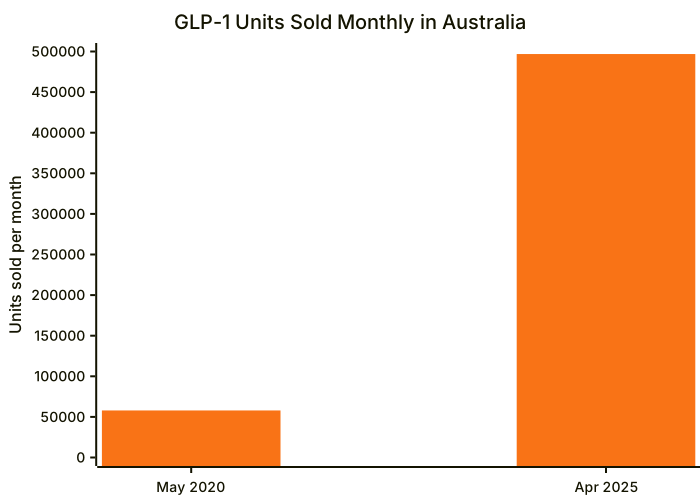
The research, from a team including UNSW’s Michael Falster, tracked pharmacy sales against PBS dispensing data and found the gap between the two widening every year as more people pay out of pocket. Only patients with type 2 diabetes currently get subsidised access. Everyone else, an estimated 180,000 to 240,000 people, is paying $200 to $600 a month at full price. That is not a niche trend. It is 2% of the adult population paying real money, every month, for rapid and often substantial weight loss.
Takeaway: Australia’s GLP-1 uptake is real, recent, and documented. What comes after it, for skin and body shape, is where the evidence thins out.
What US Surgeons Are Reporting About GLP-1 Patients
Rapid, large weight loss changes skin differently to slow weight loss through diet alone. Patients who lose 30, 50, or 100-plus kilograms on a GLP-1 drug often do it faster than their skin can adapt, leaving excess, loose skin that no amount of exercise will tighten. That is the clinical rationale behind the rise in body-contouring consultations, and it is best documented in the United States so far.
The ASPS 2024 Procedural Statistics Report measured GLP-1 prescribing by its own members for the first time. The results were the clearest data point available anywhere on this trend.
| US ASPS finding (2024, first year tracked) | Figure |
|---|---|
| GLP-1 patients who sought aesthetic care with an ASPS surgeon | 837,000+ |
| Of those, already had plastic surgery | 20% |
| Of those, considering a surgical procedure | 39% |
| Of those, considering a non-surgical procedure | 41% |
| US body-contouring procedures, 2022 → 2023 | 566,052 → 599,862 (+6%) |
All figures in this table are US data (ASPS), not Australian.
A separate clinical study published in Plastic and Reconstructive Surgery looked at 373 patients who had a panniculectomy (surgical removal of excess abdominal skin) between 2013 and 2023. GLP-1 users made up 21.7% of that group, a share that rose sharply in the later years of the study. The GLP-1 patients had higher rates of delayed wound healing (18.5% versus 7.5% for non-users) but lower rates of seroma, or fluid buildup under the skin (4.9% versus 14.0%). Researchers called the interplay between the drugs and tissue healing “complex and nuanced,” not simply good or bad.
Takeaway: the clearest quantified link between GLP-1 use and surgical demand comes from the US so far. Australia has the drug-use data. It does not yet have an equivalent surgeon-reported demand survey.
Australia’s Body-Contouring Procedure Volume in 2024
Australia does have solid data on how much body-contouring surgery is already happening, even without a GLP-1-specific breakdown. The ISAPS 2024 Global Survey, the most rigorous international dataset on aesthetic procedures, recorded 177,502 total cosmetic procedures in Australia for the year, split between 114,188 surgical and 63,315 non-surgical. Of the surgical total, 41,160 fell into the body-and-extremities category, the group that covers post-weight-loss contouring work.
| Procedure (Australia, 2024) | Count | Share of body-contouring total |
|---|---|---|
| Liposuction | 10,395 | 37.9% |
| Abdominoplasty (tummy tuck) | 9,975 | 36.4% |
| Body lift (upper + lower) | 2,835 | 10.3% |
| Brachioplasty (arm lift) | 2,415 | 8.8% |
| Thigh lift | 1,785 | 6.5% |
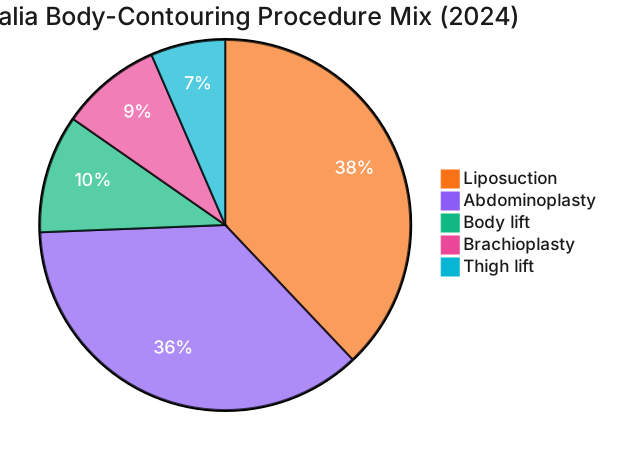
Liposuction and abdominoplasty already account for almost three-quarters of Australia’s body-contouring volume between them, which lines up with what US surgeons describe as the two most requested procedures for post-GLP-1 patients. Brachioplasty (arm lift) and thigh lift, the two procedures most specific to significant, rapid weight loss rather than general body shaping, made up a smaller but still meaningful 15.3% combined.
Takeaway: the procedure mix Australia already performs most is the same mix US surgeons say GLP-1 patients are driving. The volume exists. Whether GLP-1 use is the reason for any particular booking still isn’t tracked here.
The Data Gap: What Australia Doesn’t Know Yet
Here’s the honest part. Search “Ozempic cosmetic surgery demand Australia” and you won’t find a national survey, an AHPRA data release, or a peer-reviewed Australian study quantifying how many extra body-contouring consultations GLP-1 use has generated. What you find instead is operator-level commentary: Sydney-based plastic surgeons reporting a “peak in enquiries” for body contouring that they attribute to what one practice calls the “GLP-1 Weight Loss Era,” and total body lifting alongside customised abdominoplasty named as the most sought-after restorative procedures for 2026.
That is a real signal. It is not the same as data. Clinics and journalists searching for an Australian equivalent of the ASPS 837,000-patient figure will not find one yet, because nobody in Australia has run that survey. Given roughly 500,000 Australians are on a GLP-1 drug today, a formal Australian version of the ASPS study is overdue.
There is a second gap worth flagging for clinics operating in this space: AHPRA’s advertising rules apply just as strictly to GLP-1-driven body-contouring marketing as they do to anything else. Before-and-after imagery of a patient’s transformation, arguably the most compelling proof for this exact patient segment, is banned outright. Testimonials are banned. Clinics chasing this new wave of demand with the wrong content risk a breach before they’ve converted a single lead. If you’re marketing body-contouring or skin-removal procedures to weight-loss patients and haven’t checked your site against the current rules, talk to RockingWeb and we will flag exactly what needs to change before you spend another dollar on ads.
Takeaway: the demand signal is real and growing. The Australian research to prove its size doesn’t exist yet, and neither does the flexibility to market around that gap with banned content types.
What This Means for Clinics Marketing to GLP-1 Patients
A patient who has lost 40 kilograms on Mounjaro and is now researching a tummy tuck is a different buyer to a typical cosmetic surgery lead. They’ve already spent a year or more paying $200 to $600 a month out of pocket. They’re motivated, informed, and actively comparing surgeons on compliant content: procedure explanations, credentials, pricing transparency, and clear next steps, since testimonials and before-and-afters are off the table.
Clinics that build for that buyer now, rather than after the market catches up, get first-mover advantage in a segment that’s currently under-served by search results and under-covered by clinic marketing. RockingWeb builds AHPRA and TGA-compliant cosmetic clinic websites designed to convert this exact patient on compliant content alone, with the body-contouring and skin-removal service pages this new demand segment is actively searching for.
For clinics that want a fuller marketing system built around growing patient categories like this one, not just a website, RockingWeb’s ClinicPipeline handles AHPRA-compliant lead generation, booking, and follow-up end to end. RockingWeb is based in Western Australia and builds for cosmetic and allied health clinics across the country.
Takeaway: GLP-1 patients are already researching body-contouring surgery. The clinics that show up for them first, on compliant content, capture a lead category most competitors haven’t built for yet.
Data sources: The GLP-1 RA boom: Trends in publicly subsidised and private access in Australia, 2020-2025 (UNSW researchers, medRxiv preprint, October 2025); American Society of Plastic Surgeons (ASPS), 2024 Procedural Statistics Report; International Society of Aesthetic Plastic Surgery (ISAPS), 2024 Global Survey (Australia country data); Koenig et al., Plastic and Reconstructive Surgery (April 2026), panniculectomy and GLP-1 complication study.
RockingWeb builds AHPRA-compliant marketing systems for Australian cosmetic clinics catching this demand shift. Hire us to talk about your body-contouring patient pipeline.
Vikas Thakur
Founder of RockingWeb. 16 years building for companies like TPG, iiNet and Monadelphous, now focused on websites and marketing that comply with AHPRA's advertising guidelines and still book patients.