Before-and-After Photo Rules AHPRA: Full Guide
AHPRA's before-and-after guideline for higher risk cosmetic procedures, effective 2 September 2025, does not ban the format outright. It sets six conditions, and breaching them carries a penalty of up to $120,000 per image. Here is exactly what is banned, what is conditionally allowed, and what consent a clinic needs before publishing one.
 Vikas Thakur Founder, RockingWeb 12 min read
On this page 11
- Key Takeaways
- In Brief
- Not a Blanket Ban: What Changed on 2 September 2025
- Which Procedures the Before-and-After Rules Cover
- What’s Banned Outright
- What’s Conditionally Permitted
- Informed Consent: What “Consent” Has to Mean for a Photo
- The Penalty for Getting This Wrong
- Auditing Your Existing Gallery
- Building a Marketing System That Does Not Depend on Before-and-After Photos
- Next Step for Your Clinic
Key Takeaways
- AHPRA’s Guidelines for advertising higher risk non-surgical cosmetic procedures, effective 2 September 2025, do not ban before-and-after photos outright. They allow the format under six specific conditions.
- The “after” image cannot be the most prominent or first image in an advertisement. The “before” image, or a composite showing both, must lead.
- Editing, airbrushing, filtering, or otherwise enhancing an image is banned outright. Every image must be a genuine, unedited photo of a patient treated by that specific practitioner.
- A disclaimer that results vary between individuals is mandatory on every compliant image, alongside a stated time elapsed since treatment (for example, “3 weeks post-treatment”).
- Images of patients under 18 are banned in any cosmetic procedure advertisement, with no exception for parental consent.
- Consent to use a photo in advertising must be separate, documented consent, distinct from consent to the procedure itself, and it must be able to be withdrawn at any time.
- Maximum penalty per breach under the Health Practitioner Regulation National Law and Other Legislation Amendment Act 2025: $60,000 for an individual practitioner, $120,000 for a body corporate, up from $5,000 and $10,000 before the 2025 amendment.
- AHPRA assessed 775 advertising complaints in 2024/25, of which 419 (54.1%) concerned registered practitioners directly, per the Ahpra and the National Boards Annual Report 2024/25.
In Brief
AHPRA’s before-and-after rules for higher risk non-surgical cosmetic procedures, in force since 2 September 2025, permit the format only where the image is genuine, unedited, correctly consented to, disclaimed, and never led by the “after” shot. A breach carries a fine of up to $120,000 for a clinic. This guide covers the six conditions, the consent standard behind them, and which procedures the rules apply to.
Every split-panel before-and-after post on a Perth cosmetic clinic’s Instagram grid right now is either compliant with six specific conditions or it is a live liability.
Not banned. Conditional.
That distinction matters, because most clinic owners have heard “AHPRA banned before-and-afters” as a blanket rule, and that is not what the September 2025 guideline says. It says a before-and-after image is allowed if it clears six tests: genuine patient, no editing, before-image prominence, a disclaimer, a time-elapsed label, and an adult-only content flag. Miss one test and the same photo that was compliant marketing in 2024 becomes a $60,000 exposure today.
Here is exactly what AHPRA’s guideline bans outright, what it permits conditionally, what “editing” actually covers, and what informed consent has to look like before a single image goes live.
Not a Blanket Ban: What Changed on 2 September 2025
AHPRA published two guidelines on 3 June 2025, both effective from 2 September 2025: one for practitioners performing non-surgical cosmetic procedures, and a separate one, the Guidelines for advertising higher risk non-surgical cosmetic procedures, that governs marketing.
The advertising guideline does not use the word “ban” for before-and-after photos as a category. It restricts them. A clinic that reads a summary headline like “AHPRA bans before-and-after photos” and deletes its entire gallery in a panic has overcorrected. A clinic that keeps publishing the same content it ran in 2023 has undercorrected. The accurate position sits between those two extremes, and it is the position AHPRA’s own enforcement data backs up.
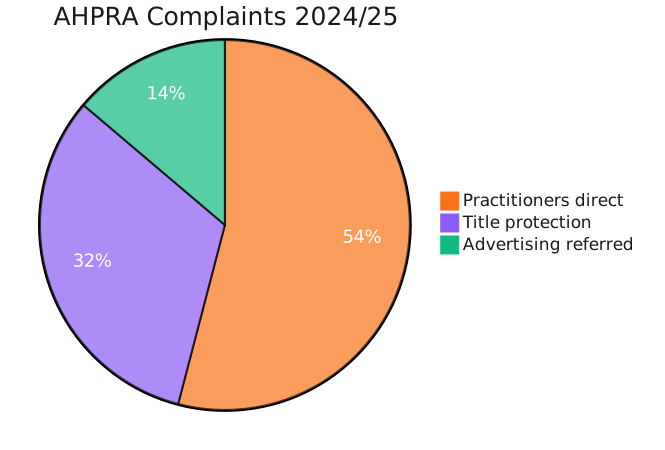
Of the 775 advertising complaints AHPRA’s compliance team assessed in 2024/25, 419 (54.1%) concerned registered practitioners directly. The remaining 356 were referred to AHPRA’s Criminal Offences Unit: 249 (32.1%) concerned title protection or “holding out” as a registered practitioner, and 107 (13.8%) concerned advertising of a regulated health service by a corporate or unregistered entity. AHPRA’s public reporting does not break this figure down further by specific advertising element (testimonial, before-and-after image, outcome claim), so treat the split between complaint types as unverified. Source: Ahpra and the National Boards Annual Report 2024/25.
Takeaway: the rules bite hard enough that AHPRA is actively assessing hundreds of advertising complaints a year, but the underlying photo rule is conditional, not a prohibition.
Which Procedures the Before-and-After Rules Cover
The six conditions below apply specifically to advertising of procedures on AHPRA’s “higher risk non-surgical cosmetic procedures” list. AHPRA defines a higher-risk procedure as one that needs an authorisation limited to certain practitioners, uses a prescription-only medicine, or requires anatomical, physiological or pharmacological knowledge to perform safely.
| Procedure category | Named examples | Who typically performs it |
|---|---|---|
| Injectables | Botulinum toxin, dermal filler, fat-dissolving injections | Cosmetic injectors, GPs, cosmetic physicians |
| Energy-based skin treatment | CO2 laser skin resurfacing, laser hair removal | Laser clinics, skin clinics, dermatologists |
| Chemical treatment | Chemical peels, dermabrasion | Skin clinics, cosmetic dermatologists |
| Vascular and body contouring | Sclerotherapy, microsclerotherapy, cryolipolysis (fat freezing) | GPs, cosmetic physicians, vascular specialists |
| Surgical-adjacent | Thread lifts, hair transplants | Cosmetic physicians, GPs |
Here is the nuance most guides skip. A cosmetic procedure that does not sit on this list, one that does not involve a prescription-only substance and does not need specialist anatomical training to perform safely, is not automatically bound by these six specific conditions. It is still bound by the general prohibition on misleading advertising and the testimonial ban under section 133 of the Health Practitioner Regulation National Law, which predates the 2025 changes and applies to every regulated health service regardless of risk tier. What changes for a lower-risk cosmetic service is the absence of the added prominence rule, the time-elapsed label requirement, and the mandatory adult-content flagging that the September 2025 guideline layers on top for the higher-risk list specifically.
In practice, most clinics running before-and-after content, injectables, laser, peels, thread lifts, do sit inside the higher-risk list. If your service menu does not include any of the procedures above, verify your specific treatment against AHPRA’s published list before assuming the lighter general rule applies.
Takeaway: the test is the procedure being advertised against AHPRA’s own risk classification, not whether a clinic calls itself “cosmetic” or “skin” on its shopfront.
What’s Banned Outright
These elements have no conditional path to compliance. There is no disclaimer or consent form that fixes them.
- The “after” image as the lead or most prominent visual. A before-and-after set where the after result is the first thing seen, the hero banner, the thumbnail, the opening frame of a Reel, is non-compliant regardless of anything else on the page.
- Edited, filtered, or airbrushed images. Any digital enhancement that changes how the result appears, skin smoothing, brightness or contrast adjustments that flatter the after shot, AI retouching, is prohibited.
- Images that are not genuine patients of that specific practitioner. Stock photography, images sourced from another clinic, or a departed practitioner’s old patient photos still in rotation are all banned.
- Images of patients under 18. No exception exists for parental consent or educational framing.
- Publishing without the required disclaimer. An image that meets every other test but omits the results-vary statement is still non-compliant.
- The “educational” framing loophole. Some clinics previously labelled before-and-after content as clinical or informational rather than promotional to avoid the advertising rules. AHPRA’s 2025 guideline closes this: if the image shows a patient before and after treatment, it is advertising, whatever caption sits above it.
Takeaway: these six items are not “high risk”, they are automatic fails. No amount of disclaimer text or consent paperwork rescues them.
What’s Conditionally Permitted
A before-and-after image for a procedure on the higher-risk list is allowed if it clears all six of these at once:
| Condition | What it requires |
|---|---|
| Genuine patient | Real patient of the advertising practitioner, not stock imagery or another clinic’s patient |
| No editing | Unedited, unfiltered, unairbrushed, consistent lighting and presentation between shots |
| Image prominence | The before image, or a composite of before and after, must be the first or most prominent image, never the after image alone |
| Disclaimer | A visible statement that results vary between individuals |
| Time-elapsed label | The after image must state how long after the procedure it was taken |
| Age and platform | Patient must be 18 or over, and on social media the content must be flagged as adult content using the platform’s age-restriction settings |
Every condition has to be true simultaneously. A clinic that adds a disclaimer to an after-first hero image has fixed one of six requirements and left the structural breach, the prominence rule, untouched.
Get in touch with RockingWeb and we’ll check every image against all six conditions at once, rather than the single test most clinics remember from a headline.
Takeaway: compliant before-and-after content is achievable. It just requires all six boxes ticked on every single image, not a best-effort pass.
Informed Consent: What “Consent” Has to Mean for a Photo
The consent standard behind these rules is stricter than the general treatment consent a patient signs before a procedure. Compliance advisories interpreting the September 2025 guideline consistently describe the same core requirements, though AHPRA’s own PDF text was not directly accessible for this guide (the document returned an access error on request), so treat the specifics below as corroborated across multiple independent legal and compliance sources rather than quoted verbatim from AHPRA.
- Separate consent for advertising use. Consent to use a patient’s image in marketing is distinct from consent to the procedure. A signed treatment consent form does not cover advertising use on its own.
- Right to view before consenting. The patient should have the opportunity to see the specific images before agreeing to their use.
- Disclosure of storage and access. The patient should be told where the original images are stored and who can access them. Images should not sit on a practitioner’s personal phone.
- Withdrawal at any time. A patient can withdraw consent to use their image after it has already been published, and the practice needs a process to remove it.
This is the same standard that makes a departed nurse injector’s old patient photos a banned category the moment they are no longer that practitioner’s patient of record, not a formality clinics can paper over with a generic waiver signed on day one.
Takeaway: treat photo consent as its own document with its own withdrawal mechanism, not a clause buried in a general treatment consent form.
The Penalty for Getting This Wrong
A breach of the advertising provisions is prosecuted as a criminal offence under the Health Practitioner Regulation National Law, not handled as a private civil dispute. The 2025 amendment act raised the ceiling significantly.
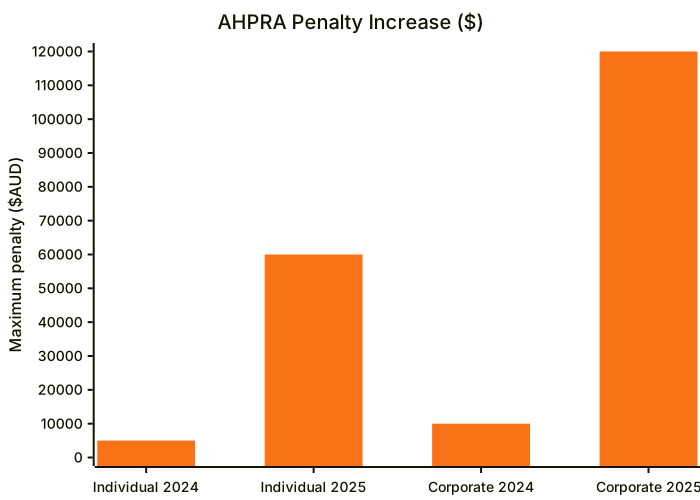
Before the Health Practitioner Regulation National Law and Other Legislation Amendment Act 2025, the maximum advertising-breach penalty was $5,000 for an individual and $10,000 for a body corporate. The Act, passed by the Queensland Parliament on 9 April 2025, raised those ceilings to $60,000 and $120,000, a twelvefold increase that applies to every regulated health profession, not only cosmetic injectable providers.
Each non-compliant image is treated as a separate breach. A clinic running five non-compliant before-and-after posts plus a website gallery with the same “after first” layout is not looking at one fine, it is looking at six separate exposure points.
Takeaway: the penalty scale changed by an order of magnitude in 2025. Content that was a manageable risk two years ago is not a manageable risk now.
Auditing Your Existing Gallery
Run through this checklist against every live before-and-after image, not just new content going up from today.
- Check the lead image. Is the after shot the first or largest image in the post, carousel, or gallery? If yes, it fails regardless of anything else.
- Check for edits. Compare lighting, angle, and skin texture between the before and after frame. Inconsistent lighting that flatters the after shot is a red flag even without obvious filters.
- Confirm patient provenance. Is this a genuine, current patient of the specific practitioner named on the page? Departed staff members’ old patient photos need to come down.
- Confirm age. Nothing in the gallery should show a patient who was under 18 at the time of treatment.
- Check for the disclaimer and time label. Both need to be visible on the image or immediately adjacent to it, not buried in a linked terms page.
- Check platform age-gating. On Instagram, Facebook and TikTok, higher-risk cosmetic procedure content needs the platform’s adult-content restriction applied.
There is no grandfathering provision. A compliant-looking post from 2023 is judged against the rules in force today, not the rules in force when it was published. Our AHPRA-compliant cosmetic clinic websites work replaces the removed gallery content with credential-led, consultation-first pages that convert without relying on a single before-and-after image.
Takeaway: audit against today’s six conditions, not the standard your last gallery update was built to.
Building a Marketing System That Does Not Depend on Before-and-After Photos
Clinics that built their entire content calendar around transformation photos need a replacement system, not a content freeze. Three approaches hold up under the current rules:
Credential-led practitioner pages. A practitioner’s training, registration, and clinical focus can be advertised in full, and this trust signal does not disappear when a gallery does.
Procedure-education content. Explaining what a treatment involves, how it works, and typical recovery timeframes is compliant, provided the copy avoids outcome guarantees and testimonial-style claims.
Consultation-first booking flows. When advertising cannot lead with a result, the consultation becomes the conversion point. A low-friction booking path for an initial consult converts more reliably, and more compliantly, than a photo gallery that is one screenshot away from a complaint.
This is the system RockingWeb builds for Perth cosmetic and skin clinics through ClinicPipeline: websites and ad accounts built around the current rules from the first draft, not retrofitted after a compliance notice arrives.
Next Step for Your Clinic
If your clinic’s Instagram grid, website gallery, or Google Ads creative still leads with the after shot, uses an edited image, or is missing the results-vary disclaimer, it is carrying exposure under rules that have applied since 2 September 2025.
RockingWeb reviews every before-and-after image across your website, social channels, and ad accounts against all six conditions, flags exactly which images fail and why, and delivers a prioritised, compliant replacement plan.
Vikas Thakur
Founder of RockingWeb. 16 years building for companies like TPG, iiNet and Monadelphous, now focused on websites and marketing that comply with AHPRA's advertising guidelines and still book patients.