Dental Payroll Tax Australia: Clinic Cost Threat
The Australian Dental Association has warned that payroll tax reclassification of contracted dentists as employees threatens backdated tax bills for dental practices, the same legal mechanism that already hit GP clinics. Dentists got a time-limited amnesty in two states. Not the ongoing exemption GPs received.
 Vikas Thakur Founder, RockingWeb 11 min read
On this page 8
- Key Takeaways
- What the ADA Has Actually Said
- The Legal Mechanism: Already Covered, Not Repeated Here
- Queensland’s Own Ruling Uses a Dental Clinic as the Example
- The Amnesty Dentists Got Was Never What GPs Got
- What a Dental-Specific Contractor Review Should Cover
- What We Couldn’t Verify
- Get Your Own Advice First
Key Takeaways
- The Australian Dental Association has publicly warned since September 2023 that contracted dentists risk being reclassified as employees for payroll tax, triggering retrospective bills going back up to 5 years (ADA, ada.org.au)
- Queensland’s own payroll tax ruling (PTAQ000.6.5) uses a dental clinic as its worked example of a taxable “relevant contract”, naming a fictional “Dr Tomas” providing dental services under contract
- Queensland gave contracted dentists a payroll tax amnesty, not an exemption: it forgives 2018 to 2025 liability only if a clinic registers and discloses by 30 June 2025. Ongoing payments from 1 July 2025 are taxable unless a separate exemption applies
- General practitioners in Queensland and Victoria got a permanent payroll tax exemption. Dentists in every state, including Queensland, did not
- ADA’s own Dental Fees Survey found practitioner fees rose only 2.14% between 2017 and 2022, while inflation over the same period ran at 14.5%
- ADA NSW President Dr Dominic Aouad described the payroll tax exposure facing dental practices as “completely untenable” and warned it would “send practices bankrupt” (Bite Magazine, January 2024)
- NSW’s Revenue Ruling PTA-041 defines “medical centre” broadly enough to explicitly include dental clinics, the same ruling category applied to GP surgeries
- No state or federal body, including the ADA, has published a specific count of how many dental practices are affected. Any number claiming otherwise should be treated as unverified
Dental practices contracting associate dentists face the same payroll tax exposure that has already produced multi-million-dollar backdated bills at GP clinics. The Australian Dental Association has warned about this since 2023. Queensland’s state revenue office literally uses a dental clinic as the textbook example in its own ruling. Two states offered dentists a narrow, time-limited amnesty on past liability. None offered the ongoing exemption GPs got. This guide sets out what the ADA has said, what the Queensland and South Australian amnesties actually covered, and where the gap sits for a dental clinic running an associate contractor model in 2026. It is not tax or legal advice. Get your own before touching a contractor agreement.
What the ADA Has Actually Said
The Australian Dental Association went public with this warning well before most dental practice owners had heard of it. In a statement published on 5 September 2023, ADA CEO Damian Mitsch said state revenue offices were pushing new interpretations that would treat payments to independent contractor dentists as taxable wages. “Deemed payroll taxes on non-employee dentists would be a huge blow to those dentists, practice operators and the patients they serve,” Mitsch said. “Some dentists are already struggling to keep their practices going as we recover from the business impacts of COVID-19 and costs rising with inflationary pressures. Unexpected tax liabilities would only make things worse and may precipitate dental practice closures.”
A month later, then ADA President Dr Stephen Liew put it more bluntly to Medical Republic: “Some dental practices will have to raise their fees and others will close without payroll tax exemptions for all medical clinics.” By January 2024, ADA NSW President Dr Dominic Aouad was telling Bite Magazine the exposure facing associate-model dental practices was “completely untenable and will send practices bankrupt”, and pointed out that including independent contractor dentists in a practice’s wage calculation “often pushes practices beyond the threshold” that triggers payroll tax liability in the first place.
That’s three separate ADA office holders, over five months, using words like “bankrupt” and “untenable”. This isn’t a hypothetical the association is raising out of caution. It’s a warning built on the same legal reasoning that already produced real assessments against GP clinics.
Takeaway: three ADA presidents and CEOs have gone on the record since 2023 warning that dental practices face the same payroll tax exposure that already closed GP clinics, using language as strong as “bankrupt” and “untenable”.
The Legal Mechanism: Already Covered, Not Repeated Here
The court decisions that created this exposure, Thomas and Naaz Pty Ltd v Chief Commissioner of State Revenue [2023] NSWCA 40 and Commissioner of State Revenue v The Optical Superstore Pty Ltd [2019] VSCA 197, were not about dentistry. They were about a medical centre and an optometry chain. RockingWeb has already covered that mechanism, the state-by-state GP relief landscape, and the full payroll tax rate and threshold table in detail in Cosmetic Clinic Payroll Tax Ruling: Cost Impact 2026. Read that first if you want the case law and the rate table. This guide picks up where that one stops: what’s specific to dental practices.
The short version worth repeating here: both cases established that a business supplying rooms, admin, booking systems and a shared brand to a contracted practitioner, in exchange for a split of the fee, can be liable for payroll tax on those payments, regardless of what the contract calls the practitioner. That description fits an associate dentist arrangement as precisely as it fits a GP surgery or an optometry store.
Takeaway: the case law is identical across GPs, optometrists, cosmetic clinics and dental practices. What differs is which of them actually got relief afterward, and dentists came out worst.
Queensland’s Own Ruling Uses a Dental Clinic as the Example
Here’s a detail cosmetic clinics don’t have to deal with, and dental practices do. Queensland Revenue Office’s Public Ruling PTAQ000.6.5, “Relevant contracts, medical centres”, doesn’t just apply to dental clinics by extension. It uses one as its own worked example. The ruling describes a fictional dental clinic, “ABC Pty Ltd”, that “operates a dental clinic and engages dentists to provide dental services to patients”, and walks through why payments to a contracted dentist named “Dr Tomas” are taxable wages under the relevant contract provisions.
NSW runs the same logic through a different document. Revenue Ruling PTA-041 defines “medical centre” broadly enough to explicitly capture dental clinics and similar healthcare providers, then confirms payroll tax is likely to apply to payments a dental practice makes to a contracted practitioner under that definition, regardless of whether the practice merely processes the fee on the practitioner’s behalf.
Neither state revenue office is treating dental as an edge case they might get around to. Both wrote dental clinics into the primary explanation of how the rule works.
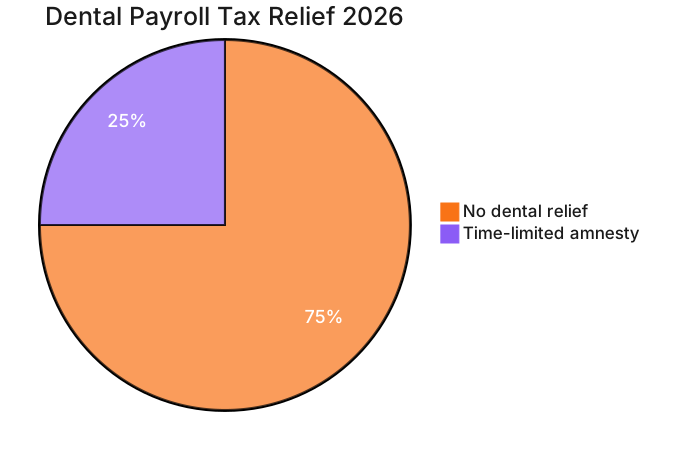
Of Australia’s 8 states and territories, only Queensland and South Australia have offered contracted dentists any relief at all, and both only forgive past liability rather than exempt future payments. The remaining 6 have issued no dental-specific relief.
Takeaway: state revenue offices aren’t treating dental clinics as an afterthought to the GP rulings. Queensland’s own guidance uses a dental clinic as its lead worked example.
The Amnesty Dentists Got Was Never What GPs Got
This is the gap that matters most for a dental practice owner reading the cosmetic clinic version of this story and assuming the same carve-outs apply. They don’t, and the difference is structural, not just a matter of degree.
Queensland made its GP payroll tax exemption permanent, effective retrospectively, covering ongoing payments to contracted GPs indefinitely. For dentists, Queensland approved something different on 30 September 2024: a payroll tax amnesty, not an exemption. Under the Queensland Revenue Office’s own terms, a dental clinic that voluntarily disclosed its contractor payments and registered for payroll tax by 30 June 2025 would not be pursued for payroll tax on payments made to contracted dentists going back to 1 July 2018, a lookback of up to seven years. That’s the entire benefit. From 1 July 2025, the same clinic has to pay payroll tax on those same contractor payments going forward, unless a separate contractor exemption happens to apply to its specific arrangement.
South Australia ran a similar shape of relief: retrospective forgiveness for dental practices that registered with RevenueSA before a 30 June 2024 cutoff, again with no confirmed ongoing exemption once that window closed.
Compare that to the GP treatment. Queensland’s GP exemption doesn’t expire. Victoria’s GP exemption, legislated from 1 July 2025, doesn’t expire either. NSW and South Australia’s GP-specific relief is narrower again, tied to bulk billing, but it’s still an ongoing rebate on a continuing basis, not a one-off forgiveness window that closed over a year ago.
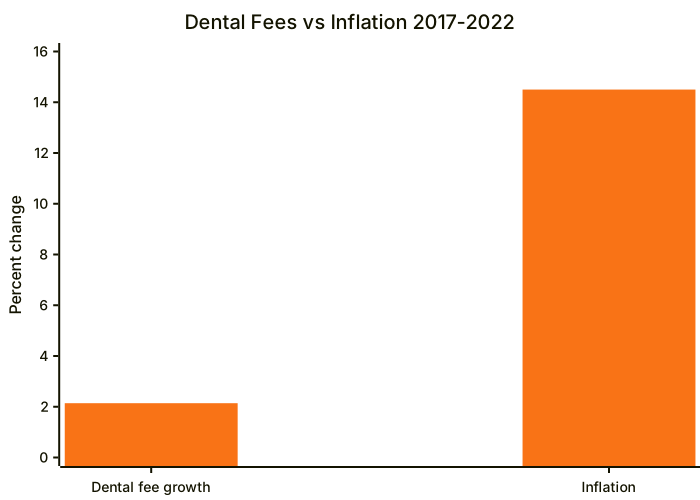
ADA’s own Dental Fees Survey found practitioner fees grew 2.14% between 2017 and 2022 while inflation ran at 14.5% over the same period. A payroll tax bill lands on practices that already couldn’t raise fees in line with costs.
Every state and territory that hasn’t announced dental-specific relief, that’s NSW, Victoria, Western Australia, the ACT, Tasmania and the Northern Territory, simply applies its general payroll tax rules to dental practices the same way it would to any other clinic running a contractor model. Western Australia is worth flagging separately: its Pay-roll Tax Assessment Act 2002 has no “relevant contract” deeming provisions at all, and no dental-specific ruling was found in this research. WA instead applies its ordinary common law employment test, the same one covered for cosmetic clinics in the linked guide above. Whether that test catches a specific dental practice depends on rosters, branding, fee collection and control, not on the fact that the contractors involved happen to be dentists.
Takeaway: Queensland and South Australia gave dentists a deadline that already passed, not an exemption. Every other state applies its general contractor rules with no dental carve-out at all.
What a Dental-Specific Contractor Review Should Cover
None of the following is tax or legal advice. It’s a starting checklist for the conversation to have with an accountant or payroll tax lawyer who has actually looked at your associate dentist agreements.
| Check | Why It Matters for a Dental Practice |
|---|---|
| Whether your associate dentist agreement was reviewed after Thomas and Naaz (2023), not before | Pre-2023 template agreements were written for a legal landscape that no longer exists |
| Whether your state's revenue office has issued dental-specific guidance | Queensland (PTAQ000.6.5) and NSW (PTA-041) both name dental clinics directly; don't assume a ruling written for GPs is silent on your practice |
| Whether you registered for the Queensland or SA amnesty before its cutoff | Both windows have closed. Missing one doesn't remove the underlying liability, it just removes the forgiveness |
| Who controls the associate's roster, fees, and patient list | The same indicium that determined Thomas and Naaz and Optical Superstore, control is the test, not the label on the contract |
| How many years of contractor payment records the practice could produce if asked | Most states can reassess up to 5 years back; Queensland's dental lookback ran to 7 |
If your practice markets its associate dentists under the clinic’s own brand with no reference to their independent status, that’s worth a look alongside the tax question. RockingWeb reviews how practitioners and their credentials are represented on your site, which is one of the first things a revenue office checks when it’s testing who actually runs a clinic. The same AHPRA advertising rules that apply to cosmetic dentistry also govern how you can describe associate dentists and their outcomes publicly.
Takeaway: the two amnesty windows dental practices actually got have already closed. What’s left is the general contractor test, and it rewards practices that reviewed their agreements after 2023, not before.
What We Couldn’t Verify
Being direct about the limits of this research matters more on a tax topic than almost anywhere else. Two things came up in reporting on this issue that this guide is deliberately not repeating as fact:
- No published count of affected practices. Some secondary commentary implies “hundreds” of dental practices are exposed. Neither the ADA nor any state revenue office has published a specific number of affected dental practices, and this guide is not going to cite one that doesn’t have a primary source.
- No WA-specific dental ruling. This research did not find a Western Australia revenue office ruling that names dental practices specifically, the way Queensland’s PTAQ000.6.5 or NSW’s PTA-041 do. WA dental practices should assume the general common law contractor test applies, not that WA has stayed silent on dentistry deliberately.
Get Your Own Advice First
This guide sets out what the ADA has said publicly and what Queensland and South Australia’s dental-specific amnesties actually covered. It’s not a substitute for advice from an accountant or payroll tax lawyer who has reviewed your specific associate agreements, your specific state, and your specific practice structure. The cost of that advice is small next to a multi-year reassessment with interest and penalty tax added on top.
If you run a dental practice and want your marketing, practitioner pages and booking flow reviewed for AHPRA compliance while your accountant handles the payroll tax side, RockingWeb works with cosmetic and general dental practices across Australia on exactly this kind of compliance-first marketing.
Talk to us about ClinicPipeline for your practice
Related reading:
- Cosmetic Clinic Payroll Tax Ruling: Cost Impact 2026: the full case law, state rate table, and GP relief detail behind this issue
- AHPRA Advertising Rules for Cosmetic Dentistry Australia 2026: what dental practices can and can’t say in marketing
- Cosmetic Clinic Websites: what an AHPRA-compliant clinic website actually needs to include
- ClinicPipeline: the marketing system built for AHPRA-regulated clinics and dental practices
Vikas Thakur
Founder of RockingWeb. 16 years building for companies like TPG, iiNet and Monadelphous, now focused on websites and marketing that comply with AHPRA's advertising guidelines and still book patients.

![How Many Cosmetic Procedures Australia Performs Yearly [2026]](/assets/cosmetic-clinic-patient-retention-CmO369h2.png)