Cosmetic Clinic Payroll Tax Ruling: Cost Impact 2026
A Melbourne medical group faced a $2 million to $5 million backdated payroll tax bill after contractor doctors were reclassified as employees. Cosmetic and injectable clinics get none of the GP-specific relief now available in Queensland, Victoria, NSW and South Australia.
 Vikas Thakur Founder, RockingWeb 13 min read
On this page 8
- Key Takeaways
- What Actually Changed: Contractors Reclassified as Employees
- Payroll Tax Rates and Thresholds by State, 2026
- Why GP Relief Doesn’t Help a Cosmetic Clinic
- The Structural Problem Specific to Cosmetic and Injectable Clinics
- What a Backdated Bill Actually Looks Like
- What to Check Before a Revenue Office Asks
- Get Your Own Advice First
Key Takeaways
- A Melbourne medical group running 8 clinics and contracting 76 GPs faced a retrospective payroll tax bill estimated at $2 million to $5 million for up to nine years of contractor payments (AusDoc, RACGP newsGP, 2023)
- Payroll tax rates on clinic wages in 2026 range from 4.75% in Queensland to 5.50% in Western Australia
- State revenue offices can reassess payroll tax going back 5 years in most states, and a 9 to 10-year lookback has already been claimed in one Victorian case
- Queensland and Victoria now give contracted GPs a full payroll tax exemption, but both rulings explicitly exclude non-GP contractors, meaning cosmetic clinic nurse injectors get zero relief under either
- The Thomas and Naaz Court of Appeal decision (NSWCA 40, 2023) confirmed that “relevant contract” payroll tax rules can catch a medical or cosmetic clinic even when its practitioners are genuine independent contractors
- The Optical Superstore case (VSCA 197, 2019, special leave refused by the High Court in 2020) already extended this same reasoning to optometrists, so the legal mechanism was never limited to general practice
- Queensland’s unpaid tax interest rate sits at 11.78% for the 2025-26 financial year, with penalty tax of up to 75% of the assessed tax added on top
- Western Australia is the only state without deeming “relevant contract” provisions, but its common law contractor test can still catch a tightly run cosmetic clinic that controls rosters, branding and fee collection
Australian state revenue offices are reassessing payment arrangements at medical, dental and cosmetic clinics, and reclassifying contracted practitioners as employees for payroll tax purposes. A Melbourne medical group faced a retrospective bill of $2 million to $5 million in 2023 after nine years of contractor GP payments were reassessed (AusDoc, RACGP newsGP). Every state that has since carved out relief for GPs has done exactly that: relief for GPs, not for the clinic model itself.
Cosmetic and injectable clinics run the same contractor structure that triggered these bills, and none of the current relief measures apply to them. This guide breaks down what actually happened, which states have moved, and where the exposure sits for a cosmetic or aesthetic clinic in 2026. None of it is legal or tax advice. Get your own advice from an accountant or lawyer who knows payroll tax before you touch your contractor agreements.
What Actually Changed: Contractors Reclassified as Employees
Payroll tax has always applied to wages paid to employees. What changed is how far “wages” now stretches. Most states harmonised their payroll tax legislation years ago to include “relevant contract” provisions: rules that deem payments to a contractor to be taxable wages if the contractor is providing services that are part of the business, even where no employment relationship exists at law.
For years, medical and allied health clinics assumed these provisions did not apply to arrangements where a doctor, dentist or optometrist used the clinic’s rooms and staff in exchange for a service fee, on the basis the practitioner was running an independent business. Two court decisions closed that gap.
Thomas and Naaz Pty Ltd v Chief Commissioner of State Revenue [2023] NSWCA 40 confirmed that a medical centre paying doctors 30% of the Medicare benefits billed for patients seen at its rooms was liable for payroll tax on those payments. The doctors were genuine contractors under their own agreements. It made no difference. The NSW Civil and Administrative Tribunal, upheld on appeal, found the doctors’ services were “a necessary part of the applicant’s medical centre business,” which was enough to bring the payments inside the relevant contract rules.
Commissioner of State Revenue v The Optical Superstore Pty Ltd [2019] VSCA 197 got there first, and for a different profession entirely. The Victorian Court of Appeal found that money collected on behalf of contracted optometrists and passed through to them counted as “paid” for payroll tax purposes, even though the optometrists, not the store, legally owned the money. The High Court refused special leave to appeal in 2020 ([2020] HCASL 16), leaving the decision standing.
Between them, these two cases established that the “relevant contract” test reaches beyond general practice into any clinic where a business supplies rooms, admin, bookings and a shared brand to practitioners who see patients and split the fee. That description fits a cosmetic injectable clinic as precisely as it fits a GP surgery.
Takeaway: the legal mechanism that caught GPs and optometrists was never GP-specific. It catches any clinic structure where the business and the practitioner split a service fee.
Payroll Tax Rates and Thresholds by State, 2026
Every state applies payroll tax above an annual wage threshold. A clinic’s exposure depends on which state it operates in, its total wage bill (including any reclassified contractor payments), and the applicable rate above that threshold.
| State | Annual Threshold (2026) | Standard Rate |
|---|---|---|
| Western Australia | $1,000,000 | 5.50% |
| New South Wales | $1,200,000 | 5.45% |
| South Australia | $1,500,000 | up to 4.95% |
| Victoria | $1,000,000 | 4.85% |
| Queensland | $1,300,000 | 4.75% (4.95% above $6.5M in wages) |
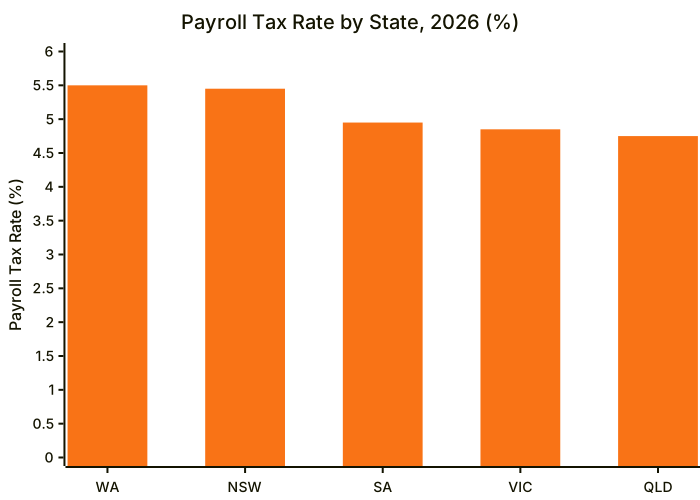
Chart shows the standard rate applied to taxable wages above each state’s threshold. Western Australia has the highest standard rate at 5.50%, Queensland the lowest at 4.75% for clinics under $6.5 million in total wages.
A reassessed clinic doesn’t just owe the tax. Queensland’s unpaid tax interest rate for 2025-26 runs at 11.78% a year, and penalty tax of up to 75% of the tax shortfall can be added where the revenue office finds the practice failed to notify a liability. In one reported medical practice matter, a 30% penalty plus interest was upheld with no remission. None of that is unique to Queensland. Every state charges interest and can apply penalty tax on top of the primary assessment.
Takeaway: the rate on the table is the smallest number in the bill. Interest and penalty tax on a multi-year reassessment usually dwarf the base tax owed.
Why GP Relief Doesn’t Help a Cosmetic Clinic
Every state that moved to fix the fallout from Thomas and Naaz moved to protect general practice specifically, not the clinic model those cases were actually about.
Queensland made its GP exemption permanent through the Revenue Legislation Amendment Bill 2024, effective from 1 December 2024. It applies to wages paid to a GP, contractor or employee. The Queensland Revenue Office’s own guidance is explicit that this exemption “does not extend to other medical doctors or allied health professionals” and does not cover cosmetic or aesthetic clinics at all. A separate, narrower amnesty ran for Queensland dentists to 30 June 2025, and nothing comparable has been offered to injectable or cosmetic clinics.
Victoria legislated a GP exemption from 1 July 2025, after running relief through the Treasurer’s ex gratia powers for earlier periods. The State Revenue Office’s own wording confirms the exemption “does not apply to non-medical GP businesses,” which on its own guidance means allied health and dental arrangements, let alone cosmetic clinics, sit outside it.
NSW never fully exempted GPs. Instead, after a 12-month audit pause from September 2023 to September 2024, it introduced the Bulk Billing Support Initiative: a rebate of 80% in metro Sydney and 70% regionally, but only on payroll tax attributable to bulk-billed GP consultations. Cosmetic clinics don’t bulk bill. There’s nothing in that rebate for them.
South Australia’s position is the same shape: an exemption from 1 July 2024, but only for bulk-billed consultations. The ACT ran an amnesty that expired 30 June 2025 and has not replaced it with an ongoing exemption. Tasmania and the Northern Territory have issued no GP-specific ruling or exemption at all.
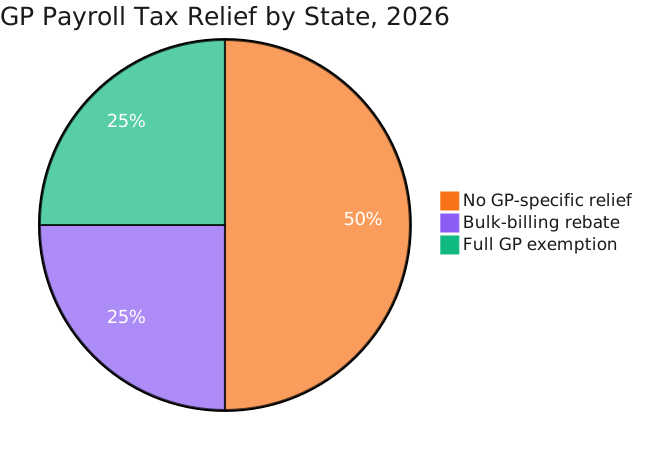
Of Australia’s 8 states and territories, only Queensland and Victoria give contracted GPs a full exemption. NSW and South Australia offer a rebate tied to bulk billing. The remaining 4, including Western Australia, have issued no GP-specific relief at all. None of the 8 extend relief to cosmetic or aesthetic clinics.
Takeaway: cosmetic clinics are sitting exactly where GP practices sat in 2022, before any of these carve-outs existed.
The Structural Problem Specific to Cosmetic and Injectable Clinics
Cosmetic injectables containing botulinum toxin or dermal filler are Schedule 4 prescription-only medicines. A registered medical practitioner has to consult with the patient and prescribe before treatment, and the person administering the injection is typically an AHPRA-registered nurse working under that prescription, not the prescribing doctor’s own employee.
That’s the structure worth paying attention to. NSW’s PTA 041 ruling on medical centres sets out an exemption for arrangements where “services are performed by two or more persons,” but only where the second person, the nurse or assistant, is engaged by the practitioner, not by the medical centre. Most cosmetic clinics do the opposite: the clinic engages the injecting nurse directly as a contractor, books their diary, sets their room, and often controls the pricing and marketing of the treatments they perform. That’s the precise arrangement the exemption doesn’t cover.
No state revenue office ruling names cosmetic or injectable clinics by name. That’s worth being upfront about. But the “relevant contract” definition in NSW and Queensland’s rulings covers any business that “conducts a medical centre business” and contracts with practitioners to see patients at its rooms, described broadly enough to catch dental clinics, physiotherapy practices and radiology centres already. A cosmetic clinic that supplies the room, the booking system, the brand and often the injectable stock itself, in exchange for a split of the treatment fee, matches that description at least as closely as a GP surgery does.
Western Australia sits differently again. It has no “relevant contract” deeming provisions in the Pay-roll Tax Assessment Act 2002. Instead, WA applies the ordinary common law employment test: a holistic look at control, rosters, leave, invoicing, uniforms and branding, and who actually collects the patient fee. The WA government has said the $1 million threshold means most GPs sitting in loose arrangements aren’t caught. A cosmetic clinic that rosters its injectors, brands them as clinic staff and controls the booking calendar is a different fact pattern, and holistic tests exist precisely to catch that difference.
If your clinic’s website and Google Business Profile still list injectors by first name under the clinic’s own brand with no reference to an independent practice, that’s a marketing and AHPRA advertising question as much as a tax one. RockingWeb can check how your practitioners and their credentials are represented publicly, which is often the first place a revenue office looks when testing who is actually running the clinic.
Takeaway: a nurse injector engaged directly by a cosmetic clinic, rostered and branded by that clinic, sits closer to the arrangements courts have already found taxable than to the arrangements now getting relief.
What a Backdated Bill Actually Looks Like
The Melbourne case is worth sitting with because it shows what “backdated” means in practice, not in theory. Dr Martin Sia’s medical centre group, 8 clinics and 76 contracted GPs, received a revenue office request for records covering nine years of contractor payments. The estimated exposure, reported separately by AusDoc and RACGP’s newsGP in late 2023, ran from $2 million to $5 million. Gathering the historical data alone cost the practice roughly $1,000 per site just to extract records from old software, on top of tens of thousands already paid to advisers.
That case involved GPs, who have since had multiple states legislate relief. A cosmetic clinic facing the same style of audit today has no equivalent safety net to fall back on if its contractor structure is found to fail the relevant contract test, or the common law test in WA.
None of this means every cosmetic clinic running contractor injectors has a payroll tax problem. Genuine independent practitioners who see their own patient base, set their own fees and could walk in and pay their own way in another clinic have a real chance of falling within an exemption. The point is that the answer depends on the actual contract and the actual working relationship, not on the label written on the top of the agreement.
Takeaway: the tax bill is one line item. The advisers, the historical data extraction and the months of disruption are the part most clinics don’t budget for.
What to Check Before a Revenue Office Asks
None of the following is tax or legal advice. It’s a starting list for the conversation to have with your accountant or a payroll tax lawyer, ideally before an audit letter arrives rather than after.
| Check | Why It Matters |
|---|---|
| Who actually engages the injecting nurse: the clinic or the prescribing doctor | Determines whether the "multiple providers" exemption in states with relevant contract rules can even apply |
| Who sets the roster, room allocation and booking calendar | Core indicium in WA's common law test and in the "necessary part of the business" reasoning from Thomas and Naaz |
| Who collects the patient fee and how it's split | The Optical Superstore case turned on this exact question: does money passing through the clinic count as "paid" to the contractor |
| Whether marketing, pricing and branding are controlled by the clinic or the practitioner | Both a payroll tax indicium and an AHPRA advertising compliance question |
| How many years of records the clinic could actually produce if asked | Most states can reassess up to 5 years back, and longer periods have been claimed |
If your clinic’s website still presents injectors as clinic-branded staff with no separate business identity, that’s worth reviewing alongside the tax question, not instead of it. RockingWeb’s ClinicPipeline system was built for exactly this kind of AHPRA-aware clinic marketing: compliant practitioner pages, clear service structures, and booking systems that don’t quietly work against the contractor position your accountant is trying to defend.
Get Your Own Advice First
This guide explains what happened in the cases that matter and where each state currently stands. It isn’t a substitute for advice from an accountant or lawyer who has looked at your specific contracts, your specific state, and your specific clinic structure. Payroll tax exposure turns on facts, not templates, and the cost of getting professional advice up front is a fraction of the cost of a multi-year reassessment.
If you run a cosmetic or injectable clinic and want your marketing, practitioner pages and booking flow reviewed for AHPRA compliance while your accountant handles the tax side, RockingWeb works with cosmetic clinics across Australia on exactly this kind of compliance-first marketing.
Talk to us about ClinicPipeline for your clinic
Related reading:
- Talk to RockingWeb: a review of how your clinic and its practitioners are represented online
- Cosmetic Clinic Websites: what an AHPRA-compliant clinic website actually needs to include
- ClinicPipeline: the marketing system built for AHPRA-regulated cosmetic clinics
- AHPRA Compliance Costs for Cosmetic Clinics: what a full advertising compliance audit costs against the penalty exposure
Vikas Thakur
Founder of RockingWeb. 16 years building for companies like TPG, iiNet and Monadelphous, now focused on websites and marketing that comply with AHPRA's advertising guidelines and still book patients.
![Medispa Market Australia: 13.02% Clinic Growth [2026]](/assets/cosmetic-clinic-seo-australia-DWhO816X.png)