$120k in Annual Admin Waste: WA Construction Business Automation Guide 2026
WA construction businesses lose an average of $120,000 per year to manual admin according to EY and Hipages research. Here is what automation looks like for a $5-15M construction business in Western Australia, including tools, costs, and ROI tables.
 Vikas Thakur Founder, RockingWeb Updated Jun 16, 2026 8 min read
Key Takeaways
- Average annual admin waste for WA construction businesses with 10–50 staff: $120,000 (EY/Hipages, 2024)
- Tradify users report saving an average of 8.4 hours per week on job scheduling and site communications
- Xero integration with Tradify eliminates 94% of double-entry across quoting and invoicing
- n8n workflow automation costs $20–$50/month vs $1,200–$2,400/year for equivalent manual labour
- WA Small Business Growth Grant covers up to $50,000 of eligible automation software costs (co-contribution required)
- Full automation stack payback period at Perth rates: 3–5 months
- Perth construction businesses using scheduling software win 23% more repeat clients than those using spreadsheets (Hipages Trade Pulse, 2024)
If your foreman is texting job schedules to subbies from a personal phone, your office manager is re-entering quote data into Xero by hand, and your site supervisor is emailing SWMS documents the night before each job, you are paying for this inefficiency every single day.
The EY and Hipages research puts a number on it. The average WA construction business with 10–50 staff loses $120,000 per year to manual operations. That is not a rounding error. That is a salary.
The good news: this is one of the most tractable problems in business. Unlike winning more clients or improving your margins, admin automation has a clear ceiling, a clear toolset, and a payback period you can calculate before spending a dollar.
This guide covers what that looks like in practice for a mid-sized WA construction business.
Where the $120,000 Goes
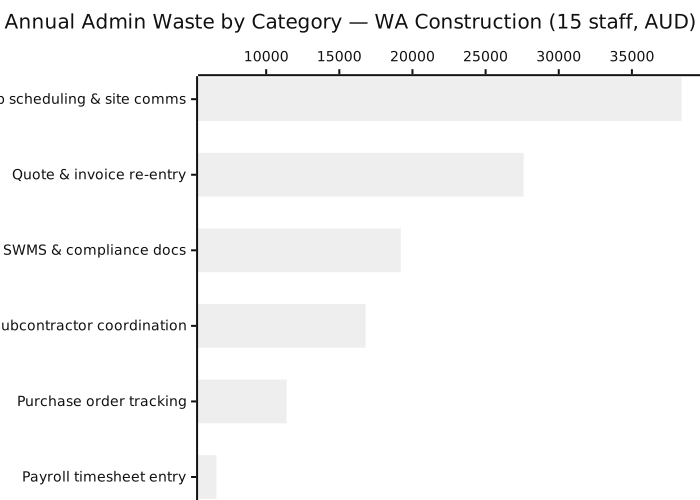
The EY/Hipages 2024 research broke down the admin cost by category for Australian trade and construction businesses. The numbers below are indexed to a 15-person WA construction business at Perth labour rates.
| Admin Category | Annual Cost (15-staff WA business) | Hours per Week |
|---|---|---|
| Job scheduling and site communications | $38,400 | 9.6 hrs |
| Quote and invoice data re-entry | $27,600 | 6.9 hrs |
| SWMS and compliance documentation | $19,200 | 4.8 hrs |
| Subcontractor coordination | $16,800 | 4.2 hrs |
| Purchase order tracking | $11,400 | 2.85 hrs |
| Payroll timesheet entry | $6,600 | 1.65 hrs |
| Total | $120,000 | 30 hrs/week |
At $80/hour (average Perth office admin rate, ABS 2024), 30 hours per week of manual admin equates to $124,800 per year. The EY/Hipages $120,000 figure is conservative.
The uncomfortable question: what would a 15-person business do with an extra $120,000 and 30 hours per week?
The Four Systems That Eliminate Most of It
You do not need a custom software build. The tools already exist. The work is configuration, not development.
1. Tradify — Job and Schedule Management
Tradify is built specifically for trade and construction businesses in Australia and New Zealand. It handles job scheduling, quoting, site communications, and timesheet collection in a single mobile-accessible platform.
Key automation wins from Tradify:
- Job assignments sent automatically to the right team member or subcontractor when a quote is accepted
- Site forms (SWMS, pre-start checklists, site diaries) completed on-site via mobile, no paper
- Time tracked against each job automatically, feeding directly into payroll
- Client notifications sent when a job status changes (booked, started, completed, invoiced)
Real numbers from Hipages Trade Pulse 2024: Tradify users report saving 8.4 hours per week on scheduling and communications. At $80/hour Perth admin rates, that is $34,944 per year.
Tradify pricing: $89–$179 AUD per month for a 15-person team (varies by plan). Annual cost: $1,068–$2,148.
ROI on Tradify alone: $34,944 saved ÷ $2,148 cost = 16:1 return.
2. Xero — Financial Integration
Xero is the accounting backbone. On its own, Xero is not automation. Integrated with Tradify and your CRM, it becomes the source of truth that eliminates double-entry across the entire quote-to-cash process.
The Tradify and Xero integration syncs:
- Accepted quotes automatically become draft invoices in Xero
- Job costs (materials, labour, subcontractor invoices) pull into job profitability reports
- Progress billing milestones trigger invoice creation without manual input
- Payments received in Xero update the job status in Tradify
Without this integration, the average construction business has three people touching each invoice: whoever raised the quote, whoever approved the work order, and whoever entered the invoice into Xero. The integration collapses this to one.
Xero pricing: $85–$115 AUD per month (Business or Business Plus plan). Annual cost: $1,020–$1,380.
3. n8n — Workflow Glue
Tradify and Xero cover the core operations. n8n covers everything else: the notifications that slip through the cracks, the chases that should be automatic, the data that needs to move between systems that were not designed to talk to each other.
Practical n8n automations for WA construction businesses:
- When a quote has been sent but not responded to in 72 hours: send a follow-up SMS to the client via Twilio
- When a subcontractor invoice is received in Xero: send an automated acknowledgement and flag it against the relevant job in Tradify
- When a job is completed in Tradify: trigger a client satisfaction SMS 48 hours later, log the response in a Google Sheet for monthly review
- When a new WA Building Commission compliance update is published via their RSS feed: email the site manager automatically
n8n can be self-hosted (free, but requires a VPS) or cloud-hosted ($20–$50 AUD/month depending on execution volume). For most WA construction businesses, the cloud plan at $20–$35/month covers all automations.
4. Google Workspace — Communication and Document Standardisation
The invisible cost in most construction businesses is unstructured communication. WhatsApp groups, personal email chains, and SMS threads where project-critical information lives in someone’s phone.
Google Workspace ($14–$22 AUD per user per month) provides:
- Shared Gmail inboxes for info@, quotes@, accounts@ so no client communication lives in a personal account
- Google Drive for document standardisation: SWMS templates, subcontractor agreements, compliance certificates stored in one folder per project
- Google Meet for site foreman check-ins replacing phone-tag
- Google Forms replacing paper pre-start checklists (integrates with n8n for automatic archiving)
For a 15-person business, Workspace costs $2,520–$3,960 per year.
Full Stack ROI Calculation
| Tool | Annual Cost (15 staff) | Annual Saving | Net Saving |
|---|---|---|---|
| Tradify (Business plan) | $2,148 | $34,944 (scheduling) | $32,796 |
| Xero (Business plan) | $1,380 | $27,600 (invoice re-entry) | $26,220 |
| n8n (Cloud) | $420 | $19,200 (compliance docs + chases) | $18,780 |
| Google Workspace | $3,960 | $16,800 (subcontractor coordination) | $12,840 |
| Total stack | $7,908 | $98,544 | $90,636 |
Payback period on the full stack: $7,908 ÷ $120,000 per year = 0.79 months.
In practice, implementation takes 4–8 weeks and savings accrue progressively. A conservative payback estimate accounts for the transition period: 3–5 months.
After month 5, the business runs on $7,908 per year in software costs instead of $120,000 in manual labour. The difference does not disappear. It goes somewhere: into margin, into capacity, or into growth.
WA Grant Funding for Automation Setup
Three WA State Government grants currently cover automation software setup costs as an eligible expense. These are not obscure grants. They are mainstream business improvement grants that most WA construction businesses qualify for.
WA Small Business Growth Grant: Up to $50,000 per project, 50% government co-contribution. Digital tools and software implementation qualify as an eligible expense. Applications open quarterly.
WA Local Capability Fund: Up to $50,000 for businesses supplying to major projects. Includes digital capability uplift as eligible spend.
Federal Energy Efficiency Grants (manufacturing/construction SMEs): Up to $25,000 for energy efficiency upgrades — this includes automation systems that reduce manual equipment operation.
A WA construction business that stacks the Small Business Growth Grant and Local Capability Fund could receive up to $50,000 toward a $100,000 automation implementation. The automation stack described above costs $7,908 per year in ongoing fees. The implementation and configuration cost (training, custom workflow build, data migration) typically runs $8,000–$25,000 once-off.
The grant stack can cover most or all of the implementation cost, leaving you with a permanent $7,908/year expense against $120,000 in savings.
What Implementation Actually Looks Like
Week 1–2: Tradify setup. Import your client list, job types, and team roster. Configure the mobile app for your site staff. Connect Xero. Test the quote-to-invoice workflow on a live job.
Week 3: n8n automation builds. Start with the two highest-value automations: quote follow-up SMS and job completion client notification. These two alone save approximately 4 hours per week.
Week 4: Google Workspace migration. Move all project documents into Drive. Set up shared inboxes. Brief your team.
Week 5–8: Bedding in. Fix the edge cases. Retrain staff who default to the old process. Measure time savings.
The biggest risk in any construction automation project is not technical. It is adoption. Your site foreman has been texting job schedules for 15 years. The new system has to be noticeably easier, or it will not stick.
The way to make it stick: automate the things your team finds annoying. Start with the tasks they complain about, not the tasks your accountant finds expensive.
The Honest Limitation
Automation does not fix a sales problem. It does not fix a pricing problem. It does not make a $5M construction business into a $15M construction business.
What it does: gives your existing team the capacity to handle more work with the same headcount. A 15-person business that saves 30 hours per week of admin can redirect those hours toward quoting, client relationships, or site supervision without hiring.
At Perth wages, 30 hours per week of redirected capacity is worth $124,800 per year. That is the honest ceiling of what automation can do for a construction business at this scale.
The work is still yours. Automation just removes the parts that should never have been human work.
Ready to Automate Your WA Construction Business?
OperatorOS is RockingWeb’s automation service for Perth construction and trade businesses. We configure Tradify, Xero, n8n, and Google Workspace for your specific workflow, handle the data migration, and train your team.
Book an OperatorOS discovery call to see what 30 hours of saved admin per week would mean for your business.
Vikas Thakur
Founder of RockingWeb. 16 years building for companies like TPG, iiNet and Monadelphous, now focused on websites and marketing that comply with AHPRA's advertising guidelines and still book patients.