Zero Doctors Hold Australia's Cosmetic Surgery Endorsement
The Medical Board of Australia approved its cosmetic surgery endorsement framework back in 2023. As of the Board's most recently reviewed pages, no training program has been accredited and no doctor has been granted the endorsement, so the credential exists in law with no living examples yet.
 Vikas Thakur Founder, RockingWeb 9 min read
On this page 9
Key takeaways
- The Medical Board’s own accreditation page states plainly: “There are no approved programs of study yet” for cosmetic surgery endorsement
- The registration standard defining the endorsement was approved by the Ministerial Council on 24 February 2023 and took effect 1 July 2023
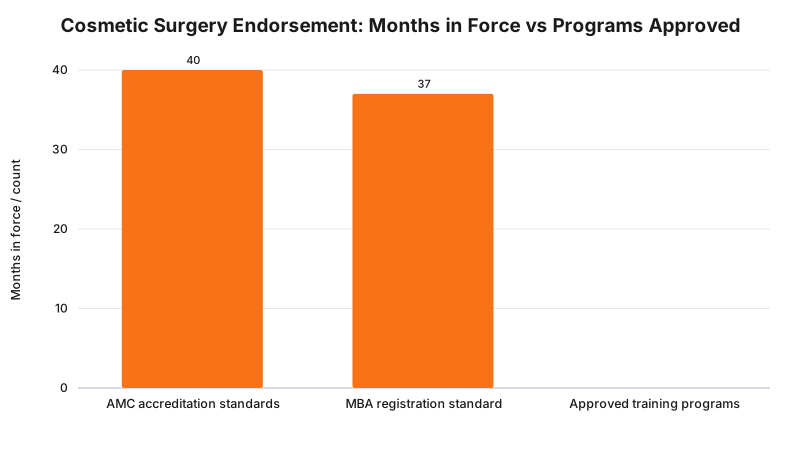
- The AMC’s accreditation standards for cosmetic surgery training providers took effect 19 April 2023, roughly 40 months before this post’s publish date, with zero accredited programs to show for it
- AHPRA’s own “About endorsement” page, last reviewed 2 September 2025, still describes the next steps in future tense: graduates “will be eligible to apply” once approved programs exist
- Education providers can already apply to the AMC to have a cosmetic surgery training program assessed, the first of three steps that has to clear before any doctor can hold the endorsement
- The endorsement does not grant the protected title “cosmetic surgeon”, a separate restriction under different legislation entirely
- Two planks make up the framework: the Medical Board’s registration standard (who qualifies) and the AMC’s accreditation standards (which training counts), both approved, neither yet producing a graduate
Australia built a legal credential for doctors who complete proper cosmetic surgery training, back in 2023. Three and a bit years later, nobody holds it. Not because the paperwork failed, both halves of the framework, the registration standard and the accreditation standards, have been formally approved since early 2023, but because the chain underneath it has an empty link. No training provider has been accredited yet, so no doctor has a qualification to apply with, so the public register has nothing to show. That is not a rumour or a delay nobody will confirm. It is what the Medical Board’s own accreditation page says in plain text: there are no approved programs of study yet. For a clinic website using the word “cosmetic surgeon” or advertising a doctor’s credentials, that gap matters more than most marketing copy accounts for.
What the Endorsement Actually Is
The cosmetic surgery endorsement is a credential the Medical Board of Australia can add to a doctor’s registration under section 15 of the Health Practitioner Regulation National Law, which lets the Ministerial Council approve an area of practice for endorsement. It exists to do one specific job: make it clear on the public register whether a doctor has met a cosmetic surgery training standard set jointly by the Board and the Australian Medical Council.
Two separate approvals sit underneath it. The Medical Board’s registration standard, approved by health ministers on 24 February 2023 and in effect since 1 July 2023, sets out who is eligible to apply and what they must keep doing to hold the endorsement, recency of practice, continuing professional development, professional indemnity insurance, and treatment only in accredited facilities. The AMC’s accreditation standards, in effect since 19 April 2023, set the bar a training program has to clear before its graduates count.
Takeaway: the endorsement is not one document. It is a two-part legal structure, and both halves have been formally in force for well over three years.
Why Nobody Holds It Yet
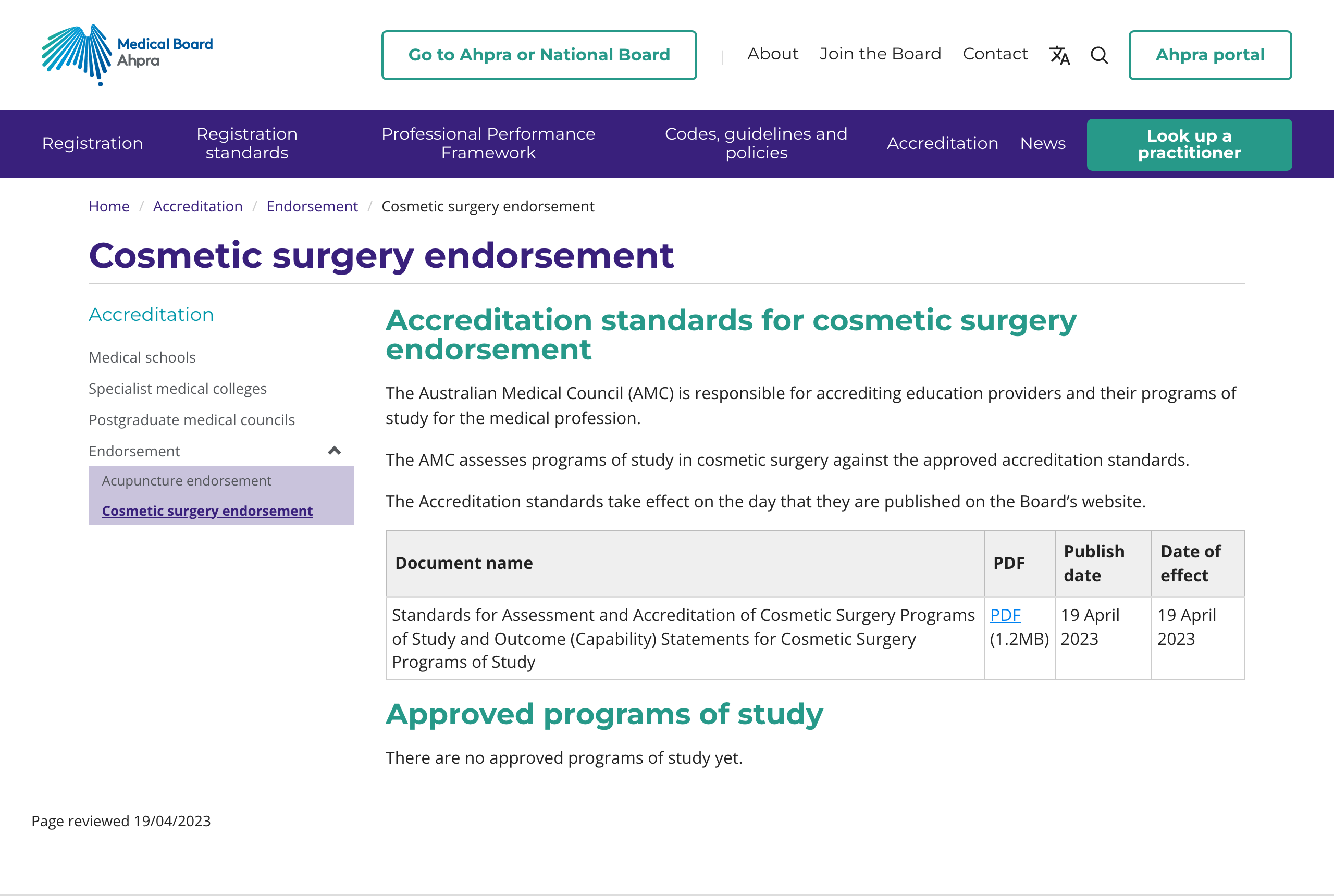
Here is the part most clinic marketing skips: the Medical Board’s own page for cosmetic surgery endorsement, under “Approved programs of study”, states there are no approved programs of study yet. AHPRA’s separate “About endorsement” page, last reviewed 2 September 2025, describes the remaining steps entirely in the future tense: “when there are Board approved programs of study, graduates of accredited and approved programs of study… will be eligible to apply to the Medical Board for endorsement.” That sentence has not changed to the past tense on any page RockingWeb has reviewed.
The process is sequential, not parallel. An education provider first applies to the AMC to have its program assessed against the accreditation standards. Only once a program is approved can its graduates apply to the Medical Board for the endorsement itself, and only once a doctor holds it does it appear on the public register. The Medical Board’s own page confirms providers “can now apply”, present tense, which places the process at the very first step of a three-step chain more than three years after the legal groundwork was finished.
Takeaway: the credential is real and legally defined. The population of doctors who hold it is currently zero, and every public Board and AHPRA page RockingWeb checked confirms that is still the case.
Zero Is a Milestone, Not a Failure
It is tempting to read a three-year gap as the reform stalling. That is not what the public pages say. Accreditation of a full training program, one built against a new capability framework, developed with input from the Royal Australasian College of Surgeons, plastic surgeons, cosmetic practitioners and consumer representatives, is a slower process than approving the standard that will eventually govern it. The standard has to exist before anyone can build a course against it.

What this means for a clinic today is narrower than the headline suggests. There is no register entry to check yet, because nobody has one. What a clinic can check today is whether any team member’s bio, page title or schema markup implies a credential that does not exist anywhere in Australia yet, cosmetic surgery endorsement or otherwise. That is exactly the kind of gap our free compliance read of your site flags against the current state of the register, not the state clinics assume it is in.
Takeaway: zero approved programs is the current, confirmed status. It is not evidence the reform failed, and it is not something a clinic website should read past.
What This Is Not: The “Surgeon” Title Question
The endorsement gets confused with a completely separate rule, and the Medical Board addresses the confusion directly. Holding a cosmetic surgery endorsement does not let a doctor call themselves a “cosmetic surgeon”. That title is protected under different legislation, the Health Practitioner Regulation National Law (Surgeons) Amendment Act 2023, and is restricted to practitioners with specialist registration in surgery, obstetrics and gynaecology, or ophthalmology. We cover that rule, and its $60,000 penalty, in full in our guide to the protected surgeon title.
| Question | Endorsement of registration | Protected “surgeon” title |
|---|---|---|
| What it shows | Completed AMC-accredited cosmetic surgery training | Specialist registration in surgery, O&G, or ophthalmology |
| Who currently holds it | Zero doctors, no programs approved yet | An existing, separate group of specialists |
| Legal basis | Section 15, Health Practitioner Regulation National Law | Surgeons Amendment Act 2023 |
| In force since | 1 July 2023 (standard); 19 April 2023 (accreditation) | 20 September 2023 |
A separate document, our review of the Medical Board’s cosmetic surgery advertising guideline versus AHPRA’s 2025 injectables guideline, covers the advertising rules that already apply regardless of endorsement status. That guideline has been enforceable since 1 July 2023 too, so a clinic’s advertising obligations do not wait on the endorsement register catching up.
Takeaway: three different things, an endorsement, a protected title, and an advertising guideline, all sit under “cosmetic surgery” and none of them are interchangeable on a clinic’s website copy.
What a Clinic Should Do With This Right Now
For a website team, the practical takeaway is not urgency, it is accuracy. No clinic can currently claim a practitioner holds a cosmetic surgery endorsement, because nobody does. Any bio, meta description, or schema markup implying otherwise is inaccurate today, regardless of intent. The safer approach describes a practitioner by their actual current registration and training, and updates the page once the public register genuinely shows an endorsement, rather than anticipating one.
That also means the moment this changes is worth planning for now rather than reacting to later. Once the AMC approves a first training program, the pathway to an actual endorsed doctor opens quickly by comparison, an approved qualification plus an application. A clinic website built to reflect current credentials accurately can update that claim the day the register does, instead of running months behind it.
Takeaway: the right claim on a clinic website today is the practitioner’s actual registration, not an endorsement nobody in Australia holds yet.
FAQ
What is the cosmetic surgery endorsement of registration?
A credential the Medical Board of Australia can add to a doctor’s registration, showing they have completed an AMC-accredited cosmetic surgery training program. It is designed to make it clear on the public register which doctors meet a specific cosmetic surgery training standard.
Can any doctor in Australia hold the cosmetic surgery endorsement right now?
No. As of the Medical Board’s Accreditation page for cosmetic surgery endorsement, there are no approved programs of study yet, which means no graduate can yet apply for the endorsement itself.
Does the cosmetic surgery endorsement let a doctor call themselves a cosmetic surgeon?
No. The Medical Board states a cosmetic surgery endorsement does not enable a medical practitioner to use the protected title surgeon. That title is restricted separately, to practitioners with specialist registration in surgery, obstetrics and gynaecology, or ophthalmology.
When did the rules behind the cosmetic surgery endorsement take effect?
The Medical Board’s registration standard took effect on 1 July 2023, approved by the Ministerial Council on 24 February 2023. The AMC’s accreditation standards for training providers took effect on 19 April 2023.
Get Your Clinic’s Practitioner Pages Checked Against the Current Register
RockingWeb reviews cosmetic clinic websites against what the public register can actually support today, not what a reform is expected to eventually allow, and flags every practitioner-credential claim against its current legal basis.
Sources and References
Medical Board of Australia
- Registration standard: Endorsement of registration for the approved area of cosmetic surgery: effective date 1 July 2023, approved by the Ministerial Council on 24 February 2023
Medical Board of Australia
- Cosmetic surgery endorsement accreditation page: AMC accreditation standards effective 19 April 2023, and the confirmation that there are no approved programs of study yet
Ahpra
- “About endorsement”: the two-plank structure of the endorsement framework and its current, future-tense status, page last reviewed 2 September 2025
Related reading:
- $60,000 Fine for Misusing ‘Surgeon’ Title in Australia: the separate, already-enforceable rule on who can use the protected “surgeon” title
- 26 Months Apart: Australia’s Two Cosmetic Ad Rulebooks: the advertising guidelines that already apply to cosmetic surgery, independent of endorsement status
For a full review of how your clinic’s practitioner pages describe credentials against the current state of the register, see ClinicPipeline or talk to us about your clinic’s marketing.
Vikas Thakur
Founder of RockingWeb. 16 years building for companies like TPG, iiNet and Monadelphous, now focused on websites and marketing that comply with AHPRA's advertising guidelines and still book patients.