

15,000: The Dental Tourism Number Australia Deleted
In late 2023 Smartraveller's website told Australians that over 15,000 people travel for medical tourism a year. After ABC News asked how many go overseas specifically for dental work, the line disappeared. No federal agency, including the ABS, holds that number.
 Vikas Thakur Founder, RockingWeb 9 min read
Key Takeaways
- Smartraveller’s website said “over 15,000 Australians travel for medical tourism” in late 2023, then deleted the line after ABC News asked how many go overseas specifically for dental work
- Health, DFAT, Home Affairs and the ABS all confirmed to ABC News in 2024 that none of them hold data on Australians travelling overseas for dental treatment
- One Queensland patient’s cheapest Australian veneer quote was $12,500; she paid $3,300 at a Bali clinic in 2022, a 73.6% difference in her case
- More than 8,000 Australians had super withdrawal applications approved for dental treatment in 2021-22, totalling $171 million, per ATO data
- 25.2% of Australians delayed or avoided dental care for any reason in 2024-25, down from 28.0% in 2023-24, per the ABS
- 16.1% named cost as the barrier to dental care in 2024-25, against 23.1% for the most disadvantaged areas, per the same ABS release
- More than 85% of dental care delivered in Australia is private, according to ABC News reporting
- The ADA said in July 2026 that dentists are treating more older patients for complications from overseas dental work
Smartraveller’s website told Australians that more than 15,000 people travel each year for medical tourism. In late 2023, ABC News asked a follow-up question: how many of those trips are for dental work? The figure disappeared soon after. Four federal agencies then confirmed, on the record, that none of them hold that data. Nobody in the Australian government can say how many people fly overseas for a filling, a crown or a set of veneers each year. What exists instead is a scattering of individual numbers: one patient’s quote, one nurse’s estimate, a super withdrawal total from the tax office. This report gathers every verified figure that does exist, and what the gap means for a dental practice’s own website.
The Number Smartraveller Deleted
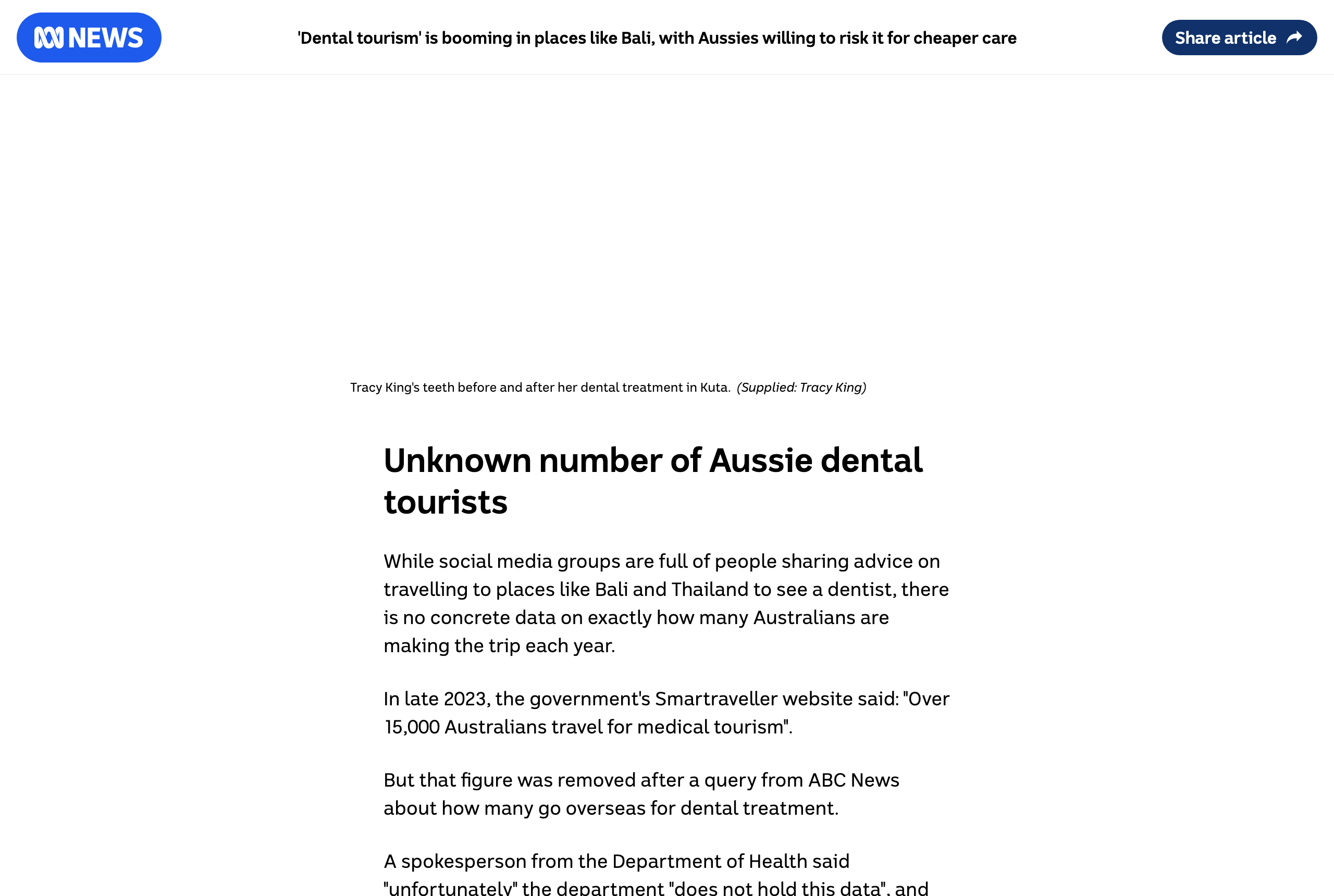
In late 2023, Smartraveller, the government’s own travel advisory site, stated that “over 15,000 Australians travel for medical tourism”. ABC News asked the obvious next question in a story published 4 March 2024: how many of those 15,000 are dental patients. Smartraveller pulled the line rather than answer it. A Department of Health spokesperson then told ABC News the department did not hold the data, and neither did DFAT, Home Affairs, nor the ABS. Four federal bodies, zero counts of the behaviour they had all been happy to quote a headline number for.
| What is known | Answer |
|---|---|
| Verified figure for Australians travelling overseas for dental treatment | None published |
| Smartraveller’s “over 15,000” claim (late 2023) | All medical tourism, not dental-specific; deleted after ABC News queried it |
| Agencies confirming they hold no dental tourism data | Health, DFAT, Home Affairs, ABS |
| Data the ATO does publish | Super withdrawals approved for dental treatment |
Takeaway: no government agency has published a figure for how many Australians go overseas for dental work, and the closest public estimate was retracted rather than defended.
What One Patient Actually Paid
Without a national dataset, the only verified cost comparisons are individual cases, reported by name. Tracy King, a 49-year-old Logan resident, found her cheapest Australian quote for veneers on her top teeth was $12,500. She had the same work done at a clinic in Kuta, Bali, in 2022, for $3,300, a saving of $9,200, or 73.6%, on that single job. Lesley Hyde, a Melbourne emergency department nurse, described her own crowns and root canals overseas at what she called “about a sixth or seventh” of the Australian price. Neither figure is a market average. Both are named, on-the-record accounts, and the most concrete cost data currently on the public record for this question.
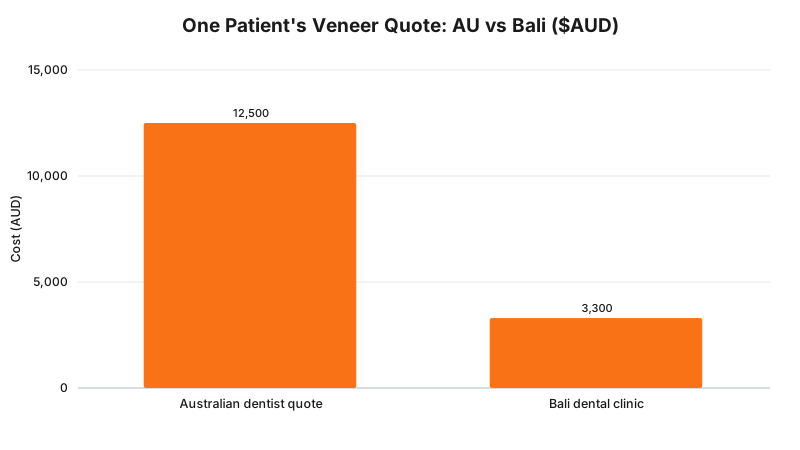
Takeaway: individual cost gaps this large are real and documented, but they describe two patients’ bills, not a national price benchmark that doesn’t currently exist.
Why the Price Gap Exists at All
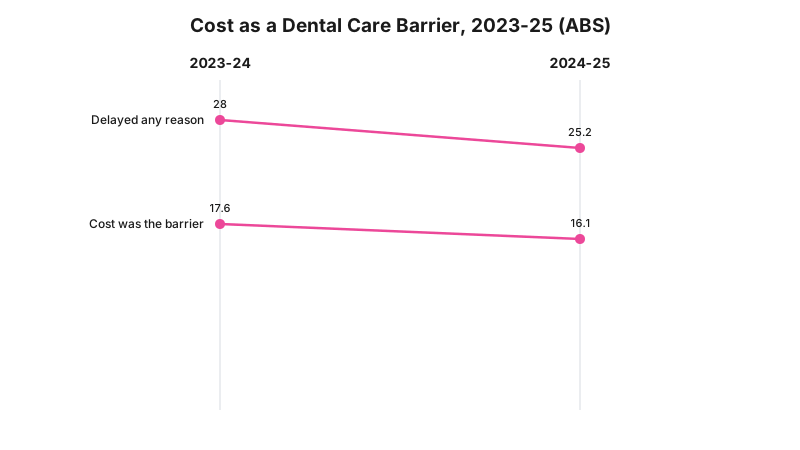
Cost is the reason patients give for looking overseas, and Australia’s own data backs it up. In the ABS’s Patient Experiences in Australia survey, 25.2% of people delayed or avoided dental care for any reason in 2024-25, down from 28.0% the year before, and 16.1% named cost as the barrier, down from 17.6%. The gap by area is wider still: 23.1% in the most disadvantaged areas cited cost, against 9.6% in the least.
Separately, more than 8,000 Australians had super withdrawal applications approved on compassionate grounds for dental treatment in 2021-22, per ATO figures reported by ABC News, totalling $171 million. That is not a dental tourism statistic either. It is evidence of the same pressure: enough Australians find local dental costs hard enough to manage that they raid retirement savings to cover it, the exact condition that makes an overseas quote attractive.
Takeaway: both cost-barrier numbers improved between 2023-24 and 2024-25, but 16.1% of the country still names price as the reason they skip the dentist, and that pressure doesn’t disappear just because no one counts where it sends people next.
What Can Go Wrong Overseas
The ADA’s president in 2024, Dr Scott Davis, a specialist prosthodontist, put it plainly to ABC News: “I see numerous patients, which are basically disasters and need complete re-treatment or even lose many teeth.” He named the issues as overservicing, poorer-quality materials, and little legal recourse once the patient is home. “Buyer beware,” he said. “You’re really taking a gamble with your health, seeing someone you don’t have a history with.”
That warning has not aged out. In a statement published 7 July 2026, the ADA said its members are increasingly treating older patients for complications from overseas dental work, who often had not factored in the ongoing cost of maintaining it. More than 85% of dental care in Australia is delivered privately, per ABC News reporting, exactly the market an overseas quote competes against on price.
Takeaway: the risk profile the ADA describes in 2026 matches the one it described in 2024. Cheaper upfront cost and a higher chance of needing expensive re-treatment are not separate stories, they’re the same one told from either end.
What This Means for Your Practice’s Website
None of the compliance rules change because a patient’s alternative is a clinic overseas rather than the practice down the road. AHPRA’s advertising guidelines still ban testimonials and before-and-after imagery, covered in full in our breakdown of AHPRA’s advertising rules for cosmetic dentistry. A dental website cannot lawfully run a “here’s what happened when a patient tried Bali” case study with clinical photos, however tempting that angle is.
What a compliant site can do is compete on cost and confidence, the two things patients say drive their decision. Clear treatment-category pricing, without misleading comparison claims, gives an enquiry a reason to convert before a patient has booked flights. A booking form that lets a patient flag they’re seeking corrective or re-treatment work lets front-desk staff quote accurately instead of guessing. Most dental and cosmetic clinic websites haven’t been checked against the current rules at all. RockingWeb flags exactly where a practice’s pricing pages, forms and social content sit against them.
Takeaway: the data gap covered in this report is a national statistics problem. What a practice controls is whether its own website gives a cost-anxious patient a clear, compliant reason to book locally before they start pricing flights.
FAQ
How many Australians travel overseas for dental treatment each year?
There is no verified figure. Smartraveller’s website said more than 15,000 Australians travel for medical tourism in late 2023, but that line covered all medical tourism, not dental specifically, and was removed after ABC News asked for a dental-only number. Health, DFAT, Home Affairs and the ABS all confirmed they hold none.
Is dental tourism actually cheaper than getting treatment in Australia?
In individual cases, yes, sometimes by a wide margin. One Queensland patient’s cheapest Australian veneer quote was $12,500 against $3,300 she paid at a Bali clinic in 2022. There is no published national average, and the ADA warns patients often skip the cost of maintaining complex work once they’re home.
What are the biggest risks of having dental work done overseas?
The ADA’s president has described seeing patients whose overseas treatment turned into disasters requiring complete re-treatment or the loss of multiple teeth. The issues cited are overservicing, poorer-quality materials, and little legal recourse once the patient is home.
What does this mean for a dental practice’s website and advertising?
The same AHPRA advertising rules that apply to cosmetic clinics apply to dental practices, including the ban on testimonials and before-and-after imagery. A compliant website competes on clear, accurate local pricing and process rather than comparison claims about overseas providers, and RockingWeb checks that the current site fits inside those rules.
Get Your Dental Practice Website Checked
RockingWeb builds AHPRA-compliant websites for dental and cosmetic practices, with pricing pages and enquiry forms that convert cost-anxious patients before they start comparing overseas quotes. Talk to us about your practice’s website.
Sources and References
- ABC News - “‘Dental tourism’ is booming in places like Bali” by Emma Pollard, 4 March 2024: the deleted Smartraveller figure, the four-agency data gap, Tracy King’s and Lesley Hyde’s cost accounts, the ATO figures, and Dr Scott Davis’s risk warnings
- Australian Dental Association - “ADA speaks out on dental tourism and misleading advertising”, 7 July 2026: dentists treating a growing number of patients with overseas complications
- Australian Bureau of Statistics - Patient Experiences in Australia, 2024-25: cost-related dental care delay rates and the disadvantage breakdown
- AHPRA Advertising Rules for Cosmetic Dentistry - full breakdown of the testimonial and imagery rules referenced above
Related reading:
- Dental Industry Australia: Market Statistics: total industry size and workforce data
- AHPRA Advertising Rules for Cosmetic Dentistry: what a dental practice can and cannot say in its advertising
- Cosmetic Clinic Websites: compliant website builds for AHPRA-regulated practices
For a dental practice website built to convert cost-conscious enquiries before they look overseas, see ClinicPipeline or talk to us about your practice’s marketing.
Vikas Thakur
Founder of RockingWeb. 16 years building for companies like TPG, iiNet and Monadelphous, now focused on websites and marketing that comply with AHPRA's advertising guidelines and still book patients.


![Invisalign vs Braces Cost Australia: Price Data [2026 Guide]](/assets/ahpra-treatment-naming-website-B-vXh4ba.png)
![Dental Implant Cost Australia: Full Price Breakdown [2026]](/assets/ahpra-compliant-meta-ads-L0i9yo7-.png)