Dental Implant Cost Australia: Full Price Breakdown [2026]
A single dental implant costs $3,000 to $7,000 in Australia in 2026, covering the implant post, abutment and crown. Full breakdown by treatment stage, material, and what Medicare and private health actually pay.
 Vikas Thakur Founder, RockingWeb 9 min read
On this page 7
- What a Single Dental Implant Costs in Australia
- The Real Cost Breakdown: Post, Abutment, Crown
- What Pushes the Price Up or Down
- When You Need More Than One Implant
- Does Medicare or Private Health Cover Any of This?
- What Clinics Can Legally Say About Implant Pricing
- Getting Compliance Right Before Competing on Implant Pricing
Key Takeaways
- A single dental implant costs $3,000 to $7,000 in Australia in 2026, covering the implant post, abutment and crown
- Most straightforward single-implant cases land in the $4,000 to $6,500 band once diagnostics and the final crown are included
- The implant post itself, the titanium fixture placed in the jawbone, is the biggest line item at $2,000 to $3,500
- A 3-unit implant-supported bridge, replacing three missing teeth on two implants, starts from around $7,800
- Full-arch All-on-4 treatment runs $19,000 to $35,000 or more per arch, according to published clinic pricing
- Medicare covers none of it. Private health extras typically rebate $1,500 to $2,500 toward the total cost, after a 12-month waiting period
- Zirconia implants cost $4,500 to $7,000, roughly $1,000 to $1,500 more than titanium implants at $3,000 to $6,000
- A bone graft or sinus lift, needed in some cases before an implant can be placed, adds $500 to $3,000 on top of the base price
A single dental implant costs $3,000 to $7,000 in Australia in 2026, according to pricing published across Australian dental practices. That range covers three separate components billed differently by every clinic: the titanium post that replaces the tooth root, the abutment that connects it to the crown, and the crown itself. Full-arch treatment costs considerably more. All-on-4 implant bridges run $19,000 to $35,000 or more per arch, a procedure we cover in full in our All-on-4 cost guide.
This post is about the more common case: one implant, a handful of implants, or an implant-supported bridge replacing a few missing teeth. Here’s exactly where that $3,000 to $7,000 goes, what pushes a quote to the top of the range, and what Medicare and private health actually pay toward it.
What a Single Dental Implant Costs in Australia
| Case | Typical Cost Range |
|---|---|
| Single implant (post + abutment + crown) | $3,000-$7,000 |
| Typical straightforward case | $4,000-$6,500 |
| Bone graft or sinus lift (if required) | +$500-$3,000 |
Ranges reflect pricing published across multiple Australian dental practice fee guides, aggregated for this post. Individual clinic quotes vary by state, implant brand, and case complexity.
Different practices quote this procedure differently. Some clinics advertise an all-inclusive “implant package” price covering the post, abutment and crown as one figure. Others itemise every stage separately, which is why the same treatment can look like a $3,000 quote from one clinic and a $7,000 quote from another for what’s functionally the same procedure. Neither number is wrong. They’re pricing different scopes.
Takeaway: before comparing two implant quotes, check whether both actually include the crown, not just the surgical placement of the post.
The Real Cost Breakdown: Post, Abutment, Crown
A single implant isn’t one fee. It’s five separate stages, each with its own cost, and each billed as a distinct line item at most practices.
| Stage | What It Covers | Typical Cost |
|---|---|---|
| Consultation & planning | Initial exam, treatment plan | $60-$200 |
| 3D CBCT scan | Imaging to assess bone volume before surgery | $150-$350 |
| Implant post (fixture) | Titanium post surgically placed in the jawbone | $2,000-$3,500 |
| Abutment | Connector piece between implant and crown | $500-$800 |
| Crown | Custom ceramic crown, lab-made to match your teeth | $1,200-$2,000 |
Consultation fees are sometimes waived if the patient proceeds with treatment. Source: aggregated pricing across multiple published Australian dental practice fee guides.
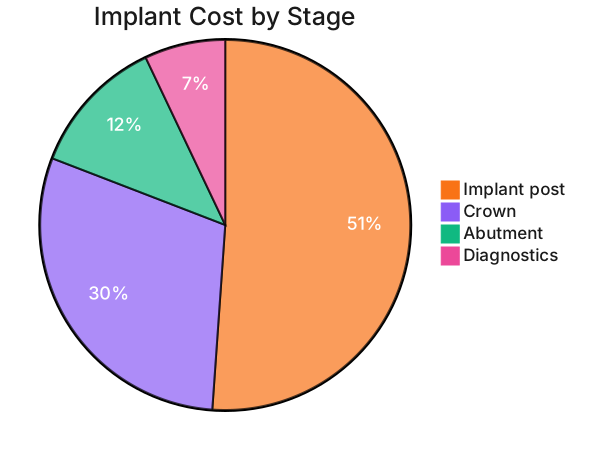
Using the midpoint of each stage’s typical range, the implant post alone accounts for just over half the total cost of a single-implant case. The crown is the next biggest line item, at close to a third. Diagnostics, the consultation and CBCT scan combined, is the smallest share, but it’s the stage that determines whether you need a bone graft before anything else can happen.
Takeaway: if a quote looks unusually low, check which of these five stages it’s actually missing. A “$2,500 implant” that only covers the post, with the abutment and crown priced separately, isn’t a cheaper implant. It’s an incomplete one.
What Pushes the Price Up or Down
Four factors move a quote within, or beyond, the $3,000 to $7,000 range.
Location. Metropolitan clinics in Sydney and Melbourne tend to sit at the higher end of the national range. Regional practices are often more competitive on price, partly reflecting lower overheads and partly reflecting local competition.
Implant brand and material. Premium Swiss or German titanium implant systems, brands like Straumann or Nobel Biocare, cost more than entry-level titanium alternatives, largely on the strength of long-term clinical data and manufacturing precision.
| Material | Typical Cost | Best Suited For |
|---|---|---|
| Titanium | $3,000-$6,000 | Molars and high-bite-force areas; over 50 years of clinical data |
| Zirconia (metal-free) | $4,500-$7,000 | Front teeth, thin gums, or metal sensitivity |
Zirconia’s higher cost reflects the material itself and a more complex manufacturing process. Titanium remains the more common choice for most cases.
Bone graft or sinus lift. If a CBCT scan shows insufficient bone volume to anchor an implant securely, which is common after a tooth has been missing for years, a bone graft or sinus lift is required first. That adds $500 to $3,000 before implant placement can even begin.
Number of teeth being replaced. One implant is a different pricing conversation to three or four.
Takeaway: location and brand explain most of the spread within a single-implant quote. A missing bone graft in an initial estimate is the single biggest reason a final invoice comes in higher than expected.
When You Need More Than One Implant
Replacing several missing teeth doesn’t necessarily mean one implant per tooth. If three or four adjacent teeth are missing, a dentist can typically anchor a fixed bridge on just two implants, rather than pricing out three or four separate procedures.
| Treatment Scope | Starting Cost |
|---|---|
| Single implant | $3,000 |
| 3-unit implant-supported bridge (2 implants) | $7,800 |
| All-on-4 full-arch bridge (per arch) | $19,000 |
Figures are starting prices from published clinic fee guides, not averages. Actual totals depend on materials, lab workflow and case complexity.
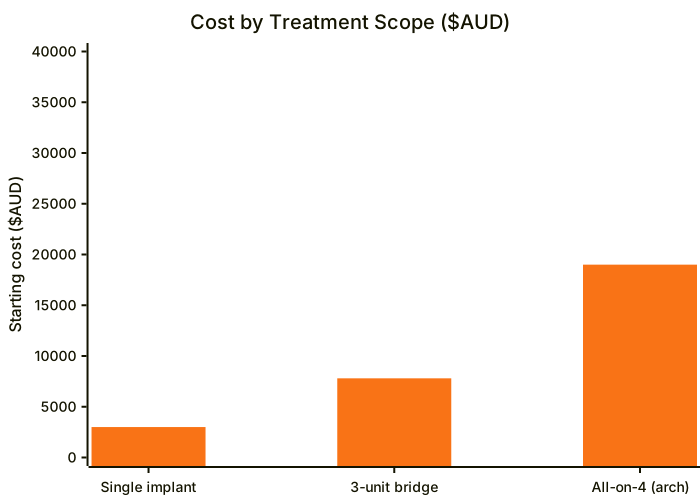
At the far end of that scale, patients missing most or all of their teeth in one jaw are usually candidates for All-on-4, a technique that anchors a full-arch fixed bridge on four implants instead of eight or more. It’s a specialised procedure with its own pricing structure, material choices and timeline, wide enough to need its own breakdown rather than a paragraph here. Our full All-on-4 cost guide covers exactly what drives that $19,000 to $35,000-plus per-arch price, including the difference between entry-level and premium bridge materials.
Takeaway: the jump from a single implant to a 3-unit bridge is roughly 2 to 3x, not the 3x you’d expect from three separate implants, because two implants can anchor three replacement teeth. The jump to a full arch is a different procedure entirely.
Does Medicare or Private Health Cover Any of This?
Medicare does not cover dental implants under any circumstance. The Medicare Benefits Schedule excludes almost all dental services, and implants, abutments, crowns, bone grafts and sinus lifts all fall outside it.
Private health insurance is only partial relief. Implants sit under “major dental,” a higher tier of extras cover than general dental, and most funds impose a 12-month continuous waiting period before an implant claim can be made. Even once that waiting period has passed, typical rebates run $1,500 to $2,500 toward the total cost, well short of covering a $5,000 procedure outright, and annual extras limits (commonly $1,000 to $2,500 across all dental services combined) cap how much a fund pays out in any one year.
Takeaway: budget for the gap payment as the default, not the exception. A private health rebate reduces the bill. It rarely comes close to covering it.
What Clinics Can Legally Say About Implant Pricing
Dentists sit under the Dental Board of Australia, regulated through the same AHPRA National Law as cosmetic medicine clinics. Publishing implant pricing on a website, per-procedure or as a package, is compliant under the current advertising guidelines. What isn’t compliant: testimonials referencing a specific implant outcome, and before-and-after imagery showing a patient’s results, both banned outright under the September 2025 amendments.
Most implant pricing pages built before that date still carry at least one of these. Our full breakdown of AHPRA’s advertising rules for cosmetic dentistry covers exactly what changed, and what a compliant implant pricing page can and can’t include. If your site hasn’t been checked against the current rules, RockingWeb can review it line by line and flag what needs to come down.
Takeaway: a compliant implant pricing page converts on clear, itemised cost breakdowns, the kind in the tables above, not on before-and-after proof the rules no longer allow a practice to show.
Getting Compliance Right Before Competing on Implant Pricing
Implant cases are high-value, multi-stage, and now subject to advertising rules that changed substantially in September 2025. RockingWeb is an AHPRA-compliance specialist for Australian cosmetic clinics and dental practices, not a generalist agency treating compliance as an afterthought. Every cosmetic clinic and dental website we build starts from the current advertising guidelines, with pricing pages structured to convert on transparency rather than visual claims the rules restrict.
For practices that want the audit, the compliant rebuild, and ongoing compliant ad management handled as one service, ClinicPipeline is our audit-and-ads offering built specifically for regulated dental and cosmetic clinics.
Takeaway: an implant patient researching a $5,000-plus procedure reads more of a website than almost any other cosmetic dentistry search. That’s exactly the traffic a non-compliant, thin pricing page loses.
Data sources: aggregated pricing across multiple published Australian dental practice fee guides (2026); industry reporting on private health extras cover, waiting periods and annual limits for major dental; AHPRA, Guidelines for advertising a regulated health service (September 2025). Where a single named clinical or government dataset was not available for a specific figure, ranges above reflect the fee guides checked for this post rather than a single verified industry-wide average.
RockingWeb builds AHPRA-compliant websites for Australian cosmetic clinics and dental practices. Contact us to discuss a compliant pricing page.
Vikas Thakur
Founder of RockingWeb. 16 years building for companies like TPG, iiNet and Monadelphous, now focused on websites and marketing that comply with AHPRA's advertising guidelines and still book patients.
![Laser Hair Removal Cost Australia: Price Data [2026 Guide]](/assets/cosmetic-7-day-cooling-off-period-advertising-xcmRn2qf.png)
![Smile Makeover Cost Australia: Full Price Range [2026]](/assets/ahpra-compliant-google-ads-BM47uRK-.png)