

Invisalign vs Braces Cost Australia: Price Data [2026 Guide]
Invisalign costs $8,000 to $10,000 in Australia, $1,000 more than metal braces at $7,000 to $9,000, according to Orthodontics Australia's national price guide. We compare cost, treatment time and case suitability across all four options.
 Vikas Thakur Founder, RockingWeb 12 min read
On this page 11
- What Invisalign and Braces Actually Cost in Australia
- Why Invisalign Costs More Than Metal Braces
- Ceramic and Lingual Braces: The Costlier Middle and Top Tier
- Treatment Time: Invisalign Finishes Faster, Usually
- The Compliance Difference Nobody Puts in the Price List
- Which Cases Actually Suit Invisalign
- When Invisalign Is Step One in a Bigger Smile Makeover
- Does Insurance Cover Either Option?
- Why We Anchored to Orthodontics Australia Instead of Practice Marketing Pages
- AHPRA’s Advertising Rules Apply to Invisalign Marketing Too
- How RockingWeb Builds Compliant Cosmetic Dentistry Websites
Key Takeaways
- Clear aligners like Invisalign cost $8,000 to $10,000 for a full 18 to 24 month course, per Orthodontics Australia’s national price guide
- Metal braces cost $7,000 to $9,000, making Invisalign roughly $1,000 to $2,000 more expensive for the same 18 to 24 month treatment window
- Ceramic braces cost $7,500 to $10,000, sitting between metal braces and Invisalign
- Lingual braces are the most expensive option at $10,000 to $12,000, priced above every other treatment type
- A 2024 clinical study (Aref, Journal of Pharmacy & Bioallied Sciences) found Invisalign patients finished in an average of 18 months versus 24 months for braces, a statistically significant difference (P < 0.001)
- The same study recorded a slightly higher relapse rate for aligner patients: 12% versus 10% for braces
- Aligners must be worn 20 to 22 hours a day to hit that faster timeline. Braces need no daily compliance decision at all
- Private health orthodontic extras cover both options at the same rebate rate, typically a few hundred to a couple of thousand dollars over the course of treatment
Invisalign costs $8,000 to $10,000 in Australia for a full 18 to 24 month treatment, about $1,000 to $2,000 more than the $7,000 to $9,000 charged for traditional metal braces, according to Orthodontics Australia’s 2025 national price guide. That’s the headline number. It’s not the whole story. Aligners often finish faster (18 months average against 24 for braces in a 2024 clinical study) but only if the patient wears them for the full 20 to 22 hours a day orthodontists recommend. Braces need no such daily decision. They’re doing their job around the clock, whether the patient thinks about them or not.
This guide breaks down what each option actually costs, how much faster Invisalign really is, which cases suit which treatment, and where the maintenance trade-off sits. We anchor every price to Orthodontics Australia, the patient body backed by the Australian Society of Orthodontists, because the practice pricing pages we checked during research disagreed with each other by thousands of dollars.
What Invisalign and Braces Actually Cost in Australia
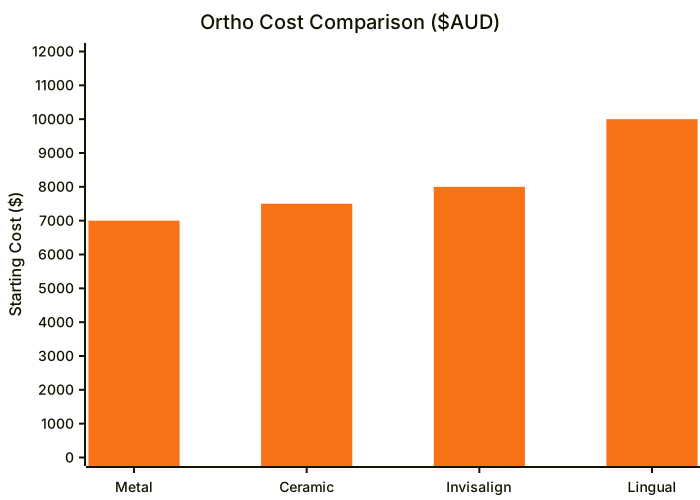
Orthodontics Australia publishes one national price guide for all four treatment types, and it’s the only source in our research that quoted the same figures across multiple pages of its own site. Here’s the full range for each:
| Treatment | Starting Price | Top of Range | Typical Duration |
|---|---|---|---|
| Metal braces | $7,000 | $9,000 | 18-24 months |
| Ceramic braces | $7,500 | $10,000 | 18-24 months |
| Clear aligners (Invisalign) | $8,000 | $10,000 | 18-24 months |
| Lingual braces | $10,000 | $12,000 | 18-24 months |
Source: Orthodontics Australia, “How much do braces cost?” (medically reviewed by the Australian Society of Orthodontists, published June 2025).
Metal braces sit at the bottom of the range. Lingual braces, brackets glued to the back of the teeth so they’re invisible from the front, sit at the top, because they’re custom-made in a lab and take longer chair time to adjust. Invisalign and ceramic braces occupy the middle, within $500 of each other at the low end.
Takeaway: if you want the cheapest option and don’t mind visible metal, braces win by $1,000 to $3,000. If discretion matters more than price, Invisalign costs less than lingual braces and looks less obvious than ceramic.
Why Invisalign Costs More Than Metal Braces
The $1,000 to $2,000 premium isn’t arbitrary. Invisalign uses a custom set of clear plastic trays, sometimes 20 to 40 of them across a full treatment course, each one 3D-printed from a digital scan of the patient’s teeth and replaced every one to two weeks as the teeth shift. Metal braces use the same bracket-and-wire hardware across every patient, adjusted at each visit rather than replaced.
That manufacturing difference is why the price gap holds across most Australian practices we reviewed, even though the exact starting figures varied. Some pricing pages quoted Invisalign as low as $3,500 for an “Express” course limited to a handful of front teeth, and as high as $9,500 for a complex adult case. We didn’t use those figures in the table above because none of the practice sites we checked disclosed what “Express” or “complex” specifically meant in terms of tray count or treatment scope, which made the numbers impossible to compare like for like. Orthodontics Australia’s full-course range is the one figure we could verify against multiple pages published by the same authoritative source.
Takeaway: the aligner premium buys custom manufacturing, not a better outcome by default. Whether it’s worth $1,000 to $2,000 more depends on how much you value not wearing visible metal for two years.
Ceramic and Lingual Braces: The Costlier Middle and Top Tier
Ceramic braces use the same bracket-and-wire mechanism as metal braces, but the brackets are tooth-coloured or clear, which makes them less visible without switching to a removable tray system. That cosmetic upgrade costs $500 to $1,000 more than metal, per Orthodontics Australia’s guide, landing at $7,500 to $10,000.
Lingual braces cost the most of any option, $10,000 to $12,000, because the brackets sit on the inside surface of the teeth facing the tongue. Every bracket has to be custom-shaped in a dental lab to fit that inner surface, and adjustment appointments take longer because the orthodontist is working somewhere they can’t see directly. They’re the only option that’s completely invisible from the front, which is the entire reason patients choose them over Invisalign despite the higher price.
Takeaway: if invisibility is the deciding factor and cost isn’t, lingual braces beat Invisalign on discretion. If cost matters too, Invisalign gets you most of the way there for $2,000 to $4,000 less.
Treatment Time: Invisalign Finishes Faster, Usually
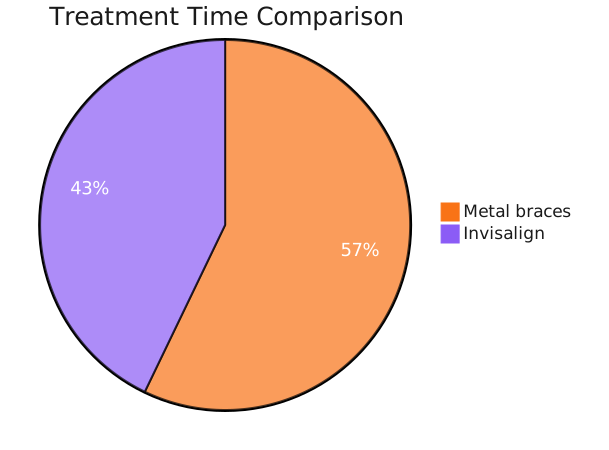
Chart shows average months to completion: Invisalign 18 months versus metal braces 24 months.
A 2024 study published in the Journal of Pharmacy & Bioallied Sciences (lead author Sayyad Aref) compared treatment duration across both options at a single tertiary care centre between 2020 and 2022. The mean treatment time for Invisalign was 18 months (standard deviation 3), against 24 months for conventional braces (standard deviation 4), a difference the study reported as statistically significant at P < 0.001.
Two caveats matter here. First, the study population was patients aged 12 to 18 at one clinical centre, so treat it as clinical evidence of a real duration difference rather than a guaranteed timeline for every Australian adult case. Second, the same study recorded a slightly higher relapse rate for the aligner group, 12% against 10% for braces, meaning a small share of aligner patients needed further correction after finishing treatment. Faster isn’t automatically better if the result doesn’t hold.
Takeaway: Invisalign’s speed advantage is real and documented, roughly five to six months faster on average, but it comes with a marginally higher chance of the teeth shifting back afterward.
The Compliance Difference Nobody Puts in the Price List
None of the pricing pages we checked mention the one factor that actually determines whether Invisalign hits its faster timeline: the patient has to do the work. Orthodontists universally recommend wearing clear aligners 20 to 22 hours a day, removing them only to eat and brush. Every hour under that isn’t neutral. It slows tooth movement and pushes the finish date out, which is part of why real-world Invisalign timelines vary more than the study average above suggests.
Braces carry no equivalent daily decision. The wire is doing its job at 3am whether the patient is asleep, eating dinner, or forgot they were wearing them at all. That’s a genuine advantage for patients who know they won’t reliably keep a removable device in for 20-plus hours, teenagers especially, where compliance is the single biggest variable orthodontists report affecting real-world Invisalign outcomes.
The maintenance load also differs day to day. Aligners come out for meals, so there’s no food restriction and cleaning the trays is straightforward. Braces mean avoiding anything sticky, hard or chewy for the full treatment, and flossing around wires takes longer than brushing a smooth aligner tray. Neither maintenance profile is objectively easier. They suit different patients.
Takeaway: Invisalign’s cost premium and faster average timeline both assume near-perfect wear compliance. Braces trade that daily discipline requirement for a bit more cost and a bit more time, guaranteed either way.
Which Cases Actually Suit Invisalign
Invisalign works well for mild to moderate crowding, gaps between teeth, and cases that don’t need significant jaw or bite correction. It’s also the option most adult patients choose specifically because it’s close to invisible in professional and social settings where visible metal brackets aren’t appealing.
Complex cases, severe crowding, significant overbite or underbite correction, or movements that need rotating a tooth on its axis, are still generally considered better suited to braces. That’s a widely held clinical view among orthodontists rather than a number we could independently verify with a specific percentage of cases, so we’re not going to invent one. If your case falls into that more complex category, the honest starting point is a consultation with a specialist orthodontist, not a generic aligner cost page.
Takeaway: the deciding factor isn’t cost first. It’s whether your specific misalignment is a good match for tray-based movement, which only an orthodontist can assess from your actual teeth and bite.
When Invisalign Is Step One in a Bigger Smile Makeover
For patients planning cosmetic work beyond straightening, veneers, bonding, or a full smile makeover, aligners are frequently the first phase rather than the only treatment. Veneers and bonding both need reasonably straight, evenly spaced teeth to sit and bond correctly, so a dentist will often recommend a clear aligner course before quoting any cosmetic work on top of it.
We cover exactly how that combination pricing stacks up, tier by tier, in our smile makeover cost guide, where a full combination case involving aligners, veneers and gum contouring runs from roughly $8,600 for aligners plus whitening up to $29,690 for a premium full combination. If you’re comparing Invisalign against braces purely as a standalone straightening decision, this page is the one to use. If aligners are one step in a bigger cosmetic plan, that guide breaks down what gets added on top.
Takeaway: budget the $8,000 to $10,000 aligner course as its own line item before pricing any veneer or bonding work that depends on straight teeth first.
Does Insurance Cover Either Option?
Medicare doesn’t cover orthodontic treatment of any kind, aligners or braces, under any circumstances. Private health insurance is a different story: orthodontic extras cover typically treats clear aligners and traditional braces at the same rebate rate, because insurers classify both as orthodontic treatment rather than distinguishing by brand or appliance type. The out-of-pocket reduction is usually a few hundred to a couple of thousand dollars, depending on your fund, annual limit and any waiting period, and it applies the same regardless of which option you choose.
Takeaway: insurance doesn’t tip the cost comparison one way or the other. Whatever rebate your policy offers applies equally to Invisalign and to braces.
Why We Anchored to Orthodontics Australia Instead of Practice Marketing Pages
During research for this guide, we checked pricing published on dozens of individual Australian dental and orthodontic practice websites. The figures didn’t agree. Invisalign quotes ranged from $3,500 up to $11,500 depending on the site. Metal braces ranged from $5,000 to $11,000. None of those pages cited a shared data source, a fee survey, or an industry-wide figure, which made it impossible to tell whether the differences reflected genuine regional variation or just inconsistent marketing copy.
Orthodontics Australia is the one source that published the same four figures, metal, ceramic, lingual, clear aligners, consistently across multiple pages of its own site, and its content is credited to the Australian Society of Orthodontists. That’s why every price in this guide traces back to that single national source rather than an average of conflicting practice quotes.
Takeaway: when practice pricing pages disagree by thousands of dollars with no attribution, that’s the signal to find the one source that actually names where its numbers come from.
AHPRA’s Advertising Rules Apply to Invisalign Marketing Too
Cosmetic dentistry marketing, including Invisalign before-and-after galleries and patient testimonials, sits under the same AHPRA advertising rules as any other regulated dental treatment. Our breakdown of AHPRA’s advertising rules for cosmetic dentistry covers what the September 2025 amendments banned outright: testimonials, most before-and-after imagery, and outcome language like “perfect smile” or “Hollywood teeth”.
Invisalign marketing carries a specific risk most practices don’t think about: side-by-side before-and-after smile photos are exactly the content format AHPRA has cracked down on hardest. If your practice’s website or Invisalign landing page hasn’t been checked against the current rules, RockingWeb can flag what needs to change before it turns into a complaint.
Takeaway: an Invisalign case study is still a regulated health service advertisement. The same testimonial and before-and-after restrictions apply whether the treatment is a veneer or a clear aligner course.
How RockingWeb Builds Compliant Cosmetic Dentistry Websites
RockingWeb builds AHPRA-compliant websites for Australian cosmetic clinics and dental practices, not generic marketing sites that treat compliance as an afterthought. Every cosmetic clinic and dental website we build starts from the current advertising guidelines, so an Invisalign pricing page or before-and-after case study can be specific and persuasive without becoming a liability.
For practices that want the audit, the compliant rebuild and ongoing compliant ad management as one service, ClinicPipeline is our audit-and-ads offering built specifically for regulated dental and cosmetic clinics.
Data sources: Orthodontics Australia, “How much do braces cost?” (June 2025); Sayyad Aref et al., Journal of Pharmacy & Bioallied Sciences (2024), treatment duration comparison; AHPRA, Guidelines for advertising a regulated health service (September 2025 amendments).
RockingWeb builds AHPRA-compliant websites for Australian cosmetic clinics and dental practices. Contact us to discuss a compliant rebuild.
Vikas Thakur
Founder of RockingWeb. 16 years building for companies like TPG, iiNet and Monadelphous, now focused on websites and marketing that comply with AHPRA's advertising guidelines and still book patients.

![All-on-4 Cost Australia: Full-Arch Price Guide [2026 Data]](/assets/cosmetic-clinic-website-design-australia-OcS5cxtN.png)
![Dental Implant Cost Australia: Full Price Breakdown [2026]](/assets/ahpra-compliant-meta-ads-L0i9yo7-.png)
![Smile Makeover Cost Australia: Full Price Range [2026]](/assets/ahpra-compliant-google-ads-BM47uRK-.png)