Dental Implant Success Rate Australia: 87.67%, Not 95-98%
The only published Australian implant-survival study puts the real 20-year success rate at 87.67%, well below the 95-98% figure many clinic websites advertise without naming a source. The data comes from a 2018 Australian Dental Journal study of 527 implants at Adelaide Dental Hospital. Here is what the gap means for how a dental practice presents success-rate claims online.
 Vikas Thakur Founder, RockingWeb 8 min read
On this page 9
- Key takeaways
- The Only Published Australian Implant Survival Study
- How the Australian Figure Compares Internationally
- The Gap Between Published Data and Website Claims
- What This Means for Your Dental Practice Website
- Building a Dental Website Around Real Data
- FAQ
- Get Your Dental Practice Website Checked
- Sources and References
Key takeaways
- The only published Australian implant-survival study reports a 20-year survival rate of 87.67%, from 527 implants placed in 320 patients at Adelaide Dental Hospital between 1996 and 2015
- That study, Duong and Dudley, was published in the Australian Dental Journal in 2018 (volume 63, issue 2, pages 177-186)
- Mandibular implant overdentures failed at four times the rate of single-crown implants in the same cohort (P = 0.0100)
- Several Australian clinic websites advertise a 95-98% success rate, described only as “shown by studies in Australia,” with no study named
- A 2024 international meta-analysis found 20-year survival of 88% across five retrospective studies covering 1,440 implants
- The same meta-analysis found prospective-study survival estimates ranging from 78% to 92% depending on how missing follow-up data was handled
- No AIHW or ADA national dataset publishes a population-level implant success rate for Australia. The Adelaide Dental Hospital study is the closest available figure
- AHPRA’s advertising rules require health service claims to be accurate, not misleading, and supported by acceptable evidence
The only published Australian study on dental implant survival puts the real 20-year figure at 87.67%, not the 95-98% that shows up across clinic websites with no study attached. The data comes from a 2018 Australian Dental Journal paper tracking 527 implants placed in 320 patients at Adelaide Dental Hospital between 1996 and 2015. That gap between the marketing number and the published number is not a rounding difference. It is nine to ten percentage points, on the only Australian dataset that exists. If your practice quotes a success rate anywhere on its website, in ad copy, or in a booking-flow FAQ, this is the number that gap gets measured against. Here is where each figure actually comes from, and what a dental practice website should do with a claim like this.
The Only Published Australian Implant Survival Study
Duong and Dudley’s 2018 retrospective cohort study, published in the Australian Dental Journal, is the closest thing Australia has to a national implant-outcomes dataset. It followed treatment at Adelaide Dental Hospital, a public sector clinic, across 1996 to 2015. The sample was 527 implants placed in 320 patients, mean age 51.5, split 296 implants across 184 female patients and 231 implants across 136 male patients.
The headline finding: an overall known implant survival rate of 87.67%. The study also found that mandibular implant overdentures had a failure rate four times higher than single-crown implants, a statistically significant result (P = 0.0100). The authors credit structured patient selection and maintained recall protocols for the outcomes achieved in a resource-limited public setting, and call for further research into what extends implant longevity.
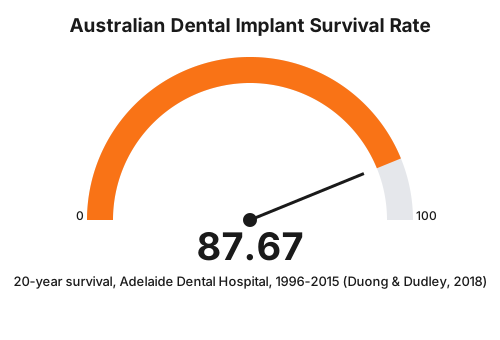
Takeaway: 87.67% is not a clinic estimate or a marketing figure. It is a peer-reviewed, 20-year, 527-implant result from an Australian public hospital, and it is the only figure of its kind that exists.
How the Australian Figure Compares Internationally
No Australian study this large has repeated the exercise, so the closest comparison is international. A 2024 meta-analysis published in Clinical Oral Investigations, “How far can we go? A 20-year meta-analysis of dental implant survival rates,” pooled data across multiple studies to estimate long-term outcomes. Across five retrospective studies covering 1,440 implants, 20-year survival came out to 88%, almost identical to the Adelaide figure. Prospective studies told a messier story: a complete-case analysis of 237 implants (three studies) gave 92% survival, but that estimate dropped to 78% once the researchers accounted for patients lost to follow-up rather than assuming they all succeeded.
That imputation detail matters. A study that only counts patients who came back for a 20-year check-up will always look better than one that accounts for everyone who dropped out, and dropped-out patients are more likely to be the ones with a failed implant they didn’t bother reporting.
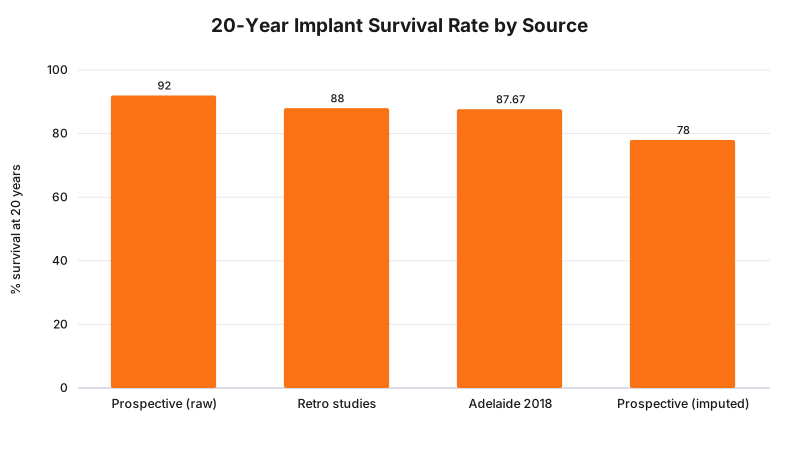
Takeaway: the Australian figure sits right where the international retrospective data says it should. It is the 95-98% marketing claim that sits outside the range every published study actually reports.
The Gap Between Published Data and Website Claims
Search for dental implant success rates and clinic-published figures cluster tightly around 95-98%. One example, a clinic FAQ page, states plainly: “Dental implants have a success rate of 95-98%, shown by studies in Australia.” No study is named. No link is provided. No year, sample size, or journal appears anywhere on the page.
That is the pattern across most clinic-published success-rate claims: a round, reassuring number with “studies show” attached and nothing else. Compare that to the one study that actually exists and is named, dated, and citable: 87.67%, not a range, over 20 years, from 527 implants.
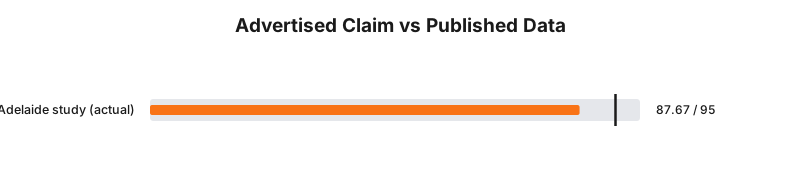
Takeaway: a website that states a success rate without naming the study behind it is asking a visitor to trust a number nobody can check. The only number that can currently be checked is 87.67%.
What This Means for Your Dental Practice Website
AHPRA’s advertising rules apply to every registered dental practitioner, not only the ones performing injectable cosmetic procedures. Its own advertising hub states the general principle plainly: advertising should give consumers access to information that is “accurate, not misleading, and is supported by acceptable evidence.” A success-rate percentage with no named source sits directly against that principle. Whether any specific page crosses the line is a compliance question for that specific page, not something a general article can rule on. Our full breakdown of AHPRA advertising rules for cosmetic dentistry covers the testimonial ban and outcome-claim restrictions that apply alongside this.
What this means practically for a booking flow: a visitor comparing implant providers is not just price shopping. A page that states “87.67% survival at 20 years, Adelaide Dental Hospital study, 2018” reads as more credible than “95-98% success rate” with no citation, because it can be checked. That credibility difference shows up in enquiry quality before it shows up in AHPRA correspondence. If your site currently carries an uncited success-rate claim anywhere, from a treatment page to a Google Business Profile post, it is worth a proper look. RockingWeb reviews exactly this kind of claim against the current rules.
Takeaway: a success-rate figure with a named, dated, checkable source is both more defensible and more persuasive than a round number attributed to unnamed “studies.”
Building a Dental Website Around Real Data
Clinics that want to compete on transparency rather than round numbers need a site built to carry that content without breaking a compliance rule elsewhere on the page. That means treatment pages that cite real sources, booking flows that don’t rely on before/after imagery or testimonials to build trust, and content that survives an audit rather than needing one. Our cosmetic clinic website builds are designed around exactly that constraint: pages that convert without leaning on the content categories AHPRA has already restricted.
Takeaway: the practices that win on transparency, not round numbers, are the ones whose website was built with the compliance rules in mind from the first page, not retrofitted after a complaint.
FAQ
What is the real dental implant success rate in Australia?
The only published Australian study puts overall implant survival at 87.67% over 20 years. It followed 527 implants placed in 320 patients at Adelaide Dental Hospital between 1996 and 2015, published in the Australian Dental Journal in 2018.
Is the commonly advertised 95-98% dental implant success rate accurate for Australia?
It does not match the only published Australian dataset. Several clinic websites state a 95-98% success rate “shown by studies in Australia” without naming a specific study. The peer-reviewed Australian figure, drawn from a 20-year hospital cohort, is 87.67%.
How does the Australian implant survival rate compare internationally?
It sits close to the international range. A 2024 meta-analysis in Clinical Oral Investigations found 20-year survival of 88% across five retrospective studies (1,440 implants) and 78% to 92% across prospective studies, depending on how missing follow-up data was handled.
Can a dental clinic advertise a specific implant success rate on its website?
AHPRA’s advertising rules for regulated health services require claims to be accurate, not misleading, and supported by acceptable evidence. Whether a specific figure on a specific website meets that bar is a compliance question, not something a general article can answer. A clinic publishing any success-rate figure should be able to name the study behind it.
Get Your Dental Practice Website Checked
RockingWeb reviews cosmetic dental practice websites and marketing content against current AHPRA advertising rules, flags every unsupported claim, and builds pages that convert without relying on the content categories the rules already restrict.
Talk to us about your dental practice websiteSources and References
Duong A, Dudley J, Australian Dental Journal, PubMed (PMID 29396995) - “Twenty-year analysis of implant treatment in an Australian public dental clinic,” 63(2):177-186, 2018: the 87.67% survival rate, 527-implant Adelaide Dental Hospital cohort, and mandibular overdenture failure-rate finding
Kupka et al., Clinical Oral Investigations, PMC - “How far can we go? A 20-year meta-analysis of dental implant survival rates,” 2024: the 88% retrospective and 78-92% prospective international 20-year survival figures
AHPRA - Advertising hub: the general principle that health service advertising must be accurate, not misleading, and supported by acceptable evidence
Bayside Family Dental - Secondary source, cited as an example of the uncited 95-98% claim pattern common across clinic websites, not as a data source
Related reading:
- Dental Implant Cost Australia: full price breakdown by treatment stage
- AHPRA Advertising Rules for Cosmetic Dentistry: the testimonial and outcome-claim rules that apply alongside success-rate claims
- Cosmetic Clinic Websites: compliant website builds for AHPRA-regulated practices
Vikas Thakur
Founder of RockingWeb. 16 years of experience from working at TPG, iiNet and Monadelphous, now building websites, software and digital marketing for local businesses in Rockingham and Perth.