The $5.05 Rule: How to Display Card Surcharges in 2026
A displayed price of $50 that becomes $50.75 at checkout can breach Australian Consumer Law. Here is what the ACCC requires, what changes for Visa, Mastercard and eftpos from 1 October 2026, and where the surcharge total needs to live on your booking or checkout page.
 Vikas Thakur Founder, RockingWeb 12 min read
On this page 12
Key takeaways
- The ACCC requires businesses to include the minimum card surcharge in the displayed price whenever there is no surcharge-free way for the customer to pay
- A surcharge-inclusive total, like $5.05 against a $5.00 headline price, must be shown as clearly as the lower figure, not buried at the payment step
- Surcharges cannot exceed the business’s actual cost of acceptance: bank and payment facilitator fees, gateway fees, terminal fees, fraud prevention costs and specific insurance costs
- The Reserve Bank’s Standard No. 3 of 2016 defines what counts inside cost of acceptance
- RBA 2023-24 data cited by the ACCC puts typical small-business card costs at debit 0.85 to 2 per cent, credit 1 to 2 per cent, falling as transaction volume rises
- The RBA announced on 31 March 2026 that Visa, Mastercard and eftpos will each introduce their own “no surcharge” rules from 1 October 2026
- Those rules sit in card network scheme agreements, not the Australian Consumer Law itself, and do not touch hospitality weekend surcharges or separate booking fees
- Until 1 October 2026, and for any payment type a network does not cover, the current surcharge rules keep applying in full
As at October 2026, a clinic or practice that shows a $50 deposit and only reveals a $50.75 total after the customer enters their card details is running the exact pattern the Australian Competition and Consumer Commission (ACCC) treats as a pricing problem, not a payments detail. The rule is simple to state and easy to get wrong in a booking flow: if there is no way to pay without a surcharge, the surcharge belongs in the price the customer sees first.
This matters more from October 2026 onward because the rule itself is about to fork. Some card types are getting a “no surcharge” rule from the networks that issue them. Others are not. A clinic running one payment gateway for online deposits and a separate EFTPOS terminal in reception can end up with different rules applying to different parts of the same booking journey.
What the ACCC Says About Surcharge Display
The ACCC’s guidance on card surcharges states that where a consumer has no option to pay without a surcharge, “the business must include the minimum surcharge payable in the displayed price for its products.” Where a business chooses to show both a base price and a surcharge-inclusive price, the ACCC is specific about prominence: the surcharge-inclusive figure “must be clear and stand out so a consumer can easily notice it as much as” the lower price. A five-cent surcharge on a five-dollar item, shown in faint grey type under a bold black headline price, does not meet that bar. Read the full guidance at accc.gov.au, Card surcharges.
The second half of the rule caps the surcharge itself. A business cannot charge more than its cost of acceptance, the actual cost of taking that payment type. The ACCC’s guidance describes this as covering fees paid to the bank or payment facilitator, plus “gateway fees, terminal fees, fraud prevention costs and costs of specific types of insurance.” The Reserve Bank of Australia’s Standard No. 3 of 2016 sets out which of those costs a merchant is allowed to count. The RBA does not fix a surcharge percentage; it defines the ceiling a business’s actual costs must sit under.
To put a number on that ceiling, the ACCC cites RBA 2023-24 data on typical card acceptance costs by business size:
| Business size (annual card volume) | Typical debit cost | Typical credit cost |
|---|---|---|
| Small business (under $1 million) | 0.85% to 2% | 1% to 2% |
| Medium business ($1 million to $100 million) | 0.25% to 1% | 0.75% to 1.5% |
| Large business (over $100 million) | 0.25% to 0.5% | 0.5% to 1% |
A solo cosmetic injector processing a low volume of card payments sits at the top end of that range. A multi-site dental group processing far higher volumes should be closer to the bottom. Either way, the surcharge percentage set in a payment gateway’s dashboard should trace back to an actual statement, not a round number picked because it looks tidy.
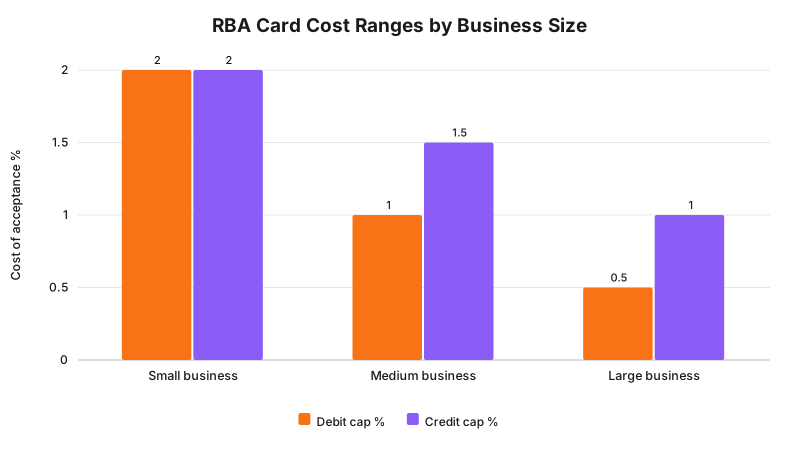
The chart plots the upper bound of each RBA-cited range, the ceiling a surcharge should not exceed for a business of that size and card type. A small clinic charging a 3 per cent card surcharge across the board is charging above what the RBA’s own data says its actual costs are likely to be, for both debit and credit.
Takeaway: the surcharge shown at checkout has two separate legal limits, a display rule and a cost rule, and a booking flow can fail either one independently of the other.
What That Means for the Build
Three places in a typical clinic or dental booking journey carry a surcharge, and each needs its own fix.
The treatment or deposit price shown before payment. If the page states “$50 deposit” and a surcharge applies because card is the only payment method offered, that headline figure needs to already include the minimum surcharge, or the surcharge-inclusive total needs equal visual weight next to it. A smaller, greyed-out ”+ card fee” line underneath a bold headline price does not meet the ACCC’s prominence test.
The payment gateway configuration. Stripe, Square, Tyro, Windcave and similar gateways used by practice management platforms like Cliniko, Halaxy, Pabau and Fresha typically expose a surcharge percentage setting per payment method (card present, card not present, American Express separately). That percentage is a business decision backed by your actual processing statement, not a platform default left untouched since setup.
The EFTPOS terminal in reception. In-person terminal surcharging is configured separately from the online gateway and easy to forget when auditing a “website” compliance question. If the website shows one surcharge rate and the terminal in reception charges a different one for the same card type, that inconsistency is itself worth fixing even before either number is checked against cost of acceptance.
The card network no-surcharge flag, from 1 October 2026. Visa, Mastercard and eftpos have each decided to introduce their own “no surcharge” rules from that date, set through each network’s scheme rules and merchant contracts rather than a change to consumer law. Where a network’s rule applies to your merchant category and card type, the surcharge line for that payment method needs to disappear from the checkout entirely, not just recalculate to zero. A hardcoded surcharge percentage sitting in a gateway config that nobody revisits will keep charging a fee the network no longer permits.
Decision Matrix: When You Must Show the Total Upfront
| Payment scenario | Surcharge-free option exists? | Must show total upfront? | Governing limit |
|---|---|---|---|
| Card-only online deposit | No | Yes, include minimum surcharge in the displayed price | Cost of acceptance, display prominence |
| Card or bank transfer offered | Yes | No, but if you show a surcharge-inclusive figure it must be as prominent as the lower one | Display prominence only |
| In-clinic EFTPOS, cash also accepted | Yes | No mandatory total, but the surcharge percentage must reflect real acceptance cost | Cost of acceptance |
| Card type covered by a network’s no-surcharge rule (from 1 Oct 2026) | Effectively yes, surcharge removed for that card type | Total shown is simply the price, no surcharge line for that method | Card network scheme rule |
| Hospitality-style weekend or public holiday fee | Not applicable, different fee category | Governed separately, not by the surcharge rules above | Not the ACCC’s card surcharge guidance |
A Worked Example
Cosmetic clinic. A clinic takes a $50 deposit to hold a consultation slot, card only, no bank transfer option on the booking page. Its Stripe surcharge setting is 1.5 per cent, in line with the small-business credit range above. Before 1 October 2026, if that card type is not covered by a network no-surcharge rule, the checkout must show $50.75 as the headline figure the customer commits to, not $50 with a smaller surcharge line appearing after card details are entered.
Cosmetic dental practice. A practice quotes a $2,000 deposit for a veneer treatment plan, taken through the same gateway at the same 1.5 per cent rate. The surcharge-inclusive total is $2,030. On a higher-value transaction like this, a surcharge line that only appears in fine print after the “confirm” button is a more visible failure, both to a patient doing the arithmetic and to a regulator reviewing the page.
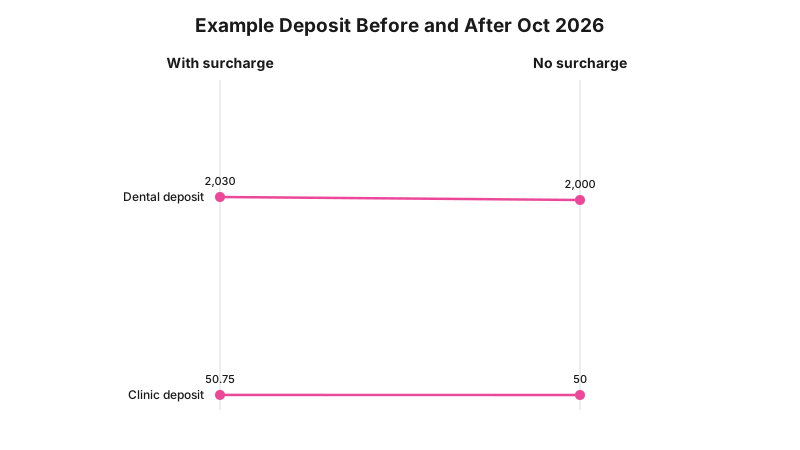
These are illustrative figures at a 1.5 per cent rate, not a fixed or mandated surcharge percentage. The “after” column only applies once a card network’s no-surcharge rule actually covers that clinic’s card type and merchant category from 1 October 2026 onward. Until then, or for any payment method a network’s rule does not reach, the “before” total is what the ACCC’s current guidance requires you to show.
Takeaway: the same percentage produces a bigger absolute display failure on a high-ticket dental deposit than on a low-ticket clinic booking fee, so audit your highest-value payment pages first.
What to Check on Your Own Site
- Find every page on your site where a customer can pay by card: online deposits, treatment plan payments, gift voucher purchases, and the in-clinic terminal.
- For each one, check whether a surcharge-free payment method (cash, bank transfer, BPAY) is actually offered, not just theoretically available.
- Where no surcharge-free option exists, confirm the price shown before payment already includes the minimum surcharge.
- Where you show both a base price and a surcharge-inclusive price, compare font size, weight and colour. The surcharge-inclusive figure needs equal prominence, not a smaller line underneath.
- Pull your last three months of payment gateway or bank statements and check your configured surcharge percentage against them. Round numbers picked at setup and never revisited are the most common gap.
- Check your EFTPOS terminal’s surcharge setting against your online gateway’s setting for the same card type. They should tell the same story.
- From September 2026 onward, check your payment provider’s or gateway’s release notes for which of your card types are moving to a network no-surcharge rule on 1 October 2026, and remove the surcharge line for those methods rather than leaving it at zero.
The Enforcement Anchor
A search of the ACCC’s published guidance did not surface a specific, named infringement notice or determination against an Australian business for a card surcharge display failure of the kind described in this post. That is a gap in this research pass, not a claim that no such action has occurred. The ACCC’s broader enforcement powers under the Australian Consumer Law, including infringement notices and court action for misleading pricing conduct, apply to surcharge display the same as they do to any other pricing representation, and the ACCC’s own guidance page treats surcharge display as a stated enforcement priority for its pricing team. Where this post cannot point to a named case, that limit is stated rather than papered over.
Where This Gets Hard
The honest limit is timing. A booking flow built before 1 October 2026 that correctly displays a surcharge-inclusive total today can become non-compliant in a different way after that date, not because the display rule changed, but because a card network stopped permitting the surcharge for a payment type the business still has hardcoded into its gateway configuration. Card network scheme rules are not published with the same clarity as ACCC guidance, and a clinic relying on its payment gateway provider to flag the change automatically is trusting a third party to do so on time.
The regulator says the total price shown must include any unavoidable card surcharge, and that the surcharge itself cannot exceed the actual cost of accepting that card; the build consequence is a checkout total calculated dynamically from a surcharge percentage you can trace to a real statement, not a static number in a template. Whether your specific payment setup, gateway contract and card mix comply with both the current rules and the incoming network changes is a question for your payment provider’s terms and, where the amounts involved are material, your accountant or lawyer.
Status
In force now, with a scheduled change layered on top. The ACCC’s surcharge display and cost-of-acceptance rules are current law today. The Visa, Mastercard and eftpos “no surcharge” rules are confirmed and dated, taking effect from 1 October 2026, but they are card network scheme rules sitting alongside the existing law, not a replacement for it, and the ACCC states plainly that businesses must keep following current surcharging laws until those changes take effect.
Frequently Asked Questions
Can I still charge a card surcharge on my booking or checkout page?
Yes, current law still applies. A business can surcharge for card payments provided the surcharge does not exceed its actual cost of accepting that card type, and the surcharge-inclusive total is displayed at least as prominently as any lower headline price. That changes only for the specific card networks and payment types where a “no surcharge” rule takes effect from 1 October 2026.
What happens to surcharges after 1 October 2026?
Visa, Mastercard and eftpos have each decided to introduce their own “no surcharge” rules from that date, under their scheme rules and merchant contracts, not through a change to the Australian Consumer Law. Where a network applies its rule to your merchant category, you will not be able to add a surcharge for that card type. Hospitality weekend and public holiday surcharges and separate fees like booking fees are a different category and are not affected.
Where should the surcharge-inclusive total appear on a booking flow?
At the point the customer is choosing whether to proceed, not after they submit payment details. If a deposit or treatment price is quoted anywhere on the page and a surcharge applies because there is no surcharge-free way to pay, the total including that surcharge needs to be at least as visually prominent as the lower, pre-surcharge figure.
Get Your Checkout Reviewed
Get in touch and RockingWeb will walk your booking and payment pages the way a patient would, checking where the surcharge-inclusive total shows up and whether your configured percentage still matches your actual processing costs.
Sources
- ACCC, Card surcharges. Checked 15 August 2026.
- Federal Register of Legislation, Competition and Consumer Act 2010 (Cth) and the Australian Consumer Law. Checked 15 August 2026.
Last reviewed: 15 August 2026.
Vikas Thakur
Founder of RockingWeb. 16 years of experience from working at TPG, iiNet and Monadelphous, now building websites, software and digital marketing for local businesses in Rockingham and Perth.