Health Insurance Covers 42% of Veneer Costs in Australia
Private health insurers paid an average of $166 toward a $393 composite veneer in Australia in 2023-24, covering 42% of the cost, according to Private Healthcare Australia's national dental claims data. Porcelain veneers barely register in the same dataset.
 Vikas Thakur Founder, RockingWeb 8 min read

On this page 10
- Key takeaways
- Private Health Insurance Pays 42% of a Composite Veneer’s Cost
- How Coverage Compares Across Common Dental Treatments
- Porcelain Veneers Barely Show Up in the Same Data
- Medicare Doesn’t Fund Veneers, Full Stop
- What This Means for a Dental Practice’s Advertising
- Building a Booking Flow That’s Honest About Cost
- FAQ
- Get a Compliant, Transparent Pricing Page Built for Your Practice
- Sources and References
Key takeaways
- Private health insurers paid an average of $166 toward a $393 composite veneer in Australia in 2023-24, covering 42% of the cost
- Patients covered the rest: an average $227 out of pocket per composite veneer, more than the fund’s own contribution
- Insurers funded 43,503 composite veneer services nationally in 2023-24, against 7.63 million general scale-and-clean services funded the same year
- A full porcelain or ceramic crown cost $1,703 on average, with insurers paying $725 (43%) and patients covering $978
- General scale and clean is 68% insurer-funded; the composite veneer, root canal and crown items compared above sit in the 42% to 44% range
- Composite veneers are billed under Major Dental item 526, the same claims category as crowns and root canals, not General Dental
- No porcelain veneer item appears among the most-claimed Major Dental services Private Healthcare Australia publishes, only the composite version
- Dentists face fines up to $120,000 for a body corporate and $60,000 for an individual for banned advertising claims, including testimonials, under section 133 of the National Law
Private health insurers paid an average of $166 toward a $393 composite veneer in Australia in 2023-24, covering 42% of the cost, according to Private Healthcare Australia’s analysis of national dental claims data. That leaves the patient with an average $227 out of pocket per tooth, more than the fund itself contributed. Most people assume veneers sit entirely outside what a health fund will touch. The real picture is narrower and stranger: one type of veneer shows up in claims data at real volume, and another barely shows up at all. This post breaks down what the funded figures say, and what a dental practice can honestly claim about the gap between quoted price and rebate.
Private Health Insurance Pays 42% of a Composite Veneer’s Cost
Private Healthcare Australia, the industry body representing Australia’s health funds, publishes a consumer factsheet built from the GT-Dental claims collection, the dataset funds use to track what they actually pay dentists. For item 526, “Composite Veneer, Direct, Per Tooth”, the 2023-24 figures show 43,503 services funded nationally, a total treatment value of $17.1 million, an average cost of $393 per tooth, an average insurer benefit of $166, and an average patient out-of-pocket cost of $227.
That 42% coverage rate only applies when a dentist bills the treatment as a composite veneer under item 526, which typically means the fund has accepted a restorative justification rather than a purely cosmetic one. It is not a blanket veneer rebate.
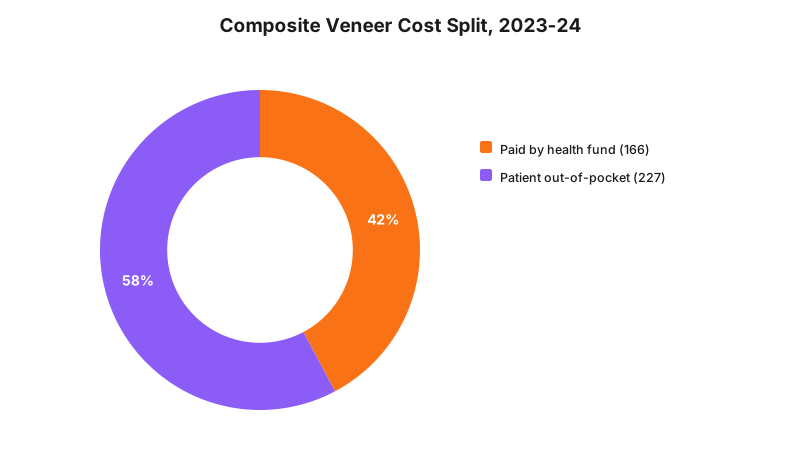
Takeaway: the $166 average benefit is real money, but it is less than half the average bill, and it applies to one specific billing category, not to veneers as a category.
How Coverage Compares Across Common Dental Treatments
The 42% figure makes more sense next to other items in the same dataset. Private Healthcare Australia’s factsheet splits claims into General Dental (check-ups, cleans, fillings) and Major Dental (crowns, root canals, veneers, dentures), and coverage rates differ noticeably between the two.
| Item | Procedure | Category | Avg. Treatment Cost | Avg. Insurer Benefit | Avg. Patient Out-of-Pocket | % Covered |
|---|---|---|---|---|---|---|
| 114 | General scale and clean | General Dental | $122 | $83 | $39 | 68% |
| 532 | White filling, back teeth, 2 surfaces | General Dental | $221 | $111 | $111 | 50% |
| 526 | Composite veneer, direct, per tooth | Major Dental | $393 | $166 | $227 | 42% |
| 419 | Root canal, first visit, nerve removal | Major Dental | $237 | $105 | $132 | 44% |
| 613 | Full porcelain or ceramic crown | Major Dental | $1,703 | $725 | $978 | 43% |
Source: Private Healthcare Australia, analysis of GT-Dental data collection, 2023-24 figures.
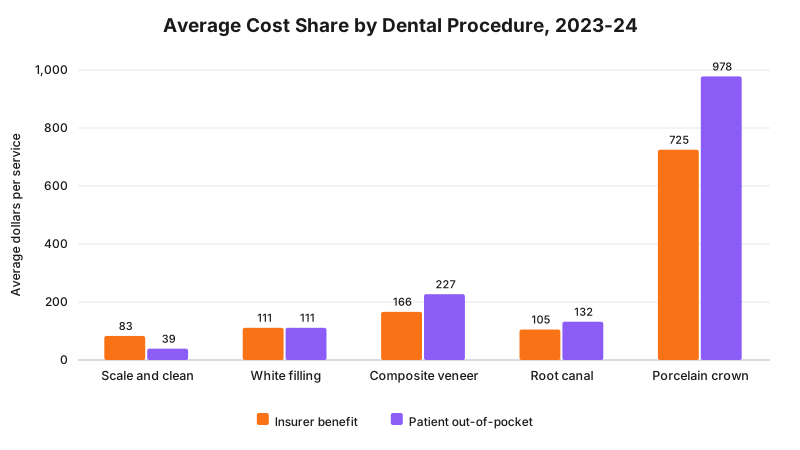
Routine preventive care is the best-covered category by a wide margin, at 68%. The composite veneer, root canal and crown items compared above cluster in a narrower 42% to 44% band. Composite veneers are not an outlier against those specific items. Coverage across the full Major Dental item list in the same dataset varies more widely, from 39% to 53%, so this narrow band does not hold for every Major Dental procedure.
Takeaway: if a quote assumes health insurance behaves the same way for a veneer as it does for a check-up, the numbers say otherwise. Major Dental coverage runs roughly two-thirds the rate of General Dental.
Porcelain Veneers Barely Show Up in the Same Data
Private Healthcare Australia’s Major Dental list includes twenty of the most commonly claimed item codes for 2023-24. Composite veneers (item 526) make that list, at 43,503 funded services. A dedicated porcelain veneer item does not appear anywhere on it.
That is not proof porcelain veneers are never funded. It does mean whatever claiming happens for porcelain veneers is small enough, relative to root canals, crowns, dentures and periodontal work, that it does not crack the top twenty Major Dental items nationally. Composite veneers can carry a restorative justification a fund will accept, a chipped or structurally compromised tooth, for example. Porcelain veneers, more often chosen for appearance alone, do not appear to generate accepted claims at the same scale.
Takeaway: the insurance gap between composite and porcelain veneers is likely wider than the treatment cost gap between them. One type shows up in national claims data at real volume. The other, functionally, does not.
Medicare Doesn’t Fund Veneers, Full Stop
Medicare is Australia’s public scheme, built around hospital care and a defined list of subsidised medical and limited dental services, primarily for children and specific eligibility groups. Veneers, cosmetic or otherwise, sit outside anything Medicare funds for adults. Every dollar not covered by a private extras policy, the $227 average out-of-pocket figure above included, is paid by the patient.
Takeaway: for adults, private extras cover is the only insurance-side lever on a veneer’s price. There is no Medicare fallback.
What This Means for a Dental Practice’s Advertising
A practice that publishes an exact price and an honest coverage estimate side by side is doing something most competitors do not. But price transparency has a compliance boundary attached to it. The Australian Dental Association’s own advertising compliance guidance confirms dentists must not use testimonials, and cannot advertise in a way that creates an unreasonable expectation of benefit, with penalties up to $120,000 for a body corporate and $60,000 for an individual practitioner, under section 133 of the National Law.
That is the same regulatory structure covered in RockingWeb’s breakdown of AHPRA’s advertising rules for cosmetic dentistry, and it applies to a veneer pricing page exactly as it applies to a before-and-after gallery. If your practice’s current site or ad account hasn’t been checked against the current rules, talk to RockingWeb and we will flag every breach against the specific provision it falls under.
Takeaway: a pricing page built on real numbers, like the ones above, is a stronger conversion asset than a vague “affordable veneers” claim, and it carries none of the compliance risk that a testimonial-driven gallery does.
Building a Booking Flow That’s Honest About Cost
Enquiry quality changes when a website states real numbers up front. A patient who sees “$393 average cost, $166 typical fund benefit, ask about your policy” arrives at a consultation calibrated on price, instead of booking on a vague promise and getting sticker shock at the front desk.
RockingWeb builds cosmetic clinic and dental practice websites around transparent pricing and booking flows, compliant with current AHPRA advertising rules from the first draft.
Takeaway: the practices getting the best-qualified veneer enquiries are the ones publishing real cost ranges, not the ones hiding behind “contact us for pricing”.
FAQ
Do private health funds cover veneers in Australia?
Partially, and only for one type. Private Healthcare Australia’s 2023-24 dental claims data shows insurers paid an average of $166 toward a $393 composite veneer, covering 42% of the cost, when a dentist bills it under item 526, the Major Dental composite veneer code. Porcelain veneers do not appear among the most-claimed Major Dental items in the same dataset.
How much does private health insurance actually pay toward a veneer?
On average, $166 per composite veneer in 2023-24, against an average treatment cost of $393. That leaves the patient with an average out-of-pocket cost of $227 per tooth, more than the insurer’s own contribution.
Does Medicare cover veneers?
No. Medicare is built around hospital care and specific subsidised services, not routine or cosmetic dental treatment for adults, and veneers fall outside anything Medicare funds.
What can a dental practice legally say about veneers in its advertising?
Dentists are bound by the same AHPRA advertising rules as other regulated health practitioners. The Australian Dental Association’s own advertising compliance guidance confirms testimonials are banned and advertising cannot create an unreasonable expectation of treatment benefit, with penalties up to $120,000 for a body corporate and $60,000 for an individual practitioner, under section 133 of the National Law.
Get a Compliant, Transparent Pricing Page Built for Your Practice
RockingWeb builds AHPRA-compliant websites and booking flows for Australian dental practices, with pricing pages that state real numbers instead of vague claims. If your current site needs a compliance check first, the audit is free.
Talk to us about your practice’s website
Sources and References
- Private Healthcare Australia - Typical Prices of Dental Care FY2024 consumer factsheet: composite veneer (item 526), general and major dental item benefit, cost and out-of-pocket figures for 2023-24, sourced from the GT-Dental data collection
- Australian Dental Association - Advertising compliance guidance: testimonial ban for dentists under the National Law
- Queensland Legislation - Health Practitioner Regulation National Law Act 2009, current as at 10 April 2026: section 133, $60,000 (individual) / $120,000 (body corporate) maximum penalty
Related reading:
- Veneers Cost Australia: State-by-State Price Data: verified per-tooth pricing ranges by material and city
- Composite Veneers Cost Australia: full cost breakdown for composite veneer treatment
- AHPRA Advertising Rules for Cosmetic Dentistry Australia: what a dental practice can and cannot publish about outcomes
- Cosmetic Clinic Websites: compliant website builds for AHPRA-regulated dental practices
For a pricing page and booking flow built to convert without breaching the current rules, see ClinicPipeline or talk to us about your practice’s website.
Vikas Thakur
Founder of RockingWeb. 16 years of experience from working at TPG, iiNet and Monadelphous, now building websites, software and digital marketing for local businesses in Rockingham and Perth.