Full Set of Veneers: $3,600 to $14,770 in Australia (2026)
A full set of veneers, 6 to 10 teeth, costs $3,600 to $14,770 in Australia in 2026, based on one Gold Coast and Sydney practice's published per-tooth rate. No government or ADA source publishes a single national average for the full-set case.
 Vikas Thakur Founder, RockingWeb 11 min read

On this page 9
- Key takeaways
- What Counts as a “Full Set” of Veneers
- Composite Full Sets: $3,600 to $6,000
- Porcelain and Zirconia Full Sets: $8,862 to $14,770
- Why No Single Practice’s Numbers Match a National Average
- Does Insurance Cover Any of a Full-Set Case?
- How Long a Full Set Lasts Before You’re Paying Again
- AHPRA’s Advertising Rules Apply to Full-Set Case Studies
- Get a Compliant Pricing Page for Full-Set Cases
Key takeaways
- A full set of veneers, 6 to 10 teeth, costs $3,600 to $14,770 in Australia in 2026, built from ArtSmiles’ published per-tooth rate for composite versus porcelain and zirconia
- ArtSmiles (Gold Coast and Sydney) charges $600 a tooth for composite, $995 for hybrid, and $1,477 for porcelain (e.max) or zirconia, so a 6-tooth case runs $3,600 in composite against $8,862 in porcelain
- The Australian Dental Association’s own schedule data, reported by dental-cover provider Smile, puts a single porcelain veneer at up to $2,036 and a composite veneer at up to $836, both well above ArtSmiles’ published rate
- Two independent Australian pricing guides put a full 6-to-10-tooth smile makeover at $5,000 to $25,000+, with 16-tooth premium full-arch cases running as high as $45,000
- Medicare covers $0 of any veneer treatment, and private insurers paid an average of just $166, or 42%, toward a single $393 composite veneer in 2023-24
- Porcelain veneers hold a 95.5% survival rate at 10 years across 6,500 veneers, well ahead of composite’s 88% pooled rate over its shorter tracked window
- The ADA’s 2022 Dental Fees Survey, based on 3,819 responses, found general dentist fees rose 3.7% over the two years to July 2022, with WA and SA charging the lowest fees of any state
- Dentists face fines up to $120,000 for a body corporate and $60,000 for an individual over banned advertising claims, under section 133 of the National Law
A full set of veneers, 6 to 10 teeth, costs $3,600 to $14,770 in Australia in 2026, based on ArtSmiles’ published per-tooth rates. The Australian Dental Association’s own schedule data puts a single porcelain veneer as high as $2,036. No government or ADA source publishes one official national full-set average.
A full set of veneers costs $3,600 to $14,770 in Australia in 2026. That’s not a single clinic’s marketing number pulled off a landing page. It’s the real spread between composite and porcelain, built from one Gold Coast and Sydney practice’s own published per-tooth rate, multiplied out across a 6-to-10-tooth case. Most “veneers cost” pages quote one per-tooth figure and leave the multiplication to you, which hides how much the material choice alone moves the total. We checked what ArtSmiles publishes for composite, hybrid, porcelain and zirconia veneers, cross-referenced it against the Australian Dental Association’s own schedule data and two independent Australian pricing guides, and lined every figure up against the other. Here’s what a full set actually costs by material and case size, why no single official average exists, and what the spread means if you’re comparing quotes.
What Counts as a “Full Set” of Veneers
“Full set” almost never means every tooth in your mouth. Across the pricing we checked, it means the 6 to 10 teeth visible when you smile: the upper front teeth, plus the first premolars on each side in larger cases. ArtSmiles prices its packages across that 6-to-10-tooth range, not a full-mouth 28-tooth case, which is why the figures below sit in the thousands rather than tens of thousands. A 16-tooth full-arch case costs considerably more, covered further down.
That distinction matters when you compare a quote against a number you’ve read online. Quote 6 teeth against a “full set” price built on 10, and you’re not comparing like with like even before the material or the practice changes anything.
Takeaway: confirm the tooth count behind any full-set price before you compare it to another quote. A 6-tooth case and a 10-tooth case from the same practice can differ by thousands of dollars.
Composite Full Sets: $3,600 to $6,000
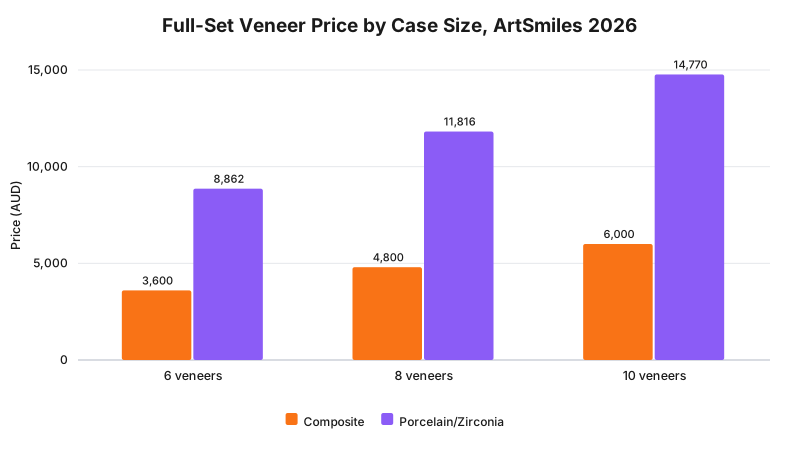
ArtSmiles, which operates on the Gold Coast and in Sydney, publishes a composite veneer rate of $600 a tooth, “club member pricing” confirmed after a clinical assessment. Multiplied out across a smile-zone case, that’s $3,600 for 6 veneers, $4,800 for 8, and $6,000 for 10, each an exact multiple of the published per-tooth rate. The practice also lists a hybrid veneer option at $995 a tooth, sitting between composite and porcelain on both price and material.
| Case size | Composite | Porcelain / zirconia |
|---|---|---|
| 6 veneers | $3,600 | $8,862 |
| 8 veneers | $4,800 | $11,816 |
| 10 veneers | $6,000 | $14,770 |
| Full set (6 to 10 veneers) | $3,600 to $6,000 | $8,862 to $14,770 |
Source: ArtSmiles, published 2026 per-tooth club pricing, $600 composite and $1,477 porcelain/zirconia, multiplied across case size.
That $600-a-tooth starting rate is well under what the Australian Dental Association’s own schedule data suggests a composite veneer can run to. Dental-cover provider Smile reports the ADA’s item 526 composite veneer fee at up to $836 a tooth, reviewed June 2024, which would put the same 6-to-10-tooth composite case at $5,016 to $8,360 at the top of that range, well above ArtSmiles’ published figure.
Takeaway: a published per-tooth rate multiplied out gives you a clean number, but “from” pricing and an “up to” schedule ceiling can sit thousands apart for the same material and case size.
Porcelain and Zirconia Full Sets: $8,862 to $14,770
Porcelain is where the real money sits. ArtSmiles prices porcelain (e.max) and zirconia veneers identically, at $1,477 a tooth, “from” pricing confirmed after clinical assessment. That works out to $8,862 for 6 veneers, ArtSmiles’ own published worked example, $11,816 for 8, and $14,770 for 10.
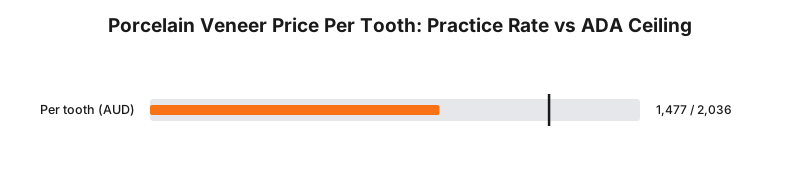
The ADA-sourced ceiling sits well above that. Smile’s reviewed-June-2024 figures put the ADA’s item 556 porcelain veneer fee at up to $2,036 a tooth, 38% higher than ArtSmiles’ published rate, which would push a 6-to-10-tooth case to $12,216 to $20,360, a calculation from the official per-tooth figure rather than a published package price. Two independent pricing guides land in a similar zone: dentistrynearme.au puts a 6-upper-tooth porcelain case at $9,000 to $17,000, and comparedentists.com.au puts a 6-to-10-tooth full smile, any material, at $5,000 to $25,000 or more.
Takeaway: treat ArtSmiles’ $8,862-to-$14,770 published range as a real, verifiable floor for a porcelain full set, not a ceiling. Quotes running to $20,000 or beyond sit inside the ADA’s own schedule ceiling and two independent market guides, not outside them.
Why No Single Practice’s Numbers Match a National Average
ArtSmiles’ figures are clean because they’re built on one published per-tooth rate multiplied out, with no volume discount built in. The Australian Dental Association runs a Dental Fees Survey every two years; its 2022 edition (ada.org.au/dental-fees-survey-2022) drew 3,819 valid responses, 3,535 from general practitioners and 284 from specialists, out of 11,035 dentists invited. That survey found general dentist fees rose 3.7% on average over the two years to July 2022, and specialist mean hourly rates jumped from $662 to $921, a 39% increase. WA and SA charged the lowest general-dentist fees of any state in that same survey, but the ADA does not publish a national average fee for a full-set veneer case, and a newer ADA fees survey covering 2024 has since superseded 2022 as the association’s most current dataset. Smile’s “up to” item figures are the closest public approximation, and even those describe a per-tooth ceiling, not a package price.
Two consumer pricing guides, comparedentists.com.au and dentistrynearme.au, both updated June 2026, attempt a full-set range directly: $5,000 to $25,000-plus for a 6-to-10-tooth smile makeover, and $24,000 to $45,000 for a 16-tooth upper-and-lower full-arch case at a premium practice.
| Benchmark | Composite (per tooth) | Porcelain (per tooth) | Source, year |
|---|---|---|---|
| ArtSmiles published rate | $600 | $1,477 | ArtSmiles, 2026 |
| ADA schedule ceiling (“up to”) | $836 | $2,036 | ADA data via Smile, reviewed June 2024 |
| National average actually paid | $393 | not reported | Private Healthcare Australia, 2023-24 |
Source: as listed per row above.
Takeaway: no single number is “the” cost of a full set. A practice’s own per-tooth rate, the ADA’s schedule ceiling, and a market-wide pricing guide are three different, all legitimate ways of answering the same question, and they don’t converge on one figure.
Does Insurance Cover Any of a Full-Set Case?
Medicare funds $0 of veneer treatment, cosmetic or otherwise, for adults, and private extras cover is narrower than most people assume. Private Healthcare Australia’s analysis of 2023-24 national dental claims data shows insurers paid an average of $166 toward a single $393 composite veneer, a 42% coverage rate, when the treatment is billed under item 526 with a restorative justification rather than a purely cosmetic one.
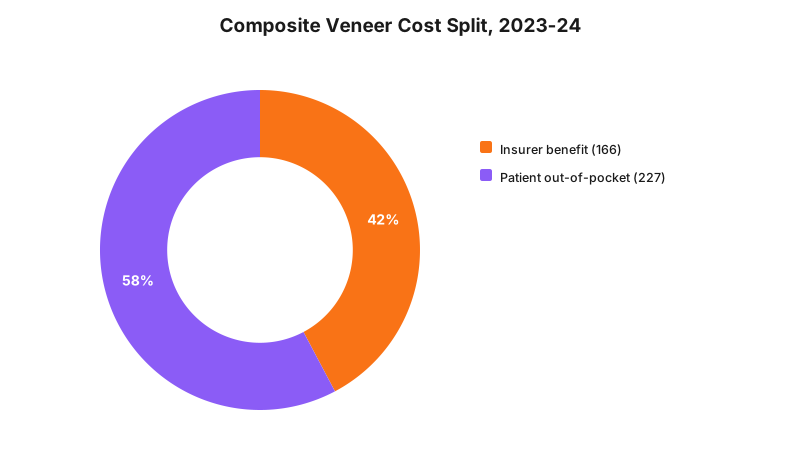
Scale that 42% rate across a 10-tooth composite full set and the arithmetic gets clearer: an average benefit of roughly $1,660 against an average $2,270 the patient still pays, on top of the $6,000-plus sticker price. Porcelain veneers do not appear among the most-claimed Major Dental items in the same dataset, so whatever porcelain claiming happens is too small to register nationally.
Takeaway: budget a full set as an out-of-pocket cost. A composite case might return a modest average rebate; a porcelain or zirconia case, on the published data, effectively won’t.
How Long a Full Set Lasts Before You’re Paying Again
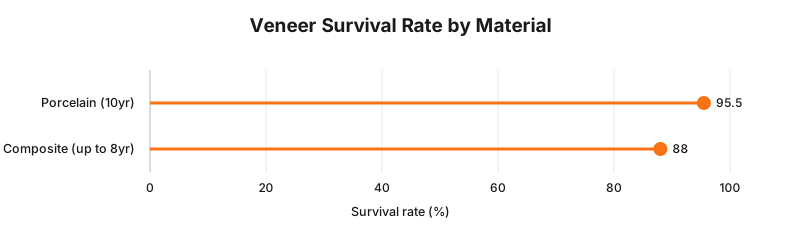
A 2021 systematic review covering 25 studies and 6,500 porcelain veneers found a 95.5% survival rate at 10 years. A 2023 review of composite veneers found an 88% pooled survival rate specific to its 3 randomised controlled trials, tracked over 24 to 97 months, roughly 2 to 8 years, a shorter proven window than porcelain’s decade of data. Neither figure is Australian-specific; both come from international clinical literature, since no AHPRA, ADA or AIHW dataset reports veneer survival rates directly.
Run that against the price gap above and the annualised cost narrows. A $14,770 porcelain full set spread across a 10-year median survival works out to roughly $1,477 a year. A $6,000 composite full set, replaced or substantially reworked somewhere inside its shorter tracked window, can land in a similar yearly range once you factor in the earlier touch-up or replacement cost.
Takeaway: the sticker price gap between composite and porcelain full sets is real, but it narrows once you spread each material’s cost over its own tracked lifespan rather than comparing the upfront numbers alone.
AHPRA’s Advertising Rules Apply to Full-Set Case Studies
None of the pricing above gives a practice a free pass to advertise a full-set case however it likes. Dentists sit under the Dental Board of Australia, regulated through the same AHPRA National Law as cosmetic medicine clinics, and our full breakdown of AHPRA’s advertising rules for cosmetic dentistry covers exactly what the rules restrict: testimonials, most before-and-after imagery, and outcome language like “perfect smile” or “guaranteed result”.
A before-and-after gallery of a 10-tooth smile makeover, the exact content most cosmetic dental marketing leans on, is the kind of material AHPRA’s guidelines were written to restrict. AHPRA reports that its Guidelines for advertising higher risk non-surgical cosmetic procedures, in effect from 2 September 2025, cover registered health practitioners including dentists through the Dental Board of Australia, and the regulator’s accompanying visual-examples information sheet names veneers directly among the procedures the guidelines apply to. Whether a specific gallery or case study actually breaches those guidelines turns on how it’s presented, not just which treatment it shows, so this is context rather than a compliance verdict on any one practice’s content. Penalties for a proven breach run up to $120,000 for a body corporate and $60,000 for an individual under section 133 of the National Law. If your pricing pages and case-study content haven’t been reviewed against the current rules, RockingWeb can flag exactly what needs to change.
Takeaway: a transparent, accurate full-set price list doesn’t offset a case-study gallery that hasn’t been checked against AHPRA’s current advertising guidelines. Get it reviewed rather than assuming it’s fine.
Get a Compliant Pricing Page for Full-Set Cases
RockingWeb builds cosmetic clinic and dental practice websites for AHPRA-regulated practices, with pricing pages built to state a real full-set range instead of a vague “veneers from $X” figure, while staying inside the current advertising rules. For practices that want the audit, the compliant rebuild and ongoing compliant ad management handled as one service, ClinicPipeline is our audit-and-ads offering built specifically for regulated dental and cosmetic clinics.
Talk to us about a compliant full-set pricing page
Data sources: ArtSmiles, published 2026 per-tooth and worked-example package pricing for composite, hybrid, porcelain and zirconia veneers; Smile (smile.com.au), consumer dental cover factsheet reviewed June 2024, ADA/HICAPS-sourced item 526 and item 556 fee data; Australian Dental Association, Dental Fees Survey 2022 (ada.org.au/dental-fees-survey-2022, 3,819 valid responses from 3,535 general practitioners and 284 specialists out of 11,035 dentists invited); Private Healthcare Australia, “Typical Prices of Dental Care” FY2024 factsheet, GT-Dental claims data; comparedentists.com.au and dentistrynearme.au, consumer pricing guides, both updated June 2026; Alenezi, Alsweed, Alsidrani and Chrcanovic, Journal of Clinical Medicine, 2021 (25 studies, 6,500 porcelain veneers); Lim, Tan, Li and Burrow, Journal of Evidence-Based Dental Practice, 2023 (composite veneer survival); AHPRA, Guidelines for advertising higher risk non-surgical cosmetic procedures, in effect 2 September 2025, announced via “Putting patients first: New guidelines for cosmetic procedures”; Health Practitioner Regulation National Law, section 133 penalty figures. Note: the ADA has since published a newer Dental Fees Survey covering 2024; the figures cited here are specific to the 2022 survey and are not claimed as the ADA’s most current data.
RockingWeb builds AHPRA-compliant websites for Australian cosmetic clinics and dental practices. Hire us to discuss a compliant rebuild.
Vikas Thakur
Founder of RockingWeb. 16 years of experience from working at TPG, iiNet and Monadelphous, now building websites, software and digital marketing for local businesses in Rockingham and Perth.