4-Stage Framework Decides Australia's Cosmetic Nurse Scope
Australia has no approved list of cosmetic procedures nurses can perform. The Nursing and Midwifery Board's 4-stage Decision-Making Framework, in effect since 3 February 2020, decides scope of practice case by case for the 512,306 registered and enrolled nurses on the national register as of March 2026.
 Vikas Thakur Founder, RockingWeb 10 min read
On this page 9
- Key takeaways
- The 4-Stage Decision-Making Framework, Not a Checklist
- Where AHPRA’s Cosmetic Guideline Adds Harder Limits
- The Nurse Practitioner Endorsement Gap
- How Many Nurses This Framework Actually Covers
- What This Means for a Cosmetic Clinic Website
- FAQ
- Get Your Clinic’s Practitioner Pages Checked Against the Current Rules
- Sources and References
Key takeaways
- The NMBA’s Decision-Making Framework runs to 4 stages, not a fixed list of approved or banned cosmetic procedures, and has been in effect since 3 February 2020
- Australia had 512,306 registered and enrolled nurses on the national register as of 31 March 2026, made up of 421,539 general registered nurses (RNs) and 66,592 general enrolled nurses (ENs)
- No national dataset breaks that 512,306 figure down by clinical interest area, so no official count exists of how many currently perform cosmetic procedures
- A registered nurse cannot gain Nurse Practitioner endorsement while working solely in non-surgical cosmetic procedures, because the NMBA does not treat cosmetics-only work as reaching the “clinically advanced practice level” the endorsement standard requires
- Enrolled nurses need direct supervision specifically for laser skin resurfacing, with the supervising RN checking laser settings before every use
- RNs holding a “sole qualification” notation in mental health, paediatric or disability nursing cannot move into cosmetic procedures without first completing a new NMBA-approved program leading to general registration
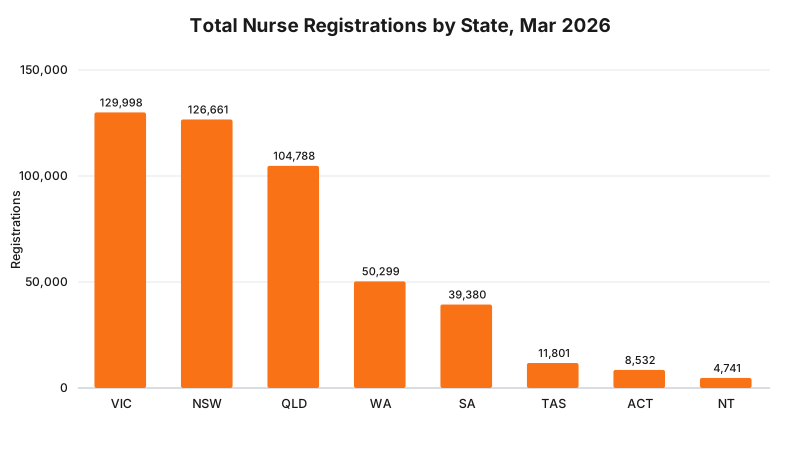
- 50,299 nurses were registered with a Western Australian principal place of practice as of March 2026, the fourth-largest state total behind Victoria, NSW and Queensland
Australia does not publish a list of cosmetic procedures a registered nurse is allowed to perform. Instead, every nurse moving into cosmetic injectables, laser treatments or thread lifts has to run their own judgement through the Nursing and Midwifery Board’s 4-stage Decision-Making Framework, in effect since 3 February 2020, and decide for themselves whether the work sits inside their scope of practice.
Scope of practice for a nurse performing cosmetic procedures in Australia is not a fixed list. It is decided nurse by nurse against NMBA’s 4-stage Decision-Making Framework, effective 3 February 2020, across 512,306 registered nurses nationally.
This guide breaks down what the 4 stages actually check, where AHPRA’s separate cosmetic procedure guideline stacks harder limits on top of them, and where the framework leaves a real gap for nurse practitioners chasing cosmetics-only endorsement. It closes with what any of this means for how a clinic website describes its injector.
The 4-Stage Decision-Making Framework, Not a Checklist
The NMBA’s Decision-Making Framework for Nursing and Midwifery has been in effect since 3 February 2020, and it applies to every nursing decision, cosmetic or otherwise, not a cosmetic-specific rulebook. It runs through 4 stages: identify the need or benefit, reflect on scope of practice and nursing practice standards, consider the context of practice and any risk, then select an appropriately competent person to perform the activity.
Each stage carries its own set of yes or no questions. If the answer to any one of them is no, the guidance is to stop and reconsider, get further training, seek supervision, or refer the person elsewhere, not to proceed anyway. Nothing in the framework names a specific cosmetic product or procedure. It is a general-purpose decision tool the NMBA expects a nurse to run every time they are weighing up whether a new activity belongs inside their own scope of practice.
| Stage | Core question the nurse must answer |
|---|---|
| 1. Identify need/benefit | Is the activity in the best interests of the person receiving care? |
| 2. Reflect on scope of practice | Is this activity within the current, contemporary scope of nursing practice? |
| 3. Consider context and risk | Is the activity supported by the organisation, with risk identified and managed? |
| 4. Select the competent person | Does the nurse have the training, experience and confidence to perform it safely? |
Takeaway: there is no AHPRA-issued list of approved or banned cosmetic procedures for nurses. Scope of practice is a decision each nurse makes and can be asked to justify, not a credential they can point to.
Where AHPRA’s Cosmetic Guideline Adds Harder Limits
The framework above is deliberately general. For cosmetic work specifically, the National Boards’ guideline for non-surgical cosmetic procedures, in effect since 2 September 2025, stacks harder, more specific rules on top of it. Two of those are easy for a clinic website to get wrong.
First, a registered nurse holding a “sole qualification” notation, meaning their registration states they are solely qualified in mental health, paediatric or disability nursing, cannot move into cosmetic procedures at all. Their foundational education does not prepare them for it. They need to complete a new NMBA-approved program of study leading to general registration first.
Second, enrolled nurses face a supervision requirement specific to one procedure type: laser skin resurfacing requires direct supervision, meaning the supervising RN is physically present and personally checks the laser settings before every use. That is a stricter standard than the direct-or-indirect supervision that applies to an EN’s other cosmetic work.
For the fuller detail on the guideline’s experience thresholds (a minimum of 1 year for RNs and 2 years combined for ENs) and its live-consultation prescribing rule, see RockingWeb’s cosmetic injectable prescribing rules guide.
Takeaway: the cosmetic guideline narrows the general framework with specific, checkable rules. A clinic advertising a nurse injector should be able to name which rule applies to that nurse’s registration type, not just say “fully qualified.”
The Nurse Practitioner Endorsement Gap
One line in AHPRA’s guideline closes off a career path some clinics assume exists. Registered nurses working toward Nurse Practitioner endorsement while practising solely in non-surgical cosmetic procedures will not meet the requirements for that endorsement. The NMBA’s stated reason is that cosmetics-only practice does not reach the “clinically advanced practice level” defined in the NP registration standard.
In practice, that means a nurse cannot build an NP endorsement through cosmetic work alone. Any nurse practitioner legitimately holding that title and performing cosmetic injectables earned the endorsement through advanced practice in another area of nursing first, then brought cosmetic work into an existing NP scope. A website copy line implying cosmetic experience alone qualifies someone as a nurse practitioner misstates how the endorsement actually works.
Takeaway: “nurse practitioner” is a specific, earned endorsement, and cosmetics-only practice cannot be the thing that earns it.
How Many Nurses This Framework Actually Covers
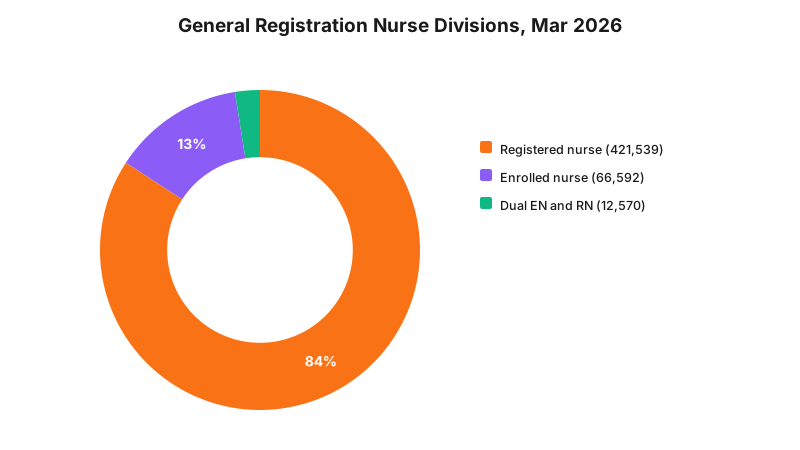
The Nursing and Midwifery Board’s quarterly registrant data, published by AHPRA, counted 512,306 nurse registrations nationally for the reporting period ending 31 March 2026. That includes 421,539 general registered nurses, 66,592 general enrolled nurses, and 12,570 nurses holding dual EN and RN registration, plus a smaller number of non-practising and provisional registrants.
None of that breakdown counts clinical interest area. AHPRA’s registrant data splits nurses by state, registration type, age and gender, not by whether a nurse currently performs cosmetic procedures. That is a genuine gap: no national dataset publishes how many of Australia’s 512,306 registered and enrolled nurses work in cosmetic injectables, laser treatments or any other non-surgical cosmetic procedure. Anyone citing a specific figure for “how many cosmetic nurses” in Australia is citing an estimate, not an AHPRA count.
| Registration type (general) | National, 31 Mar 2026 | Western Australia, 31 Mar 2026 |
|---|---|---|
| Registered nurse (RN) | 421,539 | 41,683 |
| Enrolled nurse (EN) | 66,592 | 6,424 |
| Dual EN and RN | 12,570 | 1,247 |
| All nurse registrations | 512,306 | 50,299 |
“All nurse registrations” includes non-practising and provisional registrants in addition to the general-registration rows above, so the rows do not sum exactly.
Takeaway: the 4-stage framework and the cosmetic guideline apply to a national workforce of over half a million nurses, and there is no honest way to say how many of them currently do cosmetic work, because nobody counts it that way.
What This Means for a Cosmetic Clinic Website
None of this changes what a clinic is legally allowed to say in an ad, only what it can accurately say about a practitioner’s scope. A website naming a nurse injector should be able to back up, on request, which stage of the framework and which specific cosmetic-guideline rule applies to that person’s registration type, rather than relying on a generic “fully qualified and experienced” line that dodges the question.
That level of detail also does real work for enquiry quality. A visitor who can see a practitioner’s registration type, the specific procedures they are trained and authorised to perform, and how that maps to the rules above tends to arrive with realistic expectations and fewer follow-up questions before booking. A page that is vague about who is actually holding the needle tends to attract enquiries that stall at the first detailed question.
Whether a treatment or a practitioner’s credentials justify a dedicated landing page, rather than a shared page, comes down to whether the compliance language actually differs. An RN-administered injectable, an EN-administered one under supervision, and a genuine NP-led service each answer to a different part of this framework, so each deserves copy that reflects the rule that actually applies to it. RockingWeb checks a site’s practitioner disclosures and booking flow against the current rules, and builds cosmetic clinic websites designed to hold up under that same scrutiny.
Takeaway: the safest claim a clinic website can make about a nurse injector is the one it can actually document against the framework and guideline above, not the most impressive-sounding one.
FAQ
What is scope of practice for a nurse in Australia, and who decides it?
The Nursing and Midwifery Board’s Decision-Making Framework, in effect since 3 February 2020, defines it as self-determined by each nurse’s own education, training, authorisation, competence and experience, checked against a 4-stage decision process. There is no register of specific cosmetic procedures a registered nurse or enrolled nurse is or is not allowed to perform, only the framework plus profession-specific practice standards.
Is there an official list of cosmetic procedures a nurse can or cannot perform in Australia?
No. AHPRA and the National Boards’ guideline for non-surgical cosmetic procedures sets specific limits on top of the general framework, such as banning enrolled nurses from injecting dermal filler into the glabella, nose or forehead. But scope of practice itself is decided case by case against the Decision-Making Framework, not read off a master list.
Can a nurse practitioner specialise only in cosmetic injectables?
No. The Nursing and Midwifery Board does not consider non-surgical cosmetic procedures to reach the clinically advanced practice level required for Nurse Practitioner endorsement, so a nurse working solely in cosmetics cannot use that work to qualify for or maintain NP endorsement.
How many nurses in Australia currently perform cosmetic procedures?
No national dataset publishes that number. AHPRA’s quarterly registrant data counts 512,306 registered and enrolled nurses nationally as of 31 March 2026, broken down by state, registration type, age and gender, but not by clinical interest area such as cosmetic procedures.
Get Your Clinic’s Practitioner Pages Checked Against the Current Rules
RockingWeb reviews cosmetic clinic websites against the frameworks and guidelines that actually apply to each practitioner type, and flags any claim the site cannot back up. No cost, no obligation.
Talk to us about your clinic’s websiteSources and References
AHPRA - Guidelines for registered health practitioners who perform non-surgical cosmetic procedures (effective 2 September 2025): the reference to the NMBA Decision-Making Framework, the RN sole-qualification restriction, the EN laser-supervision rule, and the Nurse Practitioner cosmetics-only endorsement gap, all in Appendix A
Nursing and Midwifery Board of Australia - Frameworks page confirming the Decision-Making Framework’s effective date of 3 February 2020
Nursing and Midwifery Board of Australia - Decision-making framework summary: Nursing, listing the 4 stages and their component questions
Nursing and Midwifery Board of Australia - Registrant data report, reporting period 1 January 2026 to 31 March 2026: national and Western Australian registration totals by division
Related reading:
- 2 Years: Australia’s Cosmetic Injectable Prescribing Rules: the RN and EN experience thresholds and the live-consultation prescribing rule in full
- AHPRA Cosmetic Guidelines Timeline: every dated milestone behind the current rules
- Injectables by Nurses vs Doctors: Australia Data: state-by-state practitioner-type rules for holding and injecting Schedule 4 stock
Vikas Thakur
Founder of RockingWeb. 16 years of experience from working at TPG, iiNet and Monadelphous, now building websites, software and digital marketing for local businesses in Rockingham and Perth.