Injectables by Nurses vs Doctors: Australia Data
Only 2 of Australia's 8 states and territories, NSW and Queensland, have published rules specific to who can hold and inject Schedule 4 cosmetic medicines. Queensland's 2025 clarification put an estimated 600 nurse-led clinics at risk of closure.
 Vikas Thakur Founder, RockingWeb 12 min read
On this page 7
- What Schedule 4 Actually Means for Botox and Dysport
- Who Can Prescribe, and Who Can Only Administer
- Queensland’s 2025 Rule Change: Why 600 Clinics Got Caught Out
- NSW’s Specific Cosmetic Medicines Law
- The Six States Still Without Public Guidance
- What This Means for Clinic Owners and Patients
- The Bottom Line
Key Takeaways
- Only 2 of Australia’s 8 states and territories, NSW and Queensland, have published guidance specific to Schedule 4 cosmetic injectables. The other 6 rely on general Poisons Act frameworks with no cosmetic-injectable-specific clarification
- Queensland’s April 2025 clarification of the Medicines and Poisons Act 2019 put an estimated 600 nurse-led clinics at risk of closure, according to Medical Republic
- A registered nurse cannot prescribe Schedule 4 medicines (Botox, Dysport, dermal fillers) anywhere in Australia. Only a doctor, dentist, or nurse practitioner can
- Since 2 September 2025, AHPRA has required registered nurses to complete 1 year of full-time postgraduate nursing experience before performing cosmetic injectables
- NSW’s Poisons and Therapeutic Goods Regulation 2008 caps a prescriber’s direction at 6 months from the date they personally reviewed the patient
- Breaching NSW’s cosmetic medicines rules carries penalties up to $22,000 for an individual and $110,000 for a body corporate
- Queensland now requires the prescriber to hold “exclusive custody” of Schedule 4 stock on-site. Nurses may only hold individually dispensed medicines for named clients
- Midwives are excluded entirely from performing cosmetic procedures under the September 2025 AHPRA guidelines
A registered nurse cannot prescribe Schedule 4 cosmetic injectables like Botox anywhere in Australia. Only doctors, dentists, and nurse practitioners can prescribe them, and only NSW and Queensland have published state-specific rules on holding the stock, as of July 2026.
Only two of Australia’s eight states and territories have told cosmetic clinics, in writing, who is allowed to hold a vial of Botox. New South Wales did it in 2021. Queensland did it in April 2025, and the clarification was blunt enough to put an estimated 600 nurse-led clinics at risk of closing, according to Medical Republic.
The other six, Western Australia included, still run on the same general Poisons Act framework every prescription medicine in the state falls under, with nothing published specifically for cosmetic injectables.
That gap matters because a registered nurse cannot prescribe Schedule 4 medicines anywhere in the country, but administering them under someone else’s prescription is a different question entirely, and the answer changes depending on which state line the clinic sits on.
Here’s what’s confirmed, what’s still murky, and what changed for good in September 2025.
What Schedule 4 Actually Means for Botox and Dysport
Botulinum toxin products (Botox, Dysport, Xeomin) and most dermal fillers containing prescription actives sit in Schedule 4 of the Poisons Standard, the national scheduling document the Therapeutic Goods Administration maintains. Schedule 4 means “prescription only”: no consumer can walk in and buy it, and no health practitioner can supply or administer it without a valid prescription from someone legally entitled to write one.
There is no single national law that governs how Schedule 4 medicines are purchased, stored, or administered. Each state and territory writes its own Poisons Act, and while they’re all built from the same national template, the detail varies enough that a clinic compliant in Perth could be operating illegally if it opened an identical branch in Brisbane.
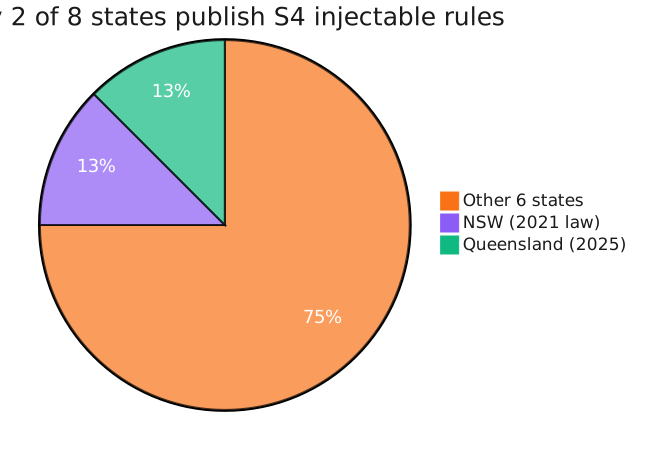
Chart: of Australia’s 8 states and territories, only NSW (2021) and Queensland (2025) have publicly clarified how their Poisons Act applies specifically to cosmetic injectables, per the Australasian Society of Cosmetic and Procedural Dermatologists’ June 2025 regulatory summary.
| State/Territory | Poisons Legislation | Cosmetic-Injectable-Specific Guidance? |
|---|---|---|
| New South Wales | Poisons and Therapeutic Goods Act 1996 | Yes, since September 2021 |
| Queensland | Medicines and Poisons Act 2019 | Yes, clarified April 2025 |
| Western Australia | Medicines and Poisons Act 2014 | Not published as cosmetic-specific |
| Victoria | Drugs, Poisons and Controlled Substances Act 1981 | Not published as cosmetic-specific |
| South Australia | Controlled Substances Act 1984 | Not published as cosmetic-specific |
| Tasmania | Poisons Act 1971 | Not published as cosmetic-specific |
| ACT | Medicines, Poisons and Therapeutic Goods Act 2008 | Not published as cosmetic-specific |
| Northern Territory | Poisons and Dangerous Drugs Act | Not published as cosmetic-specific |
Takeaway: if your clinic operates outside NSW or Queensland, there is no state government fact sheet spelling out the cosmetic-injectable rules. You’re reading the general Poisons Act and applying it yourself, or relying on your indemnity insurer and professional college for interpretation.
Who Can Prescribe, and Who Can Only Administer
Every jurisdiction in Australia draws the same basic line, and it doesn’t move regardless of postcode: Schedule 4 cosmetic injectables can only be prescribed by a medical practitioner (doctor), a dentist, or a nurse practitioner. A registered nurse, no matter how experienced, cannot write that prescription.
What a registered nurse can do is administer the injectable, but only under a valid prescription or direction from one of those three prescriber types, and only after that prescriber has personally reviewed the patient. The Nursing and Midwifery Board of Australia’s position statement on nurses and cosmetic procedures made this the standard for years; from 2 September 2025 it was formally replaced by AHPRA’s national guidelines for registered health practitioners performing non-surgical cosmetic procedures, which tightened the requirements further.
| Practitioner Type | Can Prescribe Schedule 4? | Can Administer? | 2025 AHPRA Requirement |
|---|---|---|---|
| Doctor (medical practitioner) | Yes | Yes | Must personally review patient each time |
| Dentist | Yes (facial aesthetics scope) | Yes | Bound by Dental Board fact sheet on botulinum toxin |
| Nurse practitioner | Yes | Yes | Cannot gain NP endorsement solely on cosmetic experience |
| Registered nurse | No | Yes, under direction | 1 year full-time postgraduate nursing experience required first |
| Enrolled nurse | No | Restricted, under RN supervision | Cannot inject high-risk facial areas without stringent conditions |
| Midwife | No | No | Excluded entirely from cosmetic procedures |
The September 2025 guidelines also killed a workaround that had crept into the industry: asynchronous prescribing, where a patient fills out an online questionnaire and a prescription gets issued without a real-time consultation. AHPRA’s rules now state a prescriber must have an in-person or video consultation every single time they prescribe a cosmetic injectable, and one prescription cannot cover multiple patients as a batch.
If your clinic’s booking flow or landing page still implies a nurse can “assess and treat” independently, that copy is now a compliance problem as well as a marketing one. RockingWeb can check scope-of-practice claims on your site against the current rules before a complaint does it for you.
Takeaway: the prescribe/administer split is the one rule that’s identical in every state. The part that varies is what a clinic is allowed to do with the Schedule 4 stock itself, and that’s where Queensland and NSW have gone further than anyone else.
Queensland’s 2025 Rule Change: Why 600 Clinics Got Caught Out
Until early 2025, plenty of Queensland nurse-led clinics ran on a model that looked compliant on paper: a doctor or nurse practitioner, often based interstate, consulted patients by telehealth and issued a prescription. The clinic’s on-site nurse held a working stock of Botox and dermal filler ordered under that remote prescriber’s name, and administered treatments to walk-in patients all week without a prescriber ever setting foot in the building.
Queensland Health disagreed that this was compliant with the Medicines and Poisons Act 2019 and its regulation. A fact sheet issued in December 2024, revised again in April 2025 after industry pushback, confirmed the interpretation rather than softening it: only a prescriber (a doctor or nurse practitioner) can purchase Schedule 4 medicines for clinic stock, that prescriber must physically work at the premises, and they must maintain what Queensland Health called “exclusive custody” of the stock. A registered nurse can hold individually dispensed medicines prepared for a specific, named client, but cannot hold a general stock for the clinic to draw on.
Health law specialist Geoff Bloom told Medical Republic the change made the remote-prescribing model “non-viable,” with roughly 600 nurse-led clinics across the state affected. That’s not a fringe number. It’s a meaningful share of Queensland’s cosmetic injectable market restructuring around a single clarified sentence in an existing Act.
Takeaway: Queensland didn’t write a new law. It clarified how an existing one applied, and that was enough to force hundreds of clinics to either hire an on-site prescriber or close the stock-holding side of the business.
NSW’s Specific Cosmetic Medicines Law
New South Wales took the opposite approach: instead of clarifying an existing Act, it wrote cosmetic-medicine-specific amendments into the Poisons and Therapeutic Goods Regulation 2008 back in September 2021. Under that regulation, only an authorised practitioner, meaning a medical practitioner, nurse practitioner, or dentist, or a nurse acting under that practitioner’s direction, may administer a cosmetic medicine.
Before authorising administration, the medical practitioner or nurse practitioner must personally review the patient. NSW’s rules explicitly permit that review to happen over video link, so telehealth consultation itself isn’t banned the way Queensland’s stock-holding model was. What NSW does cap is the shelf life of that authorisation: under section 68(C) of the regulation, a prescriber’s direction has effect for the period stated, but never longer than 6 months from the date they personally reviewed the patient. After that, a fresh review is required before treatment continues.
Get the record-keeping or the review timing wrong and the penalties aren’t symbolic. A breach of the regulation is a specific offence, separate from any AHPRA disciplinary action.
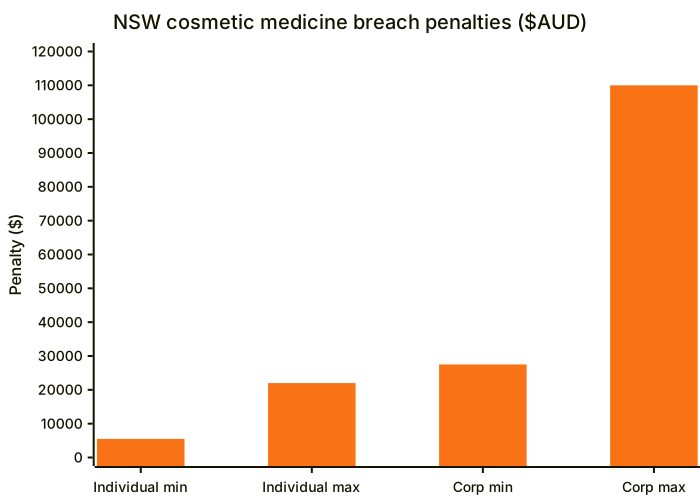
Chart: maximum penalties under NSW’s Poisons and Therapeutic Goods Regulation 2008 for breaching the cosmetic medicines administration rules, current as of the September 2021 amendment.
| Breach Type | Individual Penalty | Body Corporate Penalty |
|---|---|---|
| Breach of cosmetic medicines regulation | $5,500 to $22,000, and/or up to 6 months imprisonment | $27,500 to $110,000 |
Takeaway: NSW didn’t ban telehealth prescribing the way Queensland effectively did. It built a specific offence around it instead, with a hard 6-month cap on how long a review stays valid and a body corporate penalty that’s exactly five times the individual minimum.
The Six States Still Without Public Guidance
Western Australia, Victoria, South Australia, Tasmania, the ACT, and the Northern Territory each have their own Poisons Act, derived from the same national Poisons Standard as NSW and Queensland. None of the six has published a fact sheet, guideline, or clarification dealing specifically with how that Act applies to cosmetic injectable stock, telehealth prescribing, or nurse-led clinic structures, at least none that we could locate as of writing.
That’s an explicit gap, not a settled answer. It means a clinic operating in Perth, Melbourne, Adelaide, Hobart, Canberra, or Darwin is applying the general prescription-medicine provisions of its state Act to a cosmetic injectable business model, without the state-specific interpretation NSW and Queensland clinics now have in writing. Some industry commentary claims other states allow a 12-month prescription validity period compared to NSW’s 6 months, but we could not confirm that figure against a primary state government source for any of the six, so treat it as unverified rather than settled.
What is verifiable, and identical in all six jurisdictions, is the underlying principle every state Poisons Act shares: a registered nurse cannot purchase or hold Schedule 4 stock in their own name, and administration requires a valid, current direction from a doctor, dentist, or nurse practitioner who has actually assessed the patient. Whether “exclusive custody” language like Queensland’s applies in Perth, or whether a 6-month review cap like NSW’s applies in Melbourne, is not something any of the six state health departments has confirmed publicly.
If your clinic’s website describes its clinical model in a way that assumes rules from a different state, that’s worth fixing before a regulator or a competitor’s complaint flags it. RockingWeb builds AHPRA-compliant cosmetic clinic websites that describe scope of practice accurately for the state the clinic actually operates in, rather than copying language from a template built for someone else’s jurisdiction.
Takeaway: six states run on the same general framework NSW and Queensland used before they clarified it. Until one of them publishes its own guidance, clinics in those states are the ones carrying the interpretation risk.
What This Means for Clinic Owners and Patients
For patients, the practical question is simple: whoever is holding the needle should be able to name the doctor, dentist, or nurse practitioner who assessed you and authorised the treatment, and tell you when that authorisation was last reviewed. If a clinic can’t answer that clearly, the compliance gap is the clinic’s problem before it becomes yours.
For clinic owners, especially those running or planning a nurse-led model, the practical question is whether your current structure survives a state health department applying its Poisons Act the way Queensland did in 2025. A remote prescriber and an on-site nurse holding general stock was standard practice in Queensland until a single clarification ended it for 600 clinics. Nothing says a similar clarification won’t land in another state next.
ClinicPipeline, RockingWeb’s marketing system for cosmetic clinics, is built around the assumption that scope-of-practice rules change and vary by state, so the websites, booking flows, and advertising copy it produces get checked against current rules rather than whatever was true when the clinic first launched.
Takeaway: the safest clinical model right now is the one that would still be compliant if your state published guidance as strict as Queensland’s tomorrow, not the one that’s merely unaddressed today.
The Bottom Line
A registered nurse cannot prescribe Schedule 4 cosmetic injectables anywhere in Australia. Only doctors, dentists, and nurse practitioners can, and only NSW and Queensland have gone further to clarify how their Poisons Act applies to holding the stock and running a nurse-led clinic. The other six states and territories are silent on the specifics, which means the interpretation risk sits with the clinic, not the regulator, until that changes.
RockingWeb builds websites and marketing for Australian cosmetic clinics that reflect the rules as they actually apply in your state, not a generic version copied from somewhere else.
Talk to us about a compliant clinic website or marketing system
Data sources: Australasian Society of Cosmetic and Procedural Dermatologists / Australasian Society of Aesthetic Plastic Surgeons, “Summary of the Regulatory Framework of High Risk Non-Surgical Cosmetic Procedures using S4 Cosmetic Injectables” (4 June 2025); Nursing and Midwifery Board of Australia, Position statement on nurses and cosmetic medical procedures; AHPRA, “Performing non-surgical cosmetic procedures” guidelines (effective 2 September 2025); Queensland Health, guidance on medicines in beauty treatment and cosmetic injectable businesses (April 2025 revision); Medical Republic, “Queensland just flipped the rules on cosmetic injectables”; NSW Health, “New laws that apply to administering cosmetic medicines,” Poisons and Therapeutic Goods Regulation 2008 (NSW).
Related reading: for the advertising side of AHPRA compliance, see AHPRA Cosmetic Fines: $60,000 Per Breach Explained.
Vikas Thakur
Founder of RockingWeb. 16 years building for companies like TPG, iiNet and Monadelphous, now focused on websites and marketing that comply with AHPRA's advertising guidelines and still book patients.

![85% of Dental Websites Breach AHPRA Ad Rules: Study [2026]](/assets/ahpra-cosmetic-dentistry-advertising-CH-AE8rx.png)