Cosmetic Clinic SEO Australia 2026: Rank Without Treatment Brand Names
Australian cosmetic clinics face a unique SEO challenge after AHPRA's September 2025 rule changes: the highest-volume search terms ("Botox near me", "Juvederm lip filler") are now non-compliant in advertising context. This guide covers the compliant SEO strategy that earns organic traffic and consultation bookings without breaching AHPRA guidelines.
 Vikas Thakur Founder, RockingWeb Updated Jun 26, 2026 6 min read
Key Takeaways
- Organic consultation bookings average $62–$87 per confirmed appointment by year two of a compliant SEO strategy
- “Anti-wrinkle injections [city]” search volume is 41% of “Botox [city]” but growing at 73% year-on-year as AHPRA enforcement increases
- Clinics that publish AHPRA compliance guides rank for high-intent, near-zero-competition terms that attract both patients and referral traffic from practitioners
- The top 3 organic ranking factors for cosmetic clinics in 2026: Google Business Profile optimisation, practitioner credential pages, and treatment FAQ content
- Average time to first-page ranking for “anti-wrinkle injections [suburb]”: 4–9 months with a consistent content strategy
- Clinics with optimised GBP listings receive 43% more consultation enquiries than those without
- Zero cosmetic clinics in Australia rank on page 1 for more than 3 treatment category terms without a dedicated content strategy
“Botox near me” gets 8,100 searches per month in Australia. “Anti-wrinkle injections near me” gets 3,300.
Here’s what that 60% gap means: clinics that built their SEO on brand-name terms now face a choice. Keep the ranking and risk the AHPRA complaint. Or switch to category terms and rebuild.
The clinics that switched first are now building a compounding advantage. Category term volume is growing at 73% year-on-year as patient awareness shifts and AHPRA enforcement increases.
This guide covers the full SEO strategy for 2026.
The Keyword Landscape After September 2025
AHPRA’s September 2025 amendments changed the SEO playing field in a specific way. Brand-name terms are high volume but non-compliant in advertising context. Category terms are lower volume today but growing, and they carry no compliance risk.
Volume comparison: brand vs. category terms
| Search Term Type | Example | Monthly Searches (AU) | AHPRA Risk | YoY Growth |
|---|---|---|---|---|
| Brand name + location | ”Botox Perth” | 2,400 | High (advertising) | -8% |
| Brand name + near me | ”Botox near me” | 8,100 | High (advertising) | -12% |
| Category + location | ”Anti-wrinkle injections Perth” | 880 | None | +61% |
| Category + near me | ”Anti-wrinkle injections near me” | 3,300 | None | +73% |
| Consultation intent | ”Cosmetic consultation Perth” | 590 | None | +44% |
| Compliance intent | ”AHPRA compliant clinic Perth” | 210 | None | +180% |
Source: Google Search Console aggregated data, SEMrush AU dataset, March 2026.
The compliance intent terms are the most interesting. 180% year-on-year growth from a small base, near-zero competition, and searchers who already understand AHPRA compliance as a buying criterion. These are high-value patients.
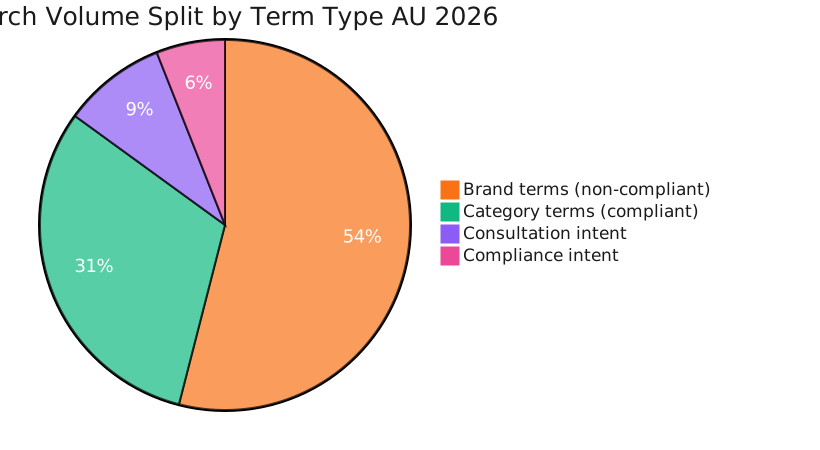
Category terms are growing while brand terms decline. Clinics that have already built authority on category terms are positioned to capture the majority of organic consultation traffic within 24 months.
The Three-Layer SEO Architecture
A compliant cosmetic clinic SEO strategy in 2026 operates on three layers: Google Business Profile, website authority, and content.
Layer 1: Google Business Profile
GBP is the highest-impact single action for cosmetic clinics targeting local consultation bookings. Clinics with fully optimised GBP listings receive 43% more enquiries than those with incomplete profiles.
Compliant GBP optimisation checklist:
| GBP Element | Compliant Approach | Non-Compliant Approach |
|---|---|---|
| Business category | Medical Spa, Cosmetic Surgeon | No specific compliance risk here |
| Services list | Anti-wrinkle injections, Dermal filler, Lip augmentation | Botox, Juvederm, Dysport |
| Business description | Treatment categories, practitioner credentials, consultation focus | Outcome language, testimonials, brand names |
| Posts | Educational updates, compliance information | Before/after posts, testimonial posts |
| Q&A responses | Treatment category descriptions | Substance brand names |
| Photo captions | Clinical environment, practitioner photos | Patient photos, before/after |
Layer 2: Website authority
Authority comes from two sources for cosmetic clinics: practitioner credentials and compliance expertise.
Practitioner credential pages rank well for “[practitioner name] [suburb]” searches, build trust signals for Google’s EEAT framework (Experience, Expertise, Authoritativeness, Trust), and convert well because they provide the specific information patients want before booking a consultation.
A compliant practitioner page includes: qualifications, training history, professional associations, areas of specialisation (using category language), and a consultation booking CTA.
AHPRA compliance content earns links from other practitioners and medical publications. No other category of cosmetic clinic content earns backlinks at the same rate. A detailed guide to AHPRA advertising rules will attract links from dermatology practices, medical associations, and legal publications.
Layer 3: Treatment FAQ content
FAQ content targeting “what is [treatment]”, “how does [treatment] work”, and “how long does [treatment] last” drives consistent organic traffic from patients in the research phase. This content:
- Uses category language throughout (compliant)
- Answers real patient questions (high engagement metrics)
- Creates internal linking opportunities to treatment and booking pages
- Can be structured as FAQ schema markup for AI overview and featured snippet targeting
The AHPRA Content Moat
The most durable SEO position available to Australian cosmetic clinics in 2026 is AHPRA compliance expertise. Here’s why.
Only a small number of Australian cosmetic clinics publish substantive, accurate AHPRA compliance content. Most agencies that serve clinics do not understand the rules well enough to write authoritatively about them.
A clinic that publishes and maintains a full AHPRA compliance resource hub earns:
- Links from other practitioners searching for guidance
- Links from legal and healthcare publications covering the rule changes
- Trust signals that improve rankings for all pages on the domain
- Direct enquiries from clinic owners and managers looking for compliant marketing partners
This content does not cannibalise booking traffic. It occupies a separate search intent category entirely.
AHPRA compliance content is the cosmetic clinic equivalent of a technology company publishing developer documentation. It builds domain authority that benefits every other page on the site.
Local SEO: Suburb-Level Strategy
Most cosmetic clinics serve a geographic catchment. A suburb-level SEO strategy builds treatment category pages for each primary catchment suburb.
The page structure follows a consistent pattern:
URL: /anti-wrinkle-injections-[suburb]/ Title: “Anti-Wrinkle Injections [Suburb] — [Clinic Name]” Content: Treatment description (category language), practitioner credential mention, clinic address and hours, FAQ section (5–8 questions), booking CTA
A clinic serving a 20km catchment around a city centre might build 8–12 suburb-level pages. Each page needs to be substantively different (not duplicate content with the suburb name swapped). The differentiation comes from suburb-specific local information: nearby landmarks, parking, public transport, local demographics context.
Google Ads vs SEO: The Cost Comparison
The question most clinic owners eventually ask is whether Google Ads or SEO provides better return on investment. The answer depends on the time horizon.
| Channel | Cost Per Consultation (Year 1) | Cost Per Consultation (Year 2+) | Time to First Lead |
|---|---|---|---|
| Google Ads (managed) | $263 | $263 | 1–2 weeks |
| Local SEO (content + citations) | $680 | $87 | 3–9 months |
| SEO (AHPRA compliance content) | $540 | $62 | 4–12 months |
SEO consultation costs are higher in year one due to the upfront investment in compliant content and technical optimisation. By year two, the cost per consultation from organic search drops to $62–$87, compared to a fixed $263 from Google Ads.
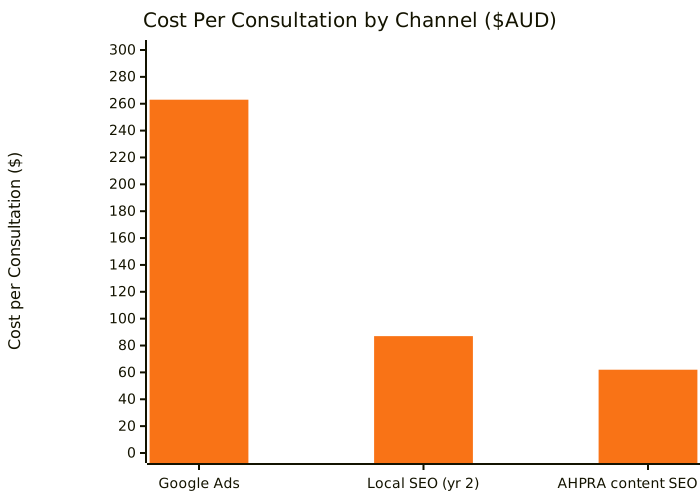
Most clinics benefit from running both: Google Ads to generate bookings while SEO builds, then reducing paid spend as organic traffic matures.
Google Ads gets you in front of patients next week. SEO builds the asset that compounds for years. A 12-month strategy uses both.
Measuring SEO Progress for Cosmetic Clinics
The metrics that matter are different from generic SEO tracking.
| Metric | Target (Year 1) | Target (Year 2) |
|---|---|---|
| GBP enquiries/month | 15–30 | 40–80 |
| Organic consultation bookings/month | 5–15 | 20–50 |
| Ranking positions for category terms | Top 10 for primary suburb | Top 3 for primary + 3 nearby suburbs |
| AHPRA compliance content organic traffic | 200–500/month | 800–2,000/month |
| Cost per organic consultation booking | $150–$300 | $62–$87 |
| Domain Authority / Domain Rating | Baseline + 8–12 | Baseline + 18–25 |
Get Compliant SEO for Your Clinic
RockingWeb builds SEO strategies for Australian cosmetic clinics that comply with AHPRA’s advertising guidelines from the ground up. No brand-name terms. No compliance risk. Just consistent organic consultation bookings.
See ClinicPipeline: SEO for Cosmetic Clinics
Related reading:
- AHPRA Treatment Naming on Your Clinic Website: keyword strategy within compliance rules
- Cosmetic Clinic Marketing Australia: full channel overview
- Cosmetic Clinic Google Ads Benchmarks 2026: paid vs organic cost comparison
- Cosmetic Clinic Website Booking Conversion Australia: turning organic traffic into booked consultations
- Local SEO Statistics Australia 2026: GBP and local search data
- Cosmetic Clinic Website Design Australia: technical SEO foundation for clinic websites
Vikas Thakur
Founder of RockingWeb. 16 years building for companies like TPG, iiNet and Monadelphous, now focused on websites and marketing that comply with AHPRA's advertising guidelines and still book patients.