How to Report a Cosmetic Clinic to AHPRA: 81% Close in 6 Months
AHPRA closed 81.1% of the 13,327 notifications it received nationally in 2024/25 within six months, and just 1.4% of closed cases ended in deregistration. Here is exactly how the complaint process works, and why AHPRA regulates practitioners, not clinics.
 Vikas Thakur Founder, RockingWeb 10 min read
On this page 12
- Key takeaways
- AHPRA Regulates Practitioners, Not Clinics
- Who Can Raise a Concern, and How
- How Long the Process Takes
- What Happens to a Complaint
- Reporting Anonymously or Confidentially
- Employer Obligations: Mandatory Notifications
- A Note on What Isn’t Published
- What This Means for Your Clinic’s Website
- FAQ
- Get an AHPRA Compliance Check Before a Complaint Finds One
- Sources and References
Key takeaways
- AHPRA received 13,327 notifications about health practitioners nationally in the 2024/25 financial year, up 19.0% on the year before
- 81.1% of all notifications were closed within six months of receipt, the fastest average completion time since the National Scheme began
- Just 1.4% of notifications closed in 2024/25 ended with the practitioner losing or being disqualified from registration
- 72.8% of notifications were made by patients, families or members of the public, not by other practitioners or regulators
- Only 1.0% (146) of notifications nationally were made anonymously, even though anonymous reporting is allowed
- AHPRA aims to finish its assessment of a new concern within 60 days, and most notifications are closed within 90 days
- AHPRA states it regulates individual practitioners, not organisations, so a complaint about “a clinic” as a business sits outside what it can act on
- The Cosmetic Surgery Hotline (1300 361 041) is a separate, dedicated channel, staffed Monday to Friday, 9am to 5pm AEST
AHPRA closed 81.1% of the 13,327 notifications it received about Australian health practitioners within six months in the 2024/25 financial year, according to its Annual Report 2024/25, tabled in Parliament on 13 November 2025. Just 1.4% of those closed cases ended with the practitioner losing their registration.
Most people searching for how to report a cosmetic clinic assume they are complaining about a business. They are not. AHPRA regulates individual registered practitioners, not the clinics, hospitals or health centres they work in. That single fact changes what a complaint can achieve, who it names, and where it needs to be sent.
This guide covers exactly how the process works: who can raise a concern, what AHPRA can and cannot act on, how long it takes, what typically happens at the end, and what it means for a clinic’s own website.
AHPRA Regulates Practitioners, Not Clinics
This is the detail most people miss. AHPRA’s “How to raise a concern” page lists “complaints about a health service or organisation” under the concerns it cannot consider, naming clinics, hospitals and health centres directly, with the explanation: “Ahpra regulates individual practitioners, not organisations.”
A notification has to be about a specific registered practitioner’s conduct, health or performance: unsafe care, unprofessional behaviour, or a health impairment creating patient risk. Fees, health record access and general service dissatisfaction are explicitly excluded and go to a state or territory health complaints entity instead.
For a clinic, this matters commercially as much as procedurally. Every practitioner named on a clinic’s website, from the injector to the reception-facing nurse, is individually and separately notifiable. A clinic that wants to know exactly where its own exposure sits can start by hiring RockingWeb to review its site and every practitioner listed on it.
Takeaway: you cannot report “a clinic” to AHPRA. You report a named, registered practitioner, and the clinic itself is only ever in scope indirectly, through the practitioners who work there.
Who Can Raise a Concern, and How
AHPRA’s own process runs in three steps: talk to the practitioner or health service directly if that feels safe to do (optional, often the fastest fix), work out the right place to report based on the state, the practitioner’s profession and the nature of the concern (AHPRA regulates 16 professions), then raise it with AHPRA itself by submitting a form online, calling, or reporting an unregistered practitioner as a criminal offence.
Notifications are not limited to patients. AHPRA’s 2024/25 annual report breaks down who actually lodges them nationally.
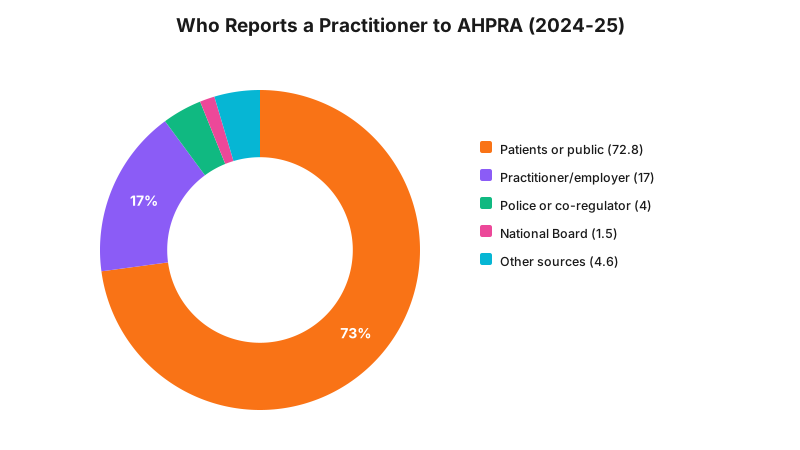
Patients, families and members of the public made almost three-quarters of all notifications. Health practitioners and employers made a further 17%, a category that includes the mandatory notifications discussed below. Only a small share came directly from regulators or National Boards themselves.
Takeaway: a complaint does not need to come from a patient. Competitors, staff, and members of the public can all lodge a notification, and 72.8% of the time, it is exactly that kind of notifier who does.
How Long the Process Takes
AHPRA states plainly that “in most cases, we try to finish the assessment process within 60 days and most notifications are closed within 90 days.” Nationally, the 2024/25 figures back that up at scale.
| Metric | Figure (2024/25) |
|---|---|
| Notifications received nationally | 13,327 (up 19.0%) |
| Notifications closed | 12,086 (up 8.3%) |
| Closed within six months (headline figure) | 81.1% |
| Made anonymously | 1.0% (146) |
| Lodged by patients or the public | 72.8% |
| Ended in loss or disqualification of registration | 1.4% of closed notifications |
| Mandatory notifications received | 1,542 (up 32%) |
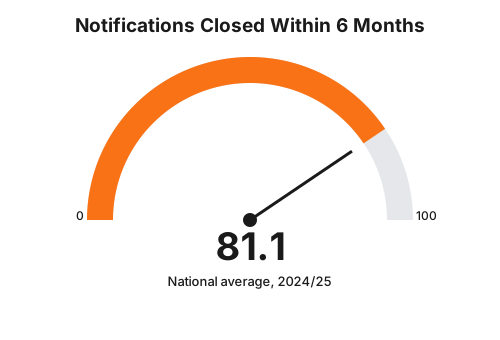
AHPRA describes this as the lowest average completion time recorded since the National Scheme began, helped by a new decision-making process for low-risk concerns that cut their average handling time by more than 30 days.
Takeaway: a notification is not an open-ended process. For the large majority of cases, expect a resolution inside two to six months, not years.
What Happens to a Complaint
Outcomes vary widely by risk level. Of the notifications AHPRA completed in 2024/25, 27.7% were retained by, or referred to, a state or territory health complaints entity. A further 19.7% of notifications received needed no referral and closed through early determination with no further action. Around 40% went through a “strengthening practice” review of the practitioner’s own corrective steps, and 17% of those closed without any regulatory action.
At the serious end, 192 practitioners were referred to a tribunal in 2024/25, down 18.3% on the year before. But across every closed notification, only 1.4% resulted in the practitioner losing, or being disqualified from, their registration.
A clinic’s own website plays into this earlier than most owners assume. Unclear treatment pages and outcome claims that read as promises raise the odds a patient’s experience ends in a notification rather than a resolved conversation. A compliant, clearly written cosmetic clinic website is the first line of defence against a complaint escalating.
Takeaway: most notifications do not end in deregistration, but the process still runs its full course, including referral to another agency or continued regulatory scrutiny, in the majority of cases.
Reporting Anonymously or Confidentially
AHPRA allows both anonymous and confidential notifications. Anonymous means AHPRA does not record the notifier’s name at all. Confidential means AHPRA does not share the notifier’s identity with the practitioner, though it notes a practitioner may sometimes guess who complained based on the content itself.
In practice, very few notifiers choose anonymity: just 1.0% (146) of the 13,327 notifications received nationally in 2024/25. Mandatory notifications, the ones a practitioner or employer is legally required to make about a colleague, cannot be anonymous under any circumstance.
Takeaway: the anonymity option exists, but the overwhelming majority of people who report a practitioner are prepared to put their name to it.
Employer Obligations: Mandatory Notifications
Clinics that employ or contract multiple practitioners carry their own reporting duty: practitioners and employers must tell AHPRA if they reasonably believe a colleague’s conduct, performance or health places patients at risk. AHPRA received 1,542 mandatory notifications nationally in 2024/25, up 32% on the year before, making up 11.6% of all notifications received. Nurses accounted for 40% (617) and medical practitioners for 32.6% (503).
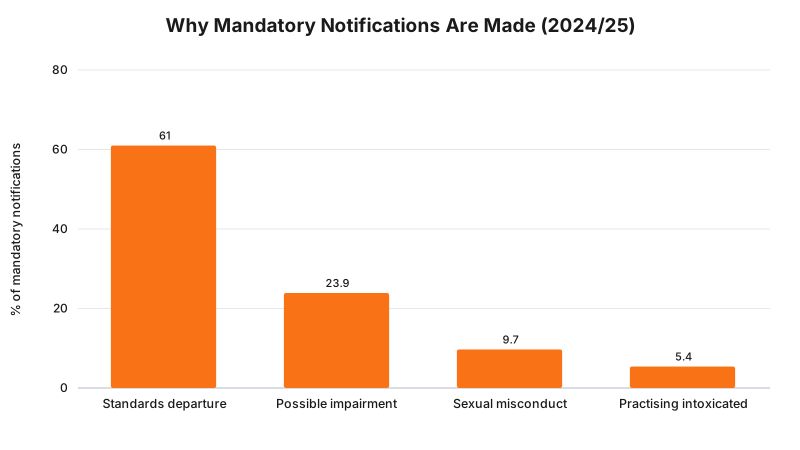
A departure from professional standards was the most common trigger, followed by a possible health impairment, sexual misconduct, and practising while intoxicated.
Takeaway: if a clinic employs more than one AHPRA-registered practitioner, its principals carry a personal legal duty to report a colleague, separate from anything a patient might raise.
A Note on What Isn’t Published
AHPRA’s Cosmetic Surgery Hotline, 1300 361 041, is a dedicated channel run by its Cosmetic Surgery Enforcement Unit, staffed Monday to Friday, 9am to 5pm AEST, and accepts confidential reports. Every figure in the table above, though, is AHPRA’s national total across all 16 regulated professions. AHPRA’s Annual Report 2024/25 does not publish a cosmetic-clinic-specific breakdown of notification volume, closure time or outcomes. Anyone benchmarking the cosmetic sector specifically should treat the hotline’s own published call figures, not these national totals, as the closest available cosmetic-specific data, since they measure a different thing: call volume, not notification outcomes.
Takeaway: national AHPRA figures describe the whole regulated health workforce. Where cosmetic-specific data does not exist, the honest answer is that it does not exist, not a rounded-off version of a different number.
What This Means for Your Clinic’s Website
Because AHPRA notifies individual practitioners, not businesses, every practitioner your clinic advertises needs to be clearly and accurately identified, with a registration status a patient can verify. Treatments carrying the highest notification risk under AHPRA’s own categories, unsafe surgical care, aftercare, infection control and informed consent, are exactly the topics that justify a dedicated, carefully written landing page rather than a shared paragraph. Vague or promotional language invites a notification under AHPRA’s advertising guidelines and produces the kind of under-informed enquiry that turns into a complaint after the fact. What your website is allowed to say about a procedure is governed by AHPRA’s separate advertising rules, not the notifications process covered here.
Takeaway: a clinic’s website is not just a marketing asset under AHPRA’s rules, it is part of how a patient decides whether a concern needs to go further than a phone call.
FAQ
Can I report a cosmetic clinic to AHPRA anonymously?
Yes, anonymously or confidentially, though few people do. Only 1.0% (146) of AHPRA’s 13,327 notifications in 2024/25 were anonymous. Mandatory notifications, the ones practitioners and employers are legally required to make, cannot be anonymous.
How long does an AHPRA complaint about a cosmetic clinic take?
AHPRA aims to finish its initial assessment within 60 days and close most notifications within 90 days. Nationally in 2024/25, 81.1% of all notifications closed within six months, the fastest average on record.
Can I report a clinic itself, or only a specific practitioner?
Only a specific registered practitioner. AHPRA regulates individual practitioners, not organisations, so complaints about a clinic, hospital or health centre as a business sit outside its remit. Fees, service quality or general business conduct go to your state or territory health complaints entity instead.
Is there a dedicated line for cosmetic surgery complaints?
Yes. AHPRA’s Cosmetic Surgery Hotline, 1300 361 041, is staffed by its Cosmetic Surgery Enforcement Unit Monday to Friday, 9am to 5pm AEST. Concerns can also be submitted online, and confidential complaints are accepted.
Get an AHPRA Compliance Check Before a Complaint Finds One
RockingWeb reviews cosmetic clinic websites against AHPRA’s current advertising rules and flags exactly which pages, claims or missing practitioner details carry the most notification risk, delivered as a walkthrough within five business days. No cost, no obligation.
Talk to us about your clinic’s compliance and websiteSources and References
AHPRA - Annual Report 2024/25, Notifications chapter: national totals, timeframes, outcomes and mandatory notification figures
AHPRA - How to raise a concern: the three-step process and what AHPRA can and cannot consider
AHPRA - How long does the notification process take: the 60 and 90-day targets
AHPRA - Can I be anonymous: anonymous and confidential notification rules
AHPRA - Cosmetic surgery complaints: Hotline number and Cosmetic Surgery Enforcement Unit details
AHPRA - Cosmetic surgery hub: Hotline operating hours (Monday to Friday, 9am to 5pm AEST)
Related reading:
- Cosmetic Surgery Hotline: 514 Calls in a Year Revealed: the hotline’s own published call and enforcement figures
- AHPRA Compliance Audit Checklist: a practical checklist for reviewing your own site
- AHPRA Advertising Guidelines for Cosmetic Clinics: what your website is and is not allowed to claim
For a full review of your clinic’s website and every practitioner listed on it, see Cosmetic Clinic Websites or talk to us about your clinic’s marketing.
Vikas Thakur
Founder of RockingWeb. 16 years of experience from working at TPG, iiNet and Monadelphous, now building websites, software and digital marketing for local businesses in Rockingham and Perth.