Google's August 2026 Update Limits Reach for Unverified Clinics
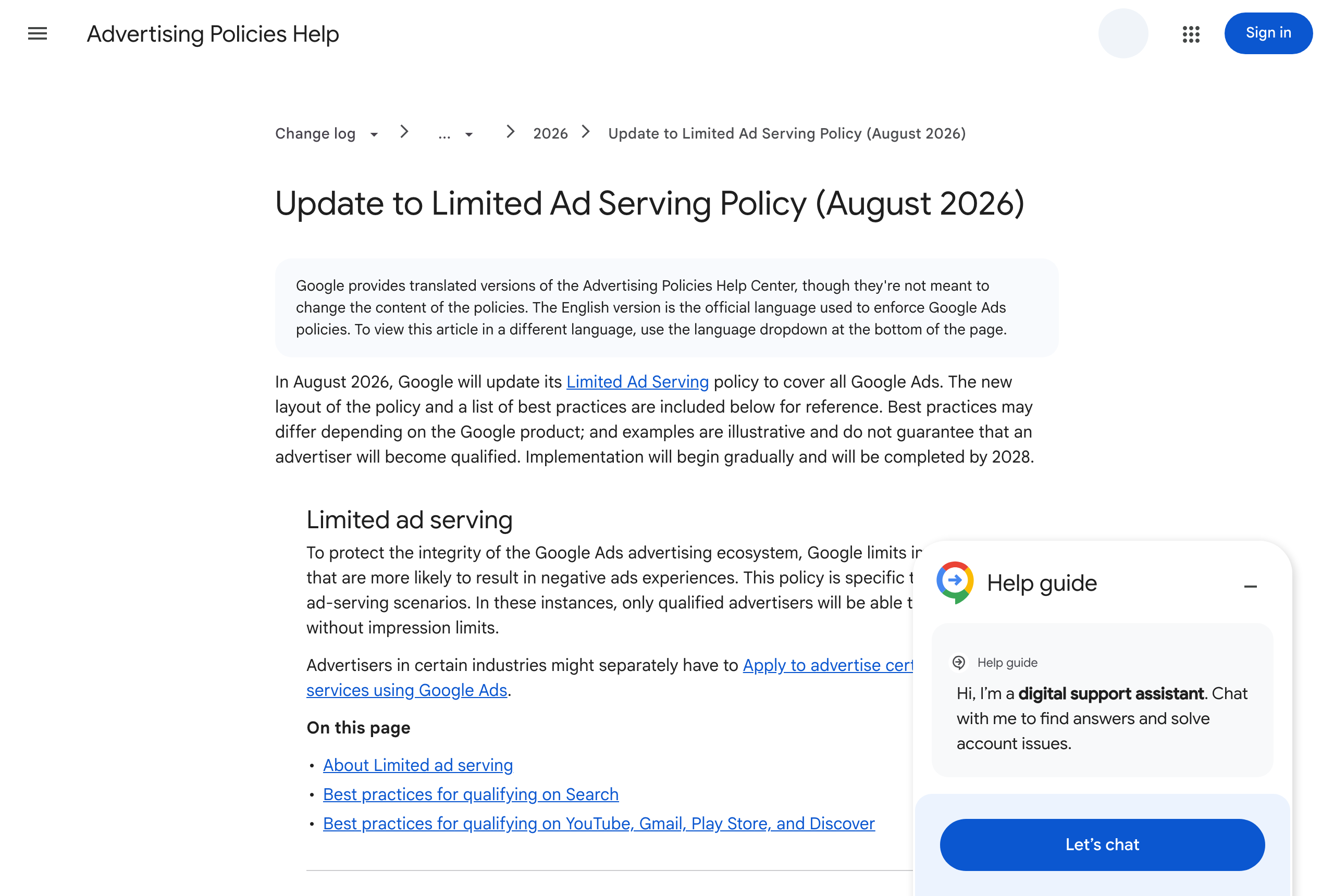
On August 5, 2026, Google confirmed its Limited Ad Serving policy will expand to cover all of Google Ads, not just Search, cutting impressions for accounts it has not classified as qualified. Rollout is gradual and finishes by 2028. Healthcare sits inside two of the checks the same page names.
 Vikas Thakur Founder, RockingWeb 9 min read
On this page 10
- Key Takeaways
- What Google Actually Changed on August 5, 2026
- From Search Only to Five Named Ad Surfaces
- The Seven Factors That Decide “Qualified” Status
- Why “Regulated Services” Raises the Stakes for Healthcare
- The Website Evidence Behind a Qualified Account
- What Happens If an Account Is Not Qualified
- FAQ
- Get an AHPRA and Ad-Account Check Before Impressions Drop
- Sources and References
Key Takeaways
- Google confirmed on August 5, 2026 that its Limited Ad Serving policy will expand to cover all of Google Ads, not just Search
- Google’s own wording states rollout is gradual and “will be completed by 2028”
- The policy lists seven factors that decide whether an advertiser counts as “qualified,” including advertiser industry and advertiser verification status
- The August 2026 update names five ad surfaces in scope: Search, YouTube, Gmail, Play Store and Discover
- This is the second Limited Ad Serving update in 2026, after a narrower, Search-only version published June 12, 2026
- The same page states advertisers in some industries “might separately have to Apply to advertise certain products & services using Google Ads”
- Google is explicit that unqualified accounts are not rejected. Ads are “limited in specific scenarios,” and notification only arrives after impressions have already dropped
Google published a policy update on August 5, 2026, that reaches every clinic running Google Ads. The Limited Ad Serving policy, which caps impressions for advertisers Google has not classified as qualified, now covers all of Google Ads, not just Search. Rollout is gradual, finishing, in Google’s own words, “by 2028.” Picture the ad running your booking form’s traffic, sitting in an account nobody at your practice has finished verifying. Under the old rules, that mattered mostly on Search. Under the new rules, it can throttle impressions on YouTube, Gmail, the Play Store and Discover too. The same page names seven factors that decide qualified status, including advertiser industry and advertiser verification status, and flags that some industries, healthcare among them, face a separate application step for regulated services. Here is exactly what changed, and what to check on your account before impressions start dropping.
What Google Actually Changed on August 5, 2026
Google’s own change log entry is short and direct. It states plainly that “in August 2026, Google will update its Limited Ad Serving policy to cover all Google Ads,” then adds the completion note: “implementation will begin gradually and will be completed by 2028.”
The policy itself is not new. Google already ran Limited Ad Serving as a check “specific to certain ad-serving scenarios,” where “only qualified advertisers will be able to serve ads without impression limits.” What changed on August 5 is the scope, from a narrower set of situations to the whole Google Ads product line.
Google is careful to say this is not a rejection mechanism. An unqualified account is not blocked. Its ads are limited: fewer impressions, in scenarios Google has decided carry a higher risk of a poor user experience. That matters for a clinic, because a throttled account can look, from the inside, exactly like a quiet week. There is no rejection notice to investigate. Spend keeps flowing. Impressions just do not.
Takeaway: the August 2026 update does not ban any ad. It widens how much of Google’s total ad inventory the qualification check now covers.
From Search Only to Five Named Ad Surfaces
Google’s earlier version of this policy, published June 12, 2026, extended Limited Ad Serving “to cover additional scenarios on Google Search.” That update warned that generic, unbranded ads “may confuse users about the identity of the advertiser.”
The August 5 update goes further, naming five ad surfaces now inside the same check: Search, YouTube, Gmail, Play Store and Discover. A clinic that only worried about its Search Ads account now has four more products where an unqualified account can lose reach.
| Update | Published | Scope, per Google |
|---|---|---|
| Limited Ad Serving (June 2026) | June 12, 2026 | Additional scenarios on Google Search |
| Limited Ad Serving (August 2026) | August 5, 2026 | All of Google Ads: Search, YouTube, Gmail, Play Store, Discover |
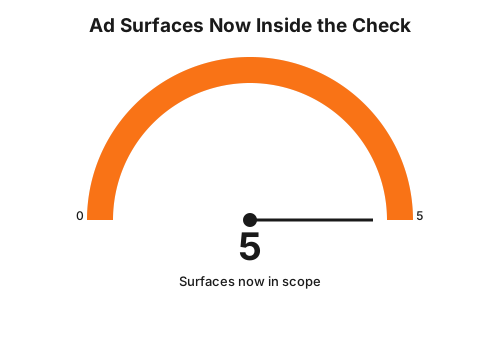
Takeaway: in eight weeks, the same policy grew from a Search-specific check to a check covering five separate Google ad products.
The Seven Factors That Decide “Qualified” Status
Google lists seven factors it uses to work out whether an advertiser counts as qualified: account attributes, user activity and reports, account maturity, ad format usage, history of policy compliance, advertiser industry, and advertiser verification status.
Two of those seven sit directly inside a clinic’s control. Advertiser verification status is whether the account has completed Google’s verification process, named as a condition of qualifying: an advertiser builds trust by “completing advertiser verification if your account is eligible.” Advertiser industry is not something a clinic can change, but Google lists it as a factor it weighs regardless.
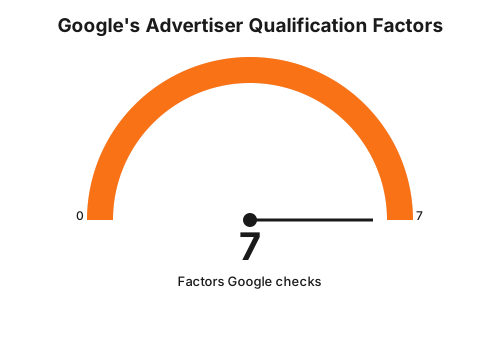
Takeaway: two of Google’s seven qualification factors, verification status and industry, apply to every clinic account by default. Neither is optional to address.
Why “Regulated Services” Raises the Stakes for Healthcare
The same August 2026 page carries a second, separate warning: advertisers in certain industries “might separately have to Apply to advertise certain products & services using Google Ads.” That is an additional check layered on top of Limited Ad Serving, not a replacement for it.
Healthcare already sits inside Google’s most closely governed advertiser categories. Google’s Healthcare and Medicines policy states the company is “dedicated to following advertising regulations for healthcare and medicine,” with separate certification requirements for specific regulated health services. A cosmetic clinic account is a healthcare advertiser by definition, which places it inside a category Google already scrutinises, right as the general qualification check widened to cover every ad surface a clinic uses.
None of this replaces AHPRA’s own advertising rules. AHPRA governs what a clinic is allowed to say in an ad. Google’s policy governs whether that ad reaches anyone at all. A clinic that has already tightened its ad copy for AHPRA still has to pass Google’s separate, account-level check, which RockingWeb can review alongside the advertising rules themselves.
Takeaway: a cosmetic clinic ad account answers to two independent systems: AHPRA’s rules on what the ad says, and Google’s qualification check on whether the ad serves at all.
The Website Evidence Behind a Qualified Account
Google’s own best-practice list for qualifying is website-facing, not ad-copy-facing. For Search, it tells advertisers to “clearly display your own brand in your ads and on your landing page,” to avoid generic ad copy and landing page content, and to “pin your domain to the front of the ad title, especially if you’re a new advertiser.” For the other four surfaces, the same page repeats the instruction to complete advertiser verification and build a track record of positive user interactions.
Read literally, every one of those instructions points back to the website. A landing page has to say who the business actually is, not run generic template copy. A domain has to resolve to a site that matches the advertiser’s declared identity, which fails if the business name on the website, the Google Business Profile and the ad account do not match, or if a rebrand has left old details live somewhere Google can still find them.
That is the gap a new clinic site, a rebrand, or a domain migration tends to create. The fix is not a new ad strategy. It is making sure the business name, contact details and domain match what is filed with Google, which is the kind of check built into a compliant cosmetic clinic website.
Takeaway: the qualification check Google describes is largely a website consistency check wearing an ad-policy label.
What Happens If an Account Is Not Qualified
Google is specific about the consequence: “ads from unqualified advertisers will be limited in specific scenarios to decrease the potential for negative user experiences.” Ads are not removed and the account is not suspended. Reach is reduced, quietly, in whichever scenarios the check applies to.
Google says unqualified advertisers with “a meaningful proportion of impressions in scope of this policy will receive an in-account notification,” and can submit a Limited Ad Serving Appeals Form to contest the restriction. Both are reactive: they surface after reach has already dropped.
Takeaway: there is no warning before impressions drop, only a notification after. Checking verification status and website consistency now is the only way to act before that happens, not after.
FAQ
Does Google’s August 2026 policy update ban cosmetic clinic ads?
No. It expands the existing Limited Ad Serving policy, which limits impressions for advertisers Google has not classified as qualified, to cover all of Google Ads rather than a narrower set of scenarios. Ads are not rejected outright. Impressions are limited “in specific scenarios,” in Google’s own wording.
When does Google’s Limited Ad Serving policy expansion take effect?
Google published the update on August 5, 2026, and states implementation “will begin gradually and will be completed by 2028.”
What factors decide whether a Google Ads advertiser is qualified?
Google lists seven: account attributes, user activity and reports, account maturity, ad format usage, history of policy compliance, advertiser industry and advertiser verification status.
What can a clinic do now to avoid being an unverified advertiser?
Complete advertiser verification if the account is eligible, and make sure the business name, address and domain on the website match exactly what is filed with the Google Ads account and the Google Business Profile.
Get an AHPRA and Ad-Account Check Before Impressions Drop
RockingWeb reviews cosmetic clinic websites and ad accounts against current AHPRA rules and the website evidence Google names in its own qualification guidance.
For a website build that keeps business details consistent from day one, see talk to us about your clinic’s marketing.
Sources and References
Google Ads Policy Help - Update to Limited Ad Serving Policy (August 2026): the announcement, the seven qualification factors, the five named ad surfaces, and the regulated-services note
Google Ads Policy Help - Updates to Limited Ad Serving Policy (June 2026): the earlier, Search-only version, published June 12, 2026
Google Ads Policy Help - Healthcare and medicines policy: Google’s separate advertiser-industry rules for healthcare and medicine
Related reading:
- AHPRA-Compliant Google Ads for Cosmetic Clinics
- Cosmetic Clinic Google Ads Benchmarks 2026
- Cosmetic Clinic Websites
For ad accounts and websites that stay inside the rules regardless of what any platform allows, talk to us about your clinic’s marketing.
Vikas Thakur
Founder of RockingWeb. 16 years building for companies like TPG, iiNet and Monadelphous, now focused on websites and marketing that comply with AHPRA's advertising guidelines and still book patients.
![Wisdom Teeth Removal Cost Australia: $491 vs $4,500 [2026]](/assets/cosmetic-clinic-seo-australia-DWhO816X.png)