Date of Birth Before Payment: Why Booking Form Order Matters
Date of birth belongs before the payment step, not after it. AHPRA's cooling-off rule for under-18 patients and its financial-gain-versus-duty-of-care obligation both depend on knowing a patient's age before any money changes hands.
 Vikas Thakur Founder, RockingWeb 12 min read
Key takeaways
- Date of birth needs to be captured and evaluated before payment is taken, not collected later on an intake form
- AHPRA’s guidelines for registered health practitioners performing non-surgical cosmetic procedures, in force since 2 September 2025, carry a mandatory seven-day cooling-off period for under-18 patients
- Those guidelines apply to all registered health practitioners except medical practitioners, who follow the Medical Board’s separate 2023 cosmetic guidelines
- A payment or deposit taken before date of birth is known creates a sequencing conflict: money changes hands before the clinic knows which path the booking should take
- The same guidelines require practitioners to recognise the potential conflict between financial gain and duty of care, a separate reason to check field order on any page that takes a deposit
- No published determination ties directly to booking-form field order specifically. The obligation wording is on the record; a case built on this exact point is not
Date of birth belongs before the payment step on a cosmetic clinic booking form, not after it. That is the short answer, and as at 6 September 2026 it follows from two things sitting in the same AHPRA guidelines document rather than one: a cooling-off rule that only works if age is known before a booking is confirmed, and a separate obligation about financial gain not outrunning duty of care. Get the field order wrong and a clinic can end up holding a deposit from a 16-year-old it had no way of screening for until the money had already cleared.
Most booking forms were not designed with either problem in mind. They were designed to convert, which usually means asking for whatever gets a payment page in front of the visitor fastest. Date of birth, if it appears at all, tends to land on a post-payment intake form, next to medical history and allergy questions nobody expects to gate anything.
What the Guidelines Say
AHPRA’s guidelines for registered health practitioners who perform non-surgical cosmetic procedures took effect on 2 September 2025. In announcing them, AHPRA stated that young people would be protected by targeted advertising bans and a mandatory seven-day cooling-off period for people under the age of 18. The guidelines apply to any health practitioner registered under the National Law who performs non-surgical cosmetic procedures, except medical practitioners, who are directed instead to the Medical Board’s own guidelines for registered medical practitioners performing cosmetic surgery and procedures.
A separate but related document, the guidelines for advertising higher risk non-surgical cosmetic procedures, sets out practitioner responsibility obligations that bear directly on a payment page. Registered health practitioners must recognise the potential for conflict between financial gain and their duty of care to patients, and must recognise that these procedures may have a negative physical, psychological or financial impact on some patients regardless of the practitioner’s skill.
Read together, those two documents point at the same build decision from different directions. The cooling-off rule needs age known before a booking is confirmed. The financial-gain-versus-duty-of-care obligation needs payment not to run ahead of clinical judgement. A form that asks for date of birth before payment, with payment itself sitting after an assessment step rather than in place of one, satisfies both.
AHPRA’s announcement is the primary source for the cooling-off obligation, reported here rather than interpreted. Whether a specific booking sequence satisfies it in your circumstances is a separate question, addressed below.
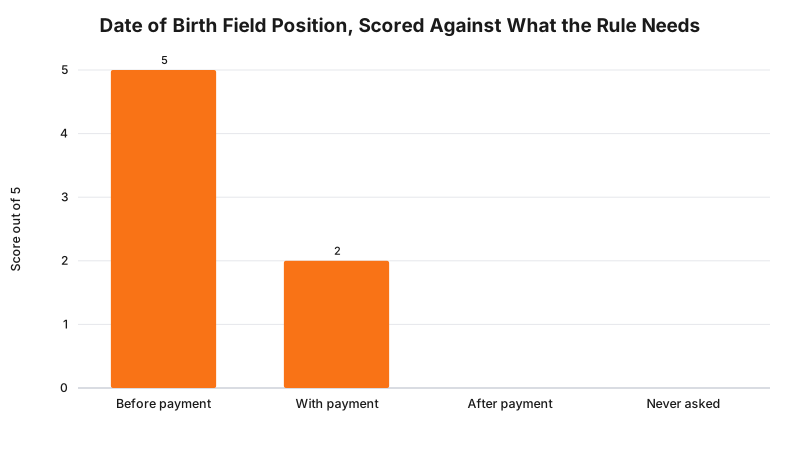
That scoring is a build assessment against the two obligations above, not a regulator’s rating or a survey result. The “with payment” position, where date of birth sits on the same screen as card details, only half works: age is known before money is charged in a strict technical sense, but a visitor already committed to entering payment details has effectively already decided, which undercuts the point of asking early.
What That Means for the Build
Put date of birth ahead of any payment field, not on the same screen as one. The question needs to be answered before a visitor reaches a page asking for card details, not alongside it.
Branch on the answer before generating a payment link. If your booking flow calls a payment gateway to create a checkout session, that call should not fire until date of birth has been captured and checked. An under-18 result should never produce a payment link at all.
Evaluate the age check server-side, against the stored patient record. A date picker on a form is not enough by itself. Front-end validation a visitor could bypass by editing the page does not count.
Route the under-18 path to a consultation booking with no payment step, or a free or fully refundable one. Moving date of birth earlier only matters if it stops a transaction happening on a path that should not have one yet.
Write the collection notice at the field. One sentence stating why you are asking satisfies the notification expectation without turning the form into a legal document.
| Field position | Payment gated correctly | Duty-of-care sequencing satisfied | Common failure mode |
|---|---|---|---|
| Before contact details | Yes | Yes | Rare, but can feel abrupt as a first question |
| After contact, before payment | Yes | Yes | The recommended pattern |
| Same step as payment | Partially | No | Visitor has already committed by the time it is asked |
| After payment, on intake form | No | No | The most common pattern on booking widgets ported from retail checkout templates |
| Never asked online | No | No | Age only discovered at the in-person appointment, after a deposit has cleared |
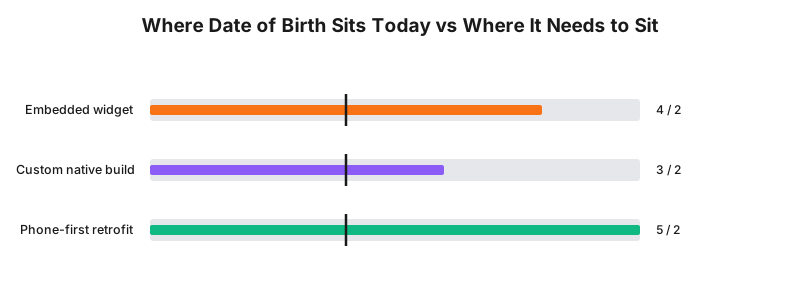
Value is the step number counted from the first field a visitor sees, so a lower number means date of birth is captured earlier; target is step two, meaning right after basic contact details and ahead of anything payment-related. This is a build-experience comparison of common flow shapes, not an audit of named vendors.
A Worked Example
Cosmetic clinic. A clinic ran an embedded booking widget where visitors chose a treatment, entered contact details, paid a $150 deposit, and only then filled in an intake form asking for date of birth, medical history and allergies. Nothing in the flow prevented a 16-year-old from reaching the payment page, entering a parent’s card details, and confirming a filler appointment for the same week. The clinic had no way of knowing a booking involved a minor until the intake form arrived, by which point a deposit had already been taken and a slot held.
The rebuild inserted a short pre-payment step: contact details, then date of birth, evaluated server-side before the flow generated a payment link. An under-18 result routed to a free consultation booking instead of a deposit page. The clinic also moved its standard new-patient deposit to sit after that first consultation rather than before it, addressing the financial-gain-versus-duty-of-care point independently of age.
The same reasoning applies where the treatment is dental rather than injectable. AHPRA’s visual examples material names dental veneers among the procedures in scope for the advertising guidelines, so a veneers deposit page built on the same checkout-first template carries the identical sequencing problem, and the same fix.
What to Check on Your Own Site
- Load your own booking flow as a new patient and note exactly which step asks for date of birth.
- Check whether that step comes before or after any field asking for card or payment details.
- Try progressing to the payment page with an obviously under-18 date of birth entered earlier in the flow. Does the payment step still load?
- Check whether the age check runs in your backend, or only as a front-end validation message that a visitor could get past by disabling JavaScript or editing the page.
- Read the field for a collection notice. Is there a sentence explaining why date of birth is being asked for, or does the field appear with no context?
- If your booking widget is third-party, ask the vendor in writing whether the flow can be gated to withhold a payment link pending an age check, or whether that has to be built in front of their system.
RockingWeb can walk your actual booking flow the way a patient would and report exactly where date of birth sits relative to payment, alongside the age-gating and cooling-off checks covered in the two related posts linked below.
The Enforcement Anchor
AHPRA’s September 2025 announcement carried a public warning from Ahpra CEO Justin Untersteiner that practitioners had been given time to get their houses in order, and that the regulator would not hesitate to act where practitioners were found prioritising profits over patient care. That is the clearest signal available of the regulator’s posture on a sequencing failure where a financial transaction runs ahead of a clinical safeguard.
There is no published AHPRA determination, infringement notice or complaint outcome that turns specifically on the order of a date of birth field relative to a payment field. The posture is on the record; a case built on this precise point is not. That gap does not make the underlying risk abstract: a deposit taken from a minor ahead of a required cooling-off period is a documented gap between what happened and what the guideline required, whether or not it has yet produced a published outcome.
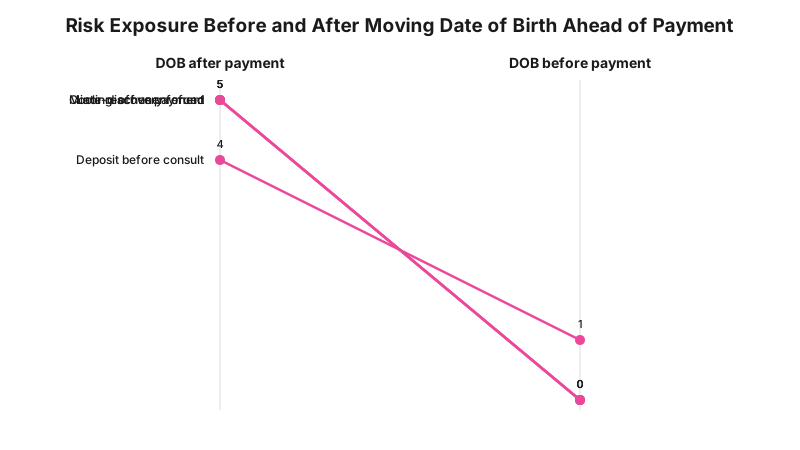
The scores are a build risk judgement tied to the two obligations discussed above, not a measured incident rate. They illustrate which specific failure modes close when the field order changes, which is the point a raw compliance checklist tends to flatten out.
Where This Gets Hard
Reordering a form field is a five-minute change. Making the reorder mean anything is not. The age check has to run server-side and has to prevent a payment link from being generated, or the new field order is cosmetic in the same way a self-certification tick box is cosmetic, covered in detail in age gating a cosmetic booking flow. Third-party booking widgets are frequently the blocker: many will not let you withhold their own payment step based on a value collected outside their system, which forces a choice between a custom gate in front of the widget or replacing it.
A date of birth entered online also remains self-reported. Moving it earlier stops a payment being taken before the age question is asked, but it does not verify the answer. Identity verification at that stage would be disproportionate for booking a consultation, and the proportionate pattern, collecting online and confirming identity at the in-person appointment, is covered in the age-gating post rather than repeated here.
The regulator says a mandatory seven-day cooling-off period applies to under-18 patients and that practitioners must recognise the conflict between financial gain and duty of care; the build consequence is that date of birth has to be captured and evaluated before a payment link is generated, not after one has been paid; whether a specific booking sequence discharges the obligation in your circumstances is a question for your medical defence organisation or your lawyer.
Status
As at 6 September 2026, AHPRA’s guidelines for registered health practitioners who perform non-surgical cosmetic procedures, including the mandatory cooling-off period for under-18 patients, have been in force since 2 September 2025. This is a current obligation, not a proposal and not pending commencement. Separately, the Medical Board’s 2023 guidelines govern medical practitioners performing the same procedures and are not affected by anything in this post.
Frequently Asked Questions
Should a clinic booking form ask for date of birth before or after taking a deposit?
Before. Date of birth has to be known before a deposit or booking fee is charged, because it determines whether the visitor is routed to a consultation path or a treatment path, and because taking money ahead of that determination puts financial commitment ahead of clinical assessment.
Does the cooling-off timing apply if a doctor performs the procedure?
AHPRA’s guidelines for registered health practitioners who perform non-surgical cosmetic procedures, which carry the mandatory seven-day cooling-off period for under-18 patients, apply to registered health practitioners except medical practitioners. Medical practitioners sit under the Medical Board’s own 2023 cosmetic guidelines instead. A clinic with both a nurse injector and a visiting doctor is running two separate governing documents, and the booking form has to know which one applies to a given booking.
What if the booking platform will not let us reorder fields?
Most third-party widgets present a fixed field set. Where the platform cannot be reordered, the practical options are a short custom form in front of the widget that captures date of birth first and only reveals the payment step once it clears, or moving the payment step to after a consultation rather than trying to reorder fields inside a system that will not cooperate.
Does asking for date of birth early create its own privacy problem?
Collecting date of birth is collecting personal information, so it needs a stated purpose and a visible collection notice at the point you ask for it, consistent with the Australian Privacy Principles under the Privacy Act 1988. Asking for it early is not the privacy problem here. Asking for it, using it to determine a booking path, and then failing to say why you collected it is.
Is taking a deposit before any consultation a separate issue from the date of birth question?
Yes, and both point the same direction. AHPRA’s advertising guidelines require practitioners to recognise the potential conflict between financial gain and duty of care. A deposit taken before a consultation raises that question regardless of the patient’s age. Date of birth ahead of payment fixes one failure mode; consultation ahead of payment fixes a related but separate one, covered in deposit pages and inducement.
Need a hand with your website?
If you want a second pair of eyes on how this applies to your own site, request a callback and we will talk it through.
Sources
- AHPRA - Putting patients first: New guidelines for cosmetic procedures, 2 September 2025. Checked 10 August 2026.
- AHPRA - Guidelines for registered health practitioners who perform non-surgical cosmetic procedures. Checked 10 August 2026.
- AHPRA - Guidelines for advertising higher risk non-surgical cosmetic procedures, practitioner responsibility obligations. Checked 10 August 2026.
- AHPRA - Visual examples information sheet naming procedures in scope, including veneers. Checked 10 August 2026.
- OAIC - Australian Privacy Principles, collection and notification. Checked 10 August 2026.
Last reviewed: 6 September 2026.
Vikas Thakur
Founder of RockingWeb. 16 years of experience from working at TPG, iiNet and Monadelphous, now building websites, software and digital marketing for local businesses in Rockingham and Perth.