Non-Refundable Deposits: What The ACL Actually Allows
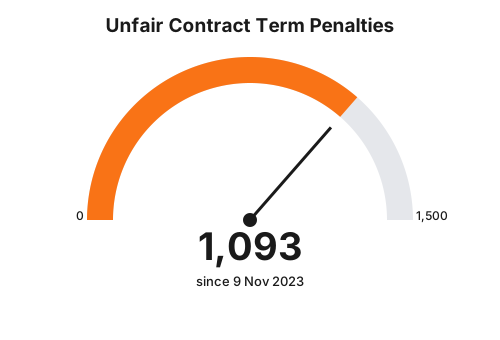
The ACCC says a blanket "no refunds" claim cannot override a customer's statutory refund rights, and unfair contract term penalties have applied to one-sided deposit clauses since 9 November 2023. Here is what your booking page and policy text need to say instead.
 Vikas Thakur Founder, RockingWeb 12 min read
On this page 11
- Key takeaways
- What the ACCC’s guidance actually says
- What that means for the booking page and the build
- Deposit forfeiture decision matrix
- Worked examples
- What to check on your own site
- Has anyone actually been penalised for this?
- Where this gets hard
- Status line
- Frequently Asked Questions
- Sources and references
Picture a patient who paid a $50 deposit to lock in a Tuesday morning anti-wrinkle appointment. On Monday night, the clinic texts to say the injector is sick and the next opening is three weeks away. The patient asks for the deposit back. The booking page’s fine print says “deposits are non-refundable,” full stop, no exceptions, no mention of what happens when the clinic is the one who cancels.
That fine print is a problem, and not just an ethics one.
Key takeaways
- The ACCC’s consumer guidance says a business cannot use a “no refunds” sign or blanket non-refundable wording to remove a customer’s statutory right to a refund.
- Penalties for unfair contract terms have applied to standard form contracts made, renewed, varied or added to on or after 9 November 2023, under the Australian Consumer Law.
- A term is more likely to be found unfair if it lets one party, but not the other, end the contract or avoid an obligation without an equivalent right running the other way.
- Where a service has a major failure, the customer can cancel the contract and get a refund, minus a reasonable amount for any work already done.
- Consumers have an automatic cooling-off right when a contract is made through telemarketing or door-to-door sales, letting them end it at no charge within the cooling-off window.
- As at 15 August 2026, no penalty figures for a specific deposit-forfeiture enforcement action against a clinic or dental practice were confirmed in this research pass.
As at 6 November 2026, a booking deposit can be labelled “non-refundable” on a clinic’s website, but the words alone do not settle the question. The ACCC’s guidance on repair, replace, refund and cancel is explicit that a blanket refusal cannot override a customer’s consumer guarantee rights, and since 9 November 2023 the ACL’s unfair contract terms regime carries civil penalties for standard form contract clauses that hand one side a benefit the other side does not get.
What the ACCC’s guidance actually says
Two separate rules sit behind the words “non-refundable deposit,” and a clinic’s booking page needs to satisfy both.
The first is the general consumer guarantee position. The ACCC’s page on repair, replace, refund and cancel states that businesses “can’t take away a consumer’s right to a refund or replacement for faulty products or services” through policy wording, and specifically calls out “displaying a ‘no refunds’ sign, or otherwise saying that refunds are not available at all” as an example of a claim that does not work. The same page confirms that where a service has a major problem, the customer can “cancel the contract and get a refund,” though “this may not be a full refund, as the consumer needs to pay a reasonable amount for any work done so far and as expected.” A deposit sits inside that same logic: it is part of the price paid, and a major failure on the clinic’s side does not stop being a major failure just because the payment in question was labelled a deposit rather than the full fee.
The second rule is newer and sharper. Since 9 November 2023, the ACL’s unfair contract terms provisions carry civil penalties, applying to standard form contracts made or renewed on or after that date, and to terms varied or added to a contract on or after that date. The ACCC’s guidance on unfair contract terms sets out the test: a term is more likely unfair if it causes “a significant imbalance in the rights and obligations of the parties,” is not reasonably necessary to protect a legitimate business interest, and would cause the other party financial or other harm if it were relied on. Terms that let “one party (but not the other) to end the contract” or “avoid or limit their responsibilities” are named examples. A booking clause that lets the clinic keep the deposit if the patient cancels, with no matching consequence if the clinic cancels or reschedules, sits squarely inside that description.
The ACCC also confirms that consumers get an automatic cooling-off right when a contract is made through telemarketing or door-to-door sales, letting them cancel at no charge within the cooling-off window. That is a narrower fact pattern for most clinics, since most bookings happen through a website form rather than an unsolicited sales call, but it matters for any practice that still books consultations by outbound phone calls or in-person sign-ups at events.
Takeaway: the word “non-refundable” on its own does nothing; the deposit clause has to survive both the consumer guarantee test and the unfair contract terms test.
What that means for the booking page and the build
None of this is abstract for the person writing the booking form. It changes specific fields, specific copy, and where that copy has to live.
The deposit policy needs its own page, not just fine print. Build a dedicated /policies/deposits page with the full policy: the deposit amount, when it is charged, what counts as a late cancellation, and what happens if the clinic cancels or reschedules. A single sentence in a footer link satisfies nobody, least of all the unfair contract terms test, which looks at the whole standard form contract, not one clause in isolation.
The booking form needs a refund_policy_text field the patient actually sees before paying, not a checkbox next to a wall of text. Render the specific cancellation window (for example, “cancel more than 48 hours before your appointment for a full refund”) on the payment step, pulled from the same source as the policy page so the two never drift out of sync.
Add a reciprocal clause next to the forfeiture clause. If the policy says the patient forfeits the deposit for a late cancellation, add a matching line saying what the patient gets if the clinic cancels or reschedules: a full refund, a priority rebooking slot, or both. It is the cheapest fix available against an unfair-contract-terms challenge, because it directly answers the “significant imbalance” test.
Log the acceptance, not just the click. Store a timestamp and the exact policy version against the booking record, the same way you would store a consent form version. If a dispute happens months later, you need to show which words the patient actually agreed to, not the current live version of the page.
Deposit forfeiture decision matrix
| Scenario | Consumer guarantee position | Unfair contract terms risk | What the build needs |
|---|---|---|---|
| Patient cancels with reasonable notice | Not a major failure; deposit terms generally apply | Low, if notice period is clearly stated and reasonable | Clear cancellation window shown before payment |
| Patient cancels with little or no notice | Not a major failure; forfeiture more defensible | Low to moderate, depends on whether the window is fair | Late-cancellation threshold defined in hours, not vague wording |
| Clinic cancels or reschedules | Refund generally expected, minus value of work done | High if the policy is silent on this case | Reciprocal clause: refund or rebooking priority stated explicitly |
| Major service failure (wrong result, unsafe practitioner, no-show by clinic) | Customer can cancel and get a refund | High if deposit is withheld anyway | Refund workflow triggered automatically on major-failure flag |
| Contract made via telemarketing or door-to-door sale | Automatic cooling-off right applies | Cooling-off terms must be disclosed, not buried | Separate disclosure step for phone or in-person bookings |
Worked examples
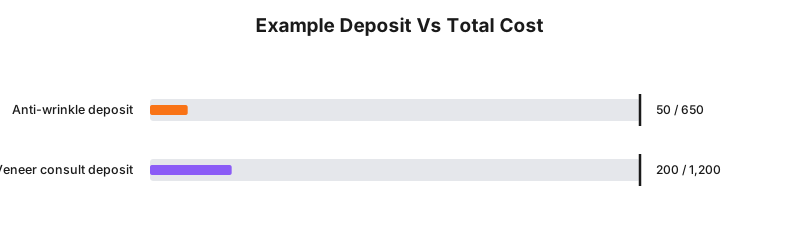
Cosmetic clinic, anti-wrinkle appointment. A Perth injectables clinic charges a $50 deposit against a $650 anti-wrinkle treatment, non-refundable if the patient cancels inside 24 hours. The booking confirmation email states this window clearly, which is a defensible, one-sided-but-reasonable term on its own. The gap the clinic had not closed: the same policy said nothing about what happens if the injector calls in sick and the clinic reschedules the patient instead. The fix was one paragraph added to the same policy page: “If we need to reschedule your appointment, your deposit is fully refunded on request or automatically applied to your new booking, whichever you prefer.” That single addition converts a one-sided clause into a balanced one.
Cosmetic dental practice, veneer consultation. A dental practice takes a $200 deposit against a roughly $1,200 veneer treatment plan, described on the booking page only as “consultation fee, non-refundable.” Two problems stack here. First, “non-refundable” with no stated exceptions reads as exactly the blanket claim the ACCC’s guidance says cannot override a refund right for a major failure, such as the practice cancelling the appointment outright. Second, the $200 is described as a “consultation fee” in one place and a “deposit” in another, on different pages of the same site, which makes it unclear to a patient (and to a regulator) whether it is a fee for a service already delivered or a deposit against a future one. The fix separated the two concepts on the site: a clearly labelled consultation fee, charged for the consult itself, and a separate, clearly labelled treatment deposit, held against the future veneer appointment with its own stated cancellation and clinic-cancellation terms.
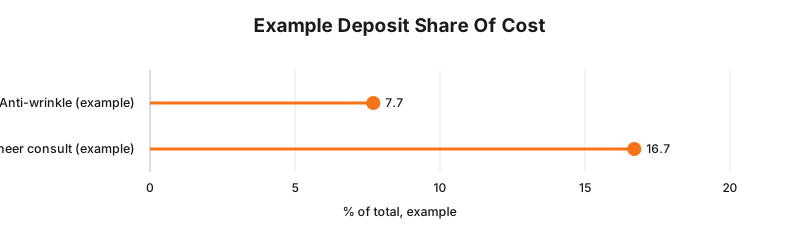
Takeaway: in both examples, the fix was adding the missing reciprocal clause, not lowering the deposit or removing it.
What to check on your own site
- Search your site for the phrase “non-refundable” and confirm it never appears as a standalone claim with no stated exceptions.
- Confirm the deposit policy has its own page, linked from the booking flow, not just a sentence in the footer or a T&Cs PDF nobody opens.
- Check that the policy states what happens if the clinic, not the patient, cancels or reschedules.
- Confirm the cancellation window (hours before the appointment) is a specific number, not a vague phrase like “sufficient notice.”
- If any bookings originate from a telemarketing call or a door-to-door or in-person event sign-up, confirm the cooling-off right is disclosed separately for that channel.
- Check that the deposit amount and refund policy text shown on the payment step match the policy page word for word, not an older cached version.
- Confirm the system logs the policy version and timestamp against each booking record, so you can show exactly what a specific patient agreed to.
- If the site distinguishes a “consultation fee” from a “deposit,” confirm the two terms are not used interchangeably anywhere.
Has anyone actually been penalised for this?
The unfair contract terms penalty regime itself is the enforcement anchor here, not a single case. Penalties for unfair contract term breaches have applied under the ACL since 9 November 2023, and the ACCC’s own guidance names one-sided cancellation and forfeiture terms as the pattern the test is built to catch. In this research pass, no specific ACCC enforcement action, court judgment, or determination naming a cosmetic clinic or dental practice’s deposit forfeiture clause was confirmed. That gap is worth stating plainly: the risk here is regulatory exposure under a penalty regime confirmed to be in force, not a track record of clinics already fined for this specific clause.
Where this gets hard
The ACCC’s guidance and the unfair contract terms test both describe the shape of a problem term; neither one hands a business a pass/fail checklist for a specific deposit clause. Whether a given cancellation window counts as “reasonable,” and whether a specific forfeiture clause creates a “significant imbalance,” are judgment calls that depend on the whole contract, not one sentence read in isolation. The regulator says a blanket non-refundable claim cannot override a consumer’s guarantee rights and that one-sided cancellation terms are the pattern the unfair contract terms test targets; the build consequence is that the deposit policy page needs a stated reciprocal clause and a specific cancellation window; whether a particular version of your policy crosses the line into an unfair contract term is a question for your medical defence organisation or your lawyer.
Status line
The unfair contract terms penalty regime is enacted, in-force Commonwealth law as at 6 November 2026, applying to standard form contracts made, renewed, varied or added to on or after 9 November 2023. The general consumer guarantee position on refunds is settled, ongoing ACL law with no pending change identified in this research pass.
Frequently Asked Questions
Can a clinic legally keep a client’s deposit if the client cancels their own appointment?
Often yes, if the policy is clear and reasonable, but the ACCC’s guidance says a blanket “no refunds” claim cannot remove a customer’s statutory consumer guarantee rights, and a term that penalises only the customer risks being challenged as an unfair contract term under the Australian Consumer Law.
Does labelling a deposit “non-refundable” on the booking page override the customer’s refund rights?
No. The ACCC’s guidance on repair, replace, refund and cancel states a business cannot use a “no refunds” sign or blanket policy wording to take away a customer’s right to a refund when the service has a major failure.
What happens to the deposit if the clinic cancels or reschedules the appointment?
A major service failure entitles the customer to cancel and get a refund minus a reasonable amount for any work already done, and a deposit clause that gives the business an exit but not the customer is exactly the kind of one-sided term the unfair contract terms test targets.
Sources and references
- ACCC, Repair, replace, refund, cancel: accc.gov.au (date checked 15 August 2026)
- ACCC, Unfair contract terms: accc.gov.au (date checked 15 August 2026)
- ACCC, Contracts (cooling-off periods and unfair terms): accc.gov.au (date checked 15 August 2026)
- ACCC, Consumer rights and guarantees: accc.gov.au (date checked 15 August 2026)
- Federal Register of Legislation, Competition and Consumer Act 2010 (Cth), Schedule 2 (Australian Consumer Law): legislation.gov.au (date checked 15 August 2026)
Last reviewed: 15 August 2026.
If your booking page’s deposit policy is one sentence of fine print with no reciprocal clause, that is a quick fix, and it is one we make regularly when we rebuild a clinic’s booking flow. Sign up with RockingWeb and we will review your policy page and booking form together.
Vikas Thakur
Founder of RockingWeb. 16 years of experience from working at TPG, iiNet and Monadelphous, now building websites, software and digital marketing for local businesses in Rockingham and Perth.