

Cosmetic Injectable Laws by State Australia: Full Guide
NSW caps a cosmetic injectable prescription at 6 months under section 68C of its Poisons and Therapeutic Goods Regulation 2008. At least five other states allow 12 months from a single consultation. Here's what each state's Poisons Act says about Schedule 4 stock, penalties, and licensing, current as of July 2026.
 Vikas Thakur 14 min read
On this page 7
- Schedule 4 Is a Federal Label. The Rules Around It Are Not
- New South Wales: The Only State With a Hard 6-Month Cap
- Queensland: Exclusive Custody and a $34,540 Ceiling
- Victoria and Tasmania: Fact Sheets That Restate the Rules, Not Change Them
- The Four States With Nothing Published
- What This Means for Clinic Owners
- The Bottom Line
Key Takeaways
- New South Wales caps a cosmetic medicine authorisation at 6 months under section 68C of the Poisons and Therapeutic Goods Regulation 2008. At least five other states, Victoria, Queensland, South Australia, Western Australia, and Tasmania, are reported to allow 12 months from a single consultation
- Queensland’s Medicines and Poisons Act 2019 carries a maximum penalty of 200 penalty units for unlawfully buying or possessing a Schedule 4 medicine, worth $34,540 at the state’s current penalty unit value of $172.70
- Victoria’s equivalent offence under the Drugs, Poisons and Controlled Substances Act 1981 caps out at just 10 penalty units, or $2,091 at the current $209.10 rate, a 16-fold gap between two states regulating the same class of stock
- NSW’s cosmetic-medicine-specific breach penalty runs from $5,500 to $22,000 for an individual and $27,500 to $110,000 for a body corporate, separate from the general possession offence
- At least 4 of Australia’s 8 states and territories, NSW, Queensland, Victoria, and Tasmania, have published some form of guidance addressing cosmetic injectables directly. Only NSW and Queensland have gone as far as rewriting or formally reinterpreting their Act
- NSW has already passed its replacement law, the Medicines, Poisons and Therapeutic Goods Act 2022, but it has not yet been proclaimed into force
- Western Australia, South Australia, the ACT, and the Northern Territory have no published cosmetic-injectable-specific guidance. Clinics there apply the general Poisons Act and hope the interpretation holds
Every state and territory in Australia regulates Schedule 4 cosmetic injectables under its own Poisons Act, and the penalties for getting it wrong are not remotely consistent. Queensland’s maximum fine for unlawfully possessing a Schedule 4 medicine is $34,540. Victoria’s version of the same offence tops out at $2,091. NSW doesn’t use a general possession penalty at all. It wrote a specific cosmetic-medicines offence into its regulation, worth up to $110,000 for a clinic structured as a company.
That’s not a rounding difference. It’s three different legal systems reaching three different answers for holding the same vial of Botox.
This guide breaks down what each state’s Act actually says: which law governs, how long a prescription stays valid, what licensing a clinic needs to hold Schedule 4 stock, and what the penalty regime looks like if that goes wrong. For who is legally allowed to hold the needle, doctor, dentist, nurse practitioner, or registered nurse under direction, see our companion piece on practitioner-type rules across the states. This one is about the laws themselves.
Schedule 4 Is a Federal Label. The Rules Around It Are Not
The Therapeutic Goods Administration schedules botulinum toxin products (Botox, Dysport, Xeomin) and most dermal fillers containing prescription actives as Schedule 4 in the national Poisons Standard. That part is uniform: no state disputes that these are prescription-only medicines. What happens after that classification, who can buy the stock, how long a prescription stays valid, what a breach costs, is decided entirely by each state and territory’s own Poisons Act, and the eight versions do not agree.
AHPRA’s national guidelines for practitioners performing non-surgical cosmetic procedures, effective 2 September 2025, standardised the clinical side: a mandatory 7-day cooling-off period for patients under 18, a ban on influencer testimonials and AI-generated before-and-after imagery, and a minimum year of postgraduate nursing experience before a registered nurse can inject. None of that touches state possession law. AHPRA can strike a practitioner off. It cannot tell Queensland Health how to interpret its own Medicines and Poisons Act, and it cannot make Victoria’s penalty match NSW’s.
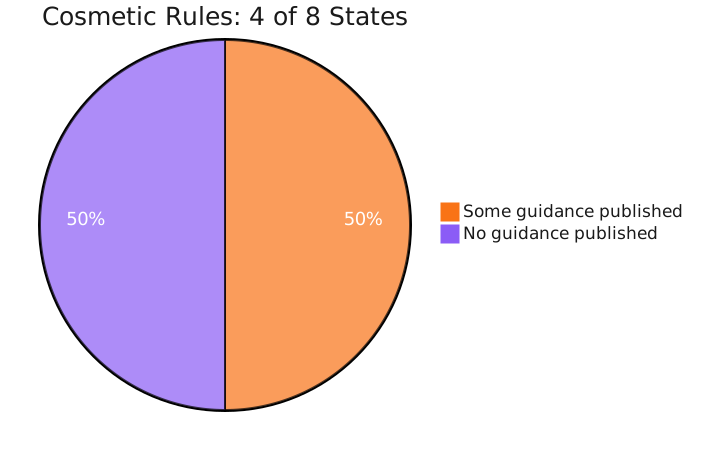
Chart: NSW, Queensland, Victoria, and Tasmania have each published some document addressing cosmetic injectables specifically. Western Australia, South Australia, the ACT, and the Northern Territory have not, as of this research.
| State/Territory | Governing Act | Cosmetic-Specific Document? |
|---|---|---|
| New South Wales | Poisons and Therapeutic Goods Act 1966 + Regulation 2008 | Yes, Part 3A inserted September 2021 |
| Queensland | Medicines and Poisons Act 2019 | Yes, fact sheet Dec 2024, revised April 2025 |
| Victoria | Drugs, Poisons and Controlled Substances Act 1981 | Yes, EHO fact sheet (restates general rules) |
| Tasmania | Poisons Act 1971 + Regulations 2018 | Yes, public and professional fact sheets |
| Western Australia | Medicines and Poisons Act 2014 | Not published |
| South Australia | Controlled Substances Act 1984 | Not published |
| ACT | Medicines, Poisons and Therapeutic Goods Act 2008 | Not published |
| Northern Territory | Medicines, Poisons and Therapeutic Goods Act 2012 | Not published |
Takeaway: four states have written something down about cosmetic injectables. Only two, NSW and Queensland, have changed or reinterpreted their actual law because of it.
New South Wales: The Only State With a Hard 6-Month Cap
NSW wrote cosmetic-medicine-specific provisions into Part 3A of the Poisons and Therapeutic Goods Regulation 2008 in September 2021, under the parent Poisons and Therapeutic Goods Act 1966. Under that regulation, only an authorised practitioner, meaning a medical practitioner, nurse practitioner, or dentist, or a nurse acting under that practitioner’s direction, may administer a cosmetic medicine, and the prescriber must have personally reviewed the patient first.
Section 68C is the specific rule worth knowing: a prescriber’s direction has effect for the period stated, but never longer than 6 months from the date of that personal review. Miss that window and the clinic needs a fresh review before treatment continues, according to NSW Health’s published guidance on the 2021 amendments.
Breach the regulation and the penalty is separate from any AHPRA disciplinary action: $5,500 to $22,000 for an individual, and up to 6 months imprisonment, or $27,500 to $110,000 for a body corporate. That’s the figure most cosmetic clinics should care about, since most operate as companies.
One thing worth flagging for anyone building a compliance plan around the 1966 Act: NSW Parliament has already passed its replacement, the Medicines, Poisons and Therapeutic Goods Act 2022 (No 73), which will repeal the 1966 Act. As of this writing it has not been proclaimed into force. The regulations underneath it are still being finalised, so the 6-month cap and the penalty figures above remain the operative law until that changes.
Takeaway: NSW is the only state with a codified, numeric cap on how long a cosmetic prescription lasts, and a replacement Act is already sitting on the shelf waiting for its regulations to catch up.
Queensland: Exclusive Custody and a $34,540 Ceiling
Queensland took a different path. Instead of writing new cosmetic-specific law, Queensland Health reinterpreted an existing one. A fact sheet issued in December 2024, revised again in April 2025 after industry pushback, confirmed that under the Medicines and Poisons Act 2019, only a prescriber, meaning a doctor or nurse practitioner who physically works at the clinic, can purchase Schedule 4 medicines for stock, and that prescriber must hold what Queensland Health calls “exclusive custody” of it. A registered nurse can hold individually dispensed medicine prepared for a specific named client, but not a general clinic stock. That single clarification put an estimated 600 nurse-led clinics at risk of restructuring, according to Medical Republic, a story we cover in full in our practitioner-type breakdown.
The general penalty sitting behind that fact sheet is section 34 of the Act: unlawfully buying or possessing a Schedule 4 or Schedule 8 medicine carries a maximum of 200 penalty units. At Queensland’s current penalty unit value of $172.70 (effective 1 July 2026), that’s $34,540. Worth noting: this is the Act’s general possession offence, not a cosmetic-specific penalty. Queensland has clarified who can hold cosmetic Botox stock. It has not published a separate, lower or higher fine specifically for getting that wrong in a cosmetic setting.
One academic source, Dr Christopher Rudge of the University of Sydney, writing in The Conversation in September 2025, put Queensland’s prescription validity at 12 months, double NSW’s cap. We could not independently confirm that figure against Queensland’s primary legislation or a Queensland Health fact sheet, so treat it as reported rather than settled.
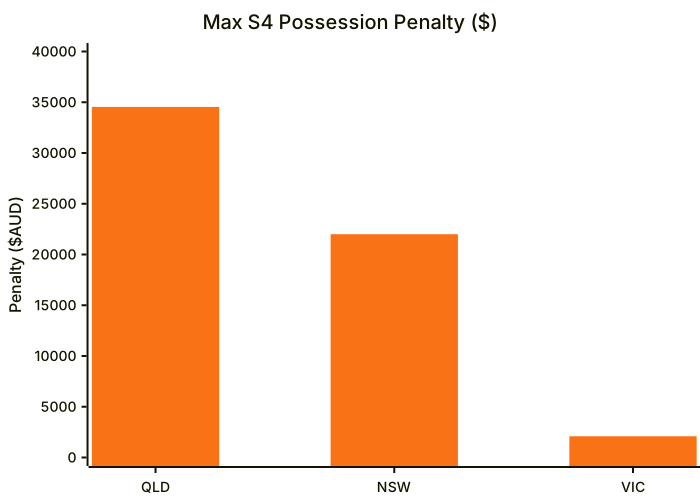
Chart: maximum penalty for the core Schedule 4 stock-control offence in each state’s own Poisons Act, current as of July 2026. Queensland and Victoria’s figures are the general possession penalty under their Act; NSW’s is the cosmetic-medicines-specific breach penalty under Part 3A. These are not the same offence, which is exactly the point: no two states measure this risk the same way.
Takeaway: Queensland didn’t write a new law. It clarified an old one hard enough to restructure hundreds of clinics, and the fine sitting behind that clarification is 57% higher than NSW’s cosmetic-specific maximum.
Victoria and Tasmania: Fact Sheets That Restate the Rules, Not Change Them
Victoria and Tasmania both publish documents that mention cosmetic injectables by name, which puts them ahead of the four states with nothing published at all. Neither goes as far as NSW or Queensland.
Victoria’s Drugs, Poisons and Controlled Substances Act 1981 is backed by an Environmental Health Officer fact sheet, “Supply and Administration of Injectable Cosmetic Treatments,” which confirms it is unlawful for a doctor to supply Schedule 4 cosmetic stock in bulk to a nurse or beauty therapist unless the Department has granted a health service permit, and that the prescribing doctor must retain control of the medicine at all times. That’s a restatement of the Act’s general control-of-medicines principle applied to a cosmetic example, not a new rule. Victoria’s general unauthorised-possession offence, section 36B, caps at 10 penalty units, $2,091 at the current $209.10 rate, the lowest ceiling of any state we could verify a figure for.
Tasmania’s Poisons Act 1971 and Poisons Regulations 2018 are backed by two fact sheets from the Tasmanian Department of Health, one for the public and one for health professionals, confirming that botulinum toxin and deoxycholic acid (a dermal filler ingredient) are Schedule 4 prescription-only medicines, and that a consumer cannot lawfully possess or administer them for cosmetic use unless they have been personally prescribed and dispensed to that individual. We could not extract Tasmania’s specific penalty figures for a breach of the Poisons Act from the documents available to us. If you operate in Tasmania, verify the current fine schedule directly with Tasmanian Health before relying on any number, including ours.
Takeaway: a published fact sheet is not the same thing as a changed law. Victoria and Tasmania have told the industry what the existing rules mean for cosmetic injectables. NSW and Queensland are the only two that have actually moved the goalposts.
The Four States With Nothing Published
Western Australia, South Australia, the ACT, and the Northern Territory each run their own Poisons or Medicines Act, all built from the same national Poisons Standard, and none has published a fact sheet or guideline addressing cosmetic injectables specifically, at least none we could locate.
That doesn’t mean these states are unregulated. Each requires a licence or permit before a business can buy, hold, or supply Schedule 4 stock:
| State/Territory | Licensing Mechanism | Source |
|---|---|---|
| Western Australia | Permit (Health Service, Government, Research/Education, or Pharmaceutical Samples category) | WA Health, Medicines and Poisons Act 2014 |
| South Australia | Medicines and Poisons Licence | SA Health, Controlled Substances Act 1984 |
| ACT | Medicines, Poisons and Therapeutic Goods licence/permit | ACT Government |
| Northern Territory | Authorisation to use or possess S4/S7/S8 poisons | NT Government, Medicines, Poisons and Therapeutic Goods Act 2012 |
We could not verify current penalty dollar figures for a Schedule 4 possession breach in any of these four jurisdictions from the sources available to us. Search results for South Australia suggested a fine range, but we could not confirm it against a current, specific section of the Act, so we’re not printing it. If your clinic operates in WA, SA, the ACT, or the NT, the honest answer is that the exact cost of getting this wrong isn’t published in plain language anywhere we could find. Ask your indemnity insurer or a health lawyer for the current figure rather than trusting a blog post, including this one, to have it.
On prescription validity, the same University of Sydney academic source cited above reported Western Australia and South Australia at 12 months, matching Victoria and Queensland. The ACT and Northern Territory were not covered in that reporting, and we found no other source confirming a validity period for either territory. Treat WA and SA’s 12-month figure as reported, and the ACT and NT as genuinely unconfirmed rather than assumed to match the mainland states.
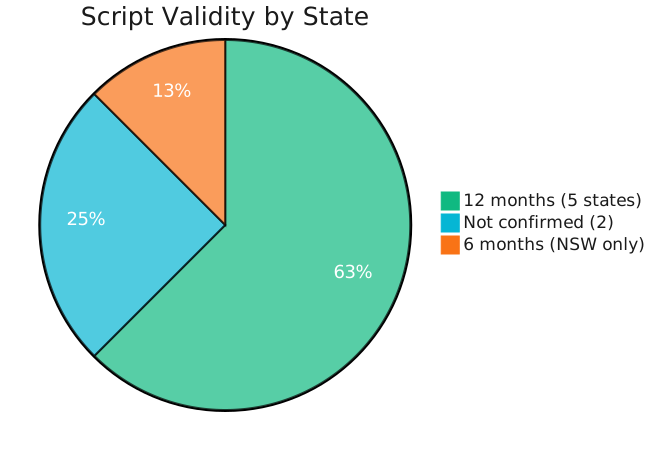
Chart: reported cosmetic-medicine prescription validity periods across Australia’s 8 states and territories. NSW’s 6-month cap is confirmed under section 68C of its Regulation. The 12-month figure for Victoria, Queensland, South Australia, Western Australia, and Tasmania is as reported by Dr Christopher Rudge (University of Sydney), writing in The Conversation, September 2025, and has not been independently verified against each state’s primary legislation. The ACT and Northern Territory are not confirmed either way.
Takeaway: four states run on general licensing regimes with no cosmetic-specific penalty published anywhere we could find. That’s not a loophole. It’s a gap clinics are expected to fill with legal advice, not assumption.
What This Means for Clinic Owners
A website or booking flow that describes your clinic’s stock-holding model, prescription review cadence, or licensing status needs to match the state you actually operate in, not a template written for somewhere else. A clinic copying NSW’s 6-month review language into a Queensland site, or vice versa, is publishing something a regulator or a competitor’s complaint could flag. A free AHPRA compliance audit checks that kind of state-specific claim against the current rules before that happens.
The same logic applies to the stock-control side of the business. If your clinic’s model assumes a doctor holds exclusive custody in one state but your actual structure looks more like the remote-prescriber model Queensland shut down in 2025, that’s worth reviewing regardless of which state you’re in, since nothing says another state won’t reach the same interpretation next. RockingWeb builds AHPRA-compliant cosmetic clinic websites that describe licensing, stock control, and review cadence accurately for the jurisdiction the clinic is actually registered in.
ClinicPipeline, RockingWeb’s marketing system for cosmetic clinics, treats state Poisons Act variation as a permanent feature of this industry, not a one-off compliance project. Websites, ad copy, and booking flows get checked against the state’s current rules on an ongoing basis, not just at launch.
Takeaway: the compliance risk in this industry isn’t hiding in AHPRA’s national guidelines. It’s sitting in eight different state Poisons Acts, three of which carry wildly different penalties for the same category of offence.
The Bottom Line
No single national law governs how Schedule 4 cosmetic injectables are bought, held, or administered in Australia. Each state and territory runs its own Poisons Act, and the details, prescription validity, licensing, and penalties, do not line up. NSW caps a review at 6 months and fines a breach up to $110,000 for a company. Queensland’s general possession penalty is $34,540. Victoria’s is $2,091. Four states have published nothing cosmetic-specific at all.
RockingWeb builds websites and marketing for Australian cosmetic clinics that reflect the law as it actually applies in the clinic’s own state, not a generic version written for somewhere else.
Talk to us about a compliant clinic website or marketing system
Data sources: Therapeutic Goods Administration, advertising health services and cosmetic injections FAQ; AHPRA, “New guidelines for cosmetic procedures” (2 September 2025); NSW Health, cosmetic medicines amendments guidance, Poisons and Therapeutic Goods Regulation 2008 (NSW); NSW Parliament, Medicines, Poisons and Therapeutic Goods Act 2022 (No 73); Queensland Health, medicines in beauty treatment/cosmetic injectable businesses fact sheet (April 2025 revision); Medicines and Poisons Act 2019 (Qld), section 34, via AustLII; Medical Republic, “Queensland just flipped the rules on cosmetic injectables”; Drugs, Poisons and Controlled Substances Act 1981 (Vic), section 36B, via AustLII; Victorian Department of Health, “Supply and Administration of Injectable Cosmetic Treatments” fact sheet; Victorian Department of Treasury and Finance, indexation of fees and penalties; Tasmanian Department of Health, cosmetic injectables fact sheets; WA Health, medicines and poisons licences and permits; SA Health, medicines and poisons licence applications; Dr Christopher Rudge, University of Sydney, “Thinking of getting botox or filler? These are the laws for cosmetic injectables,” The Conversation (29 September 2025).
Related reading: for who is legally allowed to prescribe and administer cosmetic injectables by practitioner type, see Injectables by Nurses vs Doctors: Australia Data.
Vikas Thakur
Founder of RockingWeb. 16 years building for companies like TPG, iiNet and Monadelphous, now focused on websites and marketing that comply with AHPRA's advertising guidelines and still book patients.

![Dentures Cost Australia: Full vs Partial Price Data [2026]](/assets/ahpra-social-media-rules-cosmetic-clinics-LFCez6qC.png)
![Wisdom Teeth Removal Cost Australia: $491 vs $4,500 [2026]](/assets/cosmetic-clinic-seo-australia-DWhO816X.png)
![Invisalign vs Braces Cost Australia: Price Data [2026 Guide]](/assets/ahpra-treatment-naming-website-B-vXh4ba.png)