$60,000-$120,000 Fine Per Breach: AHPRA Cosmetic Clinic Advertising Rules 2025 [Compliance Guide]
AHPRA's September 2025 guidelines banned testimonials, before/after photos, and brand names for injectable substances. Penalty per breach under the Health Practitioner Regulation National Law is $60,000 for an individual and $120,000 for a body corporate. Here is what cosmetic clinics can still advertise, and how to do it compliantly.
 Vikas Thakur Founder, RockingWeb Updated Jul 7, 2026 8 min read
On this page 9
- What Changed in September 2025
- What is Now Banned for Cosmetic Clinics
- What Cosmetic Clinics Can Still Advertise
- Compliant vs Non-Compliant Examples
- The Penalty Structure
- How to Audit Your Existing Advertising
- What If You Have a Complaint Filed Against You
- Building a Compliant Marketing System
- Next Step for Your Clinic
Key Takeaways
- AHPRA’s September 2025 guidelines are the most significant overhaul of cosmetic advertising rules in a decade
- Penalty per breach: $60,000 for an individual, $120,000 for a body corporate (civil penalty, Health Practitioner Regulation National Law s.133)
- Testimonials, before/after photos, and brand names for Schedule 4 injectable substances (e.g., Botox, Dysport, Juvederm) are now banned from all clinic advertising
- “Before and after” comparisons are prohibited even when used educationally
- Approved advertising can describe treatment outcomes in clinical, non-promotional language: there is a path through
- The ban applies to websites, Instagram, Google Ads, Facebook Ads, TikTok, clinic signage, and printed brochures: all channels
- Clinics that ran AHPRA-compliant ads before September 2025 still need to audit, since the new rules are stricter than the 2014 guidelines they replaced
- A compliant ad structure exists and works. You just need to know the four allowed content categories
AHPRA issued new advertising guidelines for regulated health services in September 2025. For cosmetic injectable clinics, they changed everything.
The numbers that matter: $60,000 for an individual, $120,000 for a body corporate, per breach.
That is the civil penalty under the Health Practitioner Regulation National Law for a single non-compliant advertisement, not a one-time fine for the campaign. It applies per breach. Run one non-compliant Instagram post, one non-compliant Google Ad, and one non-compliant page on your website and you are looking at $360,000 in potential exposure (at the body corporate rate).
Most clinics still do not know what they can and cannot advertise under the new rules. Here is the complete guide.
What Changed in September 2025
AHPRA’s 2025 advertising guidelines replaced the 2014 framework. The 2014 rules prohibited misleading claims. The 2025 rules go significantly further.
Three categories of content that were previously in a grey area are now explicitly banned:
| Previously grey area | 2025 status |
|---|---|
| Patient testimonials about treatment outcomes | Banned outright |
| Before and after photographs | Banned outright |
| Brand names of Schedule 4 and Schedule 8 substances | Banned in advertising |
| Pricing for specific injectable procedures | Permitted with conditions |
| Educational content about how treatments work | Permitted with conditions |
The 2025 guidelines also clarified the definition of “advertising” to include any content that promotes a regulated health service, including organic social media posts, blog content, and Google My Business listings.
If your clinic Instagram account posts treatment results, that is advertising under AHPRA’s definition. The rules apply to it.
What is Now Banned for Cosmetic Clinics
1. Testimonials and Patient Reviews
All patient testimonials about treatment outcomes from regulated health services are banned. This includes:
- Google reviews mentioning treatment outcomes (“my filler looked amazing”)
- Before/after posts with patient captions
- Video testimonials on YouTube, TikTok, or Instagram
- Screenshot-style review graphics used in paid ads
- “I went from X to Y” personal transformation narratives
The nuance: AHPRA does not require clinics to remove existing Google reviews from Google’s platform. That is outside their jurisdiction. But clinics cannot reproduce, quote, or direct people to those reviews in their own advertising.
2. Before and After Photographs
Before/after images are banned across all advertising channels and all contexts, including educational contexts.
The 2025 guidelines explicitly close the “educational exemption” that some clinics used to justify comparative imagery. If the image shows a patient pre- and post-treatment, it is non-compliant regardless of caption or framing.
This covers:
- Split-panel photographs
- Sequential photographs in the same post or advertisement
- “Transformation” style reels on Instagram or TikTok
- Before/after used in Google Display ads
3. Brand Names of Injectable Substances
Naming specific Schedule 4 products in advertising is now prohibited. You cannot advertise “Botox”, “Dysport”, “Xeomin”, “Juvederm”, “Restylane”, “Sculptra” or any other brand name of a regulated injectable substance.
You can describe the treatment category: “anti-wrinkle injections”, “dermal filler”, “lip augmentation treatment”.
You cannot name the product: “Botox for crow’s feet”, “2ml Juvederm lip filler”.
What Cosmetic Clinics Can Still Advertise
The rules are restrictive. They are not prohibitive. There are four categories of compliant content:
Category 1: Service descriptions (no outcomes)
Describe what the treatment involves without describing the result it produces on a patient.
Compliant: “Anti-wrinkle injections use a purified protein to temporarily relax facial muscles. Treatment takes 15 minutes.”
Non-compliant: “Anti-wrinkle injections smooth forehead lines and give you a fresher, younger look.”
The first describes the mechanism. The second describes a cosmetic outcome, and that triggers the advertising rules.
Category 2: Factual treatment information
Clinical facts about how treatments work, without before/after framing or outcome claims, are allowed.
Compliant: “Dermal filler is a gel-based injectable used to add volume to areas of the face. Results typically last 12-18 months depending on the product used and individual metabolism.”
This is informational. It does not make a promotional claim about what the treatment will do for the reader.
Category 3: Pricing and booking information
Advertising price ranges, appointment availability, and booking processes is compliant.
Compliant: “Anti-wrinkle injection consultations from $350. Book online.”
Compliant: “Initial cosmetic consultation: $150, redeemable against treatment.”
This is factual commercial information. It does not make outcome claims.
Category 4: Qualifications and accreditations
Advertising the credentials of the practitioner is compliant.
Compliant: “All injectable treatments performed by Dr Sarah Chen, MBBS (Hons), FACCS. Member of the Australasian Society of Aesthetic Plastic Surgeons.”
Non-compliant: “Our award-winning nurse injector has helped thousands of clients achieve their dream look.”
The first states facts. The second includes “dream look” (an outcome claim) and “award-winning” without specifying the award.
Compliant vs Non-Compliant Examples
| Ad element | Non-compliant version | Compliant version | | --------------------- | ----------------------------------------------- | ----------------------------------------------------------------------- | ------------ | | Hero headline | “Transform your look with our expert injectors” | “Cosmetic injectable treatments in [suburb], Perth” | | Social proof | “500 five-star Google reviews” + screenshot | “Established in 2018. Servicing Perth since.” | | Treatment description | “Get the glowing skin our clients rave about” | “Skin booster treatments using hyaluronic acid. 30-minute appointment.” | | Instagram caption | “Before and after: 2ml lip filler” | “Lip augmentation treatment: what to expect at your consultation” | | Google Ad headline | “Botox $9/unit, Perth’s Best Injector” | “Anti-Wrinkle Injections Perth | Book Online” | | Meta Ad copy | “See why 200 Perth women trust our fillers” | “Cosmetic injectable consultations from $150 | Perth” | | Website CTA | “Book your glow-up today” | “Book a consultation” |
The Penalty Structure
AHPRA’s enforcement mechanism changed in 2025. Under the Health Practitioner Regulation National Law (as amended by the Health Legislation Amendment Act 2025):
- Civil penalty: $60,000 per breach for an individual
- Civil penalty: $120,000 per breach for a corporation (body corporate)
- Regulatory caution, formal reprimand, or conditions on registration can apply in addition to financial penalties
- Complaints can be lodged by any person, including competitors
AHPRA does not need to prove financial damage or patient harm. The breach of the advertising standard itself is the offence.
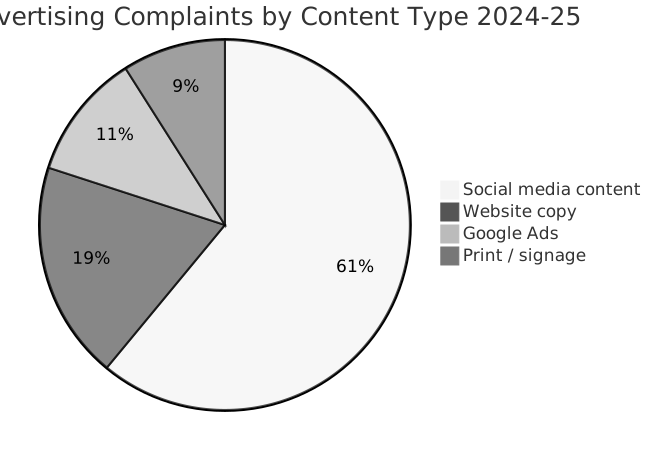
AHPRA received 2,847 advertising complaints in 2024-25. Of those, 61% were about social media content. Cosmetic services accounted for 34% of all complaints by practice type, according to AHPRA’s annual report.

How to Audit Your Existing Advertising
Work through each channel systematically:
1. Website
- Remove any before/after image galleries
- Audit all treatment page copy for outcome claims (“smoother skin”, “lifted appearance”, “younger looking”)
- Remove patient quotes and testimonials from treatment pages
- Check every product name and replace with generic category names
2. Instagram and Facebook
- Review all posts using the “Treatments” tag or equivalent
- Archive (do not delete, you may need records) all before/after posts
- Remove any testimonial-style captions or comments you have boosted
- Audit paid ads in Meta Ads Manager and pause any non-compliant creatives
3. Google Ads
- Review all headlines and descriptions for outcome language
- Remove brand names from ad copy (Botox, Dysport etc.)
- Check that any ad extensions do not include testimonial-style content
4. Google My Business
- You cannot remove authentic Google reviews, but do not reproduce them anywhere in your own advertising
- Check your business description and remove outcome claims
5. TikTok and YouTube
- Transformation content, before/after style edits, is now non-compliant regardless of platform
- Audit any content that shows patient results
What If You Have a Complaint Filed Against You
If AHPRA receives a complaint about your advertising:
- AHPRA notifies you in writing
- You have an opportunity to respond, explaining why the content is (or was) compliant
- AHPRA can issue an improvement notice, a regulatory caution, or refer the matter for formal investigation
- For serious or repeat breaches, AHPRA can apply to the relevant tribunal for civil penalty orders
If you receive an AHPRA notification, engage a health law solicitor before responding. AHPRA’s process is administrative, not criminal, but your response forms part of the permanent record.
Building a Compliant Marketing System
Non-compliant advertising is not just a legal risk. It is a business one. Clinics that rely on testimonials and before/after content for growth need to replace those conversion mechanisms with compliant alternatives.
Three strategies that work within the rules:
Strategy 1: Education-first content AHPRA’s rules do not ban educational content about how treatments work. A clinic that publishes detailed, medically accurate guides to treatment types (how hyaluronic acid works, what the lymphatic drainage process involves, the difference between anti-wrinkle and muscle-relaxant treatments) builds trust and authority without a single outcome claim.
Strategy 2: Practitioner-credentialling Advertising credentials, training history, and professional affiliations is compliant. A practitioner profile page that documents education, certifications, and membership of professional bodies communicates trust signals without testimonials.
Strategy 3: Consultation-first funnel When the advertising cannot show outcomes, the consultation becomes the conversion mechanism. Advertising that drives to a low-friction, no-cost consultation (or paid initial consultation redeemable against treatment) converts more ethically and more compliantly than outcome-promise advertising.
Next Step for Your Clinic
AHPRA compliance auditing and compliant marketing campaign setup is exactly what ClinicPipeline handles for Perth cosmetic clinics.
If you are unsure whether your current advertising meets the 2025 guidelines, get in touch. We review your website, active social content, and Google Ads account and identify every non-compliant element, before AHPRA does.
Vikas Thakur
Founder of RockingWeb. 16 years building for companies like TPG, iiNet and Monadelphous, now focused on websites and marketing that comply with AHPRA's advertising guidelines and still book patients.
![Website Costs Australia 2026: $5K–$25K Pricing Guide [SMB Data]](/assets/australian-business-website-costs-BQmDxMFY.png)