

Paid Advertising Statistics 2025: 120+ Data Points Across 11 Platforms
 Vikas Thakur · · 36 min read
Digital advertising crossed $1 trillion in 2024. These are the exact benchmarks, costs, and ROI data across 11 major platforms — PPC, social, display, programmatic — to help you build the right budget.

Key takeaways
- Global digital advertising hit $1.04 trillion in 2024 (first time ever)
- Digital now commands 72-75% of all advertising spend worldwide
- Google Ads average CPC jumped 10% to $4.66 in 2024
- Meta platforms generated $164.5 billion with Instagram growing 24.4%
- LinkedIn delivers 113% ROAS (only platform showing positive returns)
- TikTok achieves 0.84% CTR at just $1.00 CPC (42% cheaper than Facebook)
- Amazon advertising hit $56.2 billion with 9.58% conversion rate
- Australian market reached $16.4 billion (11.1% growth)
- AI-powered campaigns deliver 3.7x ROI for every dollar invested
- Retail media networks surged to $166 billion (surpassing TV)
Introduction
Digital advertising just made history.
For the first time ever, global ad spend smashed through the $1 trillion barrier in 2024.
But here’s what nobody’s talking about… 88% of marketers are now using AI daily, retail media has overtaken television, and privacy changes have slashed tracking capabilities by 55%.
The game’s changed.
This isn’t your 2023 playbook anymore.
We’ve analysed verified data from IAB, eMarketer, Statista, and platform disclosures covering 11 major advertising platforms. The result? The most detailed performance benchmarks available for marketing professionals in 2025.
Whether you’re managing $5,000 or $5 million in ad spend, you’ll find the exact numbers you need to benchmark your campaigns, justify your budget, and smoke your competitors.
Let’s dive in.
Digital advertising reaches historic trillion-dollar milestone
The numbers are staggering.
Global advertising spending hit $1.04 trillion in 2024, up 9.5% year-over-year according to GroupM. Digital advertising captured $790-800 billion of this total… that’s 72.7-75.2% of all ad spend.
The United States led all markets with $380-400.2 billion in total advertising expenditure. China followed at $204.5 billion with 13.5% growth.
Looking ahead? Industry projections show $1.17 trillion in total ad spend by 2025, with digital’s share climbing to 78.1%.
Platform dominance intensifies
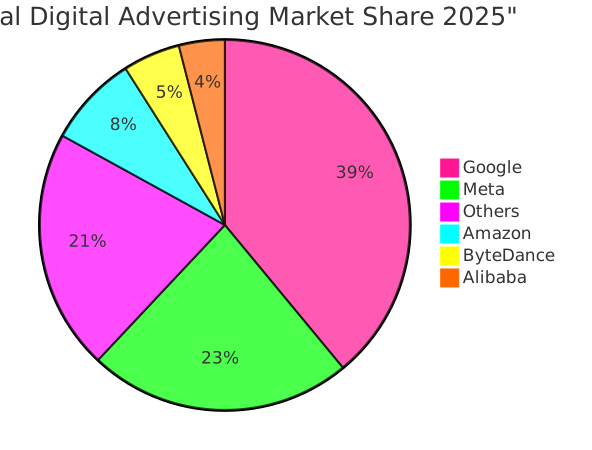
Google commands 39% of global digital ad revenue ($200+ billion in 2025). That makes it the first company to reach this milestone.
Meta captured 18-23.8% market share with $164.5 billion in 2024 revenue, rebounding strongly with 22% growth.
Amazon has emerged as the third advertising giant with 7-8.8% market share and $48.9 billion revenue, growing 21-26.4% year-over-year.
Here’s the kicker… the combined control of Google, Meta, Amazon, ByteDance, and Alibaba accounts for 50-61% of global advertising revenues.
But the duopoly is weakening. Google-Meta share declined from 50.5% in 2022 to 47.7% in 2024 in the US market.

Channel growth patterns diverge dramatically
Retail media networks are expanding 21.8-22% annually to reach $176.9 billion. That’s now surpassing traditional television advertising.
Social media advertising grew 15-18%. Connected TV surged 19.3%. Search maintained steady 7.8-10.1% growth.
In contrast? Linear television declined 3.4% while print advertising fell 4.5%.
Mobile advertising now represents 65.3-77% of digital ad spend. Programmatic trading captures 82.4% of display advertising.
The future is automated, mobile-first, and video-driven.
Google Ads dominates search with rising costs across all campaign types
Google Ads performance in 2024-2025 shows 6.42% average CTR across all industries. That’s up 5% from 2023’s 6.11%.
But here’s the painful part… average CPC increased 10% to $4.66 from $4.22.
Conversion rates decreased slightly to 6.96% (down 1% from 7.04%). Cost per lead jumped dramatically by 25% to $66.69 from $53.52.
This cost pressure affected 86% of industries.
Search advertising benchmarks by industry
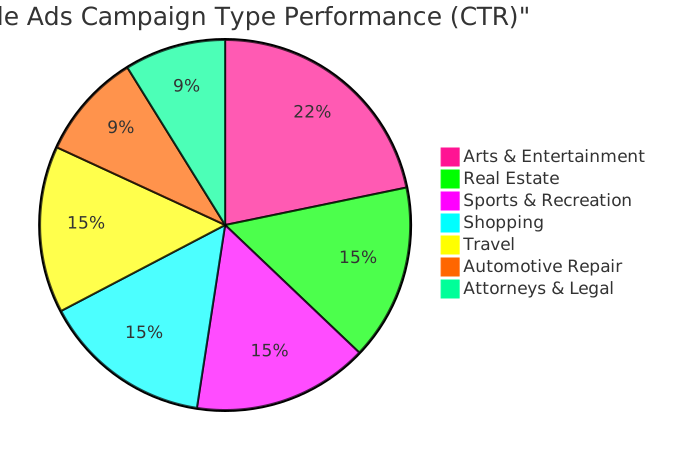
Search advertising delivered 3.17% average CTR with $2.69 average CPC and 2.81% conversion rate for e-commerce campaigns.
Industry performance varies dramatically…
| Industry | CTR | CPC | Conversion Rate |
|---|---|---|---|
| Arts & Entertainment | 13.04% | $1.72 | - |
| Real Estate | 9.20% | $2.10 | - |
| Sports & Recreation | 9.19% | $2.05 | - |
| Attorneys & Legal | 5.30% | $8.94 | 5.37% |
| Automotive Repair | 5.56% | - | 12.96% |
| Dentists & Dental | 5.44% | $7.85 | 9.08% |
Arts & Entertainment leads with 13.04% CTR at just $1.72 CPC.
Attorneys & Legal Services struggle with 5.30% CTR but pay $8.94 CPC (highest across all categories).
Automotive Repair dominates conversions at 12.96% conversion rate despite moderate 5.56% CTR.
Google Shopping campaigns deliver efficiency
Google Shopping campaigns show 0.86% average CTR, $0.66 average CPC, and 1.91% conversion rate with $38.87 average CPA.
HVAC & Climate Control emerged as the top performer with 3.30% conversion rate and remarkably low $7.28 CPA.
Chemical & Industrial categories face the highest costs at $91.21 CPA.
Display advertising delivers lower engagement at 0.46% CTR and $0.63 CPC, but maintains 76.1% viewability with average time-in-view reaching 15.78 seconds.
Performance Max campaigns show volatility
Performance Max campaigns peaked at 82% cost share in May 2024. They’ve since declined 0.65% monthly to approximately 76% by early 2025.
Real-world performance data from 4,000+ campaigns shows ROAS ranging from 700% to 1,867%, with average 804.49% ROAS and cost per conversion between $15.62-$26.51.
Recent data from November-December 2024 indicates 32.68% improvement in conversion rates and 12.06% ROAS increase. But there’s a catch… 22.22% CPC increase and 24.66% CPM increase during the competitive holiday season.

Microsoft Advertising offers compelling alternatives
Microsoft Advertising (Bing) has 4.01% global search market share. That grows to 7.56% in the US and 17.55% on US desktop.
Performance metrics significantly outperform expectations… 2.83% average CTR** (approximately 50% higher than Google), $1.54 average CPC (33% lower than Google), and 2.94% average conversion rate.
UK advertisers see even stronger results with £1.17 CPC (42% lower than Google’s £2.00) and £2.53 ROI per £1 spent (26% stronger than Google’s £2.00).
Makes you think, doesn’t it?
Meta platforms deliver mixed results with Instagram outpacing Facebook
Meta’s advertising ecosystem generated $164.5 billion globally in 2024.
Facebook and Instagram are showing divergent performance patterns.
Facebook traffic campaigns achieved 1.71% average CTR in 2025, up 9% from 1.57% in 2024. CPC decreased 9% to $0.70 from $0.77.
But lead generation campaigns tell a different story… $27.66 average CPL (up 20% from $23.10) with 7.72% conversion rate (down 6% from 8.25%).
Instagram grows faster but engagement drops
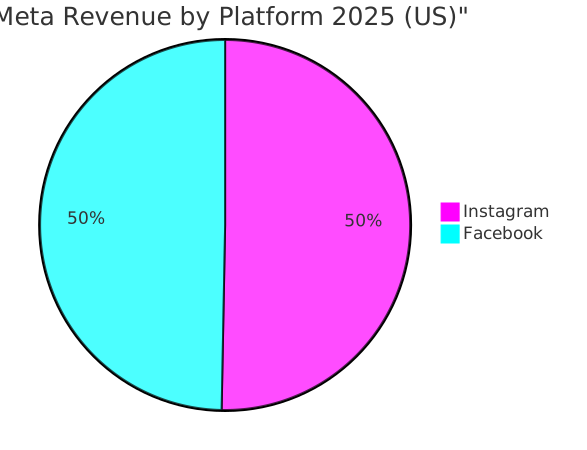
Instagram advertising revenue reached $32.03 billion in US ad revenue for 2025. That represents 24.4% year-over-year growth and captures 50.3% of Meta’s total US revenue for the first time.
Here’s the concerning part… Instagram’s average engagement dropped 28% year-over-year to 0.45% by June 2025 from 0.70%.
Meanwhile, TikTok maintained 2.50-2.80% engagement rates.
Instagram Reels partially offset this decline with 1.48% engagement rate (highest among all Instagram formats) and 22% higher engagement than standard feed ads.
Cost metrics vary dramatically by region
Overall costs range $5.61-$8.96 CPM across industries. Manufacturing has the lowest at $2.40. Technology hits $9.89 (highest).
Regional performance shows dramatic divergence…
| Region | CPM 2025 | Change vs 2024 | CPA 2025 | Change vs 2024 |
|---|---|---|---|---|
| United States | $19.66 | +81% | $2,273 | +149% |
| Europe | $4.90 | Stable | $158 | -43% |
| UAE | $7.47 | +152% | - | - |
US advertisers face $19.66 CPM in 2025 (up 81% from $10.84 in 2024) and $2,273 CPA (up 149% from $911).
European advertisers enjoy $4.90 CPM (stable) and $158 CPA (down 43% from $280).
UAE saw the most dramatic ad spend increase at 66% year-over-year, though CPM surged 152% to $7.47 from $2.96.
Meta Advantage+ Shopping campaigns demonstrate automation power
Advantage+ Shopping campaigns deliver 17% average reduction in cost per acquisition and 32% increase in ROAS according to official Meta benchmarks.
Third-party verification shows ROAS of 4.25 versus 3.78 for manual campaigns, with $20+ billion annual run-rate by Q4 2024 (70% increase vs Q4 2023).
The system automatically tests 150 creative combinations, optimises placements across Feed, Stories, and Reels.
Video content significantly outperforms static images
Video content generates 6x more engagement on Facebook and 38% more engagement on Instagram compared to image posts.
Video ads achieved 135% higher organic reach than images on Facebook.
Cost-effectiveness varies… video ads typically show 17% lower CPM than static content but require higher production investment.
Instagram Shopping shows strong adoption with 29% of users making purchases on the platform and 50%+ researching brands/products before buying.
LinkedIn dominates B2B advertising with highest ROAS despite premium pricing
LinkedIn has established uncontested leadership in B2B advertising.
Budget share grew from 31% to 39% by year-end 2024. That’s now the largest single-channel spend when separating Google’s network components.
The platform delivers 113% ROAS (the only major platform showing positive returns in recent studies).
This dramatically outperforms Google Search at 78% ROAS and Meta Ads at 29% ROAS.

The platform influences 29% of MQLs, 36% of SQLs, and 35% of New Business deals according to Dreamdata’s analysis.
CTR varies dramatically by format and region
Overall LinkedIn CTR averages 0.39-0.56% across formats.
Regional variations…
- LATAM leads at 0.68-0.74%
- APAC follows at 0.56-0.60%
- EMEA has declined to 0.29-0.43% due to market saturation
Sponsored Content single image ads achieve 0.56% global CTR.
Thought Leader Ads dramatically outperform at 1.7x to 2.5x higher CTR (effectively 0.95-1.4% CTR).
Message Ads/Sponsored InMail deliver exceptional 3.0-3.6% CTR with 38-55% open rates.
Conversation Ads achieve remarkable 12% CTR after opening with 50% open rate, though at significantly higher cost per engagement.
Premium pricing reflects platform positioning
Cost metrics reflect LinkedIn’s premium positioning…
| Metric | Global | US Market |
|---|---|---|
| Average CPC | $5.58-$8.00 | $8.00-$10.00 |
| Sponsored Content CPC | $8.00-$11.00 | - |
| Message Ads CPC | $25-$60 | - |
| Average CPM | $33.80 | $57-$70+ |
Sponsored Content costs $8.00-$11.00 per click. Message Ads command $25-$60 CPC as the most expensive format.
CPM averages $33.80 globally but reaches $57-$70+ for highly targeted campaigns.
Regional CPC data shows geographic arbitrage opportunities…
- North America… £4.34
- Global targeting… £4.57
- APAC… £1.55
- LATAM… £1.62
Lead generation costs and conversion metrics
Cost per lead on LinkedIn ranges $15-$350 depending on industry and offer complexity. Typical B2B range settles at $80-$230.
Regional CPL analysis…
| Region | CPL |
|---|---|
| North America | $230 |
| EMEA | $120 |
| APAC | $80 |
| LATAM | $60 |
Industry-specific CPLs span from Hardware & Networking at $150 and Software/IT at $125 to more affordable Education at $64 and Corporate Services at $60.
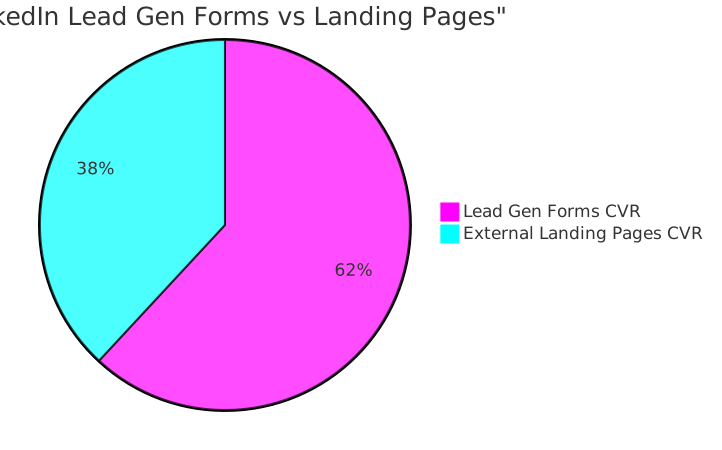
Lead Gen Forms consistently outperform landing pages with 13% average conversion rate (40-60% higher than external pages). They deliver 25% higher conversion rates with 15% lower acquisition costs.
Conversion metrics show wide variance by campaign type and audience…
Low-friction offers (content downloads, webinars) convert at 10-15%. High-friction offers (demo requests, free trials) to cold audiences convert at 1.5-4%.
Video ads show 29.5-35% average view rate (up 5% YoY) with 23% overall completion rate. North America achieves impressive 56.67% completion rate.
The platform’s B2B-focused audience delivers 202.04 ROI for impacted pipeline according to Metadata.io’s analysis.
LinkedIn Conversions API integration reduces CPA by 20% and increases attributed conversions by 31% for the 75% of customers using this server-side tracking solution.
TikTok and YouTube lead video advertising with divergent strategies
TikTok’s advertising performance demonstrates remarkable engagement efficiency.
The platform achieves 0.84% average CTR (outperforming Facebook’s 0.72% and Instagram’s 0.59%) at $1.00 average CPC (42% lower than Facebook’s $1.72 and 72% lower than Instagram’s $3.56).
Platform-wide engagement rates reach 5-16% with 5.3% average.
That dramatically surpasses Facebook at 0.09% and Instagram at 1.22%.
TikTok is approximately 4x more engaging than Instagram on per-follower basis.
TikTok Shop revolutionises social commerce
TikTok Shop has revolutionised social commerce, capturing 36% of all direct social media purchases and influencing 39% of purchase decisions on the platform.
Conversion rates increased 56.41% year-over-year from 2022-2023. CPA decreased dramatically from $24.13 to $13.08 (46% reduction).
TikTok is the only major platform where customer acquisition became cheaper during this period.
During Black Friday Cyber Monday 2023, TikTok purchases increased 135.69% and represented 7.12% of total BFCM purchases (up from 3.02% in 2022). CTR grew 17.46% year-over-year (second-highest among major platforms).
Platform reach extends to 1.58-1.7 billion monthly active users with 150 million in the US. Projected to reach 2.35 billion by 2029.

Spark Ads deliver transformational performance
Spark Ads (promoting organic content as advertisements) deliver transformational performance…
- 134% higher completion rates
- 157% increase in 6-second view-through rates
- 142% higher engagement
- 69% increase in conversion rates
- 37% lower CPA versus standard In-Feed ads
This format’s $1.00 CPC and $6.06 CPM combined with 30-40% lower cost-per-engagement makes Spark Ads TikTok’s most efficient advertising product.
Premium formats command higher costs but deliver exceptional results…
| Format | CTR | Engagement |
|---|---|---|
| TopView ads | 12-16% | - |
| Takeover ads | 7-10% | - |
| In-Feed video | 1.5-3% | 4% avg |
YouTube advertising generated record revenue
YouTube advertising generated $10.47 billion in Q4 2024 (record high) as part of $96.50 billion total 2024 revenue.
The platform reaches 2+ billion monthly active users.
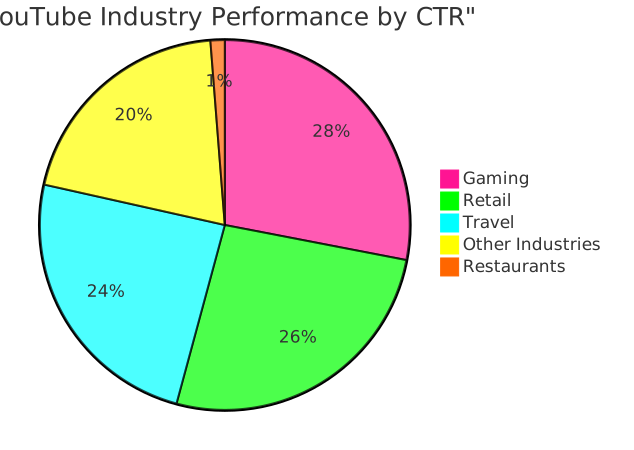
Average performance metrics show 0.65% CTR (ranging 0.10%-0.84% by industry) and $0.026 average CPV ($0.02-$0.03 range), with $3.53 average CPM varying from $1-$23 depending on targeting.
View rates averaged 31.9% overall with significant seasonal variation… 55% peak in July (Amazon Prime Day impact) declining to 29.24% in Q4 2024 during competitive holiday season.
Industry leaders include Retail at 0.84% CTR, Travel at 0.78%, and Gaming at 0.9%. Restaurants lag at 0.04% and Household Essentials at 0.045%.
Connected TV and YouTube Shorts show exceptional engagement
Connected TV viewership now accounts for 45% of YouTube consumption.
It delivers exceptional 64% view rates and 95.92% completion rates for non-skippable ads, with 86% of viewers paying more attention when watching with others on big screens.
YouTube Shorts ads show 43-57% view rates with some campaigns achieving 75% higher view-through than expected. The format reaches 70+ billion daily views on Shorts content.
TrueView skippable in-stream ads remain most reliable for balancing cost and engagement with view rates up to 66%, CPV 8.5% below average, and impressive brand impact results…
- 57% of campaigns drive consideration lifts
- 24% drive favourability lifts
- 35% drive purchase intent lifts
Emerging platforms offer niche opportunities with varying advertiser sentiment
Twitter/X faces significant advertiser challenges
Twitter/X trust dropped from 22% in 2022 to just 12% in 2024 according to Kantar research.
Only 4% of marketers believe X ads are safe for their brand (versus 39% for Google ads).
The platform experienced 54.4% year-over-year ad revenue decline from 2022-2023, with 26% of marketers planning to spend less on X in 2025 (highest pullback from any major platform).
First half 2024 saw $744 million ad spend (24% lower than $982 million H1 2023). Major advertisers including Apple, Disney, IBM, and Warner Bros. paused campaigns following brand safety concerns.
Despite these challenges, performance metrics remain competitive…
- 0.86-2.54% CTR range
- $0.18 median CPC
- $2.09 CPM (versus Meta’s $2.53)
- $2.70 return for every $1 spent (nearly 40% higher than other media)
Pinterest advertising shows strong momentum
Pinterest has 537 million monthly active users (Q3 2024) representing 11% quarterly growth and outpacing competitor growth rates.
The platform reaches 40% of US households earning $150K+ annually and 45% in top 25% of earners.
Shopping ads deliver the platform’s strongest performance…
| Metric | Performance |
|---|---|
| CTR | 0.6-1.0% |
| CPC | $0.70-$1.00 |
| Conversion Rate | 2-3% |
Overall performance ranges 0.28% baseline CTR (good performance at 0.5-0.55%+) with $0.50-$1.00 average CPC, $3-$5 average CPM, and 1.5-8.5% conversion rate depending on industry.
80% of weekly users discover new brands/products on platform.
Snapchat dominates Gen Z engagement
Snapchat dominates Gen Z with 90% of 13-24 year-olds and 75% of 13-34 year-olds using the platform among 453 million daily active users.
Advertising performance shows 0.4-1.7% CTR with exceptional 5% average swipe-up rate (significantly above industry benchmarks) at $0.65 average cost per swipe-up.

AR Lens advertising delivers transformational results…
- 6.4x higher swipe-to-purchase ratio versus commercials
- 2.4x ad awareness lift versus non-AR ads
- 1.8x brand awareness lift
- Average 12.6 seconds active attention (5x longer than other social platforms)
With 300+ million users interacting with AR lenses daily creating 200+ million lens videos in 2024, AR advertising generated $5.8 billion in creator marketing spend while delivering $3+ ROAS in documented campaigns.
Reddit offers unique community-based advertising opportunities
Reddit reaches 712 million potential ad reach across 500+ million monthly visitors and 110 million daily active users within 100,000+ active communities.
Advertising costs provide significant savings…
| Campaign Type | CPC Range |
|---|---|
| Consumer Campaigns | $0.10-$0.80 |
| B2B/SaaS | $0.50-$2.00 |
| Average CPM | $2-$6 |
| Overall CPC | $0.47-$0.62 |
That’s 50-70% lower than Facebook/Instagram for consumer campaigns.
Performance ranges 0.2-0.3% baseline CTR (0.5-1.0% in high-interest categories) with 2-8% conversion rates for low-friction actions.
The platform shows strong growth momentum…
- 56% year-over-year ad revenue growth in Q3 2024
- 42% of marketers planning to increase Reddit ad spend in 2024
- 90% of users trust the platform for product learning
- Users 27% more likely to buy products advertised on Reddit than other platforms
Amazon advertising dominates retail with exceptional conversion rates
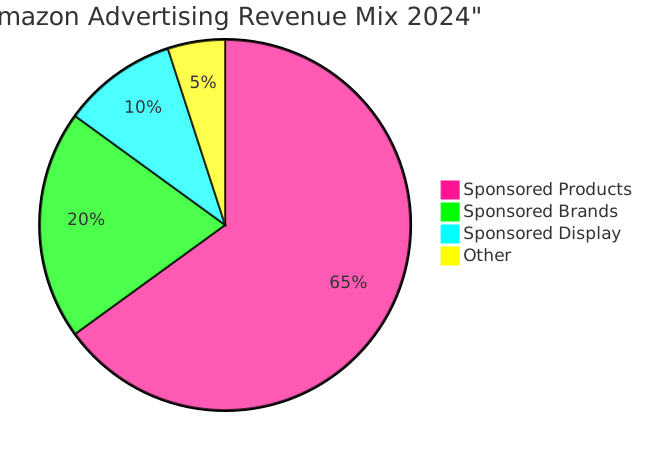
Amazon Advertising reached $56-56.2 billion revenue in 2024 (18% year-over-year growth) from Q4’s $17.29 billion (18% growth).
This establishes it as the third-largest digital advertising company globally behind Google and Meta, capturing 11-14.6% of global digital ad spending.
Sponsored Products performance shows 0.34-0.47% average CTR, $1.04 average CPC (ranging $0.80-$1.40 by category), and exceptional 9.58-10.33% conversion rate (7x higher than typical e-commerce’s 1.33%).
ROAS averages $3.41 for Sponsored Products, $3.06 for Sponsored Brands, and $1.85 for Sponsored Display.
Overall 29-30.20% ACOS (Advertising Cost of Sales) in 2025, up from lower levels in 2023 reflecting increased competition.
Category performance varies dramatically
| Category | CTR | Conversion Rate |
|---|---|---|
| Beauty & Personal Care | 0.45-0.60% | 12-15% |
| Electronics | 0.30-0.40% | 8-11% |
| FMCG/Grocery | - | 30-35% |
FMCG/Grocery products convert at exceptional 30-35% rates due to low prices and frequent repurchases.
Cost pressures intensified with average CPC increasing $0.07 year-over-year, fluctuating from $0.95 lowest in October 2024 to $1.14 peak in June 2024.
Specific categories face extreme costs… Smoking patches command $1.29 CPC (highest), while Baby products experienced 40% year-over-year CPC increase in Q1 2024.
Seller spending and performance metrics
Seller spending averages $260-298 per day for mature accounts, with…
- 60,870 daily impressions
- 284,398 daily clicks
- $910-$1,016 daily revenue per typical advertiser
Amazon’s market dominance extends across e-commerce with 49% of US e-commerce share in 2024 (some estimates at 38%), delivering 55% higher ROAS than Google for identical keywords due to superior purchase intent.
Prime Day 2024 demonstrated platform power
Prime Day 2024 results…
- Ad spend increased 26.3% year-over-year
- Sponsored Products captured 78% of overall ad budgets
- CPC rising 7.6%
- Total US Prime Day sales reaching $14.2 billion (11.8% increase)
Amazon DSP (Demand-Side Platform) grew 18% year-over-year in Q1 2024 with 65% impression growth.
It now incorporates Prime Video ads integration reaching 200+ million viewers globally with projected $3.5-5 billion ad revenue for 2025.
Cross-platform e-commerce shopping ads
Cross-platform e-commerce shopping ads show varied performance…
Instagram leads growth at 34% year-over-year in Q1 2024. Facebook, YouTube, and Google Search maintained steady 17% growth.
Meta Advantage+ Shopping campaigns deliver 12%+ reduction in cost per acquisition and 10.1% increase in conversions (median) with 15%+ ROAS and 50% ROAS improvement for some advertisers.
Walmart Connect advertising surged 35% year-over-year in Q1 2024 (highest among major platforms) with Sponsored Products showing 23.2% year-over-year growth.
CPC increased 31% year-over-year while remaining 50.7% cheaper than Amazon at $0.86 (Q2 2024).
Instacart Ads offers efficiency with $0.86 CPC (down 8.5% year-over-year) and growing 12% quarter-over-quarter in Q4 2024.
Industry benchmarks reveal dramatic performance variations across sectors
Google Ads industry benchmarks from WordStream’s analysis of 16,000+ campaigns show overall averages of 6.66% CTR, $5.26 CPC, 7.52% conversion rate, and $70.11 cost per lead.
But individual industry performance varies by 5-10x.
Top performing industries for Google Ads
| Industry | CTR | CPC | Conversion Rate | CPL |
|---|---|---|---|---|
| Arts & Entertainment | 13.10% | $1.60 | - | $30.27 |
| Sports & Recreation | 9.19% | $2.05 | - | - |
| Shopping/Collectibles | 8.92% | $2.12 | - | - |
| Travel | 8.73% | $2.05 | - | - |
Arts & Entertainment leads CTR at 13.10% with lowest $1.60 CPC and affordable $30.27 CPL.
Sports & Recreation (9.19% CTR), Shopping/Collectibles (8.92% CTR), and Travel (8.73% CTR) also achieve exceptional click-through rates above 8.5%.
All benefit from strong consumer interest and visual appeal driving engagement at relatively low costs ($2.05-$2.12 CPC range).
High-value professional services face opposite dynamics
| Industry | CTR | CPC | Conversion Rate | CPL |
|---|---|---|---|---|
| Attorneys & Legal | 5.97% | $8.58 | 5.37% | $131.63 |
| Dentists & Dental | 5.44% | $7.85 | 9.08% | - |
| Home & Home Improvement | 5.56% | $7.85 | 6.54% | - |
| Education & Instruction | - | $6.23 | 11.38% | - |
Attorneys & Legal Services command $8.58 CPC (highest across all industries) and $131.63 CPL with moderate 5.97% CTR, yet achieve only 5.37% conversion rate due to complex, high-consideration purchase process.
Dentists & Dental Services face similar challenges with $7.85 CPC and 5.44% CTR (lowest), but convert better at 9.08% due to more immediate need.

Conversion rate champions tell different stories
Automotive Repair/Service/Parts dominates at 14.67% conversion rate with reasonable $28.50 CPL, benefiting from immediate need and local intent.
Animals & Pets converts exceptionally well at 13.07% with affordable $31.82 CPL due to emotional purchase drivers and loyal customer base.
Physicians & Surgeons achieve 11.62% conversion rate despite high costs. Education & Instruction’s 11.38% conversion rate reflects strong intent from searchers.
Conversely, Finance & Insurance struggles with just 2.55% conversion rate at $89.44 CPL due to complex decision-making and regulatory friction.
Furniture converts only 2.73% despite $121.51 CPL reflecting showroom preference and purchase hesitancy.
Facebook Ads industry performance
Facebook Ads industry performance from WordStream 2025 data shows traffic campaigns averaging 1.71% CTR and $0.70 CPC.
| Industry | CTR | CPC |
|---|---|---|
| Shopping/Collectibles/Gifts | 4.13% | $0.34 |
| Travel | 2.76% | $0.51 |
| Sports & Recreation | 2.60% | $0.41 |
Shopping/Collectibles/Gifts leads at 4.13% CTR with $0.34 CPC (most efficient).
Lead generation campaigns reveal different patterns…
| Industry | Conversion Rate | CPL |
|---|---|---|
| Restaurants & Food | 18.25% | $3.16 |
| Dentists & Dental | - | $76.71 |
| Health & Fitness | - | $52.98 |
| Beauty & Personal Care | - | $51.42 |
Restaurants & Food achieve exceptional 18.25% conversion rate at just $3.16 CPL.
Dentists & Dental Services face extreme $76.71 CPL (up 97% year-over-year). Health & Fitness at $52.98 CPL, and Beauty & Personal Care at $51.42 CPL demonstrate the platform’s rising costs for local service businesses.
Budget allocation strategies differ dramatically between SMBs and enterprises
Small and medium-sized business budgets
Small and medium-sized businesses allocate 7-8.7% of gross revenue to marketing on average.
Significant variation by business type…
- B2C SMBs invest 9.6-15%
- B2B SMBs allocate 6-10%
- Startups in growth phase dedicate 11.2-30%+ of revenue
Actual spending ranges $1,000-$10,000 monthly with $2,500-$12,000 being most common.
55% of SMBs spend less than $50,000 annually. 70%+ have budgets under $100,000.
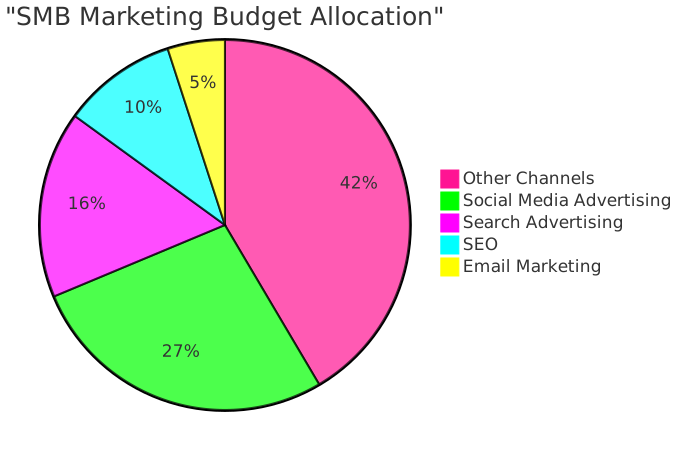
Channel distribution shows…
- 27.2% allocated to social media advertising
- 16.3% to search advertising
- Email marketing commanding $300-500 monthly
- SEO receiving variable investment based on in-house capabilities versus outsourcing
Australian SMB advertising data
Australian SMB data provides regional specificity…
33% increased advertising spend in 2024. 39% maintained budgets. 32% don’t advertise at all, citing expense (44%) and lack of previous ROI (38%) as primary barriers.
Among Australian SMBs advertising…
- 70% favour social media advertising
- 63% use online search
- 44% employ online display
- 24% plan streaming TV investment in the next 12 months
Average monthly Google Ads spend ranges AUD $5,000-$20,000 with typical annual digital marketing budgets of $30,000-$144,000.
88% report current strategies successfully acquire new customers. 71% say advertising helped expand Australian business.
Enterprise marketing budgets tell a different story
Enterprise marketing budgets average 7.7% of company revenue in 2024 (down from 9.1% in 2023) with 2025 projection rising to 9.4%.
Industry-specific enterprise allocations vary dramatically…
| Industry | Revenue Allocation |
|---|---|
| Consumer Packaged Goods | 18.5-25.19% |
| Retail | 10-15% |
| Technology/SaaS | 10-20% |
| Financial Services | 8-12% |
| Healthcare | 8-12% |
| Manufacturing | 3-7% |
| Mining/Construction | 1-1.52% |
Channel distribution for enterprises shows…
- 40-60% to core digital marketing
- 15-25% to traditional advertising
- 10-20% to events/sponsorships
- 5-15% to analytics/MarTech tools
- 10-20% to content/creative production
Budget growth trends indicate 56% of companies increased budgets in 2025 with increases typically under 20%. 47% raised KPI goals alongside budget increases to maintain performance pressure.
Digital allocation reached 57.9% of total marketing budget for enterprises.
AI investments became top priority for 95% of CMOs despite 54% feeling overwhelmed by implementation complexity.
B2B companies dedicate 36% of budget specifically to lead generation with average $200 cost per lead across all industries.
Only 7% report high ROI from sales enablement despite 77% prioritising these investments.
Australian market grows 11% reaching $16.4 billion with strong regional performance
Australia’s digital advertising market reached AUD $16.4 billion in calendar year 2024 (11.1% year-over-year growth) according to IAB Australia’s Internet Advertising Revenue Report prepared by PwC.
Up from $14.8 billion (3.7% growth) in 2023.
This acceleration significantly outpaced global average growth of 8-10% and positioned Australia as the 5th largest global market by total ad spending with projected $852 ad spend per capita by 2028 (2nd highest globally).

Quarterly performance and growth
Quarter-by-quarter performance showed…
- Q1 at $3.746 billion (9.3% growth)
- Q3 at $4.2 billion (12.1% growth, Olympics-boosted)
- Q4 at $4.258 billion (8.8% growth)
2025 forecast of AUD $18.1 billion (5.1% growth) brings total advertising market including traditional channels to $25.2 billion.
Channel breakdown and growth rates
Search & Directories dominated Australian spending at AUD $7.2 billion (44% of total digital spend) growing 10.1% year-over-year.
Google commands 94% of search market share as of August 2024 and 96% of search advertising revenue according to ACCC data.
Video Advertising showed highest growth at AUD $4.5 billion (27% of total) expanding 19.6% year-over-year.
Connected TV captured 51% share at peak. Social platform video exceeded $1.5 billion (over 1/3 of total video expenditure).
Classifieds contributed AUD $2.6 billion (16% of total, 8.3% growth).
Display advertising (excluding video) generated AUD $2.0 billion (12% of total, 1.7% growth, slowest category).
Audio Advertising reached AUD $313 million (1.9% of total, 17.8% growth) with podcasting representing 40-41% of audio advertising.
Platform market share in Australia
Platform market share in Australia mirrors global patterns with concentrated dominance…
Google’s 94% search share compares to Bing’s 4.7%, DuckDuckGo’s 0.59%, and Yahoo’s 0.45%.
| Platform | Potential Ad Reach | Monthly Time Spent |
|---|---|---|
| 16.65 million (66% of internet users) | 20h 15m | |
| TikTok | 10 million (+17% growth) | 42h 13m |
| 11+ million | 11h 46m | |
| 63.3% of population monthly | - |
TikTok shows highest engagement at 42 hours 13 minutes monthly.
Social media advertising overall represents estimated AUD $3.8 billion (28% of digital spend) growing 6-9.4% year-over-year.
Regional variations within Australia
Regional variations within Australia show concentration in major metros…
Sydney leads with highest concentration of high-net-worth individuals and 32% above national average household income.
Premium areas like Martin Place & Barangaroo show 78% international travel propensity. Double Bay/Mosman/Vaucluse reach 91%.
Melbourne follows as second-largest market with Collins Street & Docklands at 72% international travel propensity. Affluent Toorak/Brighton/South Yarra at 88%.
Brisbane/Gold Coast ranks third with Eagle Street & Queen Street Mall at 65% international travel propensity. Premium suburbs at 81%.
Perth shows 68% in St Georges Terrace and 79% in Peppermint Grove/Dalkeith/Cottesloe.
Industry experts recommend 70% budget allocation to top 3 regions (Sydney, Melbourne, Brisbane/Gold Coast) for national campaigns.
Privacy changes reshape targeting with first-party data becoming essential
Apple’s iOS 14.5 App Tracking Transparency (ATT) framework fundamentally altered mobile advertising economics.
Global opt-in rates reached 50% by Q1 2024 (up 10% since initial rollout). US opt-in rates lag at 44% and UK at 46%.
The framework reduced tracking rates by 54.73 percentage points in the US (from 72.63% to 17.90%).
This caused 20.44% decrease in advertising revenue for Apple users and 51.10% higher CPMs for the remaining trackable users.
Meta-dependent firms experienced 37.1% revenue decrease. iOS-dependent firms saw 40.1% decline.

Developer adoption and strategic shifts
Developer adoption shows strong embrace despite challenges…
84% of gaming app developers and 68% of non-gaming developers have implemented ATT compliance by Q1 2024.
Only 1-in-4 users have full data granularity available to advertisers.
Paradoxically, iOS ad spend grew 51% in non-organic installs year-over-year (May 2023-Q1 2024) compared to just 21% growth on Android.
That represents 5x higher increase on iOS despite privacy restrictions.
Advertisers adapted successfully through alternative measurement methods including SKAdNetwork, probabilistic modelling, and aggregated campaign analytics.
First-party data emerged as critical strategic priority
93% of marketers believe first-party data collection is more critical than ever in 2024.
84% use customer insight, first-party, and transactional data as top sources.
78% of businesses consider first-party data their most valuable personalisation resource.
Zero-party data (information consumers intentionally share) gained significant attention…
- 58% of consumers feel more at ease with brands collecting zero-party data (December 2023)
- 250% year-over-year growth in searches for “zero party data collection”
- 133% month-over-month interest increase
Collection methods expanded to interactive quizzes (like Sephora beauty quizzes), preference centres, surveys/polls, onboarding questionnaires, and feedback forms.
85% of marketers identify zero-party data as essential for personalised experiences.
Google’s reversal and cookieless alternatives
Google’s reversal on third-party cookie deprecation in July 2024 provided temporary relief but shifted strategy to user choice/opt-in model.
Safari and Firefox eliminated third-party cookies years earlier.
Despite extended timeline, 75% of marketers still heavily rely on third-party cookies.
88% of US marketers feel prepared for changes. 56% are testing cookieless alternatives including…
- Privacy Sandbox Topics API
- Contextual targeting (seeing 51% budget increases)
- Server-side tracking
- Universal IDs from Trade Desk, LiveRamp, and others
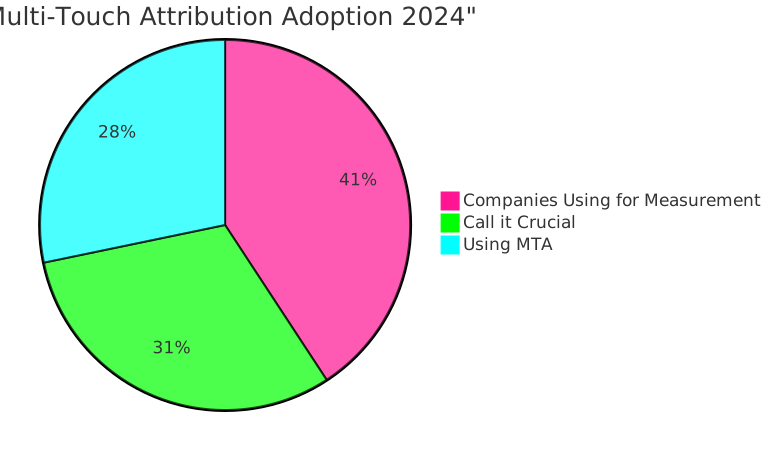
The shift accelerated adoption of multi-touch attribution… 52% of marketers using MTA in 2024, up from lower historical rates.
57% call MTA “crucial” for their organisation. 75% of companies use it to measure marketing performance.
Cookie restrictions make full journey tracking “impossible” according to 2024 industry assessments.
AI transforms advertising with 88% daily usage and automation delivering 3.7x ROI
Artificial intelligence adoption reached critical mass in advertising.
88% of marketers use AI in their daily roles in 2024, up from 78% of organisations using AI in at least one business function (up from 55% in 2023).
Investment plans show 92% of businesses planning AI investments. 72.5% of marketers aim to boost AI spending.
This drives the AI marketing market from $47.32 billion in 2025 to projected $107.5+ billion by 2028 at 36.6% annual growth rate.
Performance improvements justify investment
AI-powered campaigns deliver 3.7x ROI for every dollar invested in Generative AI.
93% create content faster. 81% boost brand awareness and sales. 56% use AI to improve overall operations rather than isolated marketing functions.
Smart bidding and automated campaign management achieved widespread adoption with over 70% of companies utilising automated bidding strategies.
The smart bidding management platform market is projected at $7.8 billion by 2031 growing at 14% CAGR.

Current strategy distribution shows…
- Maximize Conversions (33%)
- Target ROAS (33%)
- Maximize Conversion Value (15%)
- Target CPA (10%)
Manual CPC is declining as advertisers recognise competitive disadvantage against automated systems.
Platform-specific AI tools demonstrate varied implementation
Google’s Performance Max uses AI for bidding, budget optimisation, creative testing, and audience targeting.
It generates 12% average increase in conversion value at same or better ROAS with 78.15% average revenue increase after 6 months continuous use.
Google now has over 1 million active advertisers using Performance Max in 2025.
Market share peaked at 82% in May 2024 before declining 0.65% monthly to approximately 76% by early 2025.
Meta’s Advantage+ Shopping campaigns automatically test 150 creative combinations, optimise placements across Feed/Stories/Reels, and deliver 17% average CPA reduction with 32% ROAS increase.
Reached $20+ billion annual run-rate by Q4 2024.
Amazon introduced AI creative tools reducing effort by 90% for generating product variations, lifestyle imagery, and A+ content.
LinkedIn launched Accelerate in late 2024 for automated campaign optimisation across professional audiences.
Attribution and measurement evolved with AI
AI-powered incrementality testing is becoming “the gold standard” for measuring true advertising impact in 2024.
Platforms including Meta, Google Ads, and TikTok now offer built-in incrementality/lift testing tools.
Advanced statistical modelling compensates for iOS ATT limitations by achieving 80-85% attribution accuracy despite tracking restrictions.
Multi-touch attribution adoption reached 52% of marketers (up from lower historical rates) with 57% calling MTA “crucial” and 75% of companies using it for performance measurement.
Case study results validate these approaches…
- Uber saved $135 million in wasteful ad spend through incrementality testing
- Beauty brands achieved £6 incremental ROAS (600% return) with Performance Max
- Typical campaigns show 20-25% incremental lift in well-optimised implementations
Retail media networks surge to $166 billion surpassing traditional television
Retail media networks exploded to $165.9 billion in 2025.
That represents 3.3x growth since 2019 and approaches 18% of total US digital ad spend, with projections indicating over $30 billion by 2026 growing at 15-20% annually.
This category now surpasses traditional television advertising.

Amazon dominates with $56.2 billion advertising revenue in 2024 capturing 75% of US retail media market and 25% globally.
Walmart Connect reached $4.4 billion (27-28% year-over-year growth). Target Roundel generated $649 million (on pace for $2 billion in “value”).
These top platforms absorb 84%+ of retail media budgets in 2025 US market.
Advertiser adoption reached critical mass
80%+ of digital advertisers have allocated retail media network budgets.
75% plan increases in 2025.
61% of ad buyers invested in 2023 (IAB data).
69% consider RMN essential or “must-buy” status for their media plans.
The value proposition centres on unprecedented access to first-party purchase data, closed-loop measurement matching ad exposure with verified transactions in near real-time, and typically lower customer acquisition costs with 32% lower CAC on automated networks according to Criteo data.
Case studies demonstrate effectiveness… Costco achieved 2-3x expected ROAS in their first targeted RMN campaign despite limited prior digital advertising.
Programmatic retail media represents fastest-growing segment
41.7% increase in programmatic retail media display ad spending in 2024.
29.3% additional growth projected for 2025, reaching nearly 16% of all programmatic display advertising by 2026.
This automation allows brands to buy retail media inventory at scale across multiple networks simultaneously, optimise campaigns in real-time based on sales data, and integrate retail media into broader omnichannel strategies.
Platform diversity expanded beyond Amazon-Walmart duopoly as grocers, convenience stores, and even pharmacies launched advertising businesses.
81% of Australian brands now investing in or experimenting with retail media.
The retail media surge fundamentally challenges traditional advertising hierarchies, capturing budget previously allocated to traditional display advertising, social media remarketing, and even search advertising.
Industry experts project retail media will continue growing faster than overall digital advertising through 2027-2028, potentially reaching $230+ billion globally.
Connected TV reaches 90% penetration with 94% completion rates
Connected TV advertising reached $33.35 billion in 2025 growing 16-18% annually from $28.79-30 billion in 2024.
Projections indicate $46.89 billion by 2028.
Household penetration achieved 90% in 2025 with 92% projected by 2028, reaching 233.9 million US CTV viewers who spend 2 hours 15 minutes daily (20%+ year-over-year increase).
Streaming captures 43.8-46% of all TV viewing time, surpassing combined cable and broadcast for first time in history.

Demographics and viewing behavior
Demographic distribution shows 62.6 million millennials and 56.1 million Gen Z viewers in 2025.
These represent advertising’s most coveted audiences shifting definitively from linear to streaming consumption.
Ad performance on CTV dramatically outperforms other digital formats…
- 90-98% average completion rates (94.5% for 15-second ads, 96% for 30-second ads)
- 51.5% attention rates in Q1 2024
- One-third of US viewers complete purchases after viewing CTV ads
Advertisers recognise this value with 23% higher ROI than traditional channels.
Ad-supported tier adoption accelerated dramatically as 86% of consumers choose ad-supported options when offered and 57% of new subscriptions are ad-supported.
Platform market share and pricing
Platform market share shows Roku leading with 44% of CTV ad impressions in 2023 though declining to 37% market share by Q2 2025 as competition intensified.
Amazon Fire TV captures 16-17%.
YouTube and Hulu each generated approximately $3.4 billion in US CTV ad revenue during 2024.
Netflix’s ad tier reached 94 million monthly global users in 2025.
| Platform Type | CPM Range |
|---|---|
| FAST platforms | $10-15 |
| Hulu | $25 |
| Peacock | $38 |
FAST (Free Ad-Supported Streaming TV) platforms command $10-15 CPM (similar to YouTube). Hulu reaches $25 CPM. Peacock commands premium $38 CPM.
Measurement and attribution capabilities
Measurement and attribution capabilities improved significantly with 14-day attribution windows and brand lift studies showing 65% of Google Preferred ads increasing brand awareness by average 17%.
Ad recall lifts of 450%+ in successful campaigns. Consideration lifts in 57% of campaigns.
The format’s strength lies in combining television’s sight-sound-motion creative canvas with digital advertising’s precise targeting, real-time optimisation, and closed-loop measurement.
Influencer marketing reaches $32.55 billion with 8.4x earned media value ROI
Influencer marketing exploded to $32.55 billion in 2025 (35.63% year-over-year growth) from $24 billion in 2024.
Continuing 33.11% CAGR since 2014 when the market was merely $1.7 billion.
US spending specifically reached $9.29 billion (up 14.2% from $8.14 billion).
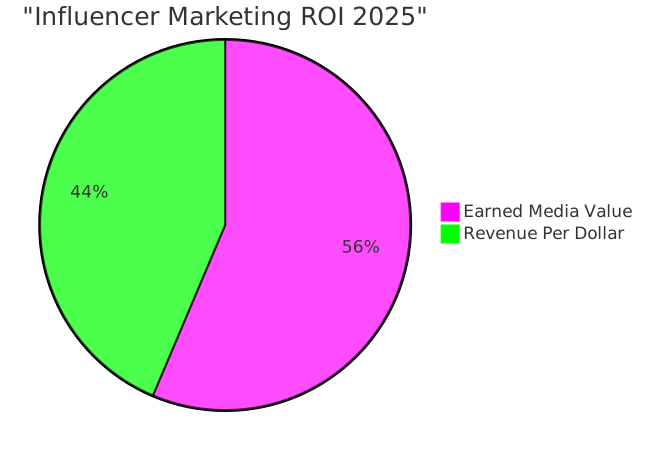
Return on investment significantly outperforms traditional advertising…
$6.50 revenue for every $1 spent on average (some studies reporting 5.78x to 8.4x), with $236 billion in Earned Media Value generated from 1.4 billion posts in 2024 representing 8.4x ROI.
Cost efficiency improved dramatically with $4.63 average CPM in 2024 (down 53% year-over-year), allowing brands to reach 2x the audience for same cost compared to previous year.
Conversion rates jumped 94% higher for products with AR/influencer content.
Budget allocation demonstrates strategic commitment
85% of marketers have dedicated influencer marketing budgets.
59.4% plan increases in 2024. 75% plan increases for 2025.
26% of marketers allocate over 40% of total marketing budget to influencers. 22.4% allocate 10-20%.
This indicates the channel graduated from experimental to core marketing strategy.
Platform distribution shows…
- TikTok leads with 69% of brands using it (most popular)
- Instagram at 47% with 30% saying it generates biggest ROI and producing $4 in sales per $1 spent
- YouTube at 33% though often commanding higher fees for longer-form content
Influencer tier preferences reveal strategic sophistication
| Tier | Followers | Brand Preference |
|---|---|---|
| Nano | 1K-5K | 44% |
| Micro | 5K-20K | 26% |
| Mega/Celebrity | 1M+ | Lower |
44% of businesses prefer nano-influencers (1K-5K followers) for authentic engagement and cost efficiency.
26% prefer micro-influencers (5K-20K followers) balancing reach and authenticity.
Mega-influencers and celebrities (1M+) receive less preference despite individual reach due to lower engagement rates and premium pricing.
Long-term partnerships became standard with 63.2% of brands working with same influencers across multiple campaigns in 2024.
This recognises that sustained relationships build authentic integration rather than transactional one-off promotions.
84.8% of brands rate influencer marketing as effective.
Effectiveness measurements evolved beyond engagement
70% of brands now measure influencer marketing ROI (though 30% still don’t measure).
Using sophisticated attribution including promo codes, affiliate links, pixel tracking, and incrementality testing to isolate influencer impact.
The channel’s growth trajectory suggests continued expansion…
Gen Z and Millennials demonstrate 16% more receptivity to sponsored creator content on Snapchat versus non-users.
87% openness to brand-sponsored creator content.
Platforms invest heavily in creator monetisation and shoppable features making the creator-brand-consumer connection increasingly frictionless and measurable across the customer journey.
Mobile dominates with 67% of traffic while programmatic captures 88% of display
Mobile advertising consolidated dominance with 67.13% of all internet traffic (December 2024).
Driving 58% of all searches, 66% of online orders, and commanding 74% of total digital advertising budgets in Australia (representative of global patterns).

Mobile ad performance consistently outperforms desktop…
- 2-5% CTR versus 1-3% for desktop
- Generating 60-70% of digital ad clicks
- 2-3x higher conversion rates despite smaller screens
Ad blocker usage remains significantly lower on mobile at 7% compared to 27% on desktop, ensuring better reach and viewability.
Mobile users exhibit different behaviours… 93% conduct research on mobile but only 17% complete purchases on mobile devices.
This requires sophisticated cross-device attribution for accurate measurement.
Global mobile ad spend and programmatic growth
Global mobile ad spend reached $402 billion in 2024 growing 11% year-over-year with mobile video dominating at 49.4% market share in programmatic.
Device-specific strategies emerged as critical…
- Mobile-first creative with vertical 9:16 aspect ratios
- Thumb-stopping hooks in first 3 seconds
- Shorter form factors (15-30 seconds optimal)
- Mobile landing page optimisation (load time under 3 seconds)
Programmatic advertising reached unprecedented scale at $678.37-802.34 billion in 2024 globally.
Projected to exceed $270 billion in US 2025 and reach $779 billion globally by 2028 with some forecasts suggesting $2.753 trillion by 2030 representing 22.8% CAGR.
The technology now powers 88.2% of US display ads purchased programmatically in 2024, with 82.4% of all digital display spending flowing through automated buying platforms.
Connected TV programmatic and regional adoption
Connected TV programmatic surged with 88% of total CTV video ad spending and 18% growth in 2025.
91% of non-social programmatic spend goes to private marketplaces (PMPs) rather than open exchanges, demonstrating advertiser preference for controlled environments with known inventory sources.
Regional programmatic adoption varies…
| Region | Market Share / Adoption |
|---|---|
| North America | 32.6% global share, 70%+ adoption |
| Asia Pacific | 24.4% CAGR (fastest growing), China 39.3% of APAC |
| Europe | 60% express privacy concerns |
Key challenges include $81 billion in projected fraud losses by 2024, 19% year-over-year increase in Made-for-Advertising (MFA) impression volume representing low-quality inventory arbitrage.
Persistent invalid traffic requires supply path optimisation, transparency initiatives, and robust fraud prevention measures.
The future of advertising converges on AI, privacy, and retail media
The advertising industry stands at transformative inflection point where AI capabilities, privacy regulations, and retail media networks converge to reshape targeting, measurement, and creative production.
Looking toward 2026-2027, industry forecasts project global ad spend reaching $1.3 trillion by 2028, with digital share climbing to 78-82% of total by 2030.
Traditional channels accelerate decline at 3-5% annually.

First-party data becomes primary targeting mechanism
93% of marketers prioritise collection. Zero-party data adoption grows 250% year-over-year as third-party cookies fade.
Privacy regulations expand beyond California and Europe to 16+ US states implementing data protection laws with varying requirements complicating compliance.
Artificial intelligence will power most advertising operations within 3 years.
Current 17.2% of marketing powered by AI is projected to reach 44.2% within 3 years according to CMO surveys. 95% of CMOs prioritise AI investments despite 54% feeling overwhelmed by implementation complexity.
Practical AI applications expand dramatically
Practical applications expand beyond simple chatbots to…
- Automated campaign creation
- Dynamic creative optimisation at scale
- Predictive audience modelling
- Real-time bidding strategy adjustment
- Performance forecasting
The 3.7x ROI on GenAI investments demonstrates early wins.
Successful adoption requires data infrastructure, organisational change management, skills development, and ethical frameworks addressing bias, privacy, and transparency concerns that currently affect 70%+ of marketers encountering AI incidents in their campaigns.
Connected TV becomes dominant video format
Connected TV will become dominant video advertising format as household penetration reaches 92% by 2028.
Ad-supported tiers expand to 60%+ of streaming subscriptions. Measurement capabilities rival digital while maintaining television’s creative impact.
Retail media networks will likely exceed $250 billion globally by 2028, potentially capturing 20%+ of digital ad spend as every major retailer, marketplace, and even quick-service restaurant develops advertising businesses monetising their customer purchase data.
This “retail media everywhere” phenomenon creates both opportunity (closed-loop measurement, high-intent audiences) and complexity (fragmented buying, inconsistent measurement, budget reallocation challenges).
The most successful advertisers in 2025-2027
The most successful advertisers will master multi-channel attribution combining MTA, MMM, and incrementality testing rather than relying on last-click or platform-reported conversions.
They will build first-party data infrastructure through value exchanges with customers.
Invest in server-side tracking bypassing cookie limitations.
Deploy AI-powered automation while maintaining strategic control.
Allocate 15-25% of budgets to emerging channels (CTV, retail media, influencers) before competitors saturate them.
Test continuously, recognising that benchmarks represent starting points rather than guaranteed outcomes given dramatic performance variations by creative quality, targeting precision, and market timing.
Pro tip for Australian advertisers
Want to slash your advertising costs without sacrificing results?
Test your campaigns during the Australian summer lull (December-February).
Many platforms see 10-25% lower CPCs during this period. Competition drops as businesses pause campaigns for holidays.
Your ads get better placements at lower costs.
Plus, you’ll have validated campaigns ready to scale when everyone else returns in March fighting for the same inventory at inflated prices.
Your next steps
Ready to dominate paid advertising in 2025?
Here’s what you need to do right now…
Book a no-obligation consultation with Vikas. He specialises in rapid prototyping and delivering robust web solutions that convert.
Whether you’re spending $5,000 or $500,000 monthly on ads, you need landing pages and tracking infrastructure that actually work.
Book your consultation today and let’s build something that makes your advertising actually profitable.
Sources and references
GroupM. (2024). “Global Advertising Forecast 2024-2025.” Annual Market Report
IAB (Interactive Advertising Bureau). (2024). “Internet Advertising Revenue Report.” Multiple quarterly reports
eMarketer. (2024). “Digital Advertising Spending Worldwide.” Market Analysis Reports
Statista. (2024). “Digital Advertising Statistics and Platform Performance.” Industry Database
Meta Investor Relations. (2024). “Q4 2024 Earnings Report.” Official Platform Disclosures
Google Alphabet. (2024). “Annual Revenue Report 2024.” Official Platform Disclosures
Amazon. (2024). “Q4 2024 Earnings Call.” Official Platform Disclosures
WordStream by LocaliQ. (2025). “Google Ads Benchmarks Report.” Analysis of 16,000+ campaigns
LinkedIn Marketing Solutions. (2024). “B2B Advertising Performance Report.” Official Platform Data
TikTok for Business. (2024). “Global Advertising Performance Benchmarks.” Official Platform Data
IAB Australia and PwC. (2024). “Internet Advertising Revenue Report CY 2024.” Official Market Report
Dreamdata. (2024). “B2B Marketing Attribution Study.” Multi-touch attribution analysis
Kantar. (2024). “Media Reactions Report 2024.” Brand Safety and Trust Research
Integral Ad Science. (2024). “Media Quality Report Q4 2024.” Viewability and Brand Safety Data
Apple. (2024). “App Tracking Transparency Framework Impact Study.” Privacy and Attribution Research
Metadata.io. (2024). “B2B Advertising ROI Analysis.” Platform performance comparison study
Criteo. (2024). “Retail Media Network Performance Report.” Cross-platform RMN analysis
ACCC (Australian Competition and Consumer Commission). (2024). “Digital Platform Services Inquiry.” Market concentration analysis
Triple Whale. (2024). “E-commerce Advertising Performance Tracker.” Real-time performance data
Nielsen. (2024). “Connected TV Advertising Report 2024.” CTV penetration and viewing behaviour
Snapchat. (2024). “Augmented Reality Advertising Effectiveness Study.” AR lens performance data
Reddit. (2024). “Q3 2024 Earnings Report and Advertising Growth.” Official platform disclosures
Pinterest. (2024). “Q3 2024 Shareholder Letter.” User growth and advertising revenue
Small Business Development Corporation WA. (2024). “Digital Adoption Trends in Western Australian Small Businesses.” Annual Report 2023-24
Note: All pricing data and performance benchmarks were last verified in January 2025 and represent average ranges across multiple sources. Actual costs and performance may vary based on specific campaign requirements, targeting precision, creative quality, and market conditions. Exchange rates calculated at time of publication.
Vikas Thakur
Founder of RockingWeb and experienced SaaS entrepreneur with 16 years of expertise in web development, conversion optimisation, and digital marketing. Passionate about helping businesses maximise their online potential through data-driven strategies and cutting-edge technology solutions.
Learn more about Vikas


![Facebook Ads Benchmarks 2025: Shopping CTR Surged 146% [Industry Data]](/assets/facebook-ads-benchmarks-2025-DWNLfm9o.png)